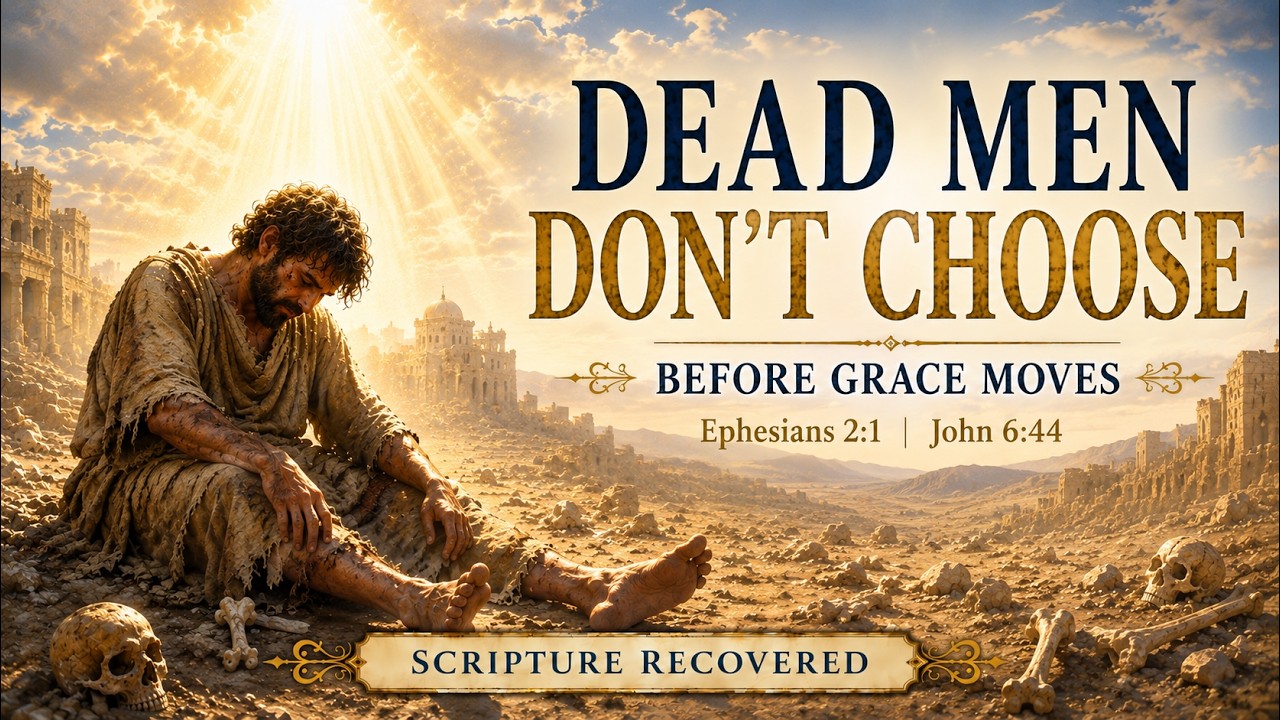
Dead Men Don’t Choose: The Undeniable Truth of God’s Grace

I’ve had it. Lately, I stumbled into a discussion tearing into Calvinism—its theology, its doctrines—and I’m not even a card-carrying Calvinist. I haven’t read his books, haven’t signed up for his club. I just try to follow the Scriptures and the Spirit of God. But what I saw incensed me: ignorance and sheer gall coming against the established Word, picking at gospel verses without context, tossing out the epistles like trash. It’s a butchery of truth, and I can’t shake it off. This battle’s raged for centuries—God’s sovereignty versus human free will—and it’s time to lay it down with the absolute, sledgehammer truth of Scripture. No more dancing around it.

Here’s the question: If we reject the points Calvinism leans on—total depravity, unconditional election, irresistible grace, all of it—what do we undo from the Word of God? Not just a system, but the Bible itself. I’m not here to defend a man-made label; I’m here to let God’s Word speak. And it’s screaming: we’re dead without Him, saved by Him, and He provides it all. Let’s hammer this home.

The Deadness: "Nekros" and Dry Bones

Start here: we’re dead. Not wounded, not limping—”nekros”. Ephesians 2:1—“You were “nekros” in your trespasses and sins.” That’s Greek for corpse. No pulse, no breath, no life. Romans 3:10-12 piles on: “None righteous, no one understands, no one seeks God. All have turned away.” Not some—”all”. Colossians 2:13—“You were “nekros” in your sins.” Dead men don’t choose. They don’t seek. They rot.

Ezekiel saw it too. Chapter 37: a valley of dry bones, scattered, hopeless. God asks, “Can these bones live?” Ezekiel doesn’t play hero—“Lord, you alone know.” Humanly? No chance. Dead bones don’t wiggle. But God says, “Prophesy,” and the Spirit’s breath—”ruach”—sweeps in. Bones rattle, flesh forms, and they stand—a vast army. Who did that? Not the bones. God. Ezekiel 37:14—“I will put my Spirit in you, and you will live.” Dead means “nekros”. No life ‘til God moves.

John 6:44 seals it: “No one can come to me unless the Father who sent me draws them.” “Can”—ability. Without the Father’s pull, we’re stuck. Romans 8:7—“The mind of the flesh is hostile to God; it does not submit, nor can it.” Hostile. Incapable. “Nekros”. If you think a corpse picks itself up, you’re not reading the Bible—you’re writing fiction.

The Process: God Provides All

Salvation’s not steps we take—it’s God’s work breaking us alive. He’s not waiting for us to climb a ladder; He’s emptying our grave. Listen:

He’s the Seed Supplier: 1 Peter 1:23—“Born again, not of perishable seed, but of imperishable, through the word of God.” Matthew 13:37—“The one who sows the good seed is the Son of Man.” Christ plants life in “nekros” soil. We don’t sprout ourselves—He sows.  

He’s the Knocker: Revelation 3:20—“I stand at the door and knock.” Jesus isn’t begging us to knock first—He’s pursuing. Dead men don’t knock back; “nekros” hearts don’t answer—He’s the hunter breaking in. Luke 19:10—“The Son of Man came to seek and save the lost.” He seeks; we’re lost.

He’s the Convictor: John 16:8—“The Spirit will convict the world of sin.” Acts 2:37—Pentecost’s crowd, “cut to the heart,” didn’t self-diagnose. The Spirit stabbed them awake. Dead hearts don’t feel ‘til He strikes.

He Gives His Spirit: Ezekiel 37:14—“I will put my Spirit in you.” John 3:5—“Born of the Spirit.” Titus 3:5—“Saved by the renewal of the Holy Spirit.” No Spirit, no life. He breathes; we don’t.

He Provides the Lamb: John 1:29—“The Lamb of God, who takes away the sin of the world.” Romans 3:25—“God put [Him] forward as a propitiation by his blood.” We didn’t slay the Paschal Lamb—God did. Hebrews 9:12—“With his own blood, he secured eternal redemption.” All Him. For if, when we were enemies, we were reconciled to God by the death of his Son, much more, being reconciled, we shall be saved by his life. Romans 5:10

These aren’t steps to be redeemed—check off faith, grab grace, earn the cross. That’s works, and Ephesians 2:9 says, “Not a result of works, so that no one may boast.” It’s His process, His redemption, His hammer smashing our “nekros” chains. Acts 13:48—“As many as were ordained to eternal life believed.” Ordained, then believed—not the other way around. Romans 2:4—“God’s kindness leads you to repentance.” He leads; we follow. He provides all, or it’s not salvation—it’s self-help.

The Gift: No Paychecks Here

If God does it all, it’s a gift. Ephesians 2:8—“By grace you have been saved through faith… it is the gift of God.” Faith too—not your grit, His grant. Philippians 1:29—“It has been granted to you to believe.” Granted, not grabbed; to them that have obtained like precious faith with us through the righteousness of God and our Saviour Jesus Christ—2 Peter 1:1. Hebrews 12:2—“Jesus, the AUTHOR and perfecter of our faith.” He writes it, not us.

If we choose God without His seed, knock, conviction, Spirit, and Lamb, that ain’t a gift—it’s a paycheck. “I chose wisely; pay me salvation.” Romans 3:27—“Where is boasting? Excluded.” Why? A “nekros” soul doesn’t choose—it’s chosen. John 15:16—“You did not choose me, but I chose you.” 1 John 4:19—“We love because he first loved us.” First. Always Him first. If we kickstart it, why the cross? Galatians 2:21—“If righteousness were through [us], Christ died for nothing.” Dead men don’t earn gifts—they receive them.

The Folly of Free Will Chasing

Some scream, “But free will!” Sure, we respond—”after” He moves. Acts 2:37—“What shall we do?”—comes after the Spirit cuts. John 1:13—“Born not of human decision, but of God.” Charles Spurgeon saw it clear: “Free will carried many a soul to hell, but never a soul to heaven. Anyone who believes that man’s will is entirely free and that he can be saved by it does not believe the fall.” He’s right. Romans 3:23—“All have sinned and fall short.” Free will without grace is freedom to rot, not rise. Romans 8:7—“The flesh “cannot” please God.” Cannot. “Nekros”.

2 Corinthians 4:6—“God… has shone in our hearts to give the light of the knowledge of the glory of God in the face of Jesus Christ.” We didn’t flip the switch—He did. Dead hearts don’t chase light; light chases them. Spurgeon’s not guessing—he’s echoing Scripture: a “nekros” will, unbound by grace, runs to ruin, not redemption.

Lay It Down

This war’s dragged on too long—centuries of dodging the obvious. Scripture’s clear: we’re “nekros” without God, revived by His Spirit, saved by His Lamb. He’s the seed, the knock, the conviction, the breath, the blood. Spurgeon’s words ring true—free will without grace is a one-way ticket down, never up. Reject that, and you’re not just undoing Calvinism—you’re undoing the gospel. Dead men don’t choose; God chooses them. John 6:44. Ezekiel 37. Ephesians 2. Romans 9:16—“It does not depend on human desire or effort, but on God’s mercy.” It’s a sledgehammer of truth, and it’s time to swing it. He provides all. Let the Word silence the noise. Full stop.

Three CRIES, One Grace: My Journey TO LIFE in God

I didn’t choose God like picking a book off a shelf. Faith wasn’t a decision I mulled over—it was a lifeline I grabbed when the darkness of my soul nearly swallowed me whole. This is my story: three cries from a broken life, answered by one grace that remade me. It’s not neat, but it’s real—and if you’re searching for purpose, it’s for you too.

The Void That Defined Me

A gnawing emptiness shadowed me from the start. Childhood wasn’t a warm memory—it was a jagged edge, a void nothing could fill. Hobbies fizzled, distractions faded, and the world seemed to spit me out like Jonah from the whale. Schools branded me hopeless, a lost cause not worth the effort. Church folks tried to reel me in, but their Sunday smiles turned hollow by Monday—I saw the masks. Oddly, I found more truth among unbelievers, rough souls who didn’t judge me like the “righteous” did. Still, I was a misfit, adrift in a life that had no slot for me. Sin’s weight grew, a stranglehold tightening, and I teetered on the edge—ready to end it all.

The Light That Found Me

Then an accident pinned me down—bedridden, trapped, with nothing but time and a sealed Gideon’s Bible on the shelf. Curiosity cracked it open, and I tore into it like a starved man, devouring every page. The Gospels hit hardest, but I didn’t have some grand epiphany—not yet. I just ate, clueless, while God’s Word sank deep, an incorruptible seed (1 Peter 1:23). Days later, it broke loose: a heavenly shift—peace flooded in, the kind Jesus promised, “My peace I give unto you” (John 14:27). Joy surged, and my old crutches—cigarettes, alcohol, filthy words—turned sour. I didn’t pray a formula; grace crashed in unbidden, remaking me from the core.

That’s when I knew why I believe. He’s the light of all humanity (John 1:4), a brilliance only the broken can truly see. In my abyss, that light pierced through—not random, but personal, as if I’d been chosen, predestined for rescue (Eph. 1:4-5). It was God’s goodness, His grace, shattering my despair like dawn through a storm. I was famished, crushed by sin’s burden, and like a dying man lunging for bread, I grabbed it—the life I couldn’t conjure. “Taste and see that the Lord is good” (Psalm 34:8), and I did. I tasted Him, and I’m changed forever.

The Cry That Birthed Me Anew

The shadows didn’t just weigh me down—they crushed me open. Weeping, I’d whisper, “Somebody help me!”—a plea from a soul collapsing under sin. That’s when the Father drew me (John 6:44). Jesus, the Great Physician, came for the brokenhearted (Luke 4:18), and my cry stirred His compassion. I wasn’t righteous or polished—I was a wreck, a child begging. The proud don’t need a Savior, but I did. He heard me, pulling me from the wreckage of my chaos.

Friends saw it: “This isn’t Bob.” The old me—ringleader of ruin—vanished. Those who thrived on my darkness ditched me; one called me a “good chap” gone astray. They drifted off, but I wasn’t alone—I’d been born of God (John 1:13). How do you wrap that in words? With man, it’s impossible; with God, it’s a miracle. I thought this was just for me, a fluke for the few, but no—salvation’s for all (Titus 2:11). I loved the shadows until they broke me. Jesus knocks on every heart (Rev. 3:20)—mine, yours, everyone’s. I was lost, now I’m found—because of Him.

A Call to the Searching

This isn’t a fairy tale for the chosen few—it’s a lifeline for the wrecked. If you feel that void, if darkness chokes you, cry out. Crack open His Word, taste His goodness. He’s the Life of man, the Physician who heals, and He’s still reaching today. Three cries—despair, discovery, deliverance—led me to one grace. Will you let Him in?

The Pawn’s Promotion: A Chessboard Lesson in God’s Grace

On a chessboard, the pawn stands small and unassuming, a mere foot soldier dwarfed by the towering presence of kings, queens, and knights. To the untrained eye, it’s the least impressive piece—just one of eight lined up as a shield for the real players. Yet, hidden in its humble march lies a mystery: the power to become the mightiest of all. What if this simple rule, buried in a game of strategy, whispers something profound about God’s ways? As someone who’s no chess master—just a curious soul struck by the pawn’s quiet potential—I’ve come to see it as more than a game piece. It’s a parable, etched in black and white, of humility, destiny, and divine promotion.

The Pawn’s Potential

In chess, the pawn is the underdog. It starts in a row, eight strong, tasked with inching forward one square at a time (or two on its first move, if it dares). It can’t leap like a knight or sweep across the board like a bishop. Its role often feels expendable—sacrificed early to protect the “important” pieces. But there’s a twist: if a pawn endures the perilous journey to the opponent’s back rank—the eighth rank for White, the first for Black—it earns a rare privilege called “promotion”. It can shed its lowly status and become any piece except the king, most often transforming into a queen, the game’s most powerful figure.

This isn’t a trick every pawn pulls off. With eight starting out and the board a battlefield, the game often ends before many—or any—reach that distant line. What’s more, only the pawn has this ability to transform. Knights stay knights, rooks stay rooks, but the pawn, the weakest of all, carries a hidden potential no other piece can claim. Its slow, fraught path mirrors the rise of an underdog, proving that even the least can become the greatest—if guided well.

A Biblical Mirror

That idea stopped me in my tracks one day, tugging at something deeper. Doesn’t this sound like the way God works? Jesus said, “The first shall be last, and the last shall be first” (Matthew 20:16), flipping the world’s pecking order upside down. The pawn fits that mold perfectly—starting as the “last,” the least of the pieces, yet holding the promise of becoming “first” through promotion. It’s a living echo of how God chooses the overlooked to fulfill His purposes. Look at Jesus Himself, the Son of Man, who “humbled Himself and became obedient to death—even death on a cross” (Philippians 2:8). He took the form of a servant, the least of all, yet God “exalted Him to the highest place and gave Him the name that is above every name” (Philippians 2:9), far above all authorities and powers. The pawn’s rise reflects that same astonishing arc—from humility to glory.

Think of David, the shepherd boy in 1 Samuel 16. When the prophet Samuel arrived to anoint a king, David’s father, Jesse, didn’t even bother calling him in from the fields. His older, stronger brothers seemed the obvious picks. Yet God saw David’s heart and lifted him from obscurity to royalty. Scripture says it plainly: “God chooses the base things of the world to confound the wise” (1 Corinthians 1:27). The pawn’s surprising rise mirrors that—lowly, underestimated, but destined for more. Or consider the kingdom of heaven, which Jesus likened to a mustard seed, ‘less than all the seeds that be in the earth,’ yet ‘it grows up and becomes greater than all herbs,’ with ‘great branches’ where ‘the fowls of the air may lodge under the shadow of it’ (Mark 4:31-32). What starts as the least becomes a towering, overshadowing presence—another pawn-like tale of humble beginnings leading to greatness.

Then there’s Jesus’ words: “Many are called, but few are chosen” (Matthew 22:14). In a chess game, all eight pawns have the chance to reach the back rank, but only a few—if any—make it. It depends on the player’s strategy and the game’s unfolding. In life, too, many are given opportunities or callings, but only some persevere or are destined to rise through God’s will. The pawn’s journey isn’t a free-for-all; it’s guided by a hand greater than its own.

Lessons in Humility

That’s where the chessboard gets even richer. Pawns teach us more than potential—they show us the power of humility. Often, a pawn is sacrificed, its loss clearing the way for a bigger move. It might block a threat or open a path for another pawn to advance. This whispers of the Christian theme of sacrifice—Jesus Himself being the ultimate example—where what looks like defeat paves the way for victory. A pawn’s “death” might be the key to another’s promotion, much like selfless acts in faith ripple beyond what we see.

The journey matters, too. Promotion isn’t instant—it’s a step-by-step trek across a contested board, dodging knights and bishops, enduring threats. That’s the Christian life in miniature: a process of growth, of sanctification, where perseverance through trials builds something greater. And while pawns start as a uniform line, each one’s path diverges—some fall, some press on—reflecting how believers, united as a “body” (1 Corinthians 12), walk unique callings shaped by God’s plan.

There’s an opponent, too, trying to block the pawn’s progress. In chess, it’s the other player; in faith, it’s the struggles or spiritual forces testing us. Yet, just as a skilled player can guide a pawn through chaos, God steers His “pawns” toward their destined place.

 The Divine Player

Here’s the clincher: the pawn doesn’t promote itself. Its fate rests with the player, an external force deciding when and how it rises. That’s the heartbeat of this metaphor—promotion comes from the Lord, not from man. As Daniel 4:25 says, God “takes away kingdoms and gives them to whom He chooses.” The pawn’s transformation is a gift, bestowed after a faithful journey, not a prize seized by ambition.

This ties into a verse that hit me as the perfect capstone: “God resists the proud but gives grace to the humble” (James 4:6; 1 Peter 5:5). The pawn doesn’t strut like a knight or dominate like a queen—it moves quietly, often unnoticed. The proud pieces, with their flashy power, might symbolize those who lean on their own strength. But God “resists” pride, just as an opponent targets those threats. The pawn, humble and unassuming, receives grace—exalted to a queen “in due time” (1 Peter 5:6), not by its own doing, but under the mighty hand of the player.

That’s what got me excited about this idea. I’m no chess expert—just someone who saw a spark in the pawn’s story. It’s a reminder that God’s kingdom doesn’t run on human logic. He lifts the overlooked, the “base,” in ways we’d never expect, and it’s His hand, not ours, that moves us forward.

Your Move

So next time you see a chessboard, look at the pawns. They’re not just soldiers—they’re a lesson carved in wood or plastic: true greatness lies in humility, patience, and trust in God’s timing. Humble yourself under His mighty hand, and in due time, He may lift you up. Where in your life might He be moving you, step by step, toward promotion? What small, faithful move is He asking of you today?

The chessboard holds more wisdom than we might think—a quiet invitation to live like the pawn, trusting the Divine Player to turn the least into the greatest.

From Chaos to Clarity: My Spiritual Journey

I once stood at a crossroads, drowning in a sea of spiritual voices—none of them agreeing. When I first came to Christ, I expected peace, but instead, I found chaos. A flood of beliefs washed over me: one group preached this, another swore by that, and a third contradicted them both. It felt like a never-ending conundrum, a maze with no exit. My soul was a battlefield, torn between longing for truth and the weight of endless disparity. Maybe you’ve been there too—searching for solid ground amid the noise.

We all have our own spiritual journeys, and mine began in that storm. I could have drifted, letting the currents of confusion carry me wherever they pleased. But something stirred—a resolve to confront the mess head-on. I couldn’t settle for half-answers or borrowed convictions. I needed to know for myself: What was true? What held firm when everything else crumbled? That choice—to dig, to question, to seek—was the first step out of the fog. It wasn’t easy. Doubt nipped at my heels, and the tangle of narratives threatened to pull me under. Yet, in that wrestle, I found an anchor I didn’t expect.

That anchor was God’s grace. I didn’t claw my way to clarity through sheer willpower—it was His mercy that carried me through. The more I leaned into His word, the more the chaos parted. Contradictions began to unravel, and a path emerged—not a perfect map, but a steady light. The Bible became my compass, guiding me past the error of the wicked and into the joy of life in Christ. Reflecting now, I’m struck by the immensity of that grace—how it met me in my confusion and led me to a place I could finally stand.

That journey fuels everything I write here. I’ve been where you might be—lost, questioning, desperate for something real. Through these pages, I hope to offer what I found: an encouraging perspective, a hand to hold as you navigate your own path. This isn’t about having all the answers—it’s about pointing to the One who does. So, join me. Explore my story, wrestle with the contrasts of faith, and let’s find clarity together. The chaos doesn’t have to win. There’s solid ground ahead—take the next step with me.