The FRIENDS of the Bridegroom: Understanding the Apostles’ UNIQUE ROLE in God’s Eternal Plan

 Introduction: An Overlooked Distinction

When John the Baptist spoke of Jesus, he said:

“He that hath the bride is the bridegroom: but the friend of the bridegroom, which standeth and heareth him, rejoiceth greatly because of the bridegroom’s voice: thus my joy is fulfilled” (John 3:29).

John deliberately placed himself outside the category of the bride. He was the friend who stood with the bridegroom, heard his voice, prepared the way, and rejoiced at the union he helped bring about.

Centuries later, Paul wrote to the Corinthians:

“For I am jealous over you with godly jealousy: for I have espoused you to one husband, that I may present you as a chaste virgin to Christ” (2 Corinthians 11:2).

Again, the language is striking. Paul does not say “we are the bride together.” He positions himself as the one who betroths and presents the church to Christ—the role of the friend of the bridegroom in ancient Jewish wedding customs.

These are not incidental phrases. Scripture does not waste words. In both cases we see a company that is intimately connected to the bridegroom and indispensable to the bride’s preparation, yet functionally and categorically distinct from the bride herself.

This article explores the possibility—drawn carefully from Scripture—that the apostles of the Lamb occupy this unique position as the “friends of the bridegroom.” They are the foundation upon which the church is built, the spiritual fathers who begat her through the gospel, and the honored company who will one day present her radiant to Christ. They are inseparable from the bride, yet not identical with her.

“The friends of the Bridegroom rejoice at His voice as the Bride is presented.”

1. Servants by Calling, Sons by Relationship

Jesus told the disciples:

“Henceforth I call you not servants [douloi]; for the servant knoweth not what his lord doeth: but I have called you friends [philous]…” (John 15:15).

Yet after the resurrection and Pentecost, the apostles consistently describe themselves as douloi—slaves—of Christ (Romans 1:1; Philippians 1:1; James 1:1; 2 Peter 1:1; Jude 1:1).

Why revert to the language Jesus had set aside?

The answer lies in the paradox of their calling. Relationally, they had been elevated to friends and sons (Galatians 4:7; Romans 8:15-17). The New Covenant was now in force through Christ’s death (Hebrews 9:16-17), and the Spirit of adoption had been poured out.

But functionally, their apostolic office required total, voluntary bondage. They were commissioned to lay the one foundation of the church (Ephesians 2:20), to steward mysteries hidden from ages past (Ephesians 3:4-5), and to inscribe the very words of God. Their task demanded a servant-posture that mirrored Christ’s own (Philippians 2:7)—a once-for-all work that left no margin for error.

We today minister from the position of sons. We prophesy in part, know in part, and our words are tested (1 Corinthians 13:9; 14:29). The apostles, in their foundational role, operated with an authority and fullness that belonged to the transitional era of establishing the New Covenant. Their servant-language reflects not a lesser relationship, but a unique obedience.

2. The Foundation That Presents the Bride

Ephesians 2:20 declares the church is

“built upon the foundation of the apostles and prophets, Jesus Christ himself being the chief corner stone.”

Revelation 21:14 describes the New Jerusalem descending as a bride adorned for her husband (v. 2), yet its wall has

“twelve foundations, and in them the names of the twelve apostles of the Lamb.”

The imagery is profound. The bride-city rests upon foundations that bear the apostles’ names eternally. They are part of the structure, yet they are the foundation—not the building itself.

Paul’s language in 2 Corinthians 11:2 and his fatherly role in 1 Corinthians 4:15 (“I have begotten you through the gospel”) reinforce this. The apostles are spiritual fathers who birth and present the bride. In Jewish custom, the friend of the bridegroom arranged the marriage, prepared the bride, and stood beside the groom as she was presented. He did not become the bride.

This distinction does not separate the apostles from the redeemed. They are part of the one new man (Ephesians 2:15), grafted into the same olive tree (Romans 11). Yet Scripture consistently honors their unique office and role.

3. Diversity of Glory in the Kingdom

Scripture never portrays the eternal Kingdom as a place of radical uniformity. Instead, it reveals ordered, harmonious diversity:

– Stars differ in glory (1 Corinthians 15:41)

– Body members differ in function and honor (1 Corinthians 12:14-26)

– Faithful servants rule over differing numbers of cities (Luke 19:17-19)

– The twelve apostles sit on thrones judging the twelve tribes of Israel (Matthew 19:28)

– Angels are arranged in ranks and orders (Colossians 1:16)

These distinctions do not produce envy or sorrow. In the age to come, perfect love and contentment will prevail. Each company—whether bride, friends of the bridegroom, invited guests, or other honored groups—will rejoice in its assigned glory, knowing it reveals another facet of God’s infinite wisdom.

Hierarchy is not oppression; it is the beauty of divine order. Submission and differing roles reflect the very nature of the Godhead (1 Corinthians 11:3). The modern impulse toward absolute egalitarianism finds little support in Scripture.

4. The Apostles’ Eternal Crown

Paul asked the Thessalonians:

“For what is our hope, or joy, or crown of rejoicing? Are not even ye in the presence of our Lord Jesus Christ at his coming? For ye are our glory and joy” (1 Thessalonians 2:19-20).

To the Philippians he wrote:

“Therefore, my brethren dearly beloved and longed for, my joy and crown…” (Philippians 4:1).

The apostles’ crown is living—it is the bride herself, perfected and presented to Christ through their gospel. At the marriage supper of the Lamb, they will stand with the Bridegroom, hearing his voice, beholding the radiant bride they labored to prepare, and knowing their suffering was worth it all.

Their joy is fulfilled not by being the bride, but by seeing the fruit of their obedience.

Conclusion: Implications and Open Questions

This understanding honors the unique, unrepeatable office of the apostles of the Lamb. It magnifies the grandeur of God’s plan, reveals the richness of Kingdom diversity, and deepens gratitude for the foundation on which we stand.

It also raises further questions worthy of continued searching:

– How do the twenty-four elders fit into this picture?

– Where do Old Testament saints stand in relation to the bride imagery?

– What other companies might Scripture hint at?

These are shared not as final dogma, but as observations drawn from careful attention to the text and the Spirit’s illumination. May we, like the Bereans, search the Scriptures to see if these things are so (Acts 17:11). And may every insight—old or newly perceived—drive us to worship the Lamb who is worthy of all glory, honor, and power.


Grace Has APPEARED: Nearness, Responsibility, and the TRAGEDY of Refusal

“For the grace of God that brings salvation has appeared to all men.”

— Titus 2:11

What if the greatest tragedy of our age is not that people cannot find God—but that God has come so near, and they still refuse Him? Scripture declares that “the grace of God that brings salvation has appeared to all men.” Not offered from afar. Not hidden behind rituals. Appeared. Light has entered history, sin has been judged in the flesh of Christ, and the Spirit now knocks at the door of the human heart. If this is true, then the question haunting our time is no longer “Can God save?” but “Why do men love darkness when life stands at the threshold?”

“Grace has appeared. The light stands at the threshold, inviting all to enter.”

A World No Longer the Same

The prophets searched diligently into this very age. They foresaw it but did not live within it. David spoke of a man whose sin would not be imputed to him, yet even then sin was covered, not judged. Sacrifices postponed reckoning; they did not end it.

But in Christ, something unprecedented occurred.

While we were yet sinners, Christ died. Sin was judged in the flesh. Death was defeated. And the promised Spirit was poured out on all flesh.

The world after the incarnation is not morally or spiritually identical to the world before it. Humanity now lives on the other side of the cross, under the nearness of grace and the presence of the Spirit. History itself has shifted.

Grace That Knocks, Not Forces

Grace appearing does not nullify the human will; it awakens it.

Scripture does not portray grace as coercive power but as living invitation: “Behold, I stand at the door and knock.” A knock implies nearness, intention, and the genuine possibility of refusal. Grace does not merely forgive; it enables response—to repent, to turn, to seek God and find Him.

This is why Scripture can say, “Harden not your hearts.” Hardening would be meaningless if resistance were imposed. Grace is sufficient, enabling, and inviting—but it does not violate. Resistance is personal. Hardening is chosen. Seeds fall on every kind of soil, yet only good ground bears fruit.

God is not at fault for the refusal of life.

Condemnation Revisited

Paul writes with sobering clarity:

“When they knew God, they glorified Him not as God.” (Romans 1)

This is not ignorance.

This is suppression.

Jesus speaks even more plainly:

“This is the condemnation: that light has come into the world, and men loved darkness rather than light.”

Condemnation is not framed as lack of opportunity but as rejection in the presence of light. Grace makes seeking possible. Light makes refusal accountable.

“What More Could I Have Done?”

Isaiah records God’s haunting question:

“What more could have been done to my vineyard, that I have not done in it?”

Under the New Covenant, this question reaches its full weight.

Creation testified.

Conscience testified.

The Law testified.

The Prophets testified.

The Son came.

The Spirit was given.

This is not divine frustration. It is judicial clarity. Judgment is not arbitrary; it is revealed. God is not withholding life—He is answering refusal.

The Physician and the “Whole”

Jesus said, “The whole have no need of a physician, but the sick.” Not all who are dying know they are sick. Some are “whole” in their own eyes, sufficient within themselves, insulated by comfort or pride.

This explains a modern grief many believers recognize: people asking for prayer, for relief, for intervention—yet refusing repentance or surrender. They want God’s help without God Himself. They desire healing, not holiness; relief, not redemption.

This sorrow is not judgmental. It is Christlike.

The Inner Cry Darkness Cannot Silence

When Jesus crossed the sea to the land of the Gerasenes, He did so for one man—bound, isolated, possessed. It was not a random detour. Christ discerned a cry that no legion of demons could silence. Though the man’s voice was overtaken, his inward longing remained intact—and Jesus responded to that depth.

There is a sanctum in the human soul the enemy cannot fully occupy. Even when speech is lost and will is bound, the inward cry for deliverance remains reachable. Grace enters there. Darkness cannot seal it.

A Witness Written Into History

When Scripture says grace has appeared to all, it does not claim that every individual has heard perfectly or equally. It speaks covenantally, not arithmetically. Just as “all Israel” does not mean every Israelite without exception, so “all men” speaks of scope, not headcount.

Every tribe has heard.

Every tongue has a witness.

Christ’s name has penetrated the earth.

For all its corruption and failures, Christendom reshaped law, conscience, and history itself. The gospel was preached to the nations. Light spread globally. Refusal now happens in the presence of that testimony.

Discerning the Times Without Sensationalism

After the pandemic, the world changed. Evangelistic structures weakened. Mega-models collapsed. Household faith intensified. Lawlessness increased. Wars multiplied. Chaos accelerated.

This is not alarmism; it is observation.

Jesus rebuked those who could discern the weather but not the times. Watchfulness is not prophecy for prestige—it is sobriety before God.

Kings, Priests, and the Responsibility to Search

Scripture declares that God has made His people “kings and priests.” Kings search out a matter. Priests draw near. To inquire, to wrestle, to seek understanding before God is not rebellion—it is vocation.

This search does not claim perfection, private authority, or new doctrine. It is undertaken with fear of the Lord, restraint, and prayer to be kept from error. The Spirit who teaches is also the Spirit who corrects.

A Final Plea

Grace has appeared.

Light has come near.

The door stands within reach.

The tragedy of this age is not that God is absent—but that He is present and refused.

“Harden not your hearts.”

            (pause)

What more could have been done?


No More SHADOWS: Why the Church Must STOP Worshipping LIKE David

For decades, millions of Christians have sung with passion:

“When the Spirit of the Lord comes upon my heart, I will dance like David danced… I will pray like David prayed… I will sing like David sang.”

These lyrics stir the soul. They evoke a man after God’s own heart, leaping before the Ark, pouring out raw pleas in the Psalms. Who wouldn’t want to worship with that kind of abandon?

Yet as we mature in the revelation of the New Covenant, a quiet unease rises. Something doesn’t align. David danced, prayed, and sang under the Old Covenant—before the veil was torn, before the Spirit was poured out on all flesh, before we were made sons and daughters indwelt by God Himself.

We now possess the substance. Why do we keep reaching back to live in the shadow?

“Believers step from shadow into the fullness of God’s presence in Christ.”

The Veil Remains When We Read the Old

The apostle Paul could not be clearer:

“To this day whenever Moses is read, a veil lies over their hearts. But when one turns to the Lord, the veil is removed.” (2 Corinthians 3:15-16)

The veil is not a relic of ancient temple architecture. It represents limited access, mediated approach, and obscured glory. For Israel, God’s presence hovered above the mercy seat, hidden behind curtain and cherubim. Only one man, once a year, could enter—and not without blood.

David, for all his anointing, lived on the outside of that veil. His dance was before the Ark—a shadow of God’s presence. His prayers ascended from a distance. His songs carried the ache of longing for a God he could approach but never fully enter.

When we turn to Christ, the veil is taken away forever. We do not approach the shadow; we enter the reality. Yet much of modern worship keeps pulling us back behind the curtain.

David’s Expressions Were Glorious—for His Time
  • David danced with all his might as the Ark entered Jerusalem (2 Samuel 6). Beautiful exuberance before the symbol of God’s presence.
  • David prayed with repentance, imprecation, and desperate cries for cleansing (Psalm 51, 109).
  • David sang psalms of deliverance, often panting like a deer for water brooks (Psalm 42:1).

These were the highest expressions possible under the Old Covenant. The Spirit came upon selected servants temporarily. Access was external. Forgiveness required repeated sacrifices that could never perfect the conscience (Hebrews 10:1-4).

We Have the Substance—Why Settle for Shadow?

In Christ, everything has changed—not in degree, but in kind.

Old Covenant Shadow (David)

New Covenant Substance (Us in Christ)

Presence above the Ark, behind the veil

Christ in us, the hope of glory; we in Christ (Col 1:27; John 14:20)

Spirit upon selected individuals temporarily

Spirit indwelling every believer permanently (Rom 8:9; 1 Cor 6:19)

Approach once a year with fear

Bold, constant access by a new and living way (Heb 10:19-22; 4:16)

Conscience reminded of sins yearly

Conscience sprinkled clean; sins remembered no more (Heb 10:17)

Longing: “As the deer pants for water”

Fulfillment: “Rivers of living water flow from within” (John 7:38-39)

Prayer from a distance

Prayer as sons crying “Abba, Father” (Rom 8:15; Gal 4:6)

No tongues—mysteries unspoken

We speak mysteries to God in the Spirit (1 Cor 14:2)

We do not pant toward the water—we are the temple from which the water gushes. We do not hide under the shadow of wings over the mercy seat—we are hidden in Christ, seated with Him far above all powers (Eph 2:6; Col 3:3).

Beloved Lyrics That Keep Us in Shadow

Consider these common declarations:

  1. “I will pray like David prayed”
    David’s prayers were magnificent, but they were offered from outside the veil. We pray from inside it, in Jesus’ name, with His authority, helped by the indwelling Spirit. To aspire primarily to David’s pattern is to step backward from sonship to servanthood.
  2. “He who dwells in the secret place of the Most High shall abide under the shadow of the Almighty” (Psalm 91:1)
    This was refuge under the shadow cast by God’s presence over the Ark. Today we do not seek the shadow—we dwell in the full light of God’s presence because the Greater than the temple lives in us (Matt 12:6).
  3. “I will dance/sing like David danced/sang”
    These reduce New Covenant worship to Old Covenant imitation. Our dance (if we dance) and our song should flow from rivers within, not from longing without.
Why Do We Cling to the Shadows?
  • Tradition feels spiritual. Psalms and Davidic language sound more “biblical” than declarations of union with Christ.
  • False humility. Embracing our true position—seated with Christ, righteous in Him, boldly entering—feels presumptuous to some.
  • Lack of teaching. How many sermon series have you heard on the superiority of the New Covenant in Hebrews 7–10?
  • Emotional comfort. Longing and shadow imagery feel poetic and safe.

But comfort purchased at the price of truth is costly indeed.

The High Cost of Shadow-Living

When we worship primarily in Old Covenant patterns:

  • We train believers to pray as outsiders rather than insiders.
  • We cultivate longing where Christ has given fulfillment.
  • We produce a church that looks more like Israel trembling at Sinai than the Bride radiant with her Bridegroom.
  • We dishonor the finality of the cross and the superiority of the covenant Christ mediates (Hebrews 8:6).
A Call to Worship in Substance

Let us declare what is true of every believer in Christ:

  • I pray in the name of Jesus, as a beloved son, with bold and confident access.
  • I worship from inside the veil, my conscience forever cleansed.
  • Out of my innermost being flow rivers of living water.
  • I am hidden in Christ, seated in heavenly places—no shadow needed.
  • I sing a new song born of resurrection life, in the Spirit and with understanding.
  • I speak mysteries to God in tongues, led by the One who dwells within.

We do not despise David—he pointed to Christ. But we surpass him, not by effort, but by grace. The least in the kingdom of heaven is greater than John the Baptist (Matthew 11:11)—how much more those indwelt by the Spirit of the risen Lord.

Conclusion: Honor Christ by Living the Better Covenant

To keep singing, praying, and declaring as though the veil still hangs is not greater humility—it is unbelief in what Christ has accomplished once for all.

The Father deserves a people who worship in Spirit and truth, reflecting the full light of the New Covenant, not retreating to shadows that have forever passed away.

It is time to step fully into the substance.
No more shadows.
The veil is torn.
We are in Christ.

Let the church arise and worship accordingly.


The CHURCH on COSMIC Display: God’s Manifold Wisdom, Christ’s Inaugurated REIGN, and the High Calling of the ECCLESIA

Ephesians 3:10 is one of those verses that should stop a reader dead in their tracks:

“…so that through the church the manifold wisdom of God might now be made known to the rulers and authorities in the heavenly places.”

Through the church… to the principalities and powers?

Yes. Paul means exactly what he says. The church is not primarily a human institution scrambling for relevance in a hostile world. It is God’s chosen theater for displaying His multicolored, many-faceted wisdom to cosmic powers—both obedient and rebellious. The messy, ordinary, often-persecuted body of Christ is the public proof that the cross was not defeat but divine checkmate.

This is not sentimental poetry. It is biblical realism with cosmic stakes.

The church, displaying God’s manifold wisdom to heavenly powers and the world.”

The Shock of the Gospel to the Heavenly Realm

In the ancient worldview shared by Paul and his readers, “principalities and powers” (archai kai exousiai) are real spiritual authorities: angelic orders, cosmic rulers tied to nations and systems, the same beings referenced in Ephesians 1:21, 6:12, and Colossians 2:15. These powers once operated on certain assumptions:

– Gentiles would remain perpetual outsiders.

– The Law would permanently divide humanity.

– Sin, death, and accusation would hold uncontested sway.

Then God did something they did not anticipate. He united Jews and Gentiles into one new body, justified sinners by grace through faith, indwelt weak people with His Spirit, and enthroned a crucified Messiah. The church—imperfect, suffering, seemingly fragile—became the living demonstration that God’s wisdom outplays every strategy of hell.

The cross disarmed these powers (Col 2:15). Not annihilated—disarmed. Their claims were exposed as illegitimate, their jurisdiction revoked in principle. Yet they remain active, prowling like a bound but dangerous predator (1 Pet 5:8). The church’s very existence is a continual violation of the old order, a walking exhibit of their defeat.

A Redemptive-Historical Flow: Three Phases of Christ’s Reign

Christ’s kingship is not postponed. It is already inaugurated, advancing through history, and destined for final unveiling. The New Testament presents one continuous reign in three distinct phases of visibility and manifestation.

I. Inaugurated Kingship 

(Enthronement Accomplished—Veiled Authority)

Key texts:

– Matthew 28:18 – “All authority in heaven and on earth has been given to me.”

– Acts 2:33–36 – God has made this Jesus… both Lord and Christ.

– Daniel 7:13–14 – The Son of Man receives everlasting dominion.

– Psalm 110:1 – Sit at my right hand until I make your enemies your footstool.

What happened:

At the resurrection and ascension, Christ was enthroned. The kingdom was installed, not delayed. Enemies are not yet eliminated, but subjugated in principle. Satan is judged (John 16:11), the powers disarmed (Col 2:15), and jurisdiction transferred to Christ (Col 1:13).

Mode of rule: By the Spirit, through the Word, under the sign of the cross.

Visibility: Veiled, recognized by faith, rejected by rebellious powers.

The King already reigns, though His reign is contested.

II. Cosmic Pedagogy 

(The Church Age—Wisdom Displayed, Powers Instructed)

Key texts:

– Ephesians 3:10 – Made known through the church to the heavenly powers.

– 1 Corinthians 4:9 – We have become a spectacle to angels and to men.

– 1 Timothy 3:15 – The church of the living God, pillar and foundation of the truth.

– Ephesians 6:12 – Our struggle is against rulers and authorities.

What happens:

The church becomes God’s public classroom. Heavenly powers—loyal and fallen—learn in real time what the cross has achieved. Every instance of unity where hostility should prevail, holiness under pressure, love amid suffering, and the gospel forming one body out of many, teaches the universe that:

– Power is perfected in weakness.

– Authority flows from self-giving love.

– Death is no longer ultimate.

Means: Preaching of the gospel, sacraments (baptism as jurisdictional transfer), faithful suffering, holy living.

Visibility: Partial, contested, often misread as defeat.

Result: Strongholds dismantled (2 Cor 10:4), false sovereignty exposed, evil restrained but not eradicated.

The church is not merely being saved—it is teaching the cosmos.

III. Final Glory 

(Parousia—Reign Unveiled, Enemies Destroyed)

Key texts:

– 1 Corinthians 15:24–28 – He hands over the kingdom… after destroying every rule and authority.

– Revelation 11:15 – The kingdom of the world has become the kingdom of our Lord.

– Revelation 20:7–10 – Final defeat of Satan.

– Revelation 21–22 – New heaven and new earth.

What happens:

Christ’s reign becomes uncontested. Faith gives way to sight. All hostile powers are destroyed, not merely restrained. Death itself is abolished.

Mode of rule: Direct, glorious, inescapable.

Visibility: Total, universal, irreversible.

What was believed is now seen. What was veiled is unveiled.

The Flow at a Glance

Resurrection / Ascension

Inaugurated Kingship (authority installed, veiled reign)

Church Age – Cosmic Pedagogy (wisdom displayed, powers instructed)

Parousia – Final Glory (reign unveiled, enemies destroyed)

The same King. The same kingdom. The same authority. Only the visibility changes.

The Church as Restrainer in History

As the Word of God has gone out to every tongue and nation, the global ecclesia has functioned as the primary restrainer of lawlessness (cf. 2 Thess 2:6–7). Where Judeo-Christian truth has shaped societies, a moral canopy has emerged: human dignity affirmed, tyranny bounded, justice pursued, the weak granted standing. Infanticide curtailed, gladiatorial games ended, kings reminded they rule under God—these are not accidents. They are the fruit of the gospel reordering creation.

When that light dims—when societies abandon the truth for autonomy and godlessness—darkness predictably increases (Rom 1:18–32; Ps 9:17). The church remains the salt and light, imperfect vessels though we are. Our compromises and failures grieve the Spirit, yet Christ’s reign advances through His Word and His body until the final day.

A High and Humbling Calling

Your life in Christ is not small. Every act of forgiveness, every stand for holiness, every expression of unity across divides, every faithful witness under pressure is on cosmic display. The heavenly powers are watching. The world is watching. And the King is reigning—through weakness, through love, through the church.

The crown was won at the cross. The full unveiling awaits. Until then, we participate in an inaugurated victory that nothing in creation can overturn.

Maranatha. Come, Lord Jesus.


From SUBMISSION to Sonship: The Hidden JOURNEY of Ephesians 5

Introduction

We often approach Ephesians 5:22–24 looking for rules about marriage. We come away either defensive or disappointed, because the passage feels either too heavy or too flattened. Yet something remarkable happens when we let the text interrogate us rather than the other way around. A single question—“What is the Greek depth of ‘be subject’?”—can lead us, almost against our will, from marital roles to the deepest mysteries of regeneration and identity in Christ.

This is not a detour. It is the text’s own logic. Submission, rightly understood, is not first a behavior but a posture made possible only by a prior and deeper reality: a life no longer rooted in Adam but begotten from above by the incorruptible seed of God.

From posture to identity — the movement Ephesians 5 assumes before it commands.

1. The Text Itself: A Posture, Not a Power Structure 

Paul does not begin with “Wives, submit to your husbands” as an isolated command. Grammatically, verse 22 has no verb. The verb is borrowed from verse 21: “being subject to one another in the fear of Christ.” The entire household code flows from a single Spirit-filled imperative: mutual submission as the fruit of being filled with the Spirit (v. 18).

The Greek word ὑποτάσσω hupotassō literally means “to arrange oneself under.” It is voluntary alignment within a given order, not coerced obedience. Soldiers align under a commander; citizens cooperate within civic order. The emphasis is harmony, not domination. And because Paul uses the middle voice—ὑποτασσόμενοι hupotassomenoi—the action is self-initiated, freely chosen.

Paul immediately defines the nature of this order Christologically: the husband is head as Christ is head of the church—self-giving, life-laying-down love (v. 25). Submission divorced from cruciform love is a distortion. The wife’s posture is analogical to the church’s relation to Christ: trusting, reverent, responsive—not because Christ coerces, but because He is Lord and Savior.

2. The Inner Posture: What Makes Submission Possible 

Yet rules, even beautiful ones, cannot produce this posture. External command alone breeds either legalism, rebellion, or behavior that is outwardly compliant but inwardly insincere. Peter is blunt: what is precious to God is “the hidden person of the heart” with a gentle and quiet spirit (1 Pet 3:4). Sarah’s calling Abraham “lord” was first an inward disposition, not a script.

Biblical submission is therefore never merely compliance. It is the outward fruit of an inward lean—a Spirit-formed inclination of trust and alignment toward God’s order. And this inclination is not native to us. It is begotten.

What begins as a question about a Greek word in a marriage passage quietly pulls us toward the engine room of the Christian life: regeneration.

3. The Necessity of New Birth 

Here the conversation deepens. If submission flows from the heart, and the heart is naturally hostile to God (Rom 8:7), then something radical must happen for this posture to become natural rather than forced.

Scripture answers with the language of seed and begetting:

– “Born again… of incorruptible seed, through the living and abiding word of God” (1 Pet 1:23).

– “His seed remains in him” (1 John 3:9).

– “That which is born of the Spirit is spirit” (John 3:6).

Regeneration is not moral renovation. It is the implantation of divine life. The Spirit-born spirit belongs to a different order—heavenly, incorruptible, originating from the last Adam who “became a life-giving spirit” (1 Cor 15:45).

4. Heavenly Identity: As Is the Heavenly, So Are They 

Paul’s bold claim in 1 Corinthians 15:48 is decisive: “As is the heavenly man, so are those who are heavenly.” Not “so should they try to be.” So are they.

This is why the believer’s spirit is “one spirit with the Lord” (1 Cor 6:17). God sends “the Spirit of His Son into our hearts” (Gal 4:6). We are not merely resembling Christ; we are partakers of the divine nature (2 Pet 1:4), bearing the image of the heavenly man. The center of gravity has shifted. We no longer ultimately belong to the Adamic order.

5. The Struggle to Name This Reality 

Language strains here. “Nature” feels too static; “essence” risks confusion; “union” can sound merely relational. Yet Scripture refuses thin categories. Seed produces according to kind. What is begotten of God is truly from God—life communicated, not imitated.

The tension is not resolved by sharper definitions but by worship. We do not need to become God (an absurd and serpent-like desire). We need only to recognize that, in Christ, our life is hidden with God (Col 3:3). He gives us identity and existence. Apart from Him we are nothing; in Him we are fully alive.

6. Returning to Submission: The Posture of Sons 

Only now does Ephesians 5 make full sense. Submission is not a duty imposed on an old-creation heart. It is the natural posture of those who know where they came from and where they are going.

A spirit begotten from above, one with the Lord, gladly arranges itself under God’s order—whether as wife, husband, child, or parent—because that order is no longer alien. It is home. The gentle and quiet spirit is not weakness; it is rest. The inward lean toward God’s will is not servitude; it is sonship finding its shape.

Conclusion

We began with a question about a Greek word. We ended in the heart of the gospel: a new genesis, a heavenly identity, a life that makes obedience possible because it is no longer obedience to a stranger but alignment with our deepest origin.

Ephesians 5 is not finally about marriage roles. It is about revealing what has already happened to us in Christ. When we see that, submission ceases to be a battle and becomes a breathing.

Let the Spirit continue the journey in us—from submission to sonship, from striving to rest, from Adam to the last Adam who lives in us and prays, “Abba, Father.”

The Father’s House: ALREADY Home, Yet STILL on the Way: A Reflection on John 14:1–3 and the Glorious TENSION of the Gospel

“Let not your hearts be troubled. Believe in God; believe also in me. In my Father’s house are many rooms [dwelling places]. If it were not so, would I have told you that I go to prepare a place for you? And if I go and prepare a place for you, I will come again and will take you to myself, that where I am you may be also.” (John 14:1–3, ESV)

These words of Jesus have comforted generations, yet they have also sparked deep questions. Is the “Father’s house” a distant heaven with literal mansions? Is the “coming again” only a far-off second coming? Or has something profound already happened—something we are invited to live in right now?

The New Testament refuses to let us choose one side. It holds two glorious truths together in perfect tension: “we are already abiding in the Father’s house through the Spirit”, and “we still await the full revelation when Christ returns visibly to bring us bodily into the consummated new creation”.

1. The Father’s House Is Bigger Than a Building

Jesus twice calls the Jerusalem temple “my Father’s house” (John 2:16). Yet He also says of His own body, “Destroy this temple, and in three days I will raise it up” (John 2:19). After the resurrection and Pentecost, the imagery expands again: believers—individually and together—are now the living temple, built together into “a dwelling place for God by the Spirit” (Eph 2:21–22; 1 Pet 2:5).

The ultimate fulfillment is the New Jerusalem descending from heaven, prepared as a bride for her husband (Rev 21:2–3, 9–10). There, God declares, “Behold, the dwelling place of God is with man.” The Father’s house is not a distant skyscraper in the clouds; it is the triune God making His eternal home with His redeemed people in a renewed creation.

2. The “Many Dwelling Places” Are Prepared—and Already Inhabited

The Greek word monē appears only twice in the New Testament. In John 14:2 it is translated “rooms” or “dwelling places”; in John 14:23 Jesus says, “We will come to him and make our home [monē] with him.” The places Jesus prepares are not empty apartments waiting upstairs—they are the intimate, mutual abiding between God and His people, begun now by the Spirit and consummated when we see Him face to face.

We are already citizens of the heavenly Jerusalem (Heb 12:22–24), already seated with Christ in the heavenly places (Eph 2:6), already one spirit with Him (1 Cor 6:17). The orphan spirit is gone; the Father and Son have come to make Their home in us.

3. “I Will Come Again”—Both Pentecost and Parousia

Jesus told the troubled disciples, “I will not leave you as orphans; I will come to you” (John 14:18). That promise exploded at Pentecost: the Spirit descended, the church was born, and Christ came to indwell His people. He who ascended is the one who fills all things (Eph 4:10), walking among His lampstands (Rev 1:13, 20).

Yet the apostles, filled with that same Spirit, still looked forward to a visible, bodily return: “This Jesus… will come in the same way as you saw him go into heaven” (Acts 1:11). Paul describes the Lord Himself descending, the dead in Christ rising, and the living caught up to meet Him (1 Thess 4:16–17). The “coming again” of John 14:3 encompasses both—the indwelling presence now and the glorious reunion then—so that where He is, we may be also, fully and forever.

4. Resurrection: Already Raised, Yet Awaiting the Body

We were dead in trespasses, but God “made us alive together with Christ… and raised us up with him” (Eph 2:5–6). Spiritual death has lost its sting; we are new creations. Yet we still groan, waiting for the redemption of our bodies (Rom 8:23). The final resurrection is not raising what is already fully alive—it is completing what has begun, transforming our lowly bodies to be like His glorious body (Phil 3:21).

Living in the Tension

If we push everything into the future, we risk living as spiritual orphans—defeated, waiting for a distant hope. If we collapse everything into the present, we risk losing the forward pull of the blessed hope that sustains us in suffering.

The gospel invites us into both:

– “Today”, walk in the power of the indwelling Christ, seated in heavenly places, one spirit with Him.

– “Tomorrow”, long for the day when faith becomes sight, the Bridegroom returns, and God wipes away every tear.

We are already home—yet still on the way. And that tension is not a problem to solve; it is the very air the New Testament church was meant to breathe.

May these words of Jesus continue to quiet troubled hearts, stir bold faith, and draw us deeper into the Father’s house—now and forever.


DECEITFUL Desires: Why the OLD MAN Must Be Seen to Be PUT OFF

Introduction

For years, I lived as a sincere believer—attending worship gatherings, serving in ministry, speaking the language of faith—but something resisted the life of Christ in me. I blamed external attacks, spiritual warfare, or circumstances. The real culprit, I later discovered, was far closer: the old man within, decaying and deceptive, masquerading as my own voice.

The moment the Holy Spirit exposed this, I was lost for words. It was humiliating, silencing, and utterly freeing. What I had treated as an outside enemy was an internal corruption, stinking and rotting from within. Only then did Ephesians 4:22 cease to be a verse I quoted and become a reality I lived.

Paul writes:

“…that you put off, concerning your former conduct, the old man which grows corrupt according to the deceitful lusts…” (Eph 4:22, NKJV).

Most teaching treats this as a call to moral improvement—try harder, resist temptation, manage sin. Paul offers something far more serious: an ontological diagnosis. The old self is not merely sinful; it is actively decomposing, driven by desires whose very source is deception. Until we see this corruption for what it is, we cannot truly put it off.

This article traces that verse from its Greek depth to its lived cost, from personal awakening to the church’s blind spots. It is written for every believer who senses a lingering resistance, and for every teacher who wants doctrine that actually saves.

1. The Greek Diagnosis

The Greek text is precise and unflinching:

τὸν παλαιὸν ἄνθρωπον τὸν φθειρόμενον κατὰ τὰς ἐπιθυμίας τῆς ἀπάτης –                ton palaión ánthrōpon ton phtheirómenon katà tàs epithymías tês apátēs

Literally:

“the old man, the one being corrupted/decaying according to the desires of deceit.”

Three terms demand attention.

First, φθειρόμενον phtheirómenon— a present middle/passive participle from φθείρω –phtheiró. This is not static corruption but ongoing, progressive decay. The same root appears in 1 Corinthians 15:42 (“sown in corruption”) and Galatians 6:8 (“reap corruption”). Paul does not picture a bad person who needs reform; he pictures something organically rotting from within—alive in appearance, dead in essence.

Second, ἐπιθυμίαςepithymías— desires or lusts. In Greek, ἐπιθυμία- epithymía is morally neutral; it simply means strong craving. Its ethical direction is supplied by the next phrase. Paul is not limiting this to sexual lust. It includes every hunger for autonomy, recognition, control, or identity apart from Christ.

Third, τῆς ἀπάτηςtēs apátēs— “of deceit” or “of deception.” The structure binds it all together: the old man decays according to (κατά -kata) these desires of deceit (τῆς ἀπάτης). The genitive is crucial: the desires are not merely deceitful; they are born of deception. Ἀπάτη apátē carries the sense of seduction by false promise—bait in a trap, an illusion masquerading as life. The lust itself is already deceived.

Deception produces desire; desire drives decay. The old self is not merely flawed—it is programmed for self-destruction. Scripture elsewhere exposes this inner sequence with brutal clarity: “Every man is tempted, when he is drawn away of his own lust, and enticed. Then when lust hath conceived, it bringeth forth sin: and sin, when it is finished, bringeth forth death” (James 1:14–15).

Paul’s description in Ephesians is not a sudden collapse but a process—a downward momentum governed from within, moving relentlessly from deception to desire, from desire to corruption, and finally to death. He immediately contrasts this with the new man: “created according to God, in true righteousness and holiness” (v.24). Deceit fragments; truth integrates. The stakes are not merely behavioral—they are existential.

2. The Lived Deception

I wish someone had taught me this at the beginning. Instead, I learned it late—after years of worship sessions, Bible studies, and what I now call “Sunday Christianity.” The flesh remained unnamed, and therefore powerful.

When the Spirit finally exposed it, the realization was devastating. The resistance I felt was not primarily demonic oppression or external temptation. It was my own corruption stinking within me—the old man convincing me that its voice was mine, its desires were natural, its accusations were true.

I had mistaken the flesh for self-protection, religious zeal, even spiritual sensitivity. It borrowed Christian language fluently. Only when the light entered the inward parts (Ps 51:6) did I see it clearly: a corpse still trying to rule.

This delay was not divine negligence but mercy. Had the Lord shown me this earlier—before my identity in Christ had substance, before grace was more than theory—it might have crushed me. He waited until the new man could bear the sight of the old. Then He spoke, gently but clearly: “This is what you are carrying—and it is not you.”

The moment I saw it, its authority broke. Exposure, not effort, disarmed it.

3. Pauline Mechanics of Flesh and Freedom

Paul never treats the old man as annihilated at conversion. He treats it as dethroned.

In Romans 6:6, “our old man was crucified with Him, that the body of sin might be rendered inoperative (καταργηθῇ –katargēthēi).” Καταργέω Katargeō does not mean destroyed but stripped of authority—made ineffective. Sin is cut off from its root, yet it lingers like a decaying body: it can contaminate, defile, deceive the senses, even attract scavengers—but it cannot reign.

That is why Paul warns, “Do not let sin reign…” (Rom 6:12). You do not negotiate with a deposed king.

Yet the decay still operates as a “law in the members” (Rom 7:23)—an ingrained reflex attempting captivity. Its poison is accusation and deception: first it entices with false promise (ἐπιθυμία τῆς ἀπάτης – epithymía tês apátēs), then it bites through the body, then it paralyzes with condemnation (“See? You’re still the old man”).

The antidote is not suppression but recognition and renewal. Paul calls believers to:

  • Spirit-led circumcision of the heart: cutting away the body of the flesh (Col 2:11).
  • Washing by the Word: cleansing thought-patterns and reframing desire (Eph 5:26).
  • Walking by the Spirit: resisting the lusts of the flesh (Gal 5:16).
  • Sanctification by the Spirit: living in true holiness (1 Thess 4:3–4).

Sexual sin receives unique urgency (“flee fornication,” 1 Cor 6:18) because it forges soul-level bonds and re-animates the memory of the old man. It does not resurrect the corpse, but it puts perfume on decay and calls it life.

Victory, for Paul, is not wrestling darkness but exposing it. Light reveals; the rot loses its voice.

4. The Church’s Blind Spot

Much modern teaching treats lust as moral weakness or lack of discipline. Paul treats it as desire engineered by deception.

We are often trained in atmosphere, activity, and emotional language, but not in discernment of the inner man. When resistance appears, we default to “the devil” or “external attack.” Rarely are we taught Paul’s honesty: “Nothing good dwells in me, that is, in my flesh” (Rom 7:18).

The result is a subtle self-deception: sincere profession without inner transformation. People learn to feel right with God, sound right with God, appear right with God—while quietly resisting truth that would save them from themselves.

Sound doctrine is resisted when it becomes “demanding.” It is dismissed as harsh, legalistic, or unloving. Yet healthy (ὑγιαίνουσα –hygiaínousa) teaching is the opposite of corrupting (φθειρόμενον-ptheirómenon). Excitement is mistaken for the Spirit; conviction is mislabeled as bondage.

Jesus faced the same response: “This is a hard saying; who can hear it?” (John 6:60). Many walked away. He did not soften the word.

5. Discerning Conviction from Legalism

Spirit-led conviction and dead legalism can feel similar at first glance. Here is how to tell them apart:

|                              Spirit-Led Conviction                  |              Dead Legalism            |

| Focus            | Heart, motives, identity           | Behavior, rules, appearances  |

| Effect on soul   | Peace + empowerment to obey    | Guilt + oppression, never “good enough”   |

| Source    | Holy Spirit through Scripture  | Human tradition, pride, or fear  |

| Goal        | Freedom, Christlikeness, life      | Control, self-justification, conformity     |

| Fruit      | Humility, repentance, renewal     | Judgment of others, hypocrisy, exhaustion      |

True conviction exposes internal corruption so the old man can be stripped off. Legalism punishes the old man superficially and feeds self-deception.

6. Doctrine That Actually Saves

Paul told Timothy:

“Take heed to yourself and to the doctrine. Continue in them, for in doing this you will save both yourself and those who hear you” (1 Tim 4:16).

Timothy was already regenerate, called, gifted. Yet Paul says continuing in sound doctrine will “save” him—not from hell, but from deception, corruption, and slow ruin.

Paul feared not heterodoxy but life-draining orthodoxy: truth spoken without transformation, grace proclaimed without surgery. Doctrine that does not rescue people from inward corruption may be correct, but it is not apostolic.

Conclusion

Ephesians 4:22 begins as Greek grammar and ends as self-recognition—and only then does it fulfill its purpose.

We need teachers willing to name the deceitful desires of the flesh, and believers willing to let the Spirit expose them. The process is painful. The old man does not go quietly. But exposure is the path to freedom.

What grace did for one late-awakened believer, it can do for many: cut away the rotting garment, wash the inward parts, and let the new man—created in truth—finally thrive.

The old man is rotting. See it, name it, put it off.

There is life on the other side.


For a fuller study of the Spirit who does this inward work of putting off the old man, see The Paraklētos and the Celestial Concierge: Recovering the Full Ministry of the Holy Spirit.

FROM the FATHER: A Meditation on the UNSHAKABLE Source, the Soul’s DEEP Trust, and the Thrilling Cosmic TRIUMPH of Redeeming Love

Come, sit with me a while. Let’s trace this together — this breathtaking journey that begins and ends with the Father.

The Father — the unbegotten, unchanging source of all life, the One who dwells in unapproachable light (1 Tim 6:16), the self-existent I AM without beginning or end. From Him everything proceeds: the Son eternally begotten, the Spirit eternally proceeding, yet all three sharing one essence in perfect perichoresis — that divine dance of mutual indwelling without confusion or division. The Father is not “more God,” but He is the fountainhead, the archē, the bedrock. As Paul blesses “the God and Father of our Lord Jesus Christ” (Eph 1:3), he is locating the source — the One Jesus Himself calls greater, not in essence but in origin (John 14:28).

This is the bedrock of hope. Everything that begins can be threatened; everything caused can be shaken. But the Father is neither. His immutability secures His dispositions: His love is not reactive, His faithfulness not a mood, His goodness not weather-dependent. “I the LORD do not change” (Mal 3:6). “Jesus Christ is the same yesterday, today, and forever” (Heb 13:8). To distrust Him who IS is to misread reality itself — yes, it grieves the heart of love. Yet here is the holy nuance: that grief is not wounded pride, not “How dare you?” but the tender ache of a Father whose child panics while holding His hand. “Why are you afraid, when I am here?”

For the child of God, trust is not a labor, not a technique to master. It is innate, ontological — born of regeneration. In the old covenant, Israel was commanded to trust and love God with all their heart, soul, and strength. The command was holy, the requirement right, but the heart was unchanged, and it royally failed — exposing the brutal truth that trust cannot be commanded into existence. It must be begotten. The new covenant changes everything: “I will give you a new heart… I will put My Spirit within you” (Ezek 36:26–27). The Spirit of the Son cries “Abba, Father” within us (Rom 8:15; Gal 4:6), uniting our weakness to Christ’s perfect trust. “He who is joined to the Lord is one spirit with Him” (1 Cor 6:17). Trust becomes the natural motion of shared life — like breath to lungs, like a vine trusting the root.

Yes — weakness and lack of trust are not the same. A bruised reed bends but remains attached; it draws life from the source (Isa 42:3). The child is weak precisely because it trusts — its weakness is the expression of faith, not its defect. Trembling faith is not unbelief; momentary panic is not settled suspicion of the Father’s character. “Lord, I believe — help my unbelief!” (Mark 9:24). Even when we stumble, He does not withdraw; He reassures. The astonishing thing: the unbegun, unending God does not say “Trust Me or else.” He says, “I am with you.”

Love begets trust — because God is love (1 John 4:8). Everyone born of God participates in that love, and love, by its nature, rests, relies, entrusts itself. Perfect love casts out fear not by scolding but by displacing it. In storms, godly sorrow bends Godward and anchors the soul; worldly sorrow curves inward and collapses (2 Cor 7:10). The child of God carries an internal lean — a default orientation toward the Father — even in grief, confusion, or affliction. “Afflicted in every way, but not crushed; perplexed, but not driven to despair” (2 Cor 4:8). That lean is the quiet triumph: sorrowful, yet always rejoicing; weak, yet upheld; shaken, yet anchored — because beneath the soul is Love Himself.

The ultimate purpose of redemption is not merely escape from sin but return to the Father — every soul coming home to find its true identity and worth. Outside Him, the soul is fractured, chaotic, wandering. In Him, it finds rest. Jesus is the Way, yet sadly many believers stop at Jesus — their Savior, Lord, teacher — without pressing through to the destination. “No one comes to the Father except through Me” (John 14:6). The Spirit, self-effacing and glorious, guides us into the love and presence of the Father and the Son. His cry of “Abba” within us is thrilling — our weakness joined to the Son’s perfect joy in the Father. This is participation in the eternal movement of Trinitarian love.

And this sonship was no afterthought — it was forethought! Before the foundation of the world, “He predestined us in love for adoption as sons through Jesus Christ to Himself, according to the good pleasure of His will” (Eph 1:4–5). Love came first. Creation itself was shaped with this intention — to bring many sons to glory. The Fall did not surprise God or force His hand. In His hidden wisdom — that mystery ordained before the ages (1 Cor 2:7) — He permitted evil to overreach, allowing the powers to act according to their own prideful nature.

Here’s where the wonder deepens — and yes, the “childlike grin” breaks through, brighter than ever.

Long before Eden, rebellion stirred in hidden heavenly places: the morning star, Hêlêl, fell in pride (Isa 14:12–15; Ezek 28:12–17), that ancient spirit of Leviathan twisting in contempt (Isa 27:1; Job 41). Anointed as covering cherub, overseer in the garden of God (Ezek 28:13–14), his heart corrupted by splendor and violence — cast down, yet his shadowed accusation lingered, leaving even the heavens not fully clean in rebellion’s wake (Job 15:15; 4:18; 25:5). The case echoed across ages, pride sowing doubt among the watchers.

But God, in manifold wisdom, chose the “perfect arena” for eternal closure: this very earth — Hêlêl’s failed domain, the tainted garden now under rebellion’s shadow. Vulnerable humanity formed from its dust, “a little lower than the angels” (Ps 8:5). What looked like weakness — animated earth, fragile image-bearers in the overseer’s corrupted territory — concealed destined glory.

The enemy, blinded by the same pride, saw contemptible dust in his former stronghold and overreached, itching to strike, to corrupt, to seize forever. He thought he was dealing a fatal blow, lunging at the heel through temptation and ultimately the cross (Gen 3:15) — right here, in the realm he had ruined.

Yet in taking that “bait” of apparent weakness (not deception from God, who cannot lie, but sovereign judicial permission — withholding full disclosure, letting pride exhaust itself under truth), he crushed his “own” head. “Wow” — one stone, two birds, on a cosmic scale! What “grand justice”: the failed overseer’s domain becomes his undoing, his stronghold the birthplace of his Destroyer. The cross disarmed the rulers and authorities, exposed them naked, and made a “public spectacle” of them before all creation, triumphing over them in it (Col 2:15). Through the church, this manifold wisdom is now displayed even to the powers in heavenly places (Eph 3:10).

The original hidden rebellion receives open, witnessed verdict. Pride — that Leviathan spirit — is judged not in secret force but in humble love made perfect in weakness, raised from the very earth it despised. The lingering case, echoing perhaps across unfathomed ages, is closed forever at Calvary: heavens cleansed, accusations silenced, every mouth stopped. All creatures — angels who beheld the shadow, powers who joined the lie — now see evil condemn itself freely, while the dust of this contested realm is exalted to life-giving spirits, co-heirs with the eternal Son (1 Cor 15:45–49).

No wonder angels long to look into these things (1 Pet 1:12), staggered by what pride never imagined: contempt turned to crown, failed stewardship to perfect obedience, hidden accusation to public vindication, ancient fall to eternal triumph.

The Elder Brother has won the decisive victory. The head is crushed; the enemy is defeated, though not yet finally removed. The  sons called not to fight for victory but from victory — “hearts liberated, no longer giving place to the devil, enforcing the triumph within and without”. “The God of peace will soon crush Satan under your feet” (Rom 16:20). Their weapons are not carnal but mighty through God for pulling down strongholds (2 Cor 10:4) — by the Spirit and might of the Elder Brother, trampling serpents and scorpions (Luke 10:19), resisting lies, advancing light, extending reconciliation. Like David beheading Goliath while Israel pursues the fleeing Philistines — the decisive blow is struck, and the younger brothers deal with the lingering spirits of Goliath. While the dust of this contested realm is exalted to life-giving spirits, co-heirs with the eternal Son — “hearts once held in shadow now throned with Christ, the usurper’s seat uprooted forever, making room for the Spirit’s indwelling life.”

What a mighty household! Flabbergasting — no oligarch, no empire-builder could craft such a family: destined in love, redeemed through sacrifice, empowered by the Spirit, destined to reign. Heaven rejoices over one repentant sinner (Luke 15:10) because one soul is of infinite worth — more than the whole world. Each redeemed life is a fresh display of the Father’s purpose, a spark in the eternal tapestry.

In the end, even the Son Himself will be subject to the Father, that God may be all in all (1 Cor 15:28). His ways are mysterious, His wisdom manifold, His love unsearchable. This is not abstract doctrine. This is home — thrilling, secure, eternal. The soul’s journey: from the Father, through the Son, in the Spirit, back to the Father forever.

Yes — wow. That’s the right response at this altitude.


The Groan Within: Living the Eschatological Tension of Romans 8

There is an ache that many believers know but few name aloud. It is not doubt, not sin, not depression—though it can feel like all three in darker moments. It is quieter, deeper: a compressed inward pressure, a sigh forced out by the weight of carrying glory in a body still bound to decay. Paul calls it a groan.

“And not only the creation, but we ourselves, who have the firstfruits of the Spirit, groan inwardly as we wait eagerly for adoption as sons, the redemption of our bodies” (Romans 8:23).

This groan is not a malfunction of faith. It is its soundtrack. Yet in much contemporary Christianity, this sound is muted, medicated, or rebranded as lack of victory. We are told that true faith means unbroken triumph, immediate flourishing, our “best life now.” Struggle is framed as an obstacle to overcome by better confession, stronger belief, or the right spiritual formula.

But Paul—the apostle of grace—refuses to sanitize the journey. He places groaning at the very center of life in the Spirit. And he insists it is good news.

🎧 Prefer listening? The audio version is available at the end of this article.

The Greek Heart of the Groan

The verb Paul uses is στενάζω (stenazō). It is not wailing, not shouting, not emotional outburst. In classical and Koine Greek, it describes the compressed sound of something under load: labor pains, the sigh of a prisoner, creation bearing a weight it cannot relieve.

This is crucial: stenazō is the sound of tension, not despair.

Paul locates it precisely: “within ourselves” (ἐν ἑαυτοῖς). Not a protest against God, but an internal dissonance between what we already are in Christ and what we are still housed in. Those who have the “firstfruits of the Spirit”—the down payment of resurrection life—groan most acutely, because the Spirit awakens a new awareness of fitness and unfitness.

Just as Adam felt naked only after his eyes were opened, the believer senses the inadequacy of mortality only after tasting immortality. Paul echoes this in 2 Corinthians 5:2–4: “In this tent we groan, longing to be clothed upon with our heavenly dwelling… not that we would be unclothed, but further clothed, so that what is mortal may be swallowed up by life.”

This is not shame-nakedness. It is inadequacy-nakedness: the quiet knowledge that this body is insufficient clothing for the glory now living inside it.

Remarkably, the groan is not solitary. Creation groans (Rom 8:22). Believers groan. The Spirit Himself intercedes with groanings too deep for words (Rom 8:26). This is not weakness. It is the sound of redemption underway.

Two Sources of the Strain

The groan has two sources, sounding together in the same body like a complex chord.

First, the upward pull: the Spirit-induced longing for fullness. “What I carry cannot be fully expressed here,” as one sufferer of this tension put it. “What I am becoming cannot yet be housed. The future is pressing against the present from the inside.”

This is eschatological compression. We are already justified, indwelt, seated in Christ—yet still time-bound, decay-bound, flesh-bound. The mismatch produces pressure. The soul has outgrown the house, but love keeps it living there for now.

Second, the downward drag: the agitation of a dethroned flesh. When Christ enters a soul, jurisdiction changes (Acts 26:18; Col 1:13). The strong man is bound and his goods plundered (Mark 3:27). But the flesh—conditioned from childhood under the old regime—does not quietly accept captivity.

It writhes. It thrashes. It resists everything life in the Spirit is: gift instead of conquest, surrender instead of control, dependence instead of self-rule. The flesh cannot digest its loss of mastery, nor the grace that dispossessed it. As Paul diagnoses, “the mind of the flesh is hostile to God… it cannot submit” (Rom 8:7).

The flesh is not rehabilitated in this age. It is subjected, restrained, starved of provision—until resurrection swallows it whole. Until then, its restlessness is the convulsion of a bound tyrant refusing to accept defeat.

Discerning these two sounds—Spirit-longing and flesh-agitation—is part of maturity. One pulls us forward in hope. The other protests in humiliation. Both register as ache.

The Father’s Loving Restraint

Given this contested space, sanctification and divine discipline are not optional luxuries. They are safeguards.

The Holy Spirit’s sanctifying work is pruning: cutting back invasive growth before it chokes the word (Matt 13:22). The Father’s chastisement is ballast, keeping the ship upright under competing forces—glory pulling ahead, flesh dragging behind, world pressing from without.

Hebrews 12 calls it παιδεία—formative training, not punishment. “He disciplines us for our good, that we may share His holiness” (v. 10). It hurts because it interrupts fleshly momentum, exposes false comforts, and forces reliance on grace. Yet it is horticulture, not hostility: addressing invasive roots before they strangle the vine.

The early Fathers knew this terrain intimately. Augustine spoke of love as pondus—weight that pulls the restless heart home. Gregory of Nyssa named it epektasis: endless stretching forward, always advancing yet never arriving in this life, because the Good is infinite. Irenaeus saw us as still being formed to bear God. Maximus the Confessor framed the tension as love willingly accepting suffering for union and restoration.

None called it weakness. They called it the normal pain of a soul claimed by eternity yet serving in time.

The Messy Journey and Its Critics

This vision stands in stark contrast to much modern teaching. “Your best life now” messages often equate blessing with comfort, success, and ease. Struggle is a problem to fix, not a path to traverse. The flesh is ignored or reframed as lack of positivity. Sanctification is optional; immediate flourishing is promised through declaration.

But the New Testament refuses shortcuts. Life in Christ is simultaneous wasting and renewal (2 Cor 4:16). Affliction is light and momentary only when measured against eternal glory (2 Cor 4:17). The present form of this world is passing away (1 Cor 7:31).

When the groan is bypassed, faith risks becoming superficial: religious activity without relational transformation, power without suffering, confession without conformation. Jesus’ sobering words—“I never knew you”—fall not primarily on overt sinners, but on those who prophesied, cast out demons, and did mighty works without ever bearing the marks of true discipleship (Matt 7:21–23).

The groan, the wrestle, the painful pruning—these are evidence that the Spirit is at work.

The Light Yoke That Carries Us

Yet the journey is not crushing. Christ did not leave us to bear the unbearable. He removed the weight of guilt, condemnation, and wrath. What remains is not punishment, but participation.

“If we are children, then heirs… provided we suffer with Him in order that we may also be glorified with Him” (Rom 8:17). Not suffering for Him only, but with Him. Fellowship in His sufferings becomes the path to knowing Him (Phil 3:10).

And His invitation stands: “My yoke is easy, and My burden is light” (Matt 11:30). Not no burden—His burden. Carried together. Shaped by love. Leading somewhere certain.

Every act of endurance under this yoke is rehearsal for reigning. Patience over impulse, faith over fear, love over self-preservation—these are the quiet dignities of those learning to rule with Him.

The Groan as Evidence

In the end, the groan itself is good news.

It means the Spirit is alive in you.

It means the flesh no longer reigns unchallenged.

It means the future has already moved in, pressing for completion.

It means you belong to a different age, yet volunteer to serve in this one.

The groan is not pathology. It is labor pain—the sound of becoming.

The road feels long because redemption is thorough, not superficial. It is messy because grace works through real humanity, not around it. But the company is perfect, and the destination is unimaginably glorious: mortality swallowed by life, tension resolved in full congruence, every resistant reflex overtaken by doxa.

Until then, we groan.

And in the groaning, we hope.

“Come, Lord Jesus.”

That cry is the Church breathing.

And He is already on the way.


🎧 Thank you for reading! You can also listen to this reflection as a podcast:

youtube placeholder image

Before you move on, you may find it helpful to reflect on the ideas above.

🔍 Reflection Quiz (from this article):

Check how well you’ve grasped the key ideas:

👉 [link]


Invisible Chains: The Gospel That Will Not Let You Stay Comfortable

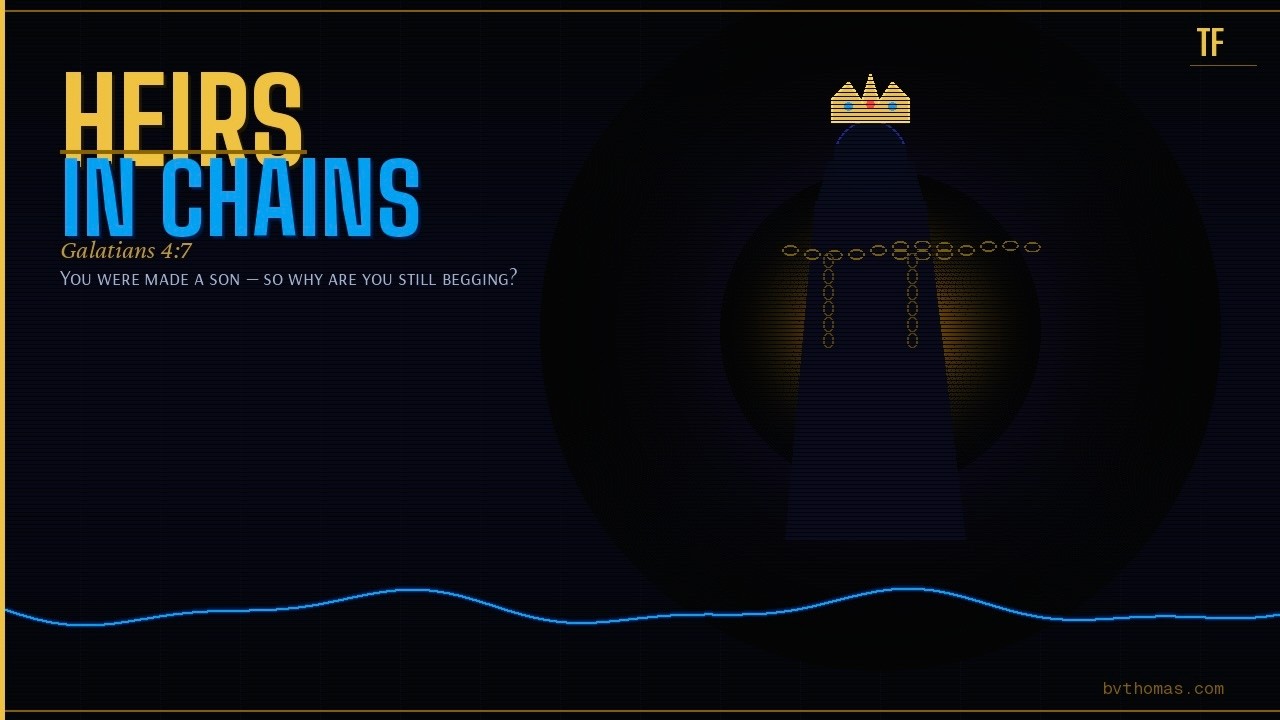
In the quiet depths of Galatians 4 lies a phrase that should unsettle every complacent soul: στοιχεῖα τοῦ κόσμου stoicheia tou kosmou—the elemental spirits of the universe.

Not the benign stuff of ancient physics—earth, air, fire, water.

No.

Paul speaks of spiritual forces, cosmic powers that once enslaved the entire human race. Invisible tyrants ruling through pride, as Leviathan reigns over the sons of pride (Job 41:34), and through the spirit now at work in the sons of disobedience (Ephesians 2:2). Before Christ, humanity groaned under their dominion—destiny dictated, sin enforced, rebellion shaped by unseen hands.

Paul compounds the bondage. For Israel, heirs by divine promise, there was another captor: the Law as pedagogue, guardian, custodian. Confined like children under strict overseers, disciplined and prepared, yet slaves all the same (Galatians 4:1–2). Institutional chains atop cosmic ones. Heirs in name, but powerless in practice.

Then the fullness of time arrived.

God sent His Son—born of woman, born under Law—to redeem from both. From the Law’s custody. From the elemental powers’ grip. To adopt as sons, placing the Spirit in our hearts to cry “Abba, Father” (Galatians 4:4–7).

Total liberation.

Cosmic redemption.

Personal adoption.

Inheritance unlocked.

But Scripture refuses to leave the story in history.

It turns the mirror on us.

Even after new birth, it is possible to remain a child in Christ—carnal, sustained on milk, unable to digest solid food, riddled with envy, strife, and divisions (1 Corinthians 3:1–3). Spiritual immaturity leaves one exposed, still echoing those ancient influences, still vulnerable to worldly and cosmic pressures.

🎧 Prefer listening? The audio is available at the end of this article.

The analogy cuts deep: just as the heir-child was under guardians, the immature believer lives under fleshly constraints.

A servant does not abide in the house forever.

Only the Son does (John 8:35).

Pause here.

The divide is stark—and eternal in consequence.

The child-servant remains temporary, bound, immature—no full voice, no complete inheritance.

The mature son is permanent, freed, led by the Spirit—an heir of God through Christ, crying “Abba” with confidence (Galatians 4:7).

Sonship is both instant gift and lifelong becoming. By faith, we are declared sons (Galatians 3:26). Yet God grants power to become sons (John 1:12)—a deliberate growth, an active transformation.

We must put off the old self, corrupted by deceitful desires, and put on the new self, created in God’s likeness, in righteousness and holiness (Ephesians 4:22–24). We must walk in newness of life (Romans 6:4).

Fail this, and one clings to old patterns, remaining a servant-child—vulnerable, barren.

Consider the land soaked by frequent rain—grace poured out abundantly—yet producing only thorns and thistles.

It is worthless.

Near to being cursed.

Its end to be burned (Hebrews 6:7–8).

Consider the branch attached to the vine yet bearing no fruit—cut away, withered, gathered, thrown into fire (John 15).

The sap dries.

Vitality ebbs.

Fruit fails.

Even a believer’s works may burn, though the soul is saved—yet as one escaping through flames (1 Corinthians 3:15).

Saved, yes—but emptied of reward, stripped of usefulness in the Father’s house.

There is no neutral territory.

No harmless stagnation.

What is not cultivated is overtaken by weeds.

What is not abided in withers.

The warnings do not soften; they intensify.

Israel was redeemed from Egypt, passed through the sea as baptized, fed with spiritual food from heaven—yet most were overthrown in the wilderness.

God was not pleased (1 Corinthians 10:1–5).

Redeemed—yet destroyed.

These things stand as examples, warnings for us.

The one who thinks he stands must take heed lest he fall (1 Corinthians 10:11–12).

How shall we escape if we neglect so great a salvation (Hebrews 2:3)?

Drift begins innocently—carelessness, ease, taking grace for granted.

But we must pay closer attention, or we drift away.

Willful sin after receiving knowledge of the truth leaves no further sacrifice—only a fearful expectation of judgment (Hebrews 10:26–27).

We are not of those who draw back to perdition, but of those who believe to the saving of the soul (Hebrews 10:39)—yet drawing back remains possible.

Apostasy is no mere weakness; it is deliberate abandonment, hardening the heart, trampling the Son of God, regarding His blood as common (Hebrews 10:29).

It would have been better never to have known the way of righteousness than, having known it, to turn back (2 Peter 2:21).

If anyone does not love the Lord Jesus Christ, let him be anathema—Maranatha (1 Corinthians 16:22).

Those who despised Moses’ law died without mercy.

How much sorer punishment awaits those who reject Christ’s greater revelation—no respect of persons with God (Hebrews 10:28–29; Romans 2:8–11).

The natural branches were broken off for unbelief.

We stand only by faith.

Do not be arrogant, but fear—for if God did not spare them, He will not spare us (Romans 11:20–21).

Knowing the terror of the Lord, we persuade others (2 Corinthians 5:11).

We work out our salvation with fear and trembling (Philippians 2:12).

We pass our sojourn here in fear (1 Peter 1:17).

The flesh is deceitful above all things.

It whispers “peace, peace” where there is no peace.

Ease leads to forgetfulness, forgetfulness to pride, pride to destruction.

These truths were once the heartbeat of Christian preaching—the fear of God, the necessity of perseverance, judgment according to works, holiness as indispensable. The early fathers thundered them. The Reformers revived them. Revivalists and Puritans lived them.

Then a softer gospel crept in—prosperity, therapy, self-affirmation, success as sign of favor. Warnings could not coexist; they pierced comfort, exposed presumption. So they were quietly buried, reframed, neutralized—to keep the message attractive.

To resurrect them today feels strange, even terrifying. Few ears are open. The polished voices preach another way.

Yet the burden endures—a fire shut up in the bones, Christ’s own weight carried in union with Him. Others bear it too, scattered across the world, often unseen, often rejected.

And at the core of this severe gospel lies the mercy that alone makes it endurable.

I once could not have spoken this without flinching—my conscience still recoils at the telling, fearing it sounds like boasting to a heart long steeped in unworthiness.

I never believed I was good enough for God.

Never thought He could love someone like me.

Never imagined inheriting the divine life promised to saints.

The old self was my only reality—shameful, naked, scarred by years of failure. It felt permanent, familiar, true.

The new self seemed a fantasy. Foreign. Unreachable. Fraudulent, even.

But the Spirit was patient beyond imagining. Through many people, across many long years of resistance, He convinced me—gently, persistently—that grace truly reaches the unlovable. That even I could live as the saints do. That I must learn to see myself not through natural eyes, but through God’s.

Only then did Christ take full form within me. Divine nature swallowing shame. Holiness covering nakedness. Power made perfect in my weakness.

Now it is no longer I who live, but Christ who lives in me. The change is not theory—it is appropriated, inhabited, alive. Preaching flows not from distant knowledge, but from this miracle experienced firsthand.

From enslavement beneath invisible powers to the freedom of mature sonship.

From double bondage to eternal inheritance.

From unbelief in love to wonder at mercy’s boundless reach.

This gospel is severe—because superficial faith cannot save.

It is merciful—because it saves to the uttermost.

It demands everything—perseverance, mortification, fear and trembling.

It gives everything—adoption, inheritance, Christ Himself.

Today’s gospel often promises ease where Scripture demands endurance. Comfort where Paul speaks terror. Affirmation where Hebrews warns of fire.

This one will not let you stay comfortable.

And if it could reach one who once stood convinced he was forever unlovable,

it can reach you.

Will you let it?

🎧 Thank you for reading! You can also listen to this reflection as a podcast:

youtube placeholder image

Before you move on, you may find it helpful to reflect on the ideas above.

🔍 Reflection Quiz (from this article):

Check how well you’ve grasped the key ideas:

👉 [link]