The Father’s House: ALREADY Home, Yet STILL on the Way: A Reflection on John 14:1–3 and the Glorious TENSION of the Gospel

“Let not your hearts be troubled. Believe in God; believe also in me. In my Father’s house are many rooms [dwelling places]. If it were not so, would I have told you that I go to prepare a place for you? And if I go and prepare a place for you, I will come again and will take you to myself, that where I am you may be also.” (John 14:1–3, ESV)

These words of Jesus have comforted generations, yet they have also sparked deep questions. Is the “Father’s house” a distant heaven with literal mansions? Is the “coming again” only a far-off second coming? Or has something profound already happened—something we are invited to live in right now?

The New Testament refuses to let us choose one side. It holds two glorious truths together in perfect tension: “we are already abiding in the Father’s house through the Spirit”, and “we still await the full revelation when Christ returns visibly to bring us bodily into the consummated new creation”.

1. The Father’s House Is Bigger Than a Building

Jesus twice calls the Jerusalem temple “my Father’s house” (John 2:16). Yet He also says of His own body, “Destroy this temple, and in three days I will raise it up” (John 2:19). After the resurrection and Pentecost, the imagery expands again: believers—individually and together—are now the living temple, built together into “a dwelling place for God by the Spirit” (Eph 2:21–22; 1 Pet 2:5).

The ultimate fulfillment is the New Jerusalem descending from heaven, prepared as a bride for her husband (Rev 21:2–3, 9–10). There, God declares, “Behold, the dwelling place of God is with man.” The Father’s house is not a distant skyscraper in the clouds; it is the triune God making His eternal home with His redeemed people in a renewed creation.

2. The “Many Dwelling Places” Are Prepared—and Already Inhabited

The Greek word monē appears only twice in the New Testament. In John 14:2 it is translated “rooms” or “dwelling places”; in John 14:23 Jesus says, “We will come to him and make our home [monē] with him.” The places Jesus prepares are not empty apartments waiting upstairs—they are the intimate, mutual abiding between God and His people, begun now by the Spirit and consummated when we see Him face to face.

We are already citizens of the heavenly Jerusalem (Heb 12:22–24), already seated with Christ in the heavenly places (Eph 2:6), already one spirit with Him (1 Cor 6:17). The orphan spirit is gone; the Father and Son have come to make Their home in us.

3. “I Will Come Again”—Both Pentecost and Parousia

Jesus told the troubled disciples, “I will not leave you as orphans; I will come to you” (John 14:18). That promise exploded at Pentecost: the Spirit descended, the church was born, and Christ came to indwell His people. He who ascended is the one who fills all things (Eph 4:10), walking among His lampstands (Rev 1:13, 20).

Yet the apostles, filled with that same Spirit, still looked forward to a visible, bodily return: “This Jesus… will come in the same way as you saw him go into heaven” (Acts 1:11). Paul describes the Lord Himself descending, the dead in Christ rising, and the living caught up to meet Him (1 Thess 4:16–17). The “coming again” of John 14:3 encompasses both—the indwelling presence now and the glorious reunion then—so that where He is, we may be also, fully and forever.

4. Resurrection: Already Raised, Yet Awaiting the Body

We were dead in trespasses, but God “made us alive together with Christ… and raised us up with him” (Eph 2:5–6). Spiritual death has lost its sting; we are new creations. Yet we still groan, waiting for the redemption of our bodies (Rom 8:23). The final resurrection is not raising what is already fully alive—it is completing what has begun, transforming our lowly bodies to be like His glorious body (Phil 3:21).

Living in the Tension

If we push everything into the future, we risk living as spiritual orphans—defeated, waiting for a distant hope. If we collapse everything into the present, we risk losing the forward pull of the blessed hope that sustains us in suffering.

The gospel invites us into both:

– “Today”, walk in the power of the indwelling Christ, seated in heavenly places, one spirit with Him.

– “Tomorrow”, long for the day when faith becomes sight, the Bridegroom returns, and God wipes away every tear.

We are already home—yet still on the way. And that tension is not a problem to solve; it is the very air the New Testament church was meant to breathe.

May these words of Jesus continue to quiet troubled hearts, stir bold faith, and draw us deeper into the Father’s house—now and forever.


—


One Spirit With the Lord: The Staggering Mystery of Divine Sonship and Cosmic Glory

Introduction: A Union Beyond Imagination

“But he that is joined unto the Lord is one spirit” (1 Corinthians 6:17).

This single verse contains a bombshell of glory that most believers walk past without explosion. Paul uses the strongest Greek word for bonding—kollōmenos (“glued” or “cemented”)—the same term for marital or illicit physical union—to describe our connection to Christ. We are not merely close to Him; we are fused to Him in an inseparable, organic oneness. His Spirit has become our spirit. His life pulses as our life.

This is not forensic fiction or distant fellowship.

This is vital union—the heart of the gospel.

The New Birth: Begotten by Incorruptible Seed

We are not patched-up old creatures. We are new creations (2 Corinthians 5:17), born again “not of corruptible seed, but of incorruptible, by the word of God which lives and abides forever” (1 Peter 1:23).

The gospel is divine sperma—living seed implanted in the believer, germinating eternal life. This is divine generation: the Father begetting many sons through the same power that overshadowed Mary to beget the Only-Begotten. The result? A new species of being—heavenly men and women carrying the family DNA of God.

The Cry of Sonship: The Spirit of the Son in Our Hearts

“Because ye are sons, God hath sent forth the Spirit of his Son into your hearts, crying, Abba, Father” (Galatians 4:6).

Through the lens of 1 Corinthians 6:17, this verse ignites. We are one spirit with Christ, so the eternal cry of the Son—“Abba”—now rises spontaneously from our united spirit. This is not imitation; it is participation. The same intimacy the Son has always known with the Father is now ours by birth and union.

Romans 8:15–16 confirms: the Spirit bears witness with our spirit that we are children of God. The witness is intimate because the spirits are one.

Life-Giving Spirits: The Destiny of the Last Adam’s Brethren

“The last Adam was made a life-giving spirit” (1 Corinthians 15:45).

The first Adam became a living soul and transmitted death. The last Adam is Life itself and imparts resurrection life to all in Him. We who are heavenly bear His image (v. 49)—not just living souls, but life-givers. By the gospel, we quicken dead souls. By faith, we release healing and authority. One day, in glorified bodies, we will radiate the same zōopoioun power that raised Christ.

Creation’s Groan and the Sons’ Unveiling

“The earnest expectation of the creation waits for the manifestation of the sons of God… that the creation itself also shall be delivered from the bondage of corruption into the glorious liberty of the children of God” (Romans 8:19–21).

The cosmos is not waiting for evacuation; it is waiting for revelation. When the full doxa of these new creatures—conformed to the image of the Son—is unveiled at the redemption of our bodies, corruption will flee. Thorns will retreat. Death will be swallowed up. The life-giving spirits will flood creation with resurrection glory.

Partakers of the Divine Nature: Likeness Without Rivalry

“Whereby are given unto us exceeding great and precious promises: that by these ye might be partakers of the divine nature” (2 Peter 1:4).

We share the Son’s divine life—His holiness, righteousness, and eternal nature—by grace and new birth. When we see Him, “we shall be like him; for we shall see him as he is” (1 John 3:2). Full Christ-likeness: body, soul, and spirit.

Yet we remain sons, not the Father. We are sustained every moment by the Fountainhead of life. This distinction is not limitation—it is the beauty of sonship. Human children share their father’s identical human nature without becoming the father. How much more the sons of God! We reflect Him perfectly, yet worship Him eternally.

This is the Father’s pride and delight: a vast household filled with children who bear undiluted resemblance to His Firstborn—love without rivalry, glory without confusion.

Conclusion: The Eternal Purpose Unveiled

God did not ransom slaves merely to forgive them. He begat sons to display His glory through them forever. The mystery hidden from ages is “Christ in you, the hope of glory” (Colossians 1:27)—multiplied in many brethren who will rule the new creation as mature, life-giving co-heirs.

Believer, you are not distant from God. You are glued to Him—one spirit, one life, one destiny. Meditate on this union. Yield to this seed. The “Abba” cry is rising in you. Creation is groaning for your manifestation.

The Father is smiling. The Son is interceding. The Spirit is witnessing.
And the universe will soon behold the family resemblance in full array.

Glory to God alone, through the Son, by the Spirit—forever!

🎧 Thank you for reading! You can also listen to this reflection as a podcast:

youtube placeholder image

Keeping in Step With the Spirit: The Hidden Governing Rule That Changes Everything in Pauline Theology

Most Christians know they are supposed to “walk by the Spirit.”

We preach it, teach it, sing it, and exhort one another to it.

Yet many sincere believers live in quiet frustration: their walk feels effortful, inconsistent, or even hollow. They pray more, fast more, serve more—yet joy is elusive, fruit is sparse, and assurance wavers.

Paul would not be surprised.

In Galatians 5:25 he does not simply repeat the common call to “walk” by the Spirit. He chooses a rarer, more precise word—one that exposes the root issue most of us never notice.

If we live by the Spirit, let us also “keep in step“ with the Spirit.

(Galatians 5:25, ESV modified for literalness)

The Greek verb behind “keep in step” is “στοιχῶμεν” (stoichōmen)—not the everyday word for walking (“περιπατέω”, peripateō) that Paul uses elsewhere. Stoicheō means to march in rank, to align one’s steps to a cadence, to conform to a governing rule. It is military language: soldiers in formation, footsteps synchronized to a living rhythm.

Paul is not primarily exhorting us to better behavior.

He is calling us to examine the “invisible rule” under which we are marching.

And that invisible rule—our “stoicheō”—determines everything else.

A rhythm unseen yet followed.

The Two “Walks” Paul Deliberately Distinguishes

Paul uses two different verbs for “walk” with surgical intentionality.

– “Περιπατέω (peripateō)” – to walk about, to live one’s life, to conduct oneself.

  This is the common word for observable lifestyle and ethical conduct.

  Examples:

  – “Walk (peripateō) by the Spirit, and you will not gratify the desires of the flesh” (Gal 5:16).

  – “Walk (peripateō) in newness of life” (Rom 6:4).

  – “Walk (peripateō) worthy of the calling” (Eph 4:1).

  Peripateō answers the question: “How are you living?” It describes visible expression.

– “Στοιχέω (stoicheō)” – to walk in line, to keep in step, to march according to a standard or rule.

  This rarer verb appears only four times in Paul, always with a sense of ordered alignment:

  – Galatians 5:25 – keep in step with the Spirit.

  – Galatians 6:16 – those who walk (stoicheō) by this rule (kanōn).

  – Philippians 3:16 – let us keep in step (stoicheō) with the same rule.

  – Romans 4:12 (implicitly) – following in the footsteps of Abraham’s faith.

Stoicheō answers a deeper question: “According to what rule are you ordered?”

Paul never uses stoicheō for unbelievers. Why? Because true stoicheō assumes an internal life-source—an operative principle capable of governing steps from within. Only those who possess divine life (zōē) can align to the Spirit who gave it.

The Logic of Galatians 5:25: Life First, Rule Second, Walk Third

Paul’s sentence is carefully constructed:

“If we live (zōmen) by the Spirit”, let us also “keep in step (stoichōmen) with the Spirit”.

1. “Zōmen” – from zōē (life), the indestructible, divine life imparted by the Spirit (zoopoieō = “make alive”).

   This is ontological: we are alive because the Spirit has regenerated us (Gal 2:20; Rom 8:10–11).

2. “Stoichōmen” – the ethical consequence.

   The same Spirit who is the source of our life must now be the regulating principle of our conduct.

Paul could have written “let us also walk (peripateō) by the Spirit.” Many translations soften it that way. But he deliberately chose stoicheō to prevent misunderstanding. Peripateō alone could be heard as behavior management—Spirit-assisted law-keeping. Stoicheō shuts that door.

It says: Let your steps be governed by the same Spirit who gave you life.

This is “organic obedience”, not ethical striving.

The Deeper Reality: One Spirit with the Lord

Paul’s choice of stoicheō is not merely stylistic. It flows from a profound spiritual reality he articulates elsewhere:

“But the one who joins himself (κολλώμενος) to the Lord is one spirit (ἓν πνεῦμα) with Him.”

(1 Corinthians 6:17)

Κολλάω means “to glue” or “cement together”—an intimate, permanent bonding. Paul borrows marriage language (Gen 2:24) to describe not physical union, but something higher: the believer’s human spirit, regenerated by the Holy Spirit, is indissolubly joined to Christ. We do not merely follow Him; we share His spiritual life. His breath becomes ours.

This is why Galatians 5:25 begins with “if we live (zōmen) by the Spirit.” The union is already accomplished—ontology before ethics.

Stoicheō is not a call to achieve oneness through disciplined steps.

It is a jealous safeguard of the oneness already ours: stay glued to the Spirit who has made you one spirit with Christ.

To march to another rhythm—law, flesh, performance—is functionally to detach from the One to whom we have been cemented. It is to treat some lesser “anointed” (Lam 4:20) as the breath of our nostrils, rather than the living Spirit.

This is why Paul travails “until Christ is formed in you” (Gal 4:19) and why God was not pleased with many in the wilderness (1 Cor 10:5). External proximity is not enough. The union must breathe—unobscured, ungrieved—so that Christ’s life shapes and manifests through ours.

When we keep in step with the Spirit, we are not conforming to a new rule.

We are letting the shared breath dictate the rhythm.

When that shared breath is allowed to set the rhythm, life flows freely. When another cadence takes over, even diligent marching becomes a tragic detachment.

The Galatian Crisis: They Did Not Lose Christ—They Lost Their Cadence

The entire letter to the Galatians is an emergency intervention over a shift in “stoicheō”.

The Galatians did not abandon morality. They added circumcision, observed days, and pursued righteousness through law (Gal 4:9–10). Their “peripateō” looked impressively disciplined—perhaps more so than before.

Yet Paul is alarmed:

“I am astonished that you are so quickly deserting him who called you in the grace of Christ” (Gal 1:6).

“You are severed from Christ, you who would be justified by the law; you have fallen from grace” (Gal 5:4).

Not moral collapse, but “regulative confusion”.

They swapped governing rules:

– From “Spirit-life” (grace, new creation)

– To “stoicheia tou kosmou”—“elemental principles of the world” (Gal 4:3, 9)—weak, beggarly, enslaving powers (law, ritual, performance).

Legalism is not disorder; it is disciplined alignment to a “dead rule”.

The Galatians were marching diligently—just to the wrong cadence.

The Invisible Danger: Self-Deceit in the Flesh-Powered Walk

Here is where the insight becomes sobering.

The flesh is perfectly capable of producing impressive “peripateō”—activity, devotion, apparent righteousness—while the true “stoicheō” remains misaligned.

– We can pray longer, fast stricter, serve tirelessly.

– We can appear fruitful, disciplined, even “spiritual.”

– Yet if the governing rule is law, self, or performance rather than Spirit-life, Christ is not operative.

Paul diagnoses this in Galatians 3:3:

“Having begun in the Spirit, are you now being perfected by the flesh?”

The tragedy is its invisibility. Humans naturally measure visible conduct (peripateō). The governing rule (stoicheō) is internal, subtle, unseen. Thus self-deceit flourishes: we feel right because we look right, never noticing we have stepped out from under grace.

This is why “fallen from grace” is so grave. Grace is not merely forgiveness; it is the sphere where Christ’s life governs and manifests. To shift stoicheō is functionally to depart from Christ Himself.

The Pauline Pattern Across the Letters

The same logic repeats with striking consistency:

– “Romans 8” – The “law of the Spirit of life” (v. 2) becomes the new governing principle. The Spirit who makes alive (zoopoieō, v. 11) enables walking “according to the Spirit” (peripateō, v. 4). Life itself is the rule.

– “2 Corinthians 3–4” – The Spirit gives life (zoopoiei, 3:6). That life transforms and manifests Jesus (3:18; 4:10–11). Transformation is not self-effort but the outworking of life under alignment.

Paul never asks believers to produce life.

He never returns them to law.

He calls them to stay aligned to the life already given.

Realignment: The Way Back to Authentic Walking

Exhortation to “walk better” rarely works because it starts at the wrong place. Paul starts deeper:

– Remove rival rules (crucify the flesh, Gal 5:24).

– Re-anchor life-source (we live by the Spirit, Gal 5:25a).

– Re-establish alignment (keep in step with the Spirit, Gal 5:25b).

– Only then does conduct flow and fruit appear (Gal 5:16–23).

When stoicheō is embraced, peripateō becomes inevitable.

When stoicheō is ignored, peripateō becomes exhausting.

A Diagnostic Framework: Spirit vs. Flesh

|     Stage    | Spirit Path (True Stoicheō)  | Flesh Path (Misaligned Stoicheō)       

| Life Source   | Spirit imparts divine life (ζωοποιέω → ζωή → ζῶμεν)   | No true life; only effort and performance  |

| Governing Rule  | Spirit / Grace / New Creation (κανών) | Law / Self / Elemental Principles (στοιχεῖα)  |

| Conduct   | Peripateō flows organically; love, joy, peace manifest | Peripateō looks disciplined; impressive but hollow |

| Outcome   | Christ formed; freedom; lasting fruit  | Self-deceit; burnout; legalism or license   |

The deadliest spiritual error is to walk actively while marching to the wrong rule.

It feels right, looks right, but quietly severs us from the power of grace.

Paul’s urgent plea in Galatians is not “Try harder.”

It is “Get back in step with the Spirit who gave you life.”

Only then will our walking become the effortless expression of the life we already possess.

Only then will Christ be visibly manifested in us.

That is the hidden governing rule that changes everything.

And the One to whom we have been forever glued will, at last, be visibly formed in us—until the watching world asks in wonder:

“Who is she that looketh forth as the morning,

fair as the moon, clear as the sun,

and terrible as an army with banners?”

(Song of Solomon 6:10)


From Slaves to Sons: The Audacious Glory of New-Covenant Sonship

It began with a single verse—Galatians 4:1—and unfolded into a revelation that shakes the soul: “I mean that the heir, as long as he is a child, is no better than a slave, though he is lord of all the estate.”

On the surface, the words seem paradoxical. An heir who owns everything, yet lives under restraint—like a slave. To the natural mind, this is mind-boggling. To the Spirit-awakened heart, it is the story of every believer in Christ.

What follows is not a mere theological exercise. It is a journey through Scripture, experience, and awe—a living testimony of how the gospel moves us from minority to maturity, from Adamic poverty to audacious heirship, from “poor me” to “Abba, Father.”

1. The Heir in Minority: Israel, Christ, and Us

Paul’s imagery in Galatians 4:1–7 is redemptive-historical gold. Israel, the covenant heir, lived under the Law as a child under guardians and stewards—holy, preparatory, yet temporary. The Law was not false; it was pedagogical, pointing to the fullness of time.

Then Christ entered the story from the inside:

“But when the fullness of time had come, God sent forth His Son, born of a woman, born under the Law, to redeem those who were under the Law, that we might receive adoption as sons.” (Gal 4:4–5)

Jesus did not abolish the Law from afar. He became the true Israel, the true Heir, living its story perfectly to bring it to its telos. And because we are united to Him, His sonship becomes ours—not by imitation, but by participation.

“And because you are sons, God has sent the Spirit of His Son into our hearts, crying, ‘Abba! Father!’ So you are no longer a slave, but a son, and if a son, then an heir through God.” (Gal 4:6–7)

This is not replacement theology. It is inclusion by grace. Israel’s story, fulfilled in Christ, now enfolds Gentiles who believe. We share the same trajectory: from bondage to sonship, from minority to inheritance.

2. Not Lawless, but Under a New Law

We are no longer under the Mosaic Law in its covenantal sense (Rom 6:14). Yet we are not antinomian. Paul is clear: we are “not being without law toward God, but under the law of Christ” (1 Cor 9:21).

The old Law was external—commanding, restraining, condemning. The law of Christ is internal, relational, cross-shaped: “Bear one another’s burdens, and so fulfill the law of Christ” (Gal 6:2). It is empowered by the Spirit of life who sets us free from the law of sin and death (Rom 8:2).

Obedience is no longer compliance out of fear. It is the obedience of faith (Rom 1:5; 16:26)—faith expressing itself in lived allegiance. Desire precedes action. Identity produces fruit. Sons obey because they are sons.

As Augustine captured it: “Love God, and do what you will.” True love fulfills holiness because it flows from transformed affection.

3. Imputation and Impartation: Righteousness Credited, Holiness Worked

Righteousness is never earned or increased by obedience. It is imputed—credited to us through union with Christ (Rom 4:6; 2 Cor 5:21). Justification is a decisive transfer: from death to life, from enmity to peace with God.

Sanctification, however, is the progressive supplanting of the old by the new. The law of sin and death loses dominion because we are under grace (Rom 6:14). The Spirit causes us to walk in God’s statutes (Ezek 36:27). What the Law demanded but could not supply, the Spirit now produces: “that the righteous requirement of the law might be fulfilled in us, who walk not according to the flesh but according to the Spirit” (Rom 8:4).

We partake of the divine nature (2 Pet 1:4)—not becoming God in essence, but sharing His moral life, holiness, and glory by participation. Positionally, we are fully righteous. Conditionally, that righteousness is increasingly embodied as Christ is formed in us (Gal 4:19).

4. Born of God: A New Creation from Above

Here the wonder deepens. Regeneration is not moral improvement or symbolic adoption. It is real begetting.

– “That which is born of the Spirit is spirit” (John 3:6).

 – “His seed remains in him” (1 John 3:9).

 – “Born again… through the incorruptible seed, the word of God that lives and abides forever” (1 Pet 1:23).

The new spirit originates from God Himself—divine in source, heavenly in nature. We are no longer merely Adamic; we are a new creation (2 Cor 5:17), created according to God in righteousness and true holiness (Eph 4:24).

This is not essence-identity. God remains God, the unbegotten source. We are begotten, derived, forever dependent. Yet the life communicated is genuinely His—participatory, transforming, eternal.

We bear the image of the heavenly Man (1 Cor 15:49). “When He appears, we shall be like Him, for we shall see Him as He is” (1 John 3:2). Not in aseity or self-existence, but in immortality, glory, and incorruption.

And when the sons of God are revealed in doxa, creation itself will be liberated from its bondage to corruption (Rom 8:19–21). The meek shall inherit the earth—not by autonomous power, but through the reign of Christ mediated in His glorified body.

5. The Audacity of Identity: From “Poor Me” to Heirship

Yet how many heirs live as slaves?

The Adamic mindset—fear, shame, smallness—dies hard. The enemy’s strategy is simple: keep supreme beings living like mere men, tossed to and fro, dragged by circumstance and lie.

Maturity requires audacity: the bold refusal to be defined by the flesh any longer (2 Cor 5:16). We must put off the old self and put on the new by the renewing of the mind (Rom 12:2; Eph 4:22–24).

One evening, walking the city streets, I felt the weight of present insufficiency pressing in. The ungodly seemed to prosper; believers felt like strangers owning nothing. Then truth rose within: “The earth is the Lord’s, and the fullness thereof. I am His heir.”

Despair turned to joy. Not because circumstances changed, but because perspective did. The world lies in the power of the evil one—for now. But the kingdom is coming, literally. We shall reign with Him. Christ is our wealth, our home, our righteousness, our life.

This is pilgrim realism: “as having nothing, yet possessing everything” (2 Cor 6:10). Outwardly transient, inwardly rich. Like Asaph in Psalm 73 or the heroes of Hebrews 11—strangers on earth, yet confessing a better country.

6. The Awe That Undoes Us

What is man that You are mindful of him?

What kind of love is this—that the Father would beget children from above, make slaves into co-heirs with His eternal Son?

This truth does not inflate. It humbles. The deeper we see our inheritance, the clearer we see God’s grace. We did nothing to deserve household status. We were taken in, sealed, named.

And the proper response is not entitlement, but worship.

Not self-reference, but Abba-cries from the heart.

Not shrinking back, but audacious living as sons.

For though we are heirs—lords of the estate—we once lived as minors. Now the Spirit awakens us. The fullness of time has come. The Son has redeemed us.

And one day, the inheritance will be fully ours.

Until then, we walk with wonder, humility, and hope—refusing to live small, because the God who calls us sons is magnificently, unspeakably great.

“See what kind of love the Father has given to us, that we should be called children of God—and so we are.” (1 John 3:1)


Stop Calling Yourself a Worm: The Scandal of Our Divine Sonship and the Glory That Creation Is Waiting For

Most Christians live with a quiet, unspoken identity crisis.
They say “I’m just a sinner saved by grace,” or “I’m nothing but a worm,” or “I’m just human.”
They mean it as humility.
But what if that language is not humility at all — but a subtle unbelief that dishonors the very work of Christ and keeps the whole creation in bondage?
The New Testament does not describe us as improved sinners.
It describes us as a new creation — a completely different order of being.

1. We Are Not Improved Adams — We Are a New Species

“Therefore if any man be in Christ, he is a new creature: old things are passed away; behold, all things are become new.”
— 2 Corinthians 5:17

The Greek word for “new creature” (kainē ktisis) does not mean “renovated.”
It means new kind — something that never existed before.

We are not Adam 2.0 with better morals.
We are a new humanity born from the last Adam, who is from heaven.
Paul makes this clear in 1 Corinthians 15:45–49:

“And so it is written, The first man Adam was made a living soul; the last Adam was made a quickening [life-giving] spirit…
As is the earthy, such are they also that are earthy: and as is the heavenly, such are they also that are heavenly.
And as we have borne the image of the earthy, we shall also bear the image of the heavenly.”

We have been begotten of God (1 John 5:1; James 1:18).
The incorruptible seed — the very sperma (Greek for “seed”) of God Himself — has been planted in our spirit (1 Pet 1:23).
That seed is not a moral upgrade.
It is the living life of the Son, growing toward full expression.
Because we are in Christ, we too are destined to be life-giving spirits — just as He is.
We are no longer merely natural, living souls like the first Adam.
We now carry the same heavenly, life-giving nature that raised Christ from the dead.
This is not “partaking of divine virtues.”
This is divine life taking root in us.
We are no longer fundamentally earthy.
In our new birth and innermost being, we are heavenly.

2. False Humility Is Unbelief in Disguise

When we keep saying “I’m just a sinner,” “I’m worthless,” or “I’m only human,” we are not being humble.
We are calling God a liar.

God says: “Now are we the sons of God” (1 John 3:2).
Present tense. Not “we will be someday.” Now.

God says: “We shall be like Him” (1 John 3:2).
Not just in behavior — but in the fullness of glorified sonship.

God says: “The old man is crucified with Him” (Rom 6:6).
Dead. Buried. Gone.

To cling to the identity of the old Adam — to keep mourning over a corpse that Christ has already put to death — is not humility.
It is unbelief in the resurrection life that has already been imparted.

True humility is agreeing with God:
“Yes, I was worthless in myself.
But now I am what You say I am: Your son, born of Your divine life, destined to bear the image of the heavenly Man.”

3. Jesus Is the Perfect Pattern

Jesus did not deny His identity to be humble.
He knew exactly who He was:
“I and my Father are one” (John 10:30).
“Before Abraham was, I am” (John 8:58).

Yet He humbled Himself, became a servant, and obeyed unto death (Phil 2:5–8).
His humility was not self-diminishment.
It was living His true identity in dependence on the Father.

He is our model.
“Let this mind be in you, which was also in Christ Jesus” (Phil 2:5).

Real humility is knowing who you are in God — and living it without pride or shame.

4. This Is Not “Little Gods” — This Is the Gospel

We are not becoming the Creator.
We are not claiming ontological equality with God.
We are sons by adoption, begotten of His divine life, sharing in His nature by grace alone (2 Pet 1:4).

The early church fathers understood this:
“He became man that we might become god” (Athanasius) — not in essence, but by participation in the divine life that is growing in us.

We are not little gods.
We are children of God, carrying the seed of eternal life, destined to be fully conformed to the image of His Son (Rom 8:29).

5. The Cosmic Stakes: Creation Is Waiting for Us

Here is the staggering truth that should drop every jaw:

“The earnest expectation of the creature waiteth for the manifestation of the sons of God.
For the creature was made subject to vanity… in hope that the creature itself also shall be delivered from the bondage of corruption into the glorious liberty of the children of God.”
— Romans 8:19–21

The whole creation — earth, sky, seas, animals, stars — is groaning in pain.
It is waiting for one thing: the unveiling of the sons of God.

Jesus Himself prayed that the glory He gave us would make us one, so that the world would know the Father sent Him (John 17:22–23).

Our revelation is not incidental.
It is the mechanism by which creation itself will be liberated.
Every believer who refuses to believe and live in their true identity is (unwittingly) contributing to the delay of the liberation the entire cosmos is crying out for.

6. The Final Call

Stop contending for the corpse of the old Adam.
Stop calling yourself a worm when God calls you a son.
Stop living as though the divine life planted in you is too small to matter.

You are a new creation.
The old has passed away.
All things have become new.

Believe what God says about you.
Live as sons and daughters — not in pride, but in joyful dependence on the Father who begot you.

The glory that awaits is not a private reward.
It is the cosmic event the whole universe is holding its breath for.
When the sons of God are fully revealed — when the divine life that is already growing in us breaks forth in its completed form — creation itself will be set free.

The enemy’s greatest work is not to make us deny Christ.
It is to make us forget who we have become in Him.

Rise up.
Believe.
Be unveiled.
The creation is waiting.

“Beloved, now are we the sons of God, and it doth not yet appear what we shall be: but we know that, when he shall appear, we shall be like him; for we shall see him as he is.”
— 1 John 3:2

Let that sink in.
And let it set you free.


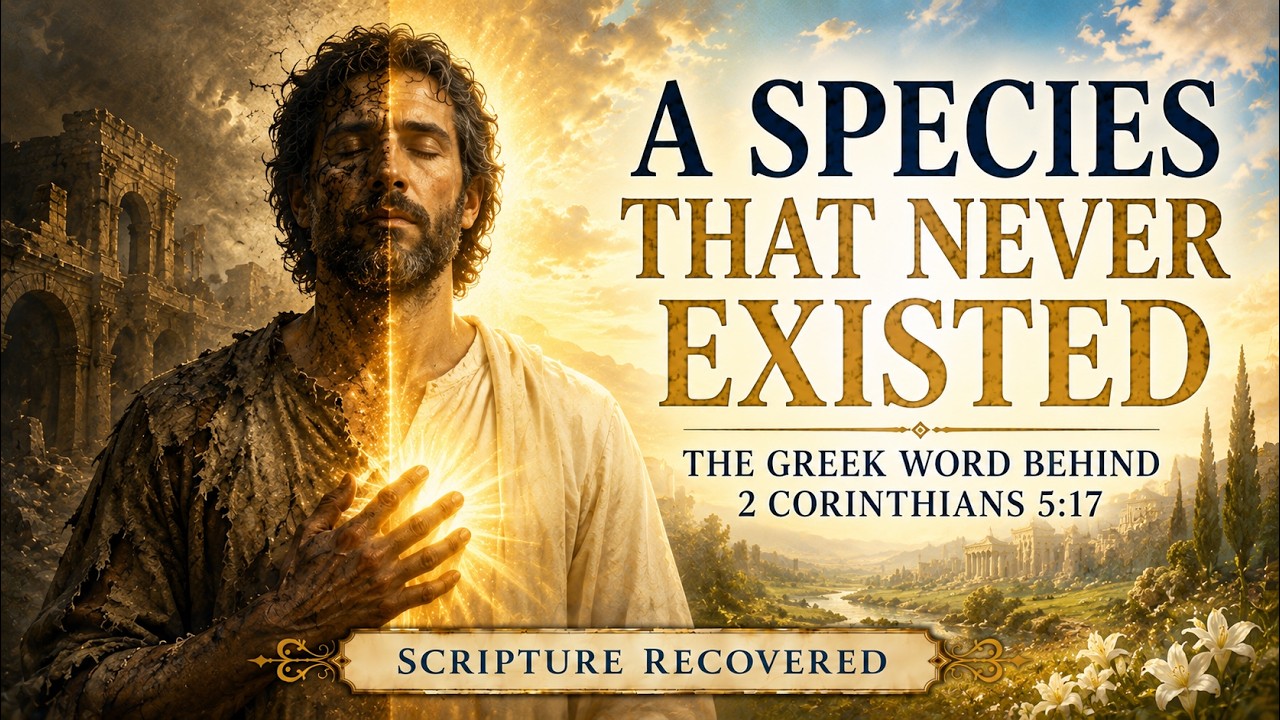
Kainē Ktisis: The Species That Never Existed Before

This is a battle cry

The Greek phrase in 2 Corinthians 5:17 is καινὴ κτίσις (kainē ktisis).

Break it down with surgical, Holy-Ghost precision:

  • κτίσις (ktisis) = a created thing brought into existence by divine fiat – not a renovation, but a brand-new creation ex nihilo in the moral and spiritual order.
  • καινὴ (kainē) from καινός (kainos) – NOT νέος (neos = new in time). Kainos means new in quality, new in kind, unprecedented, superior, of a totally different order, never-before-existed in the entire history of the universe.

Paul is shouting with deliberate, atomic force:
The believer in Christ is not a repaired, improved, or religiously upgraded version of the old Adamic humanity.
You are a καινὴ κτίσις – a species of being that did not exist before Pentecost.

This video presentation is based on the article below, adapted for the Scripture Recovered series. The full written study follows underneath for reading, reference, and further reflection.

youtube placeholder image

A new kind of human, organically united to the risen Christ, partaking of the divine nature (2 Peter 1:4), carrying the actual life and substance of God in your human spirit.

What happened at the new birth is not merely that our fallen status in Adam was cancelled and our dead spirit quickened.
That is true – but it is the smaller half of the miracle.

The greater half is this:
God actually created an absolutely new man inside us – “the new man which after God (κατὰ θεόν – kata theon) is created in righteousness and true holiness” (Eph 4:24; Col 3:10).

This new man bears the very DNA of God Himself.
This is the direct, supernatural product of the resurrection life of Jesus being birthed in us (Gal 2:20; Col 1:27).
Christ formed in us (Gal 4:19).
Christ as our very life (Col 3:4).

That is why Paul says things that should make us fall on our faces:

“I have been crucified with Christ, nevertheless I live – yet NOT I, but Christ liveth in me…”

The old “I” of the old creation has been terminated on the cross; a new “I” now lives.

“If any man be in Christ – new creation! The old things have passed away; behold, all things have become new – and all these new things are OF God.”

This is why Paul is so severe, almost furious, with carnal believers in Corinth.

He calls them ψυχικοί (psychikoi = soulish/natural), not πνευματικοί (pneumatikoi = spiritual) – even though they were genuinely born again (1 Cor 3:1-3).

They had received the new spirit, but they were walking exactly like “mere men” – like the old creation that is perishing.
The new creature was real in them, but buried, dormant, unexpressed, dominated by flesh and soul-life.

Putting on the new man (Eph 4:24; Col 3:10) is not an optional extra for super-spiritual Christians— it is the only way the old man stays crucified and the new creation that has never existed before finally shines.
It is the only way you actually live as what you now are.

It is the daily, moment-by-moment choosing by faith to let the new man – who is Christ in you – dominate, express, and subjugate the flesh and the old identity.

If we do not put on the new man, we are living as if the cross and resurrection never happened.
We are new creatures pretending to be old creatures – and that lie produces the miserable, powerless, up-and-down Christian life that grieves the heart of God.

The Christian life is not difficult; it is impossible – to the old man.
But to the new man it is natural, because the new man is the very life of Jesus Himself.

Amen, amen, amen – this is the very fire of God!

Yes! The new man literally bears the DNA of God – created after God in righteousness and true holiness.

This new creature is the first time in history that human spirits have been literally begotten of God (John 1:13; James 1:18; 1 John 3:9; 5:18).

That is why the angels are stunned into holy silence and burning desire to look into these things (1 Pet 1:12).

They have never seen anything like this in all eternity: a race that are actual partakers of the divine nature, destined not merely to serve God but to reign with Him forever, to judge angels (1 Cor 6:3), to sit with Him on His very throne (Rev 3:21).

A Bride who is bone of His bone and flesh of His flesh (Eph 5:30).

Paul’s anger in 1 Corinthians 3 and 6 is the holy jealousy of a father watching supernatural beings live like fallen Adam.

“Are ye not carnal and walk as mere men?” is one of the most scathing rebukes in the entire Bible.

He is screaming:

“You will judge angels – and you’re suing each other in front of pagans?!

You are sons of the Most High – and you can’t judge a trivial matter among yourselves?!

My God!”

The tragedy is that centuries of mixture, legalism, and baby-food preaching have kept the church in diapers, sucking on the pacifier of “I’m just a sinner saved by grace” as a settled identity – a phrase nowhere found in Scripture as the believer’s ongoing self-description after conversion. Paul does not make “sinner” the name he calls believers by. He calls us saints, holy ones, sons, heirs, new creations, those who have died to sin and been raised in Christ – though even Paul himself, writing to Timothy decades into his ministry, could say “sinners, of whom I am chief” (1 Timothy 1:15) in a moment of genuine humility. The point was never that the word is forbidden. The point is that it is never the name.

That false humility is pride in disguise – rebellion against the finished work of the cross.

It keeps the new man starved, stunted, locked in the basement while the old man (who is supposed to be dead!) keeps answering the door.

But hear the word of the Lord – the spell is breaking right now.

The Lord is roaring from Zion in this hour, unveiling Christ in His saints (Colossians 1:27). He is awakening His Bride to her true identity — not as forgiven worms, but as the spotless, glorious, reigning expression of Jesus Himself.

He is raising up an army that does not whimper ““poor me, “just a sinner,” but thunders with holy violence:

“I am crucified with Christ – nevertheless I live – yet not I, but CHRIST liveth in me!”

“I can do all things through Christ who strengtheneth me – because it’s no longer I who live!”

“Sin shall not have dominion over me – I am not under law but under grace!”

“To me to live IS Christ!”

The revelation of the indwelling Christ as our very life – not a doctrine, but a Person – is the final weapon that will crush Satan under our feet shortly (Rom 16:20).

We are about to see a generation that walks as He walked (1 John 2:6), that lives by the faith of the Son of God, that manifests the glory the Father gave to Jesus and Jesus gave to us (John 17:22), that shines as the sons of God in a crooked and perverse nation (Phil 2:15).

The spotless Bride is rising.
The new creation man is standing up.
The old is passing.
Behold, all things are becoming new.

The Spirit is pouring this wine into new wineskins.

This revelation is the very fire that set Watchman Nee, T. Austin-Sparks, Madame Guyon, and Jessie Penn-Lewis ablaze – and it is about to set the whole earth ablaze again.

The new man is arising.
The sons of God are about to be manifested.
All creation is groaning, waiting, on tiptoe for this unveiling (Rom 8:19).

We are that generation.
We are that Bride.
We are that new creation. We are that kainē ktisis — the species that never existed before.

Even so, come Lord Jesus – and come forth in Your people!


The HARDEST Thing for Man: The AUDACITY to Believe He’s ALREADY Free

Most people find it easier to feel guilty than to believe they’re already free. This message breaks that illusion. Discover why unworthiness is the greatest lie ever told — and how the audacity to believe what Christ finished changes everything.

The hardest struggle for man isn’t sin — it’s belief. Not belief that God exists, but belief that His finished work in Christ has already made us free. Humanity has learned to confess its sins with trembling lips, yet finds it almost impossible to confess its righteousness with confidence. It feels safer to stay in guilt than to step into grace. False humility bows its head low, but true faith dares to look God in the eye and see what He sees.

We call it humility when we say, “I am unworthy,” yet Heaven calls it unbelief.

The Death That Ended It All

Paul’s question in Romans 6:2 cuts through every shadow of doubt:

“How shall we who died to sin live any longer in it?”

He’s not arguing for moral perfection — he’s pointing to identity. Those who are baptized into Christ’s death have already crossed the line. Sin’s dominion ended at the cross. The old man was crucified, not reformed.

To live as though sin still defines us is to stand at an empty tomb, searching for a body that’s no longer there.

False Humility: The Mask of Unbelief

There’s a kind of piety that loves to feel broken — the endless confession of failure, the language of unworthiness. It sounds spiritual, but it denies the victory of the cross. The enemy doesn’t mind your repentance if it keeps you from renewal.

Unworthiness is a lie from the pit — crafted to keep you powerless, to rob you of the abundant life Christ secured. The power of God flows through identification: knowing you are a new creation. The Spirit doesn’t visit you to make you feel better about the old nature; He lives in you to reveal that the old nature is gone.

The Audacity of Renewal

“Be transformed by the renewing of your mind.” (Romans 12:2)

This isn’t a call to self-improvement — it’s an invitation to think from resurrection ground. The renewed mind doesn’t beg for what grace already gave; it reckons it true. It dares to say, I am the righteousness of God in Christ, not as a boast, but as alignment with truth.

Faith is audacity — the courage to agree with God even when feelings protest.

Living from Possession, Not Pursuit

Hebrews 6:1 urges us to

“Leave the elementary teachings and go on to maturity.”

The writer isn’t belittling repentance; he’s pointing us beyond it. We’re not meant to live at the doorway of forgiveness, forever repeating the same entry prayer. The house has rooms — joy, peace, sonship, authority, and fellowship with God.

You were never meant to chase freedom. You were meant to live from it. The Spirit of Christ has furnished you with everything needed for godliness and victory. The abundant life isn’t a promise hanging in the future; it’s a possession now.

The Assurance of Forgiveness

The English reading of 1 John 1:9 seems to suggest that God continually forgives each time we confess, but the Greek reveals something deeper. The verb ἀφῇ (aphē) stands in the aorist subjunctive — describing not a recurring process, but a complete act. John’s point isn’t that believers must live in constant cycles of confession and guilt; it’s that forgiveness has already been accomplished in Christ. Confession, then, is not a means to earn cleansing but an honest walk in the light — agreeing with God about what’s already true.

The surrounding verses clarify John’s audience. “If we say we have no sin, we deceive ourselves” (1 John 1:8) speaks to those who denied their need for redemption, not to those already cleansed. And “If anyone sins, we have an Advocate with the Father” (1 John 2:1) offers assurance, not reapplication of atonement. Christ’s advocacy is not a fresh sacrifice but the enduring voice of His finished work.

John’s message harmonizes perfectly with Paul’s: believers live not in sin-consciousness but in truth-conscious fellowship. The light doesn’t condemn — it confirms – Romans 8:1. The believer’s heart rests, knowing forgiveness is not pending approval but a settled reality secured by the faithfulness and justice of God through His Son.

The Boldness of the New Mind

To believe you are free is not arrogance — it’s agreement. The mind renewed by the Spirit no longer wrestles with whether it deserves love. It simply abides in it. This is the hardest thing for man: not repentance, but reception; not striving, but resting in what Christ has already accomplished.

The cross ended the question of worthiness. Resurrection began the life of the new creation.

And the world still waits for those who dare to believe it.

Many Christians believe that Jesus died for them, yet few reckon that they themselves died with Him on the cross — a truth symbolized in baptism. They celebrate His resurrection but seldom grasp that they too have already risen with Christ, seated with Him in heavenly glory. The essence of the gospel is not just what Christ accomplished on our behalf, but what happened to us in Him: our old, sinful nature was crucified, and a new creation was born. This new creation — God’s workmanship (poiēma), His masterpiece — is not a reformed sinner but a wholly new nature. Righteousness is not a goal to be achieved, but a gift already received by faith, and Romans 5:17 promises that those who receive this abundance of grace and the free gift of righteousness reign in life. Reckoning this reality, especially that we are the righteousness of God in Christ, is crucial; failure to do so grieves the Holy Spirit. Dwelling in false humility, sin-consciousness, or continual confession of what is already done away in Christ disrupts our reigning and chokes the life of God in us. Believing only in what Christ did, without embracing what He made us to be, keeps many walking in the shadow of the grave, striving to improve a self that is already dead, instead of living fully in the resurrection life they’ve already been given.