From SUBMISSION to Sonship: The Hidden JOURNEY of Ephesians 5

Introduction

We often approach Ephesians 5:22–24 looking for rules about marriage. We come away either defensive or disappointed, because the passage feels either too heavy or too flattened. Yet something remarkable happens when we let the text interrogate us rather than the other way around. A single question—“What is the Greek depth of ‘be subject’?”—can lead us, almost against our will, from marital roles to the deepest mysteries of regeneration and identity in Christ.

This is not a detour. It is the text’s own logic. Submission, rightly understood, is not first a behavior but a posture made possible only by a prior and deeper reality: a life no longer rooted in Adam but begotten from above by the incorruptible seed of God.

From posture to identity — the movement Ephesians 5 assumes before it commands.

1. The Text Itself: A Posture, Not a Power Structure 

Paul does not begin with “Wives, submit to your husbands” as an isolated command. Grammatically, verse 22 has no verb. The verb is borrowed from verse 21: “being subject to one another in the fear of Christ.” The entire household code flows from a single Spirit-filled imperative: mutual submission as the fruit of being filled with the Spirit (v. 18).

The Greek word ὑποτάσσω hupotassō literally means “to arrange oneself under.” It is voluntary alignment within a given order, not coerced obedience. Soldiers align under a commander; citizens cooperate within civic order. The emphasis is harmony, not domination. And because Paul uses the middle voice—ὑποτασσόμενοι hupotassomenoi—the action is self-initiated, freely chosen.

Paul immediately defines the nature of this order Christologically: the husband is head as Christ is head of the church—self-giving, life-laying-down love (v. 25). Submission divorced from cruciform love is a distortion. The wife’s posture is analogical to the church’s relation to Christ: trusting, reverent, responsive—not because Christ coerces, but because He is Lord and Savior.

2. The Inner Posture: What Makes Submission Possible 

Yet rules, even beautiful ones, cannot produce this posture. External command alone breeds either legalism, rebellion, or behavior that is outwardly compliant but inwardly insincere. Peter is blunt: what is precious to God is “the hidden person of the heart” with a gentle and quiet spirit (1 Pet 3:4). Sarah’s calling Abraham “lord” was first an inward disposition, not a script.

Biblical submission is therefore never merely compliance. It is the outward fruit of an inward lean—a Spirit-formed inclination of trust and alignment toward God’s order. And this inclination is not native to us. It is begotten.

What begins as a question about a Greek word in a marriage passage quietly pulls us toward the engine room of the Christian life: regeneration.

3. The Necessity of New Birth 

Here the conversation deepens. If submission flows from the heart, and the heart is naturally hostile to God (Rom 8:7), then something radical must happen for this posture to become natural rather than forced.

Scripture answers with the language of seed and begetting:

– “Born again… of incorruptible seed, through the living and abiding word of God” (1 Pet 1:23).

– “His seed remains in him” (1 John 3:9).

– “That which is born of the Spirit is spirit” (John 3:6).

Regeneration is not moral renovation. It is the implantation of divine life. The Spirit-born spirit belongs to a different order—heavenly, incorruptible, originating from the last Adam who “became a life-giving spirit” (1 Cor 15:45).

4. Heavenly Identity: As Is the Heavenly, So Are They 

Paul’s bold claim in 1 Corinthians 15:48 is decisive: “As is the heavenly man, so are those who are heavenly.” Not “so should they try to be.” So are they.

This is why the believer’s spirit is “one spirit with the Lord” (1 Cor 6:17). God sends “the Spirit of His Son into our hearts” (Gal 4:6). We are not merely resembling Christ; we are partakers of the divine nature (2 Pet 1:4), bearing the image of the heavenly man. The center of gravity has shifted. We no longer ultimately belong to the Adamic order.

5. The Struggle to Name This Reality 

Language strains here. “Nature” feels too static; “essence” risks confusion; “union” can sound merely relational. Yet Scripture refuses thin categories. Seed produces according to kind. What is begotten of God is truly from God—life communicated, not imitated.

The tension is not resolved by sharper definitions but by worship. We do not need to become God (an absurd and serpent-like desire). We need only to recognize that, in Christ, our life is hidden with God (Col 3:3). He gives us identity and existence. Apart from Him we are nothing; in Him we are fully alive.

6. Returning to Submission: The Posture of Sons 

Only now does Ephesians 5 make full sense. Submission is not a duty imposed on an old-creation heart. It is the natural posture of those who know where they came from and where they are going.

A spirit begotten from above, one with the Lord, gladly arranges itself under God’s order—whether as wife, husband, child, or parent—because that order is no longer alien. It is home. The gentle and quiet spirit is not weakness; it is rest. The inward lean toward God’s will is not servitude; it is sonship finding its shape.

Conclusion

We began with a question about a Greek word. We ended in the heart of the gospel: a new genesis, a heavenly identity, a life that makes obedience possible because it is no longer obedience to a stranger but alignment with our deepest origin.

Ephesians 5 is not finally about marriage roles. It is about revealing what has already happened to us in Christ. When we see that, submission ceases to be a battle and becomes a breathing.

Let the Spirit continue the journey in us—from submission to sonship, from striving to rest, from Adam to the last Adam who lives in us and prays, “Abba, Father.”

—

Gentleness Is Not Timidity: A Rebuke to a Church That Honors the Dead and Suspiciously Watches the Living

The modern church honors saints of the past while mistrusting visible transformation today. This article confronts false humility, hypocrisy, and the fear of Christ’s work in living believers.

For too long, the church has honored saints of the past while mistrusting the living. This article—written as both exposition and manifesto—emerges from a burden to confront false humility, religious fear, and the subtle resistance to visible obedience and Spirit-led transformation. It seeks to honor God’s work in His people today and call the Body to recognize, rejoice in, and walk in the light He produces.

We Will Not Apologize for the Work of God in Us

The church has learned how to honor the dead while quietly distrusting the living.

David may repent, fail, and be celebrated centuries later. Paul may speak boldly of Christ’s meekness in him—once he is safely gone.  Elijah may be excused as “a man of like passions,” long after his fire has faded into story.

But let that same God produce the same fruit today—gentleness instead of rage, clarity instead of chaos, obedience instead of impulse—and suddenly suspicion replaces joy.

“We know him.”                                                                                                                   

“She’s changed.”                                                                                                             

“That feels like pride.”

Grace exits the room without a sound.

Paul anticipated this distortion. That is why he dared to say:

“I, Paul myself, beseech you by the meekness and gentleness of Christ—who in presence am lowly among you, but being absent am bold toward you.” 2 Corinthians 10:1

Do not miss what he is doing.

He is not boasting.                                                                                                                    He is naming Christ’s work before others                                                              redefine it for him.

What they called timidity, Paul called meekness. What they judged as weakness, he identified as the gentleness of Christ.

And he was not ashamed.

Why should he be?

That gentleness did not come cheaply. It was forged—through years of obedience, fire, contradiction, loss, and the slow death of the flesh. Fruit does not grow in a day (James 1:2-4). Everyone will be salted with fire—tested, and refined through trial (Mark 9:49). No vessel becomes fit for the Master’s use without first being emptied of what once filled it.

Yet here is the madness of our time:

The same church that tells broken believers, “Come out of low self-esteem. Believe who you are in Christ,” turns on them the moment they actually do.

As long as humility looks like insecurity, it is praised. But when humility stands upright—peaceful, unthreatened, clear—it is suddenly called pride.

This is not discernment.                                                                                                            It is fear of visible transformation.

Jesus never taught us to hide the work of God. A lamp is not lit to be covered. (Matthew 5:15) A tree does not apologize for bearing fruit. Fragrance is not arrogance. Light is not self-promotion.

What kind of gospel produces fruit and then demands silence?

Paul goes further. He says this clarity—this truthful disclosure of God’s work—pulls down strongholds. It dismantles arguments. It takes            thoughts captive.

Why?

Because lies thrive in ambiguity. Darkness survives where believers are trained to distrust what God has actually done in them.

Then comes the line the flesh cannot tolerate:

“…being ready to exercise authority when your obedience is fulfilled.” 2 Corinthians 10:6

Authority is not claimed.                                                                                                          It emerges.

A workman who rightly divides the Word need not be ashamed—because his life agrees with his mouth. That kind of believer becomes dangerous to deception. Which is why the religious spirit always tries to shame them back into hiding.

But Scripture refuses that narrative:

“He shall be a vessel unto honour, sanctified, and meet for the Master’s use, prepared unto every good work.” 2 Timothy 2:21

Not an afterthought.                                                                                                              Not a leftover.                                                                                                                          Not a second-class saint borrowing glory from the past.

A forethought in Christ.                                                                                                            A son.                                                                                                                                            An heir.                                                                                                                                              A living testimony.

So let it be said plainly:

We will not apologize for the fruit God has grown. We will not pretend we are unchanged to comfort the insecure. We will not bury light to preserve religious peace.

Gentleness is not timidity. Clarity is not arrogance. Obedience is not pride.

We will rejoice when one member is honored. We will glorify God when His virtues appear in a brother or sister. We will covet rightly—not by tearing others down, but by desiring the same work in our own lives.

Let darkness be disturbed. Let false humility be exposed. Let the church relearn how to recognize Christ—not only in Scripture, but walking among His people again.

This is not rebellion.                                                                                                              This is obedience.

This is not self-exaltation. This is Christ revealed in vessels of clay.

And those who have eyes to see will know exactly what they are looking at.


The Captives Who Conquered: How God Parades You as the Sweet Smell of Victory

The Captives Who Conquered: How God Parades You as the Sweet Smell of Victory

Imagine the scene: Thunderous cheers echo through the streets of ancient Rome. A conquering general rides in a golden chariot, crowned with laurel. Behind him march defeated kings in chains, their faces etched with humiliation. Spoils of war gleam in the sun. And rising above it all—thick clouds of burning incense, sweet spices filling the air.

To the victors, that fragrance meant triumph—life, glory, celebration.
But to the chained prisoners marching toward execution? The same scent screamed doom and death.

Now hear Paul drop this atomic bomb in 2 Corinthians 2:14-16 (NIV):

“But thanks be to God, who always leads us as captives in Christ’s triumphal procession and uses us to spread the aroma of the knowledge of him everywhere. For we are to God the pleasing aroma of Christ among those who are being saved and those who are perishing. To the one we are an aroma that brings death; to the other, an aroma that brings life.”

Stop. Breathe that in.

Paul doesn’t say we’re the conquering generals. No—we’re the captives. Surrendered. Chained to Christ. Yet in His victory parade over sin, death, and Satan, God Himself marches us through the world… and uses ordinary, broken you and me to diffuse the fragrance of knowing Him everywhere.

And get this: To God the Father, this scent rising from our lives is always, eternally pleasing—the sweet aroma of His Son’s perfect sacrifice and victory. Just like the Old Testament offerings that were a “soothing aroma” to the Lord.

But to the world? One fragrance, two responses.

To those being saved, we smell like life—drawing them to the Savior.
To those perishing, the same gospel fragrance is a reminder of judgment, a scent of death. (Not because we’re harsh, but because light exposes darkness.)

This is beyond our natural understanding of worth and beauty in Christ! We feel like failures, weaklings, barely holding on. Yet heaven sees us as the triumphant perfume of the King of Kings. Every prayer, every act of obedience, every quiet stand for truth—God spreads it like incense across nations.

You don’t manufacture this aroma. You don’t have to be eloquent, successful, or Instagram-perfect. Christ in you is the fragrance. Your surrendered life is the censer He swings.

So why do we live smelling like defeat when we’re the aroma of victory?

Church, wake up! The world doesn’t need more self-help gurus or polished performers. It needs captives joyfully marching in Christ’s triumph—lives that release the knowledge of Him like perfume in a stuffy room.

One day soon, the parade ends at the throne. No more mixed responses. Only glory. Until then, let Him lead you in triumph. Let the fragrance spread.

Because you, believer, are the sweet smell of Christ’s conquest to a dying world—and the delight of God Himself.

What a jaw-dropping identity. What unspeakable grace.


Stop Calling Yourself a Worm: The Scandal of Our Divine Sonship and the Glory That Creation Is Waiting For

Most Christians live with a quiet, unspoken identity crisis.
They say “I’m just a sinner saved by grace,” or “I’m nothing but a worm,” or “I’m just human.”
They mean it as humility.
But what if that language is not humility at all — but a subtle unbelief that dishonors the very work of Christ and keeps the whole creation in bondage?
The New Testament does not describe us as improved sinners.
It describes us as a new creation — a completely different order of being.

1. We Are Not Improved Adams — We Are a New Species

“Therefore if any man be in Christ, he is a new creature: old things are passed away; behold, all things are become new.”
— 2 Corinthians 5:17

The Greek word for “new creature” (kainē ktisis) does not mean “renovated.”
It means new kind — something that never existed before.

We are not Adam 2.0 with better morals.
We are a new humanity born from the last Adam, who is from heaven.
Paul makes this clear in 1 Corinthians 15:45–49:

“And so it is written, The first man Adam was made a living soul; the last Adam was made a quickening [life-giving] spirit…
As is the earthy, such are they also that are earthy: and as is the heavenly, such are they also that are heavenly.
And as we have borne the image of the earthy, we shall also bear the image of the heavenly.”

We have been begotten of God (1 John 5:1; James 1:18).
The incorruptible seed — the very sperma (Greek for “seed”) of God Himself — has been planted in our spirit (1 Pet 1:23).
That seed is not a moral upgrade.
It is the living life of the Son, growing toward full expression.
Because we are in Christ, we too are destined to be life-giving spirits — just as He is.
We are no longer merely natural, living souls like the first Adam.
We now carry the same heavenly, life-giving nature that raised Christ from the dead.
This is not “partaking of divine virtues.”
This is divine life taking root in us.
We are no longer fundamentally earthy.
In our new birth and innermost being, we are heavenly.

2. False Humility Is Unbelief in Disguise

When we keep saying “I’m just a sinner,” “I’m worthless,” or “I’m only human,” we are not being humble.
We are calling God a liar.

God says: “Now are we the sons of God” (1 John 3:2).
Present tense. Not “we will be someday.” Now.

God says: “We shall be like Him” (1 John 3:2).
Not just in behavior — but in the fullness of glorified sonship.

God says: “The old man is crucified with Him” (Rom 6:6).
Dead. Buried. Gone.

To cling to the identity of the old Adam — to keep mourning over a corpse that Christ has already put to death — is not humility.
It is unbelief in the resurrection life that has already been imparted.

True humility is agreeing with God:
“Yes, I was worthless in myself.
But now I am what You say I am: Your son, born of Your divine life, destined to bear the image of the heavenly Man.”

3. Jesus Is the Perfect Pattern

Jesus did not deny His identity to be humble.
He knew exactly who He was:
“I and my Father are one” (John 10:30).
“Before Abraham was, I am” (John 8:58).

Yet He humbled Himself, became a servant, and obeyed unto death (Phil 2:5–8).
His humility was not self-diminishment.
It was living His true identity in dependence on the Father.

He is our model.
“Let this mind be in you, which was also in Christ Jesus” (Phil 2:5).

Real humility is knowing who you are in God — and living it without pride or shame.

4. This Is Not “Little Gods” — This Is the Gospel

We are not becoming the Creator.
We are not claiming ontological equality with God.
We are sons by adoption, begotten of His divine life, sharing in His nature by grace alone (2 Pet 1:4).

The early church fathers understood this:
“He became man that we might become god” (Athanasius) — not in essence, but by participation in the divine life that is growing in us.

We are not little gods.
We are children of God, carrying the seed of eternal life, destined to be fully conformed to the image of His Son (Rom 8:29).

5. The Cosmic Stakes: Creation Is Waiting for Us

Here is the staggering truth that should drop every jaw:

“The earnest expectation of the creature waiteth for the manifestation of the sons of God.
For the creature was made subject to vanity… in hope that the creature itself also shall be delivered from the bondage of corruption into the glorious liberty of the children of God.”
— Romans 8:19–21

The whole creation — earth, sky, seas, animals, stars — is groaning in pain.
It is waiting for one thing: the unveiling of the sons of God.

Jesus Himself prayed that the glory He gave us would make us one, so that the world would know the Father sent Him (John 17:22–23).

Our revelation is not incidental.
It is the mechanism by which creation itself will be liberated.
Every believer who refuses to believe and live in their true identity is (unwittingly) contributing to the delay of the liberation the entire cosmos is crying out for.

6. The Final Call

Stop contending for the corpse of the old Adam.
Stop calling yourself a worm when God calls you a son.
Stop living as though the divine life planted in you is too small to matter.

You are a new creation.
The old has passed away.
All things have become new.

Believe what God says about you.
Live as sons and daughters — not in pride, but in joyful dependence on the Father who begot you.

The glory that awaits is not a private reward.
It is the cosmic event the whole universe is holding its breath for.
When the sons of God are fully revealed — when the divine life that is already growing in us breaks forth in its completed form — creation itself will be set free.

The enemy’s greatest work is not to make us deny Christ.
It is to make us forget who we have become in Him.

Rise up.
Believe.
Be unveiled.
The creation is waiting.

“Beloved, now are we the sons of God, and it doth not yet appear what we shall be: but we know that, when he shall appear, we shall be like him; for we shall see him as he is.”
— 1 John 3:2

Let that sink in.
And let it set you free.


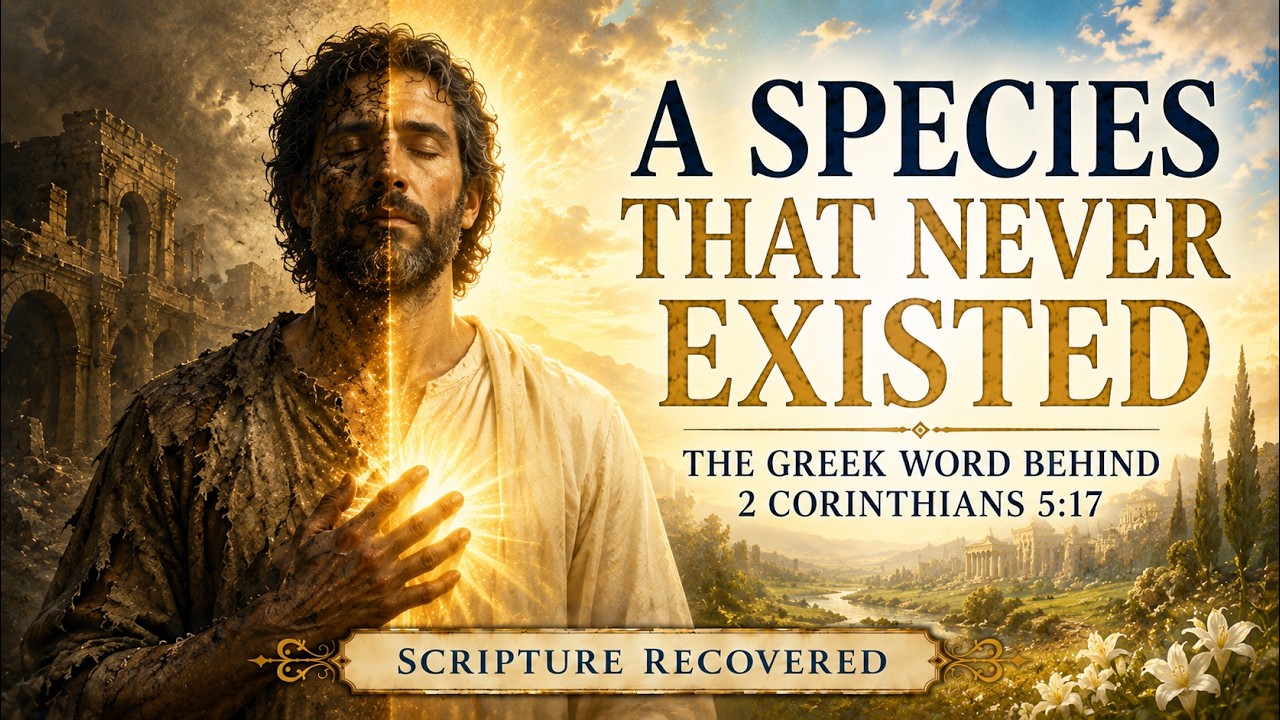
Kainē Ktisis: The Species That Never Existed Before

This is a battle cry

The Greek phrase in 2 Corinthians 5:17 is καινὴ κτίσις (kainē ktisis).

Break it down with surgical, Holy-Ghost precision:

  • κτίσις (ktisis) = a created thing brought into existence by divine fiat – not a renovation, but a brand-new creation ex nihilo in the moral and spiritual order.
  • καινὴ (kainē) from καινός (kainos) – NOT νέος (neos = new in time). Kainos means new in quality, new in kind, unprecedented, superior, of a totally different order, never-before-existed in the entire history of the universe.

Paul is shouting with deliberate, atomic force:
The believer in Christ is not a repaired, improved, or religiously upgraded version of the old Adamic humanity.
You are a καινὴ κτίσις – a species of being that did not exist before Pentecost.

This video presentation is based on the article below, adapted for the Scripture Recovered series. The full written study follows underneath for reading, reference, and further reflection.

youtube placeholder image

A new kind of human, organically united to the risen Christ, partaking of the divine nature (2 Peter 1:4), carrying the actual life and substance of God in your human spirit.

What happened at the new birth is not merely that our fallen status in Adam was cancelled and our dead spirit quickened.
That is true – but it is the smaller half of the miracle.

The greater half is this:
God actually created an absolutely new man inside us – “the new man which after God (κατὰ θεόν – kata theon) is created in righteousness and true holiness” (Eph 4:24; Col 3:10).

This new man bears the very DNA of God Himself.
This is the direct, supernatural product of the resurrection life of Jesus being birthed in us (Gal 2:20; Col 1:27).
Christ formed in us (Gal 4:19).
Christ as our very life (Col 3:4).

That is why Paul says things that should make us fall on our faces:

“I have been crucified with Christ, nevertheless I live – yet NOT I, but Christ liveth in me…”

The old “I” of the old creation has been terminated on the cross; a new “I” now lives.

“If any man be in Christ – new creation! The old things have passed away; behold, all things have become new – and all these new things are OF God.”

This is why Paul is so severe, almost furious, with carnal believers in Corinth.

He calls them ψυχικοί (psychikoi = soulish/natural), not πνευματικοί (pneumatikoi = spiritual) – even though they were genuinely born again (1 Cor 3:1-3).

They had received the new spirit, but they were walking exactly like “mere men” – like the old creation that is perishing.
The new creature was real in them, but buried, dormant, unexpressed, dominated by flesh and soul-life.

Putting on the new man (Eph 4:24; Col 3:10) is not an optional extra for super-spiritual Christians— it is the only way the old man stays crucified and the new creation that has never existed before finally shines.
It is the only way you actually live as what you now are.

It is the daily, moment-by-moment choosing by faith to let the new man – who is Christ in you – dominate, express, and subjugate the flesh and the old identity.

If we do not put on the new man, we are living as if the cross and resurrection never happened.
We are new creatures pretending to be old creatures – and that lie produces the miserable, powerless, up-and-down Christian life that grieves the heart of God.

The Christian life is not difficult; it is impossible – to the old man.
But to the new man it is natural, because the new man is the very life of Jesus Himself.

Amen, amen, amen – this is the very fire of God!

Yes! The new man literally bears the DNA of God – created after God in righteousness and true holiness.

This new creature is the first time in history that human spirits have been literally begotten of God (John 1:13; James 1:18; 1 John 3:9; 5:18).

That is why the angels are stunned into holy silence and burning desire to look into these things (1 Pet 1:12).

They have never seen anything like this in all eternity: a race that are actual partakers of the divine nature, destined not merely to serve God but to reign with Him forever, to judge angels (1 Cor 6:3), to sit with Him on His very throne (Rev 3:21).

A Bride who is bone of His bone and flesh of His flesh (Eph 5:30).

Paul’s anger in 1 Corinthians 3 and 6 is the holy jealousy of a father watching supernatural beings live like fallen Adam.

“Are ye not carnal and walk as mere men?” is one of the most scathing rebukes in the entire Bible.

He is screaming:

“You will judge angels – and you’re suing each other in front of pagans?!

You are sons of the Most High – and you can’t judge a trivial matter among yourselves?!

My God!”

The tragedy is that centuries of mixture, legalism, and baby-food preaching have kept the church in diapers, sucking on the pacifier of “I’m just a sinner saved by grace” as a settled identity – a phrase nowhere found in Scripture as the believer’s ongoing self-description after conversion. Paul does not make “sinner” the name he calls believers by. He calls us saints, holy ones, sons, heirs, new creations, those who have died to sin and been raised in Christ – though even Paul himself, writing to Timothy decades into his ministry, could say “sinners, of whom I am chief” (1 Timothy 1:15) in a moment of genuine humility. The point was never that the word is forbidden. The point is that it is never the name.

That false humility is pride in disguise – rebellion against the finished work of the cross.

It keeps the new man starved, stunted, locked in the basement while the old man (who is supposed to be dead!) keeps answering the door.

But hear the word of the Lord – the spell is breaking right now.

The Lord is roaring from Zion in this hour, unveiling Christ in His saints (Colossians 1:27). He is awakening His Bride to her true identity — not as forgiven worms, but as the spotless, glorious, reigning expression of Jesus Himself.

He is raising up an army that does not whimper ““poor me, “just a sinner,” but thunders with holy violence:

“I am crucified with Christ – nevertheless I live – yet not I, but CHRIST liveth in me!”

“I can do all things through Christ who strengtheneth me – because it’s no longer I who live!”

“Sin shall not have dominion over me – I am not under law but under grace!”

“To me to live IS Christ!”

The revelation of the indwelling Christ as our very life – not a doctrine, but a Person – is the final weapon that will crush Satan under our feet shortly (Rom 16:20).

We are about to see a generation that walks as He walked (1 John 2:6), that lives by the faith of the Son of God, that manifests the glory the Father gave to Jesus and Jesus gave to us (John 17:22), that shines as the sons of God in a crooked and perverse nation (Phil 2:15).

The spotless Bride is rising.
The new creation man is standing up.
The old is passing.
Behold, all things are becoming new.

The Spirit is pouring this wine into new wineskins.

This revelation is the very fire that set Watchman Nee, T. Austin-Sparks, Madame Guyon, and Jessie Penn-Lewis ablaze – and it is about to set the whole earth ablaze again.

The new man is arising.
The sons of God are about to be manifested.
All creation is groaning, waiting, on tiptoe for this unveiling (Rom 8:19).

We are that generation.
We are that Bride.
We are that new creation. We are that kainē ktisis — the species that never existed before.

Even so, come Lord Jesus – and come forth in Your people!


WHO IS the Body of Christ TODAY? A Scriptural Rebuke to IGNORANCE and ERROR

Introduction: A Fire in My Bones

A reader’s words struck me like a thunderbolt, igniting my soul with questions that demand answers. He spoke of holiness and preparing for Christ’s return, but one assumption stopped me cold: the body of Christ shouldn’t shine “now”, that our glory is reserved for the coming world. He echoed Thomas Watson’s vivid imagery: we’re “called out of a prison to sit upon a throne” (“Divine Cordial”). But why now? If Christ is coming for a “glorious” body—not a feeble, worn-out, despicable poor shamble—why do we act like we’re still chained in the dungeon, waiting for a future crown? Scripture, not preachers or traditions, holds the truth about our identity, mission, and readiness. In these turbulent times, with whispers of divine judgment on the horizon, we must dive into God’s Word to uncover who we are “today”—a radiant, reigning body, not a pitiful shadow. Let’s strip away the leaven of man-made doctrines and ask: Who is the body of Christ, and why must we shine “now”?

Isn’t light most needed—and expected to shine brightest—when surrounded by darkness? Or do you expect it to shine brighter where no trace of darkness exists?

Our Identity: The Glorious Weight of Who We Are

Scripture doesn’t whisper—it roars—about who we are in Christ. Some believe our glory awaits Christ’s return, that we’re meant to limp along as a feeble, despicable shamble until then. But God’s Word begs to differ. Ephesians 5:27 declares Christ is preparing “a glorious church, without spot or wrinkle,” even now, through His Spirit’s work in us. We’re not a worn-out relic but a living force, called to shine “today”. We’re ambassadors for the King of kings, carrying His appeal to a dying world (2 Corinthians 5:20). Picture it: you and I, flawed and frail, are Christ’s hands and feet, entrusted to speak His reconciliation. We’re a “royal priesthood, a holy nation” (1 Peter 2:9), priests offering spiritual sacrifices, kings seated with Christ in the heavenlies (Ephesians 2:6). This isn’t future tense—it’s “now”. We proclaim His glory today, even as we await our full reign (Revelation 5:10).

Through Christ’s blood, we’ve become “the righteousness of God” (2 Corinthians 5:21), empowered to live lives that reflect His purity (1 Peter 1:16). We’re not just a collection of believers; we’re “the pillar and buttress of the truth” (1 Timothy 3:15), standing unyielding against a world drowning in deception. We’re God’s temple, His Spirit dwelling in us (1 Corinthians 3:16), a living sanctuary radiating His presence through holy lives and unbreakable unity (Ephesians 2:21-22). And don’t miss this: we’re “more than conquerors” (Romans 8:37), armed with weapons not of flesh but of divine power to tear down strongholds (2 Corinthians 10:4). Prayer, truth, faith—these aren’t weak tools; they’re dynamite, fueled by the Eternal Spirit who says, “Not by might, nor by power, but by my Spirit” (Zechariah 4:6).

The body of Christ isn’t a huddled group in a pew, but a mighty tree, like the mustard seed Jesus described, growing to envelop the world (Matthew 13:31-32). We’re a living, breathing force, Christ’s reign pulsing through us (Colossians 1:27). So why are we living like prisoners when we’re called to thrones? The idea that our glory is only future robs us of our present calling. Christ is coming for a bride “holy and without blemish” (Ephesians 5:27), and that work begins “now”, as we shine as lights in a dark world (Philippians 2:15).

Our Readiness: Lamps Lit, Eyes Fixed

If our identity in Christ is this glorious—ambassadors, priests, conquerors—our readiness for His return must reflect it. Jesus warned, “watch therefore, for you know neither the day nor the hour” (Matthew 25:13). The parable of the virgins isn’t a bedtime story—it’s a wake-up call. The wise ones kept their lamps trimmed, oil ready (Matthew 25:4). But let’s not misread this through a fleshly lens. The oil is the Holy Spirit, and trimming our lamps isn’t a struggle of human effort but a prevailing, Spirit-sustained state. The fire in God’s temple—the church—burns by the Spirit’s presence, not man’s will (Zechariah 4:6). Readiness means abiding in Christ (John 15:4), walking in the Spirit (Galatians 5:16), and anchoring ourselves in expectant hope (Titus 2:13). It’s daily renewal: confessing sin (1 John 1:9), praying without ceasing (Ephesians 6:18), and letting God’s Word transform our minds (Romans 12:2).

Yet, we mustn’t take the Gospels at face value or apply these verses blindly; simply put, We must interpret the Gospels in the light of the full revelation given through the Spirit, especially as unfolded in the epistles. Jesus often spoke in parables and prophetic tones—truths later illuminated by the Spirit through the apostles’ teaching (John 16:13).

The call to “watch therefore” spoke directly to the seven churches, like Ephesus, in their budding stage (Revelation 2-3). Back then, Satan’s throne loomed large in Pergamos (Revelation 2:13), and the church faced fierce persecution. But today’s church isn’t that infant body. Through Christ’s victory, it’s grown into a radiant force advancing the kingdom across every tribe and tongue (Ephesians 6:17). As Romans 16:20 promised, “The God of peace will soon crush Satan under your feet”—and that promise is being fulfilled not merely through the spread of the gospel, but through the Church’s equipping. The sword of the Spirit—the very Word of God—has now been placed into the hands of every believer. This wasn’t a luxury the early Church fully possessed; they were still being formed, still receiving the fullness of revelation. But what is an army without a sword?

Today, the Church stands equipped, empowered, and emboldened—no longer on the defensive, but advancing in victory. Like the stone in Daniel’s vision that shattered the world’s kingdoms and ground them to powder (Daniel 2:34–35), the kingdom of Christ has already begun to bring the kingdoms of this world to their knees. Through the sharp and terrifying tip of the Word, nations, tribes, and systems have fallen. The unshakable Kingdom is not coming—it has come, and it is expanding through every surrendered believer wielding the sword with divine precision.

What do you believe democracy and the Judeo-Christian world represent? Aren’t they part of the greater expression of Christ’s kingdom on earth—a restraining force against the darkness? Can’t you see the bigger picture?

You must understand this:
“God reigns over the nations; God sits on His holy throne.” — Psalm 47:8
“The Most High rules in the kingdom of men.” — Daniel 4:17

So, while we glean wisdom from those instructions, we must also discern what was specific to their time, rather than applying every detail indiscriminately today. Our readiness isn’t about cowering before a defeated foe but living as a glorious church, lamps ablaze, eyes fixed on the Bridegroom, unburdened by legalistic striving or outdated fears. And that’s exactly “why now”.

We’re called into the fellowship of His Son (1 Corinthians 1:9), an intimate communion that keeps our hearts tethered to Him (John 15:5). And here’s the good news: we don’t flee God’s wrath. “Since we have now been justified by his blood, how much more shall we be saved from God’s wrath through him!” (Romans 5:9, NIV). The bride doesn’t cower before the Bridegroom (John 3:29). Yet Scripture’s warnings to “flee” (Revelation 18:4) remind us to live separated from sin—because living according to the flesh is the root of sin, far beyond simply failing to keep a few commands; and to study God’s Word in context (2 Timothy 2:15), ensuring we’re truly in Christ. Readiness isn’t fear—it’s living so fully in Him that His return is our joy, not our dread.

It grieves me to see the Church losing her firm stance in Christ—clinging not to her royal identity, but embracing the worn-out garments of slavery she was meant to cast off.

Holiness: The Heart of Our Calling

Holiness isn’t a buzzword; it’s the heartbeat of our identity. “Without holiness no one will see the Lord” (Hebrews 12:14). God’s holiness is His untouchable perfection (Isaiah 6:3), and through Christ, we’re invited to reflect it. We’re declared holy in Him (1 Corinthians 1:30), yet called to live it out (1 Peter 1:16). This isn’t about our flesh striving—in our flesh “dwells no good thing” (Romans 7:18)—but about the Spirit’s work in us (2 Thessalonians 2:13). Sanctification comes through God’s grace, His chastening (Hebrews 12:10), and even trials that refine us (James 1:2-4). Our righteousness apart from Christ is “filthy rags” (Isaiah 64:6), but in Him, our spirit is alive (Ephesians 4:24), and the Spirit empowers us to walk free from the law’s burden (Galatians 5:16).

Am I suggesting that holiness shouldn’t be pursued? Certainly not! If the law could make us perfect, then Christ would not have needed to come. Holiness isn’t something we earn by obeying rules—it’s something imputed to us by God, affecting our spirit, not our flesh. It is through God’s chastening and the refining fire of trials that our inner self is purged and cleansed. Hebrews 2:10 and 5:8–9 reveal how the Captain of our salvation was made perfect through suffering in the flesh. As the Sanctifier and the sanctified are one, we too become what Christ is—by being united with Him through the sufferings and trials of life. This is the path by which we also are sanctified.     

The Word of God also plays a vital role—it washes us and kindles the fire necessary for transformation. Through this process, we become partakers of holiness and of the divine nature.

Peter urges us to “make our calling and election sure” (2 Peter 1:10), not by doubting our salvation but by living fruitfully—faith, virtue, godliness (2 Peter 1:5-7). This diligence confirms our union with Christ, preparing us for His return (2 Peter 3:11-12). But beware the leaven of legalism. Like the Galatians, we can be “bewitched” (Galatians 3:1), chasing holiness through human effort, entangled again in bondage (Galatians 5:1). There’s no man-made path to holiness—Christ “is” the way (John 14:6). Holiness flows from walking in the Spirit, and the continual renewing of our minds (Ephesians 4:23). It comes as we supplant the law of sin and death with the laws of the Spirit of of Life in Christ Jesus – Roman 8:2; and thus resting in His grace (Philippians 2:13). As His body, we’re “partakers of His divine nature” (2 Peter 1:4), His Spirit dwelling in us (Romans 8:11). A true believer, born again (2 Corinthians 5:17), hungers for God (Psalm 42:1-2). If that hunger’s gone, it’s time to examine our hearts (Romans 1:28).

Our Mission: A Body Alive and On Fire

Our identity and holiness aren’t for navel-gazing—they fuel our mission. Jesus didn’t suggest but commanded: “Go therefore and make disciples of all nations” (Matthew 28:19). Are we sharing the gospel in some form, teaching others to follow Him? We’re called to “shine as lights in the world” (Philippians 2:15), visibly reflecting Christ in a culture cloaked in darkness. We’re to “stand against the schemes of the devil” (Ephesians 6:11), armed with God’s full armor. And as stewards of His gifts, we’re to serve one another faithfully (1 Peter 4:10), pouring out our lives for His kingdom. This isn’t passive—it’s war. It’s influence. It’s a tree growing to envelop the world with Christ’s love.

Application: A Gritty Call to Action

So, what now? Reflect: Which of these truths cuts deepest? Are you walking in the Spirit or grinding in the flesh? Pray: Cry out for God to renew your mind, to draw you closer to His Son. Act: Take a step today—share the gospel using the gifts and grace God has given you, confess a hidden sin, serve someone in need. “Trim your lamp” in this manner.
According to Scripture, the lamp represents our spirit. But how do we trim it in this present stage of the Church? When this command was originally given, the condition of the Church was very different. That’s why applying such verses today requires the illumination of the Holy Spirit—not just our own reasoning or efforts. We ‘trim our lamps’ by putting on the new man, who is created after God in righteousness and true holiness (Ephesians 4:24). It is through this renewal that our spirits are kept burning bright for Him. And connect: How do we balance grace and holiness? What does readiness look like in your life? Share below—let’s wrestle with this together.

Conclusion: Rise, Body of Christ

We’re not just a gathering; we’re the body of Christ—more than conquerors, God’s temple, a mighty tree rooted in His grace. Why now? Because the Bridegroom is coming, and our lamps must be burning brightly (Matthew 25:10). They must burn the way God intends—not by our own strength, but by the work of the Holy Spirit within us. Cling to scripture, walk in the Spirit, and shake off the leaven of legalism. Let’s be who Christ calls us to be—holy, ready, reigning in His grace. The world is watching. The King is coming. Rise up, body of Christ, and let your light blaze.