Testimony, Not Life: What Romans 2:14–15 Does and Does Not Say About the Gentile Conscience

This is a supporting study to “The Gospel Before the Wrath” and “Dead, Not Innocent” — Gospel opens the series by tracing what Paul himself establishes about the gospel in Romans 1:1–17, before he ever diagnoses the unbeliever, and Dead, Not Innocent rests, in part, on the claim that the Gentile conscience bears witness against the unbeliever without ever reconciling him to God. This study takes up the single hardest verse raised against that claim and works through what Romans 2:14–15 will and will not bear.

There is a verse that tempts good readers toward two opposite errors, and both errors feel, in the moment, like they are honoring the text more carefully than the passage’s own argument does.

The first error attributes genuine law-keeping, or spiritually acceptable righteousness, to fallen Gentiles through the power of their natural condition — as though the unregenerate mind, in its own strength, produces something pleasing to God. This attributes to fallen nature a spiritually acceptable righteousness that Paul’s wider teaching will not permit, and it collides directly with Paul’s own verdict a chapter later — “there is none righteous, no, not one” (Romans 3:10) — and with his verdict on the natural mind in Romans 8:7, which “is not subject to the law of God, neither indeed can be.”

The second error, reaching for the opposite correction, says: this must describe regenerate Gentiles — believers in Christ, indwelt by the Spirit, whose transformed hearts now keep, by grace, what the Mosaic law required. This reading has real exegetical instincts behind it, and deserves to be taken seriously rather than dismissed. But when it is tested against Paul’s own vocabulary and the argument’s own shape, it does not hold — and seeing why it does not hold is what actually clarifies what Romans 2:14–15 is doing.

The text in question

“For when the Gentiles, which have not the law, do by nature the things contained in the law, these, having not the law, are a law unto themselves: which shew the work of the law written in their hearts, their conscience also bearing witness, and their thoughts the mean while accusing or else excusing one another” (Romans 2:14–15).

Every word here has been pressed hard by careful readers. Three questions carry the real weight: what does “by nature” modify? What does “the work of the law” mean, and how does it differ from “works of the law”? And what does “written in their hearts” borrow from — general moral witness, or Jeremiah’s new covenant?

Does “by nature” belong to the Gentiles, or to what they do?

The Greek reads: ethnē ta mē nomon echonta physei ta tou nomou poiōsin — “Gentiles, not having the law, by nature do the things of the law.” Koine word order permits physei to be read two ways, since the earliest manuscripts carried no punctuation to settle it: either “Gentiles who by nature do not have the law” (making physei describe their Gentile birth and covenantal position, parallel to Galatians 2:15’s “we who are Jews by nature”) — or “Gentiles do, by nature, the things of the law” (making physei describe how they do it — natively, instinctively, without Torah).

This ambiguity is real, not manufactured, and it deserves to be named as genuinely open rather than waved past. It should also be said precisely: in Romans 2:14, physei stands within the main verbal clause — between the participial phrase and the verb poiōsin, with the object ta tou nomou sitting between them — rather than immediately beside ethnē the way Galatians 2:15 places physei directly beside Ioudaioi. The most natural reading, on that comparison, takes physei as qualifying their doing rather than their birth-condition, though the alternative attachment remains grammatically possible and should not be dismissed by appeal to word-adjacency alone.

One more piece of evidence must be handled carefully. Thirteen verses later, Romans 2:27 speaks of “the uncircumcision which is by nature,” where physei plainly describes an inherited condition. That confirms Paul can use the word this way in this very argument, and it therefore keeps the alternative reading of verse 14 genuinely open. It does not settle what physei modifies in verse 14. The word’s position there still leans toward “do by nature,” but Romans 2:27 prevents that preference from being treated as certain.

“The work of the law” is not “works of the law” — and the distinction should be stated carefully

Paul is a careful writer, and he is capable of precision most readers move past too quickly. When he wants to describe deeds required by the Mosaic law — especially when those deeds are treated as the ground of justification, boasting, or covenant standing — he uses the plural: erga nomou, “works of the law.” “By the works of the law shall no flesh be justified” (Romans 3:20). Circumcision, food laws, and sacred days are important manifestations of that controversy in Paul’s letters, but the phrase is not limited to boundary markers alone; it names the whole body of commanded acts wherever they are set up as the basis of standing before God.

Romans 2:15 does not use that phrase. It uses to ergon tou nomou — singular. This is a real and easily overlooked distinction, and naming it sharpens the passage considerably. But the singular should not be pressed toward a single confident meaning. To ergon tou nomou is singular and collective, and it may refer to the law’s moral requirement or substance — what the law demands — rather than narrowly to an effect the law produces upon a person, such as exposure or accountability alone. The Gentiles are not merely shown to have had something done to them by the law’s exposing action; their conduct shows that the law’s moral requirement is in some way known internally, even without the Mosaic law as revealed covenantal legislation being possessed.

Either way, the singular construction is doing more cautious work than the plural would. Paul later uses explicit vocabulary for the law’s righteous requirement being fulfilled in those who walk according to the Spirit — “that the righteousness of the law might be fulfilled in us, who walk not after the flesh, but after the Spirit” (Romans 8:4) — but that statement comes six chapters later, addressed to believers, in an entirely different argument. He does not use that fuller vocabulary here. The narrower, singular phrase in 2:15 is describing something short of Spirit-wrought fulfillment.

“Written in their hearts” echoes Jeremiah — but only partially, and the difference matters

Jeremiah’s new covenant promise is unmistakable: “I will put my law in their inward parts, and write it in their hearts” (Jeremiah 31:33). Romans 2:15 uses language strikingly similar to that promise: law, writing, and the heart all appear together. Whether Paul intends a direct allusion to Jeremiah or is simply drawing on the same shared biblical vocabulary of inward inscription, the resemblance is real enough that the two passages must be compared. But resemblance in wording does not establish identity of meaning.

But look closely at what is written. Jeremiah says God will write my law — the covenantal will of God itself — within the renewed heart. That covenantal will is not, on its own, the source of life; Paul is elsewhere emphatic that “if there had been a law given which could have given life, verily righteousness should have been by the law” (Galatians 3:21) — implying it was not. In the new covenant, life comes through God’s regenerating action and the gift of the Spirit, with the law internalized as part of that larger work, not as its cause. Romans 2:15 says what is written in the Gentile heart is the work of the law — its moral requirement or substance — with conscience bearing witness to that inward moral knowledge, and thoughts accusing or defending on its basis. That is Paul’s actual sequence: the law’s work written in the heart, conscience co-witnessing to it, thoughts rendering verdicts upon it. What is inscribed is not the law itself in the fuller, covenantal, Spirit-accompanied sense Jeremiah describes — the echo of his language is real, but the content of what is written is not the same. Romans 2:15 describes moral knowledge present in the heart. Jeremiah 31 describes God renewing the heart covenantally. The first explains why the Gentile can be judged; the second explains how a sinner is renewed.

The cumulative evidence therefore indicates that Paul is not invoking the new-covenant promise of Jeremiah 31 as the reality already possessed by these Gentiles. He is explaining the inward moral testimony that leaves those without Torah accountable before God’s judgment. Paul may be echoing the language of the greater promise while describing something categorically short of it — much as Romans 1:20 speaks of true knowledge of God through creation while insisting that such knowledge, when suppressed, leaves a man without excuse rather than in fellowship.

The judicial frame identifies the Gentiles in view

Set the philology aside for a moment and look at where this passage sits. Verse 12 opens the unit: “as many as have sinned without law shall also perish without law.” Verse 16 closes it: “in the day when God shall judge the secrets of men by Jesus Christ.” Between those two verses sits a courtroom — sin, law, and a coming day of judgment, with conscience “accusing or else excusing one another” functioning as testimony inside that courtroom. This entire unit is building toward Romans 3:9’s verdict, that both Jews and Greeks are “all under sin,” and Romans 3:19’s “that every mouth may be stopped, and all the world may become guilty before God.”

It should be said carefully what this argument does and does not require. A believer’s conscience can certainly accuse him; Scripture nowhere teaches that justification eliminates internal moral accusation or conviction. The point is not that regenerate men never feel accused. The point is contextual: the accusing and defending thoughts here are introduced as witnesses inside a judicial argument explaining how those without Torah remain answerable at the final judgment. Nothing in the unit identifies these particular Gentiles as justified or in Christ — and a regenerate-Gentile reading, whatever its other merits, weakens the specific force of this passage, because Paul’s immediate question in 2:12–16 is how Gentiles without Torah can justly be judged at all.

It is also worth clarifying what “excusing” does not mean. Conscience, on this reading, functions as a tribunal issuing judgments both unfavorable and favorable — accusing on one count, defending on another — without thereby declaring the whole person righteous before God. A conscience that excuses a particular act is not the same thing as a conscience, or a person, acquitted. Otherwise the passage seems to ask why a purely condemning function would ever excuse anything; the answer is that conscience judges particular acts, not the state of the whole man before God.

Two kinds of inward testimony

Romans 2:14–15 has now established the exegetical distinction at the center of this study — moral testimony without spiritual life. What follows draws out its theological significance from elsewhere in Scripture, without displacing Romans 2 as the passage that governs the argument.

Romans 1 and Romans 2:14–15, read together, are not describing two different doctrines. They are describing one doctrine — general revelation, sufficient to condemn, insufficient to save — operating through two related channels. Romans 1 emphasizes the Creator’s witness through what has been made and what is manifest among fallen humanity (1:19–20); Romans 2 emphasizes the accompanying inward witness of conscience. The distinction between an external and an internal register is useful, but it should not be treated as a rigid partition — Romans 1 already includes an inward element (“that which may be known of God is manifest in them,” 1:19), and Romans 2 does not exclude the external testimony of creation that grounds it.

This is worth naming as a distinction in its own right, because it clarifies exactly what Ephesians and Romans 2 are and are not claiming about the fallen mind. Ephesians 2:1 calls the unbeliever dead — but the same passage immediately describes that dead man as one who still walks, still desires, still thinks, still follows, still acts (2:2–3). Deadness in Paul’s vocabulary means separation from God’s life, not the cessation of every function. A dead man can still carry a conscience that testifies against him, exactly as a dead man can still walk in the course of this world. Conscience is therefore not evidence of regeneration. It is part of the very witness that makes suppression, and eventual judgment, just.

For clarity, we may call these two different forms of inward testimony by name, since Scripture does not label them but the distinction is easy to blur and important to keep clear:

Creational testimony — the moral knowledge present within fallen humanity as creatures who remain accountable to their Creator, testifying against fallen man rather than for him. This is what Romans 1 describes through what is made and manifest, and what Romans 2:14–15 describes through the accompanying witness of conscience. It supplies testimony. It does not supply life.

New-covenant inscription — the inward writing of God’s will within the renewed heart, belonging to the regenerating work of the Spirit promised in Jeremiah 31 and Ezekiel 36, by which God’s people are given new hearts, know Him, and are enabled to walk in His ways. Romans 2:28–29 belongs to this new-covenant reality — “he is a Jew, which is one inwardly… circumcision is that of the heart, in the spirit” — deliberately shifting Paul’s vocabulary from outward possession and letter to inward renewal and Spirit. It supplies life, inward renewal, and covenant obedience.

The first testifies. The second transforms. Confusing them either flatters fallen man with a capacity Scripture denies him, or robs Paul’s actual argument — a courtroom case for universal guilt, closing in on grace as the only remedy — of one of the central conscience-based witnesses by which it makes its case.

Why the distinction matters beyond the exegesis

This is not merely a technical dispute for the study, and the two rejected readings carry two different dangers, not the same one.

A minister who reads these verses as regenerate Gentiles may obscure Paul’s immediate courtroom argument and lose an important text concerning the accountability of those without Torah — importing new-covenant transformation into a passage whose immediate function is to establish guilt, not describe grace. That is an exegetical misstep, not a denial of total depravity; it attributes the Gentiles’ conduct to grace and the Spirit rather than to fallen ability, which is the right instinct pointed at the wrong verse.

A minister who treats the passage as proof that fallen people produce spiritually acceptable righteousness through natural ability creates the opposite and more serious error. He collides with Paul’s teaching on sin, the flesh, and inability the very next time he preaches Romans 3 or Romans 8 — having already taught his people that natural men can, in some measure, please God apart from Christ.

The precise reading avoids both errors. It leaves the unbeliever fully guilty: his conscience testifies, and his thoughts stand ready to accuse him. It also leaves him fully incapable: nothing in that testimony amounts to saving righteousness, and occasional outward correspondence to a command does not constitute submission to God’s law as a whole. That last clause is worth holding onto directly against Romans 8:7 and Romans 3:10: doing “the things of the law” in particular, occasional instances is not the same claim as being subject to the law, or fulfilling it, in the comprehensive sense Paul denies the natural mind can ever reach. That is the same tension “Dead, Not Innocent” traced through Romans 1: guilt, inherited corruption, and consequent inability must be held together. His inability does not excuse his guilt, and his guilt does not imply that he retains the power to heal his fallen nature. Together they show why rescue must be an act of sovereign grace, and not an achievement he has partly managed on his own.

Romans 2 distinguishes moral testimony from spiritual capacity. The unregenerate Gentile possesses sufficient moral and creational testimony to be accountable, but he does not possess the life by which God is known, loved, and obeyed. Creational testimony testifies and leaves him accountable. New-covenant inscription transforms and brings him into life.
Dead, Not Innocent: What Romans One Actually Says About the Man Without God

The wrath of God is revealed from heaven against all ungodliness and unrighteousness of men (Romans 1:18). A study of what Paul actually claims about the man without God in the world — guilty for suppressed light, incapable by inherited death, and already abiding under wrath rather than merely threatened by it.

This study picks up where “The Gospel Before the Wrath” leaves off — that piece establishes what Paul says about the gospel itself in Romans 1:1–17, before he ever turns to diagnose the unbeliever. This is a companion study as well to “Without God in the World” — that piece traces how the apostles addressed the gospel differently depending on the hearer standing before them; this one establishes what Romans 1 says is actually true of that hearer before a word is spoken to him.

There is a way of speaking about the unbeliever that has become common in evangelistic circles, and it is wrong in two directions at once. It treats him as an innocent who simply hasn’t heard — as though the gospel is news arriving to a blank slate. And it treats his darkness as a private, gradual decline — a man dimming his own light over the course of a lifetime, as though given a longer life or a gentler upbringing he might have turned out otherwise. Romans 1 will permit neither error. The man without God in the world is not innocent. And the darkness that now defines him was never his biography to begin with. Untangling these two claims — real guilt, and real incapacity, resting on a fall that is corporate rather than personal — is where any faithful ministry to the unbeliever has to begin.

He is not ignorant. He is guilty.

Romans 1:18 opens not with mercy but with wrath: “the wrath of God is revealed from heaven against all ungodliness and unrighteousness of men, who hold the truth in unrighteousness.” The very next verse tells you why the wrath is just — “because that which may be known of God is manifest in them; for God hath shewed it unto them” (1:19). Verse 20 goes further: His eternal power and Godhead are “clearly seen, being understood by the things that are made, so that they are without excuse.”

This is the first thing that must not be softened when the unbeliever’s condition is described. He is not an innocent who simply hasn’t heard. He has already received a testimony — creation itself — sufficient to leave him without excuse. Whatever else is true of his condition, ignorance is not his defense. Paul will not permit it as one.

The knowledge was suppressed, not absent.

Verse 21 tells you what he did with what he had: “because that, when they knew God, they glorified him not as God, neither were thankful; but became vain in their imaginations, and their foolish heart was darkened.” This is not a man groping toward God and falling short. This is a man who had light and turned from it — deliberately, culpably. What follows in verses 22–32 — the exchange of God’s glory for images, the exchange of truth for a lie, the downward cascade into degrading passions and a reprobate mind — all of it is described as God’s judicial response to that suppression: “God also gave them up” (1:24, 26, 28), three times. The darkness he now stands in is not a starting condition. It is a sentence already being executed.

One caution here, because it is easy to mistake this passage for something it is not. “Their foolish heart was darkened” is not a description of an individual life — not a man born with some capacity for light who dims it gradually through his own choices as he matures. The language is representative and historical, not biographical. “Professing themselves to be wise, they became fools, and changed the glory of the uncorruptible God into an image made like to corruptible man” (1:22–23) gathers up the larger biblical pattern of human revolt. The exchange of glory for an image finds its closest verbal echo not in Genesis 3 itself but in Israel’s own history of idolatry, described in almost identical terms — “they changed their glory into the similitude of an ox that eateth grass” (Psalm 106:20), and “my people have changed their glory for that which doth not profit” (Jeremiah 2:11). Paul is tracing a pattern that runs from Adam’s original revolt, through the nations’ idolatry, into Israel’s own repeated failure — the same kind of corporate statement as “by one man sin entered into the world” (Romans 5:12). It is not the biography of any particular man ministered to today. He was not born innocent and did not personally re-enact this decline from some starting point of light. He was born already dark, already condemned, already an heir of the very exchange this passage narrates — “in sin did my mother conceive me” (Psalm 51:5), “by nature the children of wrath” (Ephesians 2:3). Romans 1:21–23 tells how the race came to be in this state. Total depravity tells what every individual already inherits from it the moment he is born. The unbeliever is not partway down a slope he is personally descending — he is already standing at the bottom of a fall that occurred in Adam and was re-enacted by the nations, and he arrived there by inheritance, not by gradual erosion within his own lifetime.

None of this makes him a passive inheritor only. He did not create the fallen condition into which he was born, but neither does he stand inside it innocently. Born into Adam’s darkness, he personally repeats the race’s refusal every time he withholds from God the honor and thanksgiving creation’s testimony still requires of him. The inherited condition explains why he does not come to God on his own. It does not excuse the suppression he continues to enact himself.

And yet he cannot see rightly, or move Godward, on his own.

Here the chapter must be read alongside the rest of Paul’s diagnosis, or the man in front of you will be misjudged in the other direction. Ephesians 2:1 calls him dead in trespasses and sins. Ephesians 4:18 says his understanding is darkened, his heart hardened. Titus 1:15 says his mind and conscience are defiled. Scripture elsewhere shows that a conscience can be seared past feeling through continued, willful rebellion — 1 Timothy 4:2 describes false teachers whose consciences have reached exactly this state, cauterized by long practice until they barely register what they once felt keenly. The general unbeliever’s conscience need not have gone that far to still be defiled and unreliable rather than trustworthy.

Both of these must be held without collapsing either one into the other. His conscience still bears some witness — Romans 2:15 says Gentile conscience “bears witness,” accusing or excusing, sufficient again to condemn — but that witness is not the same as spiritual life, and it cannot reconcile him to God any more than a smoke detector can put out the fire it warns of. He is dead Godward: unable to do what would please God (Romans 8:7–8), unable to receive spiritual truth as spiritual truth because the very faculties by which he hears and reasons are themselves darkened, and require the Spirit’s renewing work before they can discern what is spiritually discerned (1 Corinthians 2:14). His guilt, his inherited corruption, and his consequent inability must all be held together. His inability does not excuse his rebellion, and his guilt does not mean he retains the power to heal the nature from which that rebellion proceeds. Together they are exactly what makes his rescue an act of sovereign grace rather than an achievement he simply hasn’t gotten around to.

This is a different condition than Israel’s, and it changes how he must be addressed.

Everything above describes the man who is, as Paul puts it elsewhere, “without Christ… having no hope, and without God in the world” (Ephesians 2:12) — atheoi: without God. The rest of that verse — no covenant, no commonwealth, no promise — belongs to the wider description Paul gives in that sentence, not to the word atheoi itself; but taken together, the verse leaves this man with nothing of Israel’s covenant standing to his name. This is not the condition of a Jew who had the law, knew the covenant, and turned from it. That man’s category is different: Israel can be summoned back — shuv, to turn back or return — because there was a Mosaic covenant already given to Israel, and already broken by Israel. That is why Peter can say to Israel, without preamble, “this Jesus, whom ye have crucified” (Acts 2:36) — the charge presumes a covenant relationship Israel already had and violated.

The Gentile has no Mosaic covenant to which he can be summoned back. That does not mean he stands in no relationship to God at all — the first section of this study has already shown that he does, through creation, and that he has violated it. What he lacks is not a relationship but a covenant: he has never possessed the commonwealth, the promises, or the law entrusted to Israel. He must therefore be introduced to the God he has refused to honor, and brought, through the gospel, into a covenant fellowship he has never before possessed. That is why Paul, before Gentile hearers, does not open with an accusation of covenant-breaking the way Peter does with Israel — he opens by establishing who God even is (Acts 17:24–29) before he ever calls for repentance. Both men are guilty. Neither is innocent. But one is a covenant-breaker being summoned back to a covenant he broke, and the other is a covenant-stranger being brought near for the first time — and collapsing that difference, treating the Gentile as though he merely needs to turn back to a covenant he never held, will produce confusion in him, not conviction.

The wrath in view is present, not only future.

Notice the tense in verse 18: the wrath “is revealed” — present, ongoing, already operating through the very handing-over described in the verses that follow. This is not only a warning of a coming day, though that day is certainly in view elsewhere in Paul. It is a description of a condition already abiding on the unbeliever now — he does not merely risk wrath, he currently abides under it, exactly as John says: “he that believeth not the Son shall not see life; but the wrath of God abideth on him” (John 3:36). This is why the gospel cannot be offered to him as an improvement or an addition to a life otherwise neutral. He is not neutral. He is under a sentence already in force, and what he needs is not encouragement but rescue.

What alone can give him life.

None of this — creation’s testimony, his suppression of it, his deadness, the wrath already abiding — is reversed by anything said to him directly. Paul has already given the remedy, in the verse that stands just before all of this: “I am not ashamed of the gospel of Christ: for it is the power of God unto salvation to every one that believeth” (Romans 1:16). The gospel is not merely information added to a man who lacks data. It is power brought to a man who is dead. The same Spirit who opened Lydia’s heart to attend to what Paul spoke (Acts 16:14), who fell on the Gentiles at Cornelius’s house before any of them had done a single thing to secure it, is the only one who crosses the distance Romans 1 describes. The task of the one who preaches is to proclaim the whole of what Paul proclaims here — the true God, the suppressed knowledge, the abiding wrath, the crucified and risen Christ who alone answers it — and to leave the piercing of the heart to the one who alone can pierce it.

In short: the man without God in the world is not an innocent bystander waiting for good news he has never heard. He is a suppressor of light already given, judged in that suppression by being given over to it, dead in his capacity to reverse it by inheritance from a fall that is corporate and historical rather than personal and gradual, and under a wrath already abiding rather than merely threatened. He cannot be summoned back to a covenant he never held — he can only be brought, for the first time, into the covenant fellowship he has never possessed, face to face with the very God whose testimony in creation he has spent his life suppressing — and only the Spirit, not the preacher’s skill, will make him see it.

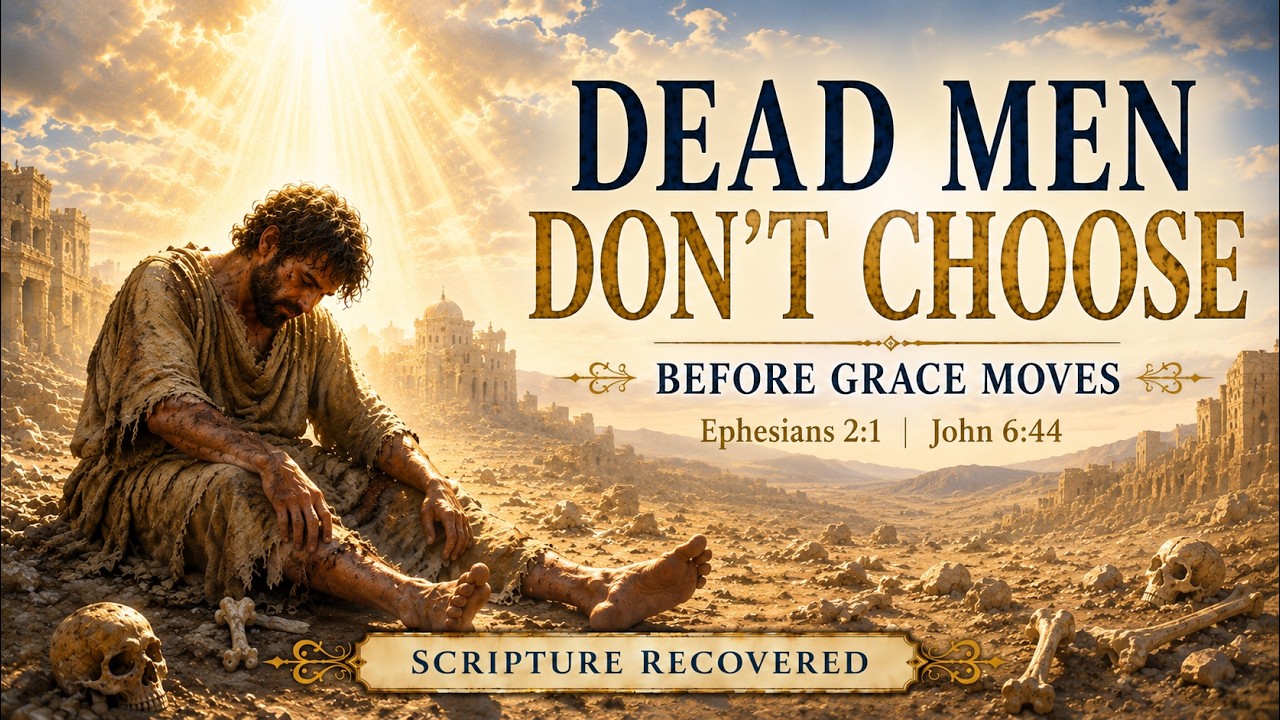
Dead Men Don’t Choose: The Undeniable Truth of God’s Grace

I’ve had it. Lately, I stumbled into a discussion tearing into Calvinism—its theology, its doctrines—and I’m not even a card-carrying Calvinist. I haven’t read his books, haven’t signed up for his club. I just try to follow the Scriptures and the Spirit of God. But what I saw incensed me: ignorance and sheer gall coming against the established Word, picking at gospel verses without context, tossing out the epistles like trash. It’s a butchery of truth, and I can’t shake it off. This battle’s raged for centuries—God’s sovereignty versus human free will—and it’s time to lay it down with the absolute, sledgehammer truth of Scripture. No more dancing around it.

This video presentation is based on the article below, adapted for the Scripture Recovered series. The full written study follows underneath for reading, reference, and further reflection.

youtube placeholder image

Here’s the question: If we reject the points Calvinism leans on—total depravity, unconditional election, irresistible grace, all of it—what do we undo from the Word of God? Not just a system, but the Bible itself. I’m not here to defend a man-made label; I’m here to let God’s Word speak. And it’s screaming: we’re dead without Him, saved by Him, and He provides it all. Let’s hammer this home.

The Deadness: "Nekros" and Dry Bones

Start here: we’re dead. Not wounded, not limping—”nekros”. Ephesians 2:1—“You were “nekros” in your trespasses and sins.” That’s Greek for corpse. No pulse, no breath, no life. Romans 3:10-12 piles on: “None righteous, no one understands, no one seeks God. All have turned away.” Not some—”all”. Colossians 2:13—“You were “nekros” in your sins.” Dead men don’t choose. They don’t seek. They rot.

Ezekiel saw it too. Chapter 37: a valley of dry bones, scattered, hopeless. God asks, “Can these bones live?” Ezekiel doesn’t play hero—“Lord, you alone know.” Humanly? No chance. Dead bones don’t wiggle. But God says, “Prophesy,” and the Spirit’s breath—”ruach”—sweeps in. Bones rattle, flesh forms, and they stand—a vast army. Who did that? Not the bones. God. Ezekiel 37:14—“I will put my Spirit in you, and you will live.” Dead means “nekros”. No life ‘til God moves.

John 6:44 seals it: “No one can come to me unless the Father who sent me draws them.” “Can”—ability. Without the Father’s pull, we’re stuck. Romans 8:7—“The mind of the flesh is hostile to God; it does not submit, nor can it.” Hostile. Incapable. “Nekros”. If you think a corpse picks itself up, you’re not reading the Bible—you’re writing fiction.

The Process: God Provides All

Salvation’s not steps we take—it’s God’s work breaking us alive. He’s not waiting for us to climb a ladder; He’s emptying our grave. Listen:

– He’s the Seed Supplier: 1 Peter 1:23—“Born again, not of perishable seed, but of imperishable, through the word of God.” Matthew 13:37—“The one who sows the good seed is the Son of Man.” Christ plants life in “nekros” soil. We don’t sprout ourselves—He sows.  

– He’s the Knocker: Revelation 3:20—“I stand at the door and knock.” Jesus isn’t begging us to knock first—He’s pursuing. Dead men don’t knock back; “nekros” hearts don’t answer—He’s the hunter breaking in. Luke 19:10—“The Son of Man came to seek and save the lost.” He seeks; we’re lost.

– He’s the Convictor: John 16:8—“The Spirit will convict the world of sin.” Acts 2:37—Pentecost’s crowd, “cut to the heart,” didn’t self-diagnose. The Spirit stabbed them awake. Dead hearts don’t feel ‘til He strikes.

– He Gives His Spirit: Ezekiel 37:14—“I will put my Spirit in you.” John 3:5—“Born of the Spirit.” Titus 3:5—“Saved by the renewal of the Holy Spirit.” No Spirit, no life. He breathes; we don’t.

– He Provides the Lamb: John 1:29—“The Lamb of God, who takes away the sin of the world.” Romans 3:25—“God put [Him] forward as a propitiation by his blood.” We didn’t slay the Paschal Lamb—God did. Hebrews 9:12—“With his own blood, he secured eternal redemption.” All Him. For if, when we were enemies, we were reconciled to God by the death of his Son, much more, being reconciled, we shall be saved by his life. Romans 5:10

These aren’t steps to be redeemed—check off faith, grab grace, earn the cross. That’s works, and Ephesians 2:9 says, “Not a result of works, so that no one may boast.” It’s His process, His redemption, His hammer smashing our “nekros” chains. Acts 13:48—“As many as were ordained to eternal life believed.” Ordained, then believed—not the other way around. Romans 2:4—“God’s kindness leads you to repentance.” He leads; we follow. He provides all, or it’s not salvation—it’s self-help.

The Gift: No Paychecks Here

If God does it all, it’s a gift. Ephesians 2:8—“By grace you have been saved through faith… it is the gift of God.” Faith too—not your grit, His grant. Philippians 1:29—“It has been granted to you to believe.” Granted, not grabbed; to them that have obtained like precious faith with us through the righteousness of God and our Saviour Jesus Christ—2 Peter 1:1. Hebrews 12:2—“Jesus, the AUTHOR and perfecter of our faith.” He writes it, not us.

If we choose God without His seed, knock, conviction, Spirit, and Lamb, that ain’t a gift—it’s a paycheck. “I chose wisely; pay me salvation.” Romans 3:27—“Where is boasting? Excluded.” Why? A “nekros” soul doesn’t choose—it’s chosen. John 15:16—“You did not choose me, but I chose you.” 1 John 4:19—“We love because he first loved us.” First. Always Him first. If we kickstart it, why the cross? Galatians 2:21—“If righteousness were through [us], Christ died for nothing.” Dead men don’t earn gifts—they receive them.

The Folly of Free Will Chasing

Some scream, “But free will!” Sure, we respond—”after” He moves. Acts 2:37—“What shall we do?”—comes after the Spirit cuts. John 1:13—“Born not of human decision, but of God.” Charles Spurgeon saw it clear: “Free will carried many a soul to hell, but never a soul to heaven. Anyone who believes that man’s will is entirely free and that he can be saved by it does not believe the fall.” He’s right. Romans 3:23—“All have sinned and fall short.” Free will without grace is freedom to rot, not rise. Romans 8:7—“The flesh “cannot” please God.” Cannot. “Nekros”.

2 Corinthians 4:6—“God… has shone in our hearts to give the light of the knowledge of the glory of God in the face of Jesus Christ.” We didn’t flip the switch—He did. Dead hearts don’t chase light; light chases them. Spurgeon’s not guessing—he’s echoing Scripture: a “nekros” will, unbound by grace, runs to ruin, not redemption.

Lay It Down

This war’s dragged on too long—centuries of dodging the obvious. Scripture’s clear: we’re “nekros” without God, revived by His Spirit, saved by His Lamb. He’s the seed, the knock, the conviction, the breath, the blood. Spurgeon’s words ring true—free will without grace is a one-way ticket down, never up. Reject that, and you’re not just undoing Calvinism—you’re undoing the gospel. Dead men don’t choose; God chooses them. John 6:44. Ezekiel 37. Ephesians 2. Romans 9:16—“It does not depend on human desire or effort, but on God’s mercy.” It’s a sledgehammer of truth, and it’s time to swing it. He provides all. Let the Word silence the noise. Full stop.