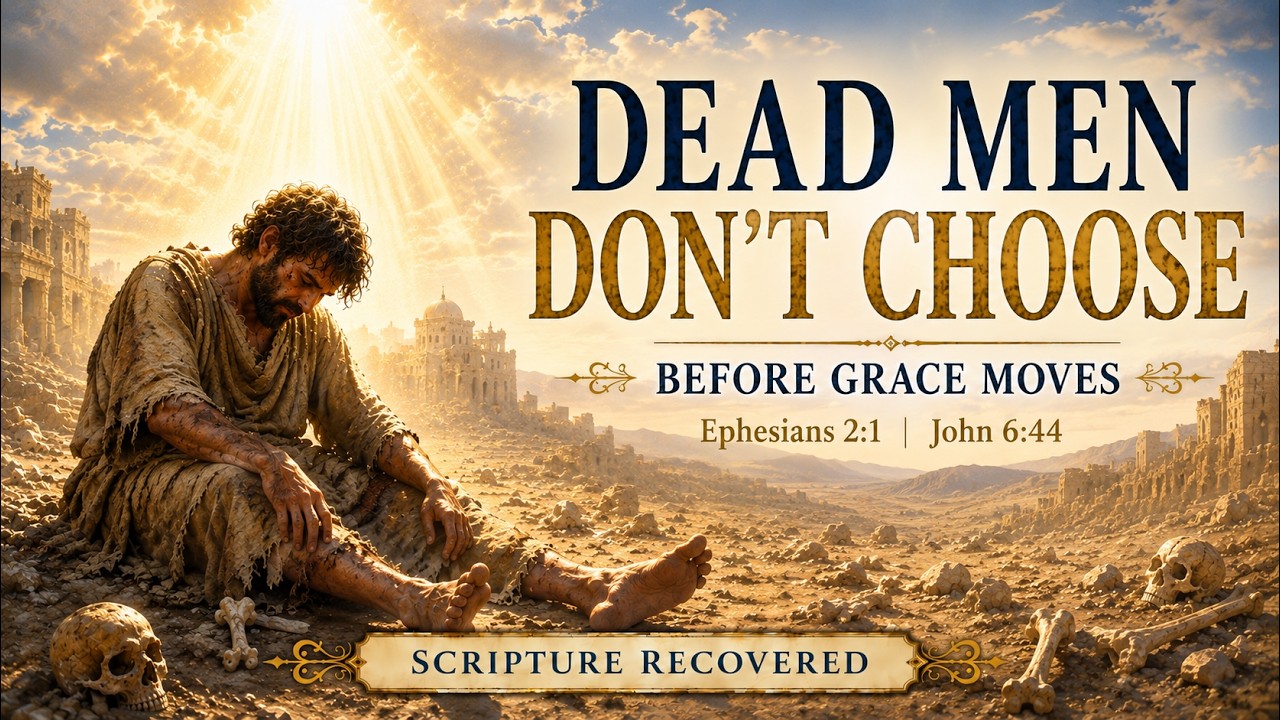
Dead Men Don’t Choose: The Undeniable Truth of God’s Grace

I’ve had it. Lately, I stumbled into a discussion tearing into Calvinism—its theology, its doctrines—and I’m not even a card-carrying Calvinist. I haven’t read his books, haven’t signed up for his club. I just try to follow the Scriptures and the Spirit of God. But what I saw incensed me: ignorance and sheer gall coming against the established Word, picking at gospel verses without context, tossing out the epistles like trash. It’s a butchery of truth, and I can’t shake it off. This battle’s raged for centuries—God’s sovereignty versus human free will—and it’s time to lay it down with the absolute, sledgehammer truth of Scripture. No more dancing around it.

Here’s the question: If we reject the points Calvinism leans on—total depravity, unconditional election, irresistible grace, all of it—what do we undo from the Word of God? Not just a system, but the Bible itself. I’m not here to defend a man-made label; I’m here to let God’s Word speak. And it’s screaming: we’re dead without Him, saved by Him, and He provides it all. Let’s hammer this home.

The Deadness: "Nekros" and Dry Bones

Start here: we’re dead. Not wounded, not limping—”nekros”. Ephesians 2:1—“You were “nekros” in your trespasses and sins.” That’s Greek for corpse. No pulse, no breath, no life. Romans 3:10-12 piles on: “None righteous, no one understands, no one seeks God. All have turned away.” Not some—”all”. Colossians 2:13—“You were “nekros” in your sins.” Dead men don’t choose. They don’t seek. They rot.

Ezekiel saw it too. Chapter 37: a valley of dry bones, scattered, hopeless. God asks, “Can these bones live?” Ezekiel doesn’t play hero—“Lord, you alone know.” Humanly? No chance. Dead bones don’t wiggle. But God says, “Prophesy,” and the Spirit’s breath—”ruach”—sweeps in. Bones rattle, flesh forms, and they stand—a vast army. Who did that? Not the bones. God. Ezekiel 37:14—“I will put my Spirit in you, and you will live.” Dead means “nekros”. No life ‘til God moves.

John 6:44 seals it: “No one can come to me unless the Father who sent me draws them.” “Can”—ability. Without the Father’s pull, we’re stuck. Romans 8:7—“The mind of the flesh is hostile to God; it does not submit, nor can it.” Hostile. Incapable. “Nekros”. If you think a corpse picks itself up, you’re not reading the Bible—you’re writing fiction.

The Process: God Provides All

Salvation’s not steps we take—it’s God’s work breaking us alive. He’s not waiting for us to climb a ladder; He’s emptying our grave. Listen:

He’s the Seed Supplier: 1 Peter 1:23—“Born again, not of perishable seed, but of imperishable, through the word of God.” Matthew 13:37—“The one who sows the good seed is the Son of Man.” Christ plants life in “nekros” soil. We don’t sprout ourselves—He sows.  

He’s the Knocker: Revelation 3:20—“I stand at the door and knock.” Jesus isn’t begging us to knock first—He’s pursuing. Dead men don’t knock back; “nekros” hearts don’t answer—He’s the hunter breaking in. Luke 19:10—“The Son of Man came to seek and save the lost.” He seeks; we’re lost.

He’s the Convictor: John 16:8—“The Spirit will convict the world of sin.” Acts 2:37—Pentecost’s crowd, “cut to the heart,” didn’t self-diagnose. The Spirit stabbed them awake. Dead hearts don’t feel ‘til He strikes.

He Gives His Spirit: Ezekiel 37:14—“I will put my Spirit in you.” John 3:5—“Born of the Spirit.” Titus 3:5—“Saved by the renewal of the Holy Spirit.” No Spirit, no life. He breathes; we don’t.

He Provides the Lamb: John 1:29—“The Lamb of God, who takes away the sin of the world.” Romans 3:25—“God put [Him] forward as a propitiation by his blood.” We didn’t slay the Paschal Lamb—God did. Hebrews 9:12—“With his own blood, he secured eternal redemption.” All Him. For if, when we were enemies, we were reconciled to God by the death of his Son, much more, being reconciled, we shall be saved by his life. Romans 5:10

These aren’t steps to be redeemed—check off faith, grab grace, earn the cross. That’s works, and Ephesians 2:9 says, “Not a result of works, so that no one may boast.” It’s His process, His redemption, His hammer smashing our “nekros” chains. Acts 13:48—“As many as were ordained to eternal life believed.” Ordained, then believed—not the other way around. Romans 2:4—“God’s kindness leads you to repentance.” He leads; we follow. He provides all, or it’s not salvation—it’s self-help.

The Gift: No Paychecks Here

If God does it all, it’s a gift. Ephesians 2:8—“By grace you have been saved through faith… it is the gift of God.” Faith too—not your grit, His grant. Philippians 1:29—“It has been granted to you to believe.” Granted, not grabbed; to them that have obtained like precious faith with us through the righteousness of God and our Saviour Jesus Christ—2 Peter 1:1. Hebrews 12:2—“Jesus, the AUTHOR and perfecter of our faith.” He writes it, not us.

If we choose God without His seed, knock, conviction, Spirit, and Lamb, that ain’t a gift—it’s a paycheck. “I chose wisely; pay me salvation.” Romans 3:27—“Where is boasting? Excluded.” Why? A “nekros” soul doesn’t choose—it’s chosen. John 15:16—“You did not choose me, but I chose you.” 1 John 4:19—“We love because he first loved us.” First. Always Him first. If we kickstart it, why the cross? Galatians 2:21—“If righteousness were through [us], Christ died for nothing.” Dead men don’t earn gifts—they receive them.

The Folly of Free Will Chasing

Some scream, “But free will!” Sure, we respond—”after” He moves. Acts 2:37—“What shall we do?”—comes after the Spirit cuts. John 1:13—“Born not of human decision, but of God.” Charles Spurgeon saw it clear: “Free will carried many a soul to hell, but never a soul to heaven. Anyone who believes that man’s will is entirely free and that he can be saved by it does not believe the fall.” He’s right. Romans 3:23—“All have sinned and fall short.” Free will without grace is freedom to rot, not rise. Romans 8:7—“The flesh “cannot” please God.” Cannot. “Nekros”.

2 Corinthians 4:6—“God… has shone in our hearts to give the light of the knowledge of the glory of God in the face of Jesus Christ.” We didn’t flip the switch—He did. Dead hearts don’t chase light; light chases them. Spurgeon’s not guessing—he’s echoing Scripture: a “nekros” will, unbound by grace, runs to ruin, not redemption.

Lay It Down

This war’s dragged on too long—centuries of dodging the obvious. Scripture’s clear: we’re “nekros” without God, revived by His Spirit, saved by His Lamb. He’s the seed, the knock, the conviction, the breath, the blood. Spurgeon’s words ring true—free will without grace is a one-way ticket down, never up. Reject that, and you’re not just undoing Calvinism—you’re undoing the gospel. Dead men don’t choose; God chooses them. John 6:44. Ezekiel 37. Ephesians 2. Romans 9:16—“It does not depend on human desire or effort, but on God’s mercy.” It’s a sledgehammer of truth, and it’s time to swing it. He provides all. Let the Word silence the noise. Full stop.

The “Law”: INDISPENSABLE & a Bulwark to Society

The Divine Foundation of Law: Navigating Justice, Order, and Human Flourishing

First, it is crucial to understand that the law is a spiritual force expressed through language. Given by whom? We shall discuss that presently! Mankind cannot contrive the kind of “Justice and Order” that prevails upon humanity. I posit that the law can only be conceived by minds aligned with the Creator of the heavens and the earth, whom we call GOD ALMIGHTY. Human hearts, tainted by sin and bound by finite understanding, lack the purity and omniscience to originate laws that reflect eternal righteousness. It is impossible for mere man to formulate what is spiritual in nature; it must come from a spiritual being who is Righteous, Holy, and Just.

The Nature of the Law

The law has two sides: the Sword and Grace. It is a terror to those who rebel against the natural laws of nature and a buffer to those who are fearful and upright in heart.

Before the inception or compilation of the Holy Bible, which is the Word of God, there was no law and order in the world as we have now. The world then was a chaotic realm under the reign of dictators, evil kings, and rulers whose vassals were all the souls that came under them. A commoner held no eminence; the rulers had such authority that even the keys of death and hell were in their hands—think of the blood-soaked altars where innocents were sacrificed to appease capricious gods. Whom they would annihilate, they would; whom they would let live, lived. It’s not that the Sovereign God didn’t have any power, but that God is Just and He works in perfect Righteousness. Despite man’s wicked heart, He values mankind as they are created in His own image and likeness. Therefore, He won’t violate and thrust Himself into a territory without mediums. And the law of God is one such medium.

The Atonement and Its Significance

When it is said, “God so loved the world,” it carries tremendous ideas of God in it. The sacrifice of the Lamb of God on the cross of Calvary was one of those ideas, as is the gift of the Spirit of God and the law of God. The “Atonement”—the reconciliation of God and humankind through Jesus Christ—stands pivotal as that one love offering of God, which alone made other manifold graces of God to be poured upon mankind to receive. By satisfying divine justice, it laid the foundation for a legal order that redeems rather than merely condemns.

The Conflict of Laws

Whether you are ignorant or not, the world is under the sway of the evil and good; the wicked and the just; the good seed and the bad seed; the devil and God. If so, the two entities have their own law and order. One is Chaos, which is lawlessness and disorder, ultimately embodied in a figure Scripture calls “the lawless one,” whose spirit already stirs rebellion against truth. The other is Shalom, which is order and good fruits. The lawless one wants to turn the world into an inhabitable environment, and it has held the world like that for many centuries. However, the work of God on the cross of Calvary transformed everything, initiating a process that worked toward man’s liberation.

The Impact of the Bible

Although it took centuries for it to become effective for humanity’s benefit, it emerged after the dark ages in the form of the Bible, the Sword of the Spirit of God. Until then, this Sword was not made available to multiple generations. This Sword of God permeated the entire globe, bringing liberation to mankind, turning vile, despicable, and abhorrent souls into well-behaved and ethical characters. The Reformation and the Renaissance were a few major milestones of its inception. The light finally dawned on mankind, bringing liberty, individual rights, and development. The once ferocious tribes and cannibals that would sacrifice humans on their altars to appease their internal longing for redemption have become regions of light and life, just because of the Sword of the Spirit, which is the Bible.

The Diverse Landscape of Law

Laws around the world can be categorized into various types based on their scope and application. Understanding these categories is crucial to grasp the complexity of justice and order that underpins society. Here are some key categories:

1. Constitutional Law: Governs the structure and function of government institutions and the rights of individuals.

2. Criminal Law: Defines offenses against the state and prescribes punishments, including felonies, misdemeanors, and regulatory offenses.

3. Civil Law: Addresses disputes between individuals or organizations, including contract disputes, property issues, and family law.

4. International Law: Governs the relationships between nations, encompassing treaties, customary international law, and principles like sovereignty and human rights.

5. Humanitarian Law: Specifically addresses the conduct of armed conflict, known as the laws of war or the law of armed conflict (e.g., the Geneva Conventions).

6. Environmental Law: Focuses on regulations and treaties aimed at protecting the environment, covering issues like pollution, wildlife protection, and natural resource management.

7. Labor Law: Governs the rights and duties of workers, employers, and unions, addressing wages, working conditions, and employment contracts.

8. Commercial Law: Regulates business and commercial transactions, including contract law, sales, and partnerships.

9. Family Law: Covers marriage, divorce, child custody, and other family-related matters.

10. Property Law: Governs ownership and use of property, including real estate and intellectual property rights.

11. Administrative Law: Regulates the actions of government agencies and their rule-making processes.

12. Cyber Law: Addresses legal issues related to the internet, digital communications, and technology.

Each type of law serves different societal needs and may vary significantly between countries, reflecting the unique cultural, ethical, and spiritual values that shape human interactions.

The Birth of Law and Order

Law and order have slowly but gradually been birthed into the world by the Judeo-Christian worldview. Before this, human attempts like Hammurabi’s Code sought order, but they lacked the spiritual depth and redemptive power of God’s law. The freedom that the world now relishes came through this divine medium. It reflects the common grace of God upon humanity—evidence of His care for His creation.

The Dangers of Undemocratic Regimes

Could you imagine a world without law? That’s exactly what the undemocratic regimes of the world would want. They seek to take liberty from the hands of the commoner and give it to authoritarianism, totalitarianism, or oligarchy, whose characteristics often include repression of dissent, limited freedom of speech, and lack of accountability to the public. An undemocratic regime typically refers to a government system where power is concentrated in the hands of a few, often disregarding the principles of democracy such as free and fair elections, civil liberties, and political pluralism. For example, in regimes like North Korea, where state-enforced atheism rejects divine order, or Venezuela, where corruption undermines justice, citizens experience severe restrictions on their rights and freedoms, illustrating the chaotic environment that arises without law rooted in God’s righteousness.

Addressing Counterarguments

Some may argue that laws can be oppressive or misused by those in power, leading to injustice rather than protection. Historical examples, such as Jim Crow laws in the United States or the Nuremberg Laws in Nazi Germany, illustrate how legal frameworks can be manipulated to justify discrimination and violence. However, it is essential to recognize that the failure lies not in the concept of law itself but in its application by flawed humans. Divine law, in its pure form, seeks justice and order; human distortion cannot tarnish its eternal essence. The pursuit of a just legal system requires constant vigilance and a commitment to righteousness.

The Coming of the Lawless One

A hybrid human is going to be the king of the planet for a short period, whose spirit is already at work in the world. He will oppose everything that embodies truth, righteousness, and GOD. He is going to be mankind’s worst nightmare. Despite his authority—God is Sovereign. This evil entity is called “the lawless one,” and in contrast to the Law, which enabled the righteous reign and brought justice to the world, he will let the wicked reign and will turn the world into a burning furnace. For it is the judgment of God upon all that shun truth and righteousness. The grace period upon the world, which God has bestowed upon mankind, will shut its doors forever. Once again, God will shut the door, just as He did when He closed the door of Noah’s ark during the great deluge.

Conclusion

I am not suggesting that the law has been beneficial for some while detrimental to others. I admit that all men are equal in the sense that all possess a wicked and unrighteous heart. But some fear the law and curb their wicked acts, allowing the righteous traits to be imputed to them, while the multitude that rebel and act foolishly fall into the hands of law and order to be either slain or punished by it.

Call to Action

As we reflect on these truths, I urge you to consider the vital role of law in our society. Engage in discussions about justice and governance, advocate for democratic principles, and educate others about the importance of upholding the rule of law. The future of our societies may depend on our collective commitment to these values.

Personal Reflection

Reflecting on these themes reminds me of my own experiences witnessing the impact of law and order in various contexts. I have seen communities flourish under just governance, where individuals are empowered to live freely and ethically. Conversely, I have also seen the despair that arises in places where lawlessness prevails. These observations fuel my conviction that the law, rooted in divine principles, is essential for a flourishing society.

Wherefore the law is holy, and the commandment holy, and just and good – Romans 7:12

Scripture Verses That Affirm The Role of God in THE EXISTENCE OF EVIL

Scripture Verses That Affirm the Role of God in The Existence of Evil.

References:

  • What? shall we receive good at the hand of God, and shall we not receive evil? (Job 2:10)
  • GOD IS SOVEREIGN – Since God is the BEGINNING and He contains everything – He must be the sole creator of evil also. Let’s analyze the Scriptures.
  • Come, behold the works of the Lord, what desolations he hath made in the earth. (Psalm 46:8)
  • I form the light, and create darkness: I make peace, and create evil: I the Lord do all these things. (Isaiah 45:7)
  • Shall there be evil in a city, and the Lord hath not done it? (Amos 3:6)
  • Who hath made man’s mouth? or who makes the dumb, or deaf, or the seeing, or the blind? have not I the Lord? – Exodus 4:11
  • Deuteronomy 32:39 says, “See now that I, even I am he, and there is no god beside me; I kill, and I make alive; I wound, and I heal; and there is none that can deliver out of my hand.” God holds final sway in every death and every life.
  • God sent an evil spirit – Judges 9:23
  • The Spirit of the Lord departed from Saul, and an evil spirit from the Lord troubled him – 1Samuel 16:14,15/18:12/19:9 – the evil spirit from God came upon Saul, and he prophesied in the midst of the house – 1Samuel 18:10
  • And there came forth a spirit, and stood before the Lord, and said, I will persuade him. And the Lord said unto him, Wherewith? And he said, I will go forth, and I will be a lying spirit in the mouth of all his prophets. And he said, thou shalt persuade him, and prevail also: go forth, and do so. 1 Kings 22:21-22
  • God gave them over in the sinful desires of their hearts to sexual impurity for the degrading of their bodies with one another – Rom 1:24
  • And the Lord smote the king, so that he was a leper (2 Kings 15:5)
  • And the Lord rejected all the seed of Israel, and afflicted them, and delivered them into the hand of spoilers, until he had cast them out of his sight (2 Kings 17:20)
  • And so, it was at the beginning of their dwelling there, that they feared not the Lord: therefore, the Lord sent lions among them, which slew some of them (2 Kings 17:25,26)
  • And the Lord sent against him bands of – 2Kings 24:2
  • Thus, saith the Lord of hosts, the God of Israel, unto all that are carried away captives, whom I have caused to be carried away from Jerusalem unto Babylon – Jeremiah 29:4
  • I will send upon them the sword, the famine, and the pestilence, and will make them like vile figs, that cannot be eaten, they are so evil. And I will persecute them with the sword, with the famine, and with the pestilence, and will deliver them to be removed to all the kingdoms of the earth, to be a curse, and an astonishment, and an hissing, and a reproach, among all the nations whither I have driven them: Because they have not hearkened to my words, saith the Lord – Jeremiah 29:17-19 – I make Jerusalem a burdensome stone for all people (Zechariah 12:3)
  • God appointed a plant and made it come up over Jonah, that it might be a shade over his head, to save him from his discomfort. So, Jonah was exceedingly glad because of the plant. But when dawn came up the next day, – God appointed a worm that attacked the plant, so that it withered – Jonah 4:6,7
  • And the Lord gave Jehoiakim king of Judah into his (Nebuchadnezzar king of Babylon) hand (Daniel 1:2)
  • A ravenous bird (ayit – a hawk or other bird of prey: — bird, fowl, ravenous (bird)) from the east, the man that executes my counsel from a far country (Isaiah 46:11) – about the anti-Christ!
  • The Lord hath mingled a perverse spirit in the midst thereof: and they have caused Egypt to err in every work thereof, as a drunken man staggers in his vomit. (Isaiah 19:14)
  • And I will give it into the hands of the strangers for a prey, and to the wicked of the earth for a spoil; and they shall pollute it. (Ezekiel 7:21)
  • The Lord hath made all things for himself: yea, even the wicked for the day of evil. (Proverbs 16:4)
  • evil came down from the Lord unto the gate of Jerusalem (Micah 1:12)
  • “Abraham fell into a deep sleep and a thick and dreadful darkness came over him. Then the Lord said – Gen 15:10-12
  • I will lay my vengeance upon Edom by the hand of my people Israel: and they shall do in Edom according to mine anger and according to my fury; and they shall know my vengeance, saith the Lord God (Ezekiel 25:14)
  • But the Spirit of the Lord departed from Saul, and an evil spirit from the Lord troubled him. (1 Samuel 16:14)
  • And the evil spirit from the Lord was upon Saul (1 Samuel 19:9)
  • And Satan stood up against Israel, and provoked David to number Israel (1 Chronicles 21:1) – And again the anger of the Lord was kindled against Israel, and he moved David against them to say, Go, number Israel and Judah. (2 Samuel 24:1)
  • And there came forth a spirit, and stood before the Lord, and said, I will persuade him. (1 Kings 22:21) – And the Lord said unto him, Wherewith? And he said, I will go forth, and I will be a lying spirit in the mouth of all his prophets. And he said, thou shalt persuade him, and prevail also: go forth, and do so. (1 Kings 22:22) – Now therefore, behold, the Lord hath put a lying spirit in the mouth of all these thy prophets, and the Lord hath spoken evil concerning thee. (1 Kings 22:23)
  • Him, being delivered by the determinate counsel and foreknowledge of God, ye have taken, and by wicked hands have crucified and slain: (Acts 2:23)
  • I am the Lord, and there is none else, there is no God beside me: I girded thee, though thou hast not known me: That they may know from the rising of the sun, and from the west, that there is none beside me. I am the Lord, and there is none else. I form the light, and create darkness: I make peace, and create evil: I the Lord do all these things. Isaiah 45:5-7
  • Evil is God’s punishment to the transgressing creature. If Satan is the author of evil, then how come He was once said to be perfect in all his ways until iniquity was found in him. Where did pride come from?
  • Therefore, God gave them over in the sinful desires of their hearts to sexual impurity for the degrading of their bodies with one another.
  • Because of this, God gave them over to shameful lusts. Even their women exchanged natural relations for unnatural ones.
  • He gave them over to a depraved mind, to do what ought not to be done

God rulers upon all Kingdoms

  • The most High rules in the kingdom of men, and giveth it to whomsoever he will, and setteth up over it the basest of men (Daniel 4:17,25,32)
  • The king’s heart is in the hand of the Lord, as the rivers of water: he turns it whithersoever he will (Proverbs 21:1)
  • And he changes the times and the seasons: he removes kings, and sets up kings: (Daniel 2:21)
  • For the scripture saith unto Pharaoh, even for this same purpose have I raised thee up (Romans 9:17)
  • Who is like unto the Lord our God, who dwelleth on high, (Psalm 113:5)—the Lord, who doeth all these things (Acts 15:17)?

But though he causes grief, yet will he have compassion according to the multitude of his mercies.

For he doth not afflict willingly nor grieve the children of men.

To crush under his feet all the prisoners of the earth,

To turn aside the right of a man before the face of the most High,

To subvert a man in his cause, the Lord approves not.

Who is he that saith, and it cometh to pass, when the Lord commands it not?

Out of the mouth of the most High proceeds not EVIL AND GOOD? Lamentations 3:32-38