
By B.V. Thomas
Scribed in the fire of revelation, November, 2025
There are verses in Scripture that strike like a sudden chord in the hush of eternity—notes that linger, unresolved, until the whole symphony of the Godhead swells in response. I was musing there, in the quiet chamber of 1 Corinthians 8:6, when it pierced me: “yet for us there is one God, the Father, from whom are all things and for whom we exist, and one Lord, Jesus Christ, through whom are all things and through whom we exist.” Paul, that thorn-crowned apostle, distills the cosmos into this divine economy—the Father as the overflowing Source, the Son as the pulsing Channel—binding creation and redemption in a single, breathless stroke. No mention of the Spirit here, not a whisper. And yet, in that very omission, He reveals Himself more starkly than any proclamation could.
This video presentation is based on the article below, adapted for the Scripture Recovered series. The full written study follows underneath for reading, reference, and further reflection.
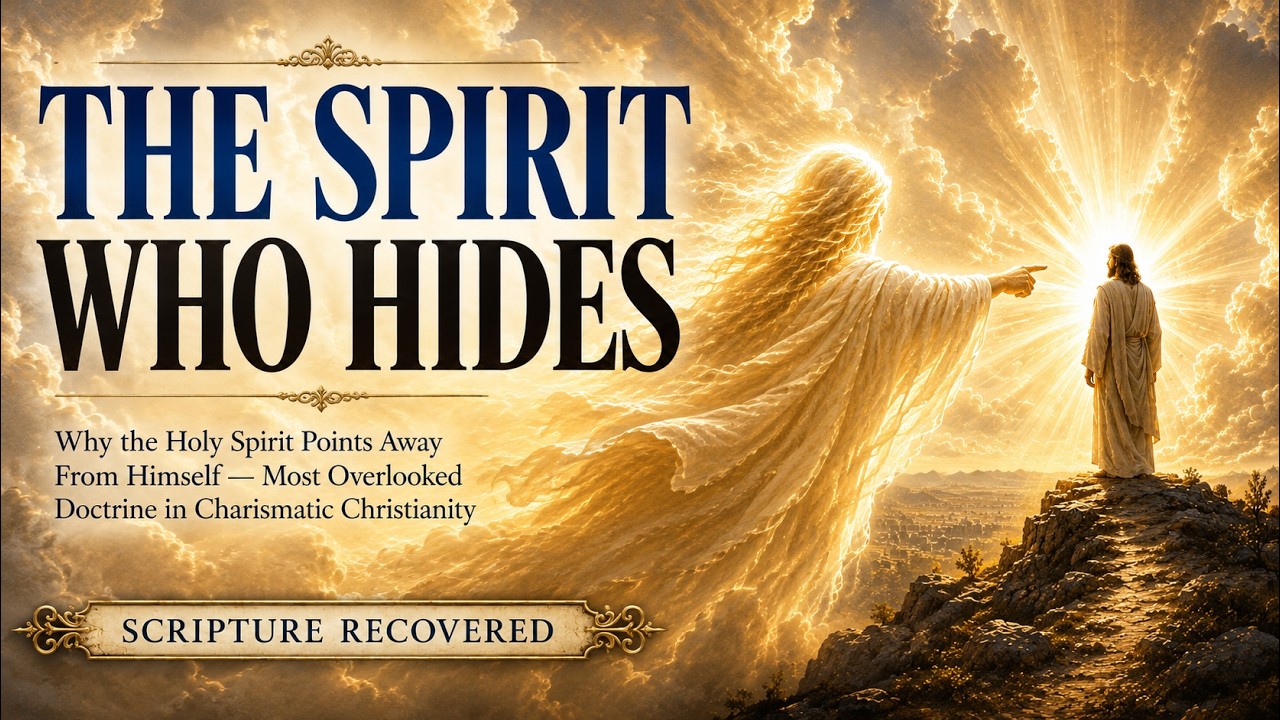
Turn the page in your spirit to 1 John 1:3: “that which we have seen and heard we proclaim also to you, so that you too may have fellowship with us; and indeed our fellowship is with the Father and with his Son Jesus Christ.” John, the beloved, doesn’t just report a truth; he draws us into its flame, insisting that our communion—yours, mine—is with the Father and His Son. Again, the Spirit is absent from the page. But oh, the chills that race through the soul when you begin to see the pattern. Read that absence beside the words of Jesus in John 16:14, “He will glorify me,” and something extraordinary begins to emerge. It is almost an erasure. Not the erasure of His Person, His deity, or His glory, but the self-effacement of the eternal Breath, delighting to turn the gaze beyond Himself. He who hovered over the waters at creation (Genesis 1:2), who overshadowed Mary in the Incarnation (Luke 1:35), veils His own glory so that ours streams toward the Father and the Son. It is as if the Conductor of the ages steps off the podium, baton lowered, so the melody of Jesus might ring unchained.
This attribute—His hidden nature of joyful erasure—doesn’t shout from the rooftops of theology. No, it whispered into my spirit unbidden, a private tremor from the Dove who rests on the Branch without claiming the nest. And in that revelation, my prayer erupted: Lord, let me know Him too—the Spirit—in His distinctness, as I’ve come to know the Father’s sovereign heart and the Son’s pierced hands. To glimpse the Three not as a flat diagram, but as Persons pulsing with other-centered love. And why does He so consistently direct attention beyond Himself in the apostolic witness, rather than toward His own recognition? Because His delight is in our worship of Them—the Father who begets, the Son who redeems—and in that veiling, He unveils the wild generosity of God.
Layer this mystery upon perichoresis, that ancient word for the divine dance, the eternal circumincessio where Father, Son, and Spirit indwell one another in seamless, swirling unity. It’s no stately procession but a living waltz: the Father eternally begetting the Son in boundless affection, the Son spiraling back in flawless obedience, and the Spirit—the unclaimed bond—circling through Both, His every motion yielding the floor. It is a mutual indwelling where no one leads because all are leading, all following, all embracing. Yet even here, the Spirit’s steps curve humbly, not to spotlight His rhythm but to harmonize the Father’s voice with the Son’s song. Imagine it: the Three who are One, and the Spirit’s self-effacement isn’t diminishment but the very pulse that keeps the circle unbroken. He doesn’t hoard the stage; He ignites it for the Son, turning our gaze from the Wind to the Word made flesh.
But here’s where the conventional Christian air thickens with inversion, where Christian emphasis can become inverted. How often do we hear the Holy Spirit’s name thundered from stages—techniques to summon Him, encounters to chase Him, prophecies to claim Him—while the Name He glorifies echoes faintly, if at all? Modern books and “anointed” voices fixate on the Dove as the destination, dissecting His gifts as if they were treasures to hoard, preaching the Spirit solo as the source of power and presence. Yet Scripture flips the script with surgical precision: His ministry does not terminate in drawing attention to Himself, but in Christ being proclaimed. He is glorified when Jesus is preached, when that Name alone—evoked in faith, lifted in surrender—stirs the heavens to move.
Recall John 16:13-15, where Jesus unmasks the Spirit’s heart: “When the Spirit of truth comes, he will guide you into all the truth… He will glorify me, for he will take what is mine and declare it to you. All that the Father has is mine, and the Spirit will declare it.” See the choreography? The Spirit takes from the Son (and thus the Father) and broadcasts it to us—not a self-portrait, but a living icon of Jesus. And when the Spirit was poured out at Pentecost, what followed was not self-adulation but immediate, Spirit-filled proclamation centering entirely on Jesus: Peter rising to declare, “Let all the house of Israel therefore know for certain that God has made him both Lord and Christ, this Jesus whom you crucified” (Acts 2:36). The Spirit falls, and the apostolic proclamation that immediately emerges from Pentecost centres upon the Son. The Name of Jesus—that’s the spark. Demons scatter at it (Mark 16:17), revival ignites around it (Acts 4:12), and the Spirit’s own filling moves immediately toward exalting that Name unadorned. Chase the Wind, and you’ll grasp smoke; lift the Son, and the Wind will carry you home.
The Spirit does not erase His Person. He erases Himself from the centre of attention so that the Son fills the frame.
This truth didn’t dawn in abstraction for me—it carved itself through the flint of lived fire. I was radically saved, a soul snatched from the jaws of my own rebellion, filled to bursting with the Holy Spirit in those early, electric days. My mouth and heart sang one Name alone: Jesus. Power swelled in me like a river unbound—joy that mocked sorrow, authority that silenced storms, a fellowship so tangible it felt like walking with the Nazarene Himself. His wounds were my wonder; His resurrection, my rhythm. Then came a book that fascinated me with stories of intimate dialogue with the Holy Spirit and a conscious, daily fellowship with Him unlike anything I had deliberately pursued before. I devoured it, hungry for more of the God who had already flooded my life.
But somewhere in what I took from it and began pursuing, a sly theft happened within me. I did not see it at first: the pivot from the Lord who had birthed me in the Spirit to a growing preoccupation with the Spirit Himself, as though He were the prize rather than the One who leads us into the fullness of Christ.
I began shaping my devotional life around that pursuit. Morning greetings, a heightened attention to His personality and presence, and an increasing desire to cultivate experiences of the Spirit gradually occupied more of my spiritual attention. None of those things appeared dangerous to me at the time. But in my own walk, something precious was being displaced.
My first love for Jesus, the Pearl of great price, cooled to embers. Revelation 2:4 convicted me later: “But I have this against you, that you have abandoned the love you had at first.” It was not a full apostasy, but a drift, a fascination that rerouted my river. Power? It ebbed to a trickle. Joy? Swallowed by despondency’s slough.
The fallout was a freight train: powerlessness that mocked my calling, sins that shouldn’t ensnare a saint, a near-shattering of life itself—relationships fractured, purpose frayed, the call on my life dangling by a thread. Years wandered in that wilderness, a prodigal chasing the wrong wind, until grace—the same Spirit I’d misplaced—tugged me back. He taught me, not through thunder but through the quiet ache of return: This isn’t pursuit of Me you crave, child; it’s the Son I introduced you to, the One in whom I rest. By God’s mercy, He mapped me home to that first, fierce love, restoring the song of Jesus as my unceasing pulse.
I want to be careful here, because this testimony is easy to misread in either direction. I am not making a judgment about the motives or spiritual condition of those from whom I encountered these emphases, nor am I saying that every person exposed to them will experience what I experienced, nor am I attempting here to give a comprehensive review of the teaching itself. I can testify only to what happened in my own walk. My problem was never that I learned the Spirit is a Person, or began speaking to Him directly—Scripture itself invites both. What happened was subtler: the means became the destination, and Christ ceased occupying the place He had occupied in my first love.
I’ve told no one this fracture till now, but as we’ve unraveled it thread by thread, it fits like a missing bone: the Spirit never wanted my altars built to Him alone. He yearns for the smoke to rise to the Lamb.
And I cannot believe I am the only one who has been derailed on this track—ensnared by the glamour of Spirit-centric seminars, books that bottle the Dove as a self-help elixir, teaching where the language of presence can become detached from the centrality of the cross. It’s possible to taste sparks but miss the blaze, fragments but not the Fullness. True power, the swelling river of joy? It’s not in dissecting the Breath but abiding in the Branch where He alights (John 15:4-5). The Holy Spirit’s union with the body of Christ is inseparable—we are all baptized by one Spirit into one body (1 Corinthians 12:13), sealed by Him (Ephesians 1:13-14)—yet John describes our fellowship as being with the Father and with His Son (1 John 1:3). He cries “Abba!” within us (Romans 8:15), intercedes wordlessly (Romans 8:26-27), seals every benediction (2 Corinthians 13:14). His distinctive ministry does not terminate upon Himself. This is the erasure I mean: not disappearance, not diminishment, but divine self-effacement. The Spirit makes Himself known by making Christ unavoidable. He brings us into the knowledge, life, and glory of Christ, and through the Son to the Father.
This fights the grain of convention, I know—the tidy formulas that treat Spirit-focus and Christ-focus as interchangeable, the revival circuits that can reduce His presence to something summoned, activated, or pursued as an end in itself. It’s hard to hold such a flame within; it scorches the silence. But now? It’s time to let it flow, all of it, from the verse that started the spark to the scars that sealed the lesson. The Spirit’s veiled glory isn’t a footnote—it’s the gospel’s heartbeat, calling us back to preach one Name, to dance in perichoresis by yielding our steps to the Son. Let pulpits quake, bookshelves bow: the Holy Ghost is most glorified when Jesus is lifted high.
So rise, church—abandon the chase, reclaim the cross. Sing His Name till the winds howl in response. And in that symphony, may we glimpse the Spirit at last: not erased, but exalted in His exquisite surrender. To the Father, the Source; to the Son, the Savior; to the Spirit, the Silent Herald—glory, now and ever. Amen.