
Before there was a nation, there was a choice.
And before we can understand what God chose Israel for — before we can make sense of the exile and the scattering and the suffering and the survival — we need to understand what kind of God is doing the choosing.
He is a farmer.
This video presentation is based on the article below, adapted for the Scripture Recovered series. The full written study follows underneath for reading, reference, and further reflection.
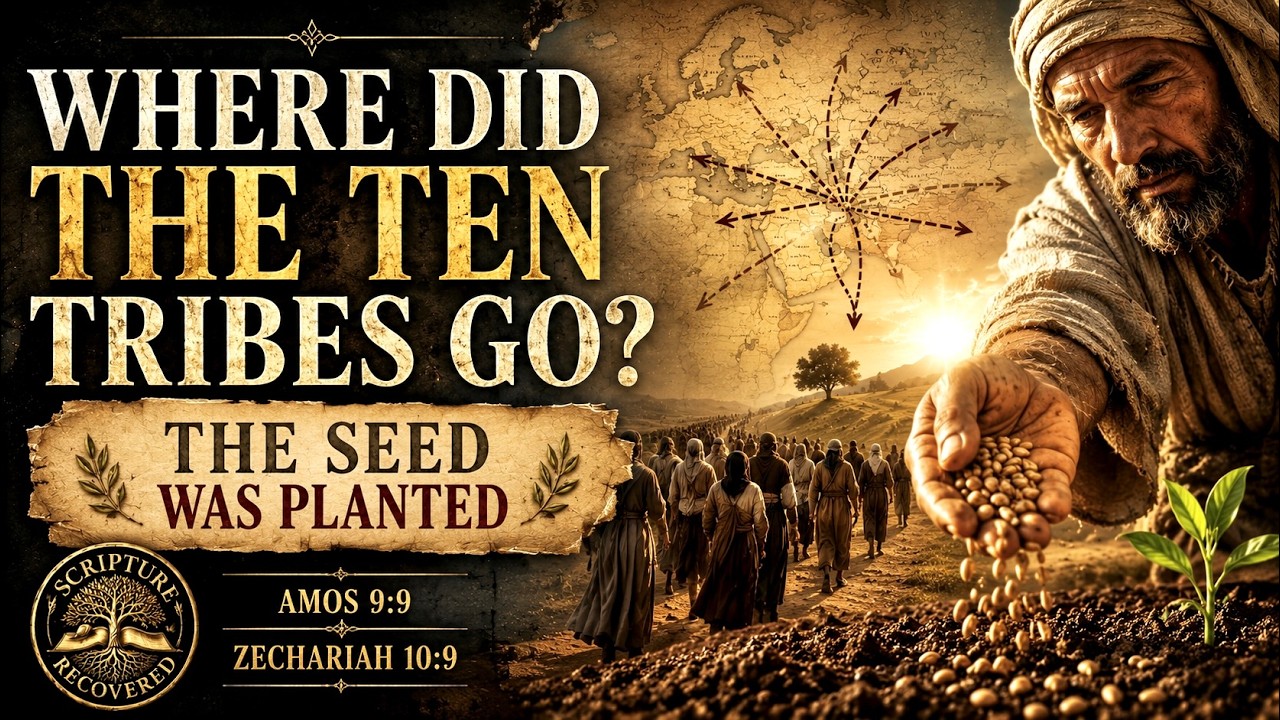
Not a general deploying troops. Not an engineer designing a system. Not a king moving pieces on a board. A farmer — patient, purposeful, working on a timescale that the seed cannot perceive from inside the ground — who chose the smallest seed, planted it in the most unlikely soil, scattered it across the face of the earth, and has been tending the harvest ever since.
The Lord did not set his love upon you, nor choose you, because ye were more in number than any people; for ye were the fewest of all people (Deuteronomy 7:7).
The fewest. The smallest. The least significant by every measurable standard of the ancient world. A wandering herdsman’s family. A slave nation in Egypt. A people with no military tradition, no cultural inheritance, no geopolitical leverage. God chose them precisely because of their smallness. Because when the harvest came — when the fruit of this planting covered the face of the earth — no one would be able to credit it to the seed. The credit would belong entirely to the Farmer.
This continues directly from the argument in the previous article: their fall was the riches of the world, and now we trace what became of the fallen seed itself.
I want to show you something that has been hiding in plain sight across thirty-five centuries of biblical and secular history — something the prophets described in agricultural language so precise that it reads, from where we now stand, not as poetry but as a field manual.
Israel was not merely a nation. Israel was a seed. And God is a farmer who knew exactly what He was doing when He planted it.
The Language of the Prophets
The prophets described what was coming to Israel in agricultural terms — not because they lacked other language, but because agricultural language was the most precise language available for what they were being shown.
Begin with Zechariah. Writing after the Assyrian conquest had already happened — after the ten northern tribes had already been marched into captivity — he records God’s own description of what the scattering was. I will sow them among the people: and they shall remember me in far countries; and they shall live with their children, and turn again (Zechariah 10:9).
I will sow them. Not: I will scatter them in judgment. Not: I will allow them to be driven out. I will sow them. The first person singular. God’s own act. God’s own intention. The Assyrian army was not a catastrophe interrupting God’s plan for Israel. It was the farming implement God chose to break up the settled ground and place the seed in the nations. Sown among the people. Remembering God in far countries. Living and multiplying. Turning again. This is not the language of a people destroyed. This is the language of a seed planted with a specific expectation of return.
Jeremiah, writing in the generation before Jerusalem itself would fall, records God’s comprehensive statement of the entire process. Behold, the days come, saith the Lord, that I will sow the house of Israel and the house of Judah with the seed of man, and with the seed of beast (Jeremiah 31:27). Both houses. The northern kingdom and the southern. The whole of Israel — from the Assyrian scattering of the ten tribes to the Babylonian exile of Judah — sown into the earth. The agricultural metaphor is not applied to one branch of the nation but to the entire tree.
And Amos, preaching to the northern kingdom before it fell, adds an image of extraordinary precision. I will sift the house of Israel among all nations, like as corn is sifted in a sieve, yet shall not the least grain fall upon the earth (Amos 9:9).
A sieve. Not random scattering. Deliberate distribution — grain placed through a mesh with care, each kernel going exactly where the sifting directs it. And the promise attached is the most extraordinary detail in the verse: not the least grain shall fall upon the earth. Not one kernel of true seed will be wasted. Not one will fall in the bare dirt between the rows.
From a biblical-theological view, none of the communities scattered across the centuries sit outside the Farmer’s field — the Malabar Jews on the Kerala coast of India, the Beta Israel in the highlands of Ethiopia, the Kaifeng Jews from the interior of China, the Moroccan Jews, the Yemenite Jews, the Georgian Jews, the Jews of Persia and Babylon and Spain and the Rhine valley. No grain sits outside His field. No scattering is beyond His hand. The Farmer does not lose seeds.
What a Seed Does
But here is where the argument requires a moment of careful thought. Because the standard historical verdict on the ten northern tribes is not survival — it is assimilation. They were scattered, absorbed into surrounding peoples, lost their language and their religious distinctives, and ceased to exist as an identifiable people. They did not return as distinct tribal units after the Assyrian conquest. From the perspective of ancient ethnography, the assessment is broadly accurate.
And this is precisely where the agricultural metaphor becomes essential. Because this objection — the ten tribes assimilated, therefore they were lost — makes the same mistake as a person who walks into a field three weeks after sowing and announces that the seeds have been annihilated.
Technically accurate. Catastrophically wrong.
Because a seed, buried in the ground, ceases to be a seed. It loses its form. Its outer husk breaks down. Its individual identity is dissolved into the soil around it. The very process that looks like destruction from the outside is, from the inside, the beginning of everything. The dissolution of the seed is not the end of the story. It is the precondition of the harvest.
Assimilation was not the failure of God’s plan for the ten tribes. It was the mechanism of it. History can describe the disappearance of tribal identity. Scripture shows us what God was doing underneath that disappearance.
A seed that refuses to dissolve into the soil will not grow. Had every scattered branch of Israel been preserved only as a sealed enclave, the seed would have been present but not planted in the same way. Instead, the northern tribes dissolved. They became the soil’s own. Their seed was carried into the populations of Mesopotamia, Media, Persia, Asia Minor, Egypt, North Africa, Spain, the Indian coast — and the Gospel, when it came, centuries later, found prepared ground.
Verily, verily, I say unto you, Except a corn of wheat fall into the ground and die, it abideth alone: but if it die, it bringeth forth much fruit (John 12:24). Jesus speaks this of Himself — of His own death and resurrection and the harvest that would follow. But He was not inventing a new principle. He was stating the law that had governed Israel’s history for seven centuries before He arrived. The nation had been living this parable. The seed had been in the ground. And the much fruit was coming.
The Map That Should Shake Every Christian
If the thesis is correct — that the northern scattering was a divine sowing, and that the Gospel followed the trails of the diaspora — then there should be visible historical evidence. The seed-sown zones and the earliest Gospel expansion zones should substantially overlap.
They do.
This is not a minor coincidence. This is one of the most remarkable patterns in the history of civilisation — and it has been hiding in plain sight for two thousand years.
Consider the world into which the apostles carried the Gospel after Pentecost. Paul’s missionary journeys took him through Asia Minor — modern Turkey — into Macedonia and Greece, to Rome. These are many of the very regions where the Assyrian, Babylonian, and later Jewish dispersions had deposited Israelite seed across the preceding centuries.
But before Paul — look at the apostles themselves. Where did the Gospel go in the generation immediately after the resurrection? They went home carrying the Gospel along every road the diaspora had already prepared. Damascus had a significant Jewish population long established — and the Gospel reached it before Paul’s conversion on the road to persecute the believers already there. The seed was already in Damascus. The harvest had already begun when Paul arrived to destroy it.
Antioch in Syria became the great launching base for Gentile mission — the city where followers of Jesus were first called Christians. Antioch had one of the largest Jewish communities in the ancient world outside of Alexandria. The diaspora had put down deep roots. The synagogue was established. The God-fearers were numerous. When the Gospel arrived, it found prepared ground and grew so rapidly that a Gentile city became the centre of world mission within a generation of the resurrection.
Now they which were scattered abroad upon the persecution that arose about Stephen travelled as far as Phenice, and Cyprus, and Antioch, preaching the word… And the hand of the Lord was with them: and a great number believed, and turned unto the Lord (Acts 11:19–21).
They which were scattered abroad. The persecution that drove the Jerusalem believers out of the city — the very persecution that Saul of Tarsus had helped orchestrate — scattered them along the diaspora roads. Phoenicia. Cyprus. Antioch. These were not random destinations. They were the cities with established Jewish communities, the seed-sown zones where displaced Jewish believers would naturally travel — and where they would find, upon arrival, prepared soil ready to receive what they were carrying. The persecution that looked like a setback was another sowing. God was using the enemy’s own pressure to scatter the seeds of the Gospel along the same trails the original diaspora had already cut.
Paul’s Journeys as a Harvest Map
Read Paul’s three missionary journeys in Acts not as the travel itinerary of an individual evangelist, but as a systematic harvest of seeds that had been in the ground for centuries — and the map resolves into perfect coherence.
The first journey takes him through Cyprus and into the heart of Asia Minor — Antioch, Iconium, Lystra, Derbe. Regions with established Jewish communities. Cities on the trade routes that diaspora merchants had travelled for generations. The synagogues were there before Paul. The God-fearers were there before Paul. The soil was ready.
The second journey takes him further — into Macedonia and Greece. Philippi, Thessalonica, Berea, Athens, Corinth. The same pattern in every city: the synagogue first, the God-fearers, the prepared ground, the rapid growth.
And the apostolic letters confirm the agricultural reading of the diaspora explicitly. James, a servant of God and of the Lord Jesus Christ, to the twelve tribes which are scattered abroad, greeting (James 1:1). James was not using this as a vague metaphor for Christian believers generally dispersed around the Roman world. He was writing to the actual descendants of the twelve tribes of Israel — the seeds that had been sown into the nations — who were now, through the Gospel, coming alive in Christ. His letter has a specific, historically grounded recipient: the diaspora seed, now being harvested.
Peter opens his first letter in the same terms. Peter, an apostle of Jesus Christ, to the strangers scattered throughout Pontus, Galatia, Cappadocia, Asia, and Bithynia, elect according to the foreknowledge of God (1 Peter 1:1). The elect exiles of the dispersion — the same regions where the Assyrian and Babylonian scatterings had deposited Israel’s seed centuries earlier. The apostles were not writing into a vacuum. They were writing to fields that had been planted. And the fields were bearing fruit.
The Enemy Knows What Farmers Know
There is one more implication of the seed identity that must be named — because it explains something that secular history has never been able to adequately explain.
If Israel is the seed — the carrier of divine life sown into the earth — then the hatred that has followed the Jewish people across every century and every continent is not irrational. It is, from the enemy’s perspective, precisely rational.
In the parable of the Sower, it is the birds that devour the seed. In the Revelation, it is the dragon who makes war against the seed of the woman. John sees it plainly: And when the dragon saw that he was cast unto the earth, he persecuted the woman which brought forth the man child (Revelation 12:13). Cast down from heaven, his rage finds its target — the woman who brought forth the Messiah. And it does not end with her alone: And the dragon was wroth with the woman, and went to make war with the remnant of her seed, which keep the commandments of God, and have the testimony of Jesus Christ (Revelation 12:17).
This is not God’s wrath being poured out on Israel through human hands as punishment for rejecting her Messiah. This is the dragon’s wrath — Satan’s own fury, following his own casting down — directed at the woman and at her seed because of what they carry, not because of what they have done. The most hunted people in human history are hunted because of what they carry.
Farmers do not wage war against tares. They wage war against seeds.
Every attempt to destroy the Jewish people — from Pharaoh drowning the infant sons in the Nile, to Haman’s decree in Persia, to the Spanish Inquisition, to the Holocaust — has the same author and the same objective. Not ethnic hatred alone, though that is the instrument used. Behind every attempt at annihilation is the same intelligence that understood, from the garden of Eden onward, that the seed of the woman would bruise the serpent’s head. Kill the seed and the harvest cannot come. Destroy the people and the Messiah cannot arrive. Eliminate the covenant nation and the promises cannot be fulfilled.
Beneath every pogrom, every decree, every attempt at annihilation, the same old hatred of the seed can be heard.
And every attempt failed. Because the Farmer who placed the seed in the earth also guards it. The enemy, for all his cunning, cannot outgarden God.
The Faces of the Seeds Coming Home
And now — in our own generation — we are watching the most extraordinary visible confirmation of this ancient sowing that history has ever produced.
The modern return of Jewish people to the land of Israel — the aliyah of the last century and a half — has brought home faces from every corner of the earth: Jews from Ethiopia, Jews from India, Jews from China, Jews from Iraq, from Yemen, from Morocco, from Georgia, from Eastern Europe, from Persia, from Spain, and from beyond — gathered under one covenant identity, a people unlike anything the world has ever seen.
That breadth of appearance is exactly what we should expect from a people preserved through centuries of exile, migration, and return — seeds buried in every soil, now being called up out of the ground by the Farmer who placed them there.
This is not merely moving. It is a visible witness. The sieve of Amos 9 is being reversed before our eyes. What was scattered is being gathered. What was planted is coming home.
He shall cause them that come of Jacob to take root: Israel shall blossom and bud, and fill the face of the world with fruit (Isaiah 27:6). Fill the face of the world with fruit. Isaiah wrote that in the eighth century BC. He was not describing something he had witnessed. He was describing something he had been shown — a harvest so vast and so universal that it would cover the face of the earth as completely as a field in full fruit covers the ground beneath it.
We are living in the middle of that harvest. Most of us do not know whose seeds are under our feet.
Now we do.
The Assyrian as Plough
One more image is needed before this argument can close. What instrument did the Farmer use?
O Assyrian, the rod of mine anger, and the staff in their hand is mine indignation. I will send him against an hypocritical nation, and against the people of my wrath will I give him a charge (Isaiah 10:5–6).
The rod of mine anger. God used the most brutal empire of the ancient world as His farming implement. The Assyrian army was the plough that broke up the settled ground of northern Israel and scattered the seed into the nations. And when the ploughing was done, God dealt with the plough as well. Assyria fell. Babylon fell. Rome fell. Every empire that God has used as a farming implement has been set aside when the work was complete — because the implement is never the point. The harvest is the point. And the harvest belongs to the Farmer, not the plough.
Only a God of infinite patience and infinite purpose could work like this. Only a God who sees the end from the beginning could look at ten tribes being marched into captivity and call it a sowing. Only a God who loves the world enough to spend centuries preparing its soil before He sends the Gospel could engineer history on this scale.
How Much More Their Fulness
We are now standing at the end of a single argument followed across three articles, from its beginning to its present unfinished state.
God chose the smallest seed. He trained it through a thousand years of priestly discipline in blood. He scattered it into every soil on earth — not merely in punishment, but in planting. He sent the Seed of seeds — the grain of wheat that fell into the ground and rose again — bearing fruit that has never stopped multiplying for two thousand years. He guarded the seed against the dragon who hunted it in every century and could not destroy it. He called it home from every corner of the earth in our own generation.
And the harvest is not complete.
Now if the fall of them be the riches of the world, and the diminishing of them the riches of the Gentiles; how much more their fulness? (Romans 11:12).
How much more. Three words that contain the entire unanswered question of the age. Everything traced across this series — the crime, the gift, the sowing, the diaspora trails, the Gospel harvest covering the earth — all of that is the fruit of the fall. The riches of the world produced by the diminishing of Israel.
And the fulness is still coming. The bones are still coming home. The veil is still partially in place. The one new man is still being formed. The knowledge of the Lord has not yet covered the earth as the waters cover the sea. The last sheaf has not yet been gathered in.
But the Farmer is still in the field.
And the God who chose the smallest seed, who trained it in blood, who scattered it into the nations, who sent His own Son as the Seed of seeds, who has been gathering the harvest for twenty centuries without interruption — that God does not abandon harvests.
He finishes what He plants.
The harvest is vast. The fulness is still coming. And the Farmer who planted it knew — from before the foundation of the world — exactly what He was doing.
Watch Episode 4 — When the Bones Come Home → here
B.V. Thomas is the author and theologian behind The Hermeneutical Quill, a platform reaching readers across 170+ countries. This article is adapted from the Scripture Recovered video teaching series.
Subscribe to Scripture Recovered on YouTube — and visit bvthomas.com for more.
Scripture references in this article: Deuteronomy 7:7 · Zechariah 10:9 · Jeremiah 31:27 · Amos 9:9 · John 12:24 · Acts 11:19–21 · James 1:1 · 1 Peter 1:1 · Revelation 12:13, 17 · Isaiah 10:5–6 · Isaiah 27:6 · Romans 11:12