Gentleness Is Not Timidity: A Rebuke to a Church That Honors the Dead and Suspiciously Watches the Living

The modern church honors saints of the past while mistrusting visible transformation today. This article confronts false humility, hypocrisy, and the fear of Christ’s work in living believers.

For too long, the church has honored saints of the past while mistrusting the living. This article—written as both exposition and manifesto—emerges from a burden to confront false humility, religious fear, and the subtle resistance to visible obedience and Spirit-led transformation. It seeks to honor God’s work in His people today and call the Body to recognize, rejoice in, and walk in the light He produces.

We Will Not Apologize for the Work of God in Us

The church has learned how to honor the dead while quietly distrusting the living.

David may repent, fail, and be celebrated centuries later. Paul may speak boldly of Christ’s meekness in him—once he is safely gone.  Elijah may be excused as “a man of like passions,” long after his fire has faded into story.

But let that same God produce the same fruit today—gentleness instead of rage, clarity instead of chaos, obedience instead of impulse—and suddenly suspicion replaces joy.

“We know him.”                                                                                                                   

“She’s changed.”                                                                                                             

“That feels like pride.”

Grace exits the room without a sound.

Paul anticipated this distortion. That is why he dared to say:

“I, Paul myself, beseech you by the meekness and gentleness of Christ—who in presence am lowly among you, but being absent am bold toward you.” 2 Corinthians 10:1

Do not miss what he is doing.

He is not boasting.                                                                                                                    He is naming Christ’s work before others                                                              redefine it for him.

What they called timidity, Paul called meekness. What they judged as weakness, he identified as the gentleness of Christ.

And he was not ashamed.

Why should he be?

That gentleness did not come cheaply. It was forged—through years of obedience, fire, contradiction, loss, and the slow death of the flesh. Fruit does not grow in a day (James 1:2-4). Everyone will be salted with fire—tested, and refined through trial (Mark 9:49). No vessel becomes fit for the Master’s use without first being emptied of what once filled it.

Yet here is the madness of our time:

The same church that tells broken believers, “Come out of low self-esteem. Believe who you are in Christ,” turns on them the moment they actually do.

As long as humility looks like insecurity, it is praised. But when humility stands upright—peaceful, unthreatened, clear—it is suddenly called pride.

This is not discernment.                                                                                                            It is fear of visible transformation.

Jesus never taught us to hide the work of God. A lamp is not lit to be covered. (Matthew 5:15) A tree does not apologize for bearing fruit. Fragrance is not arrogance. Light is not self-promotion.

What kind of gospel produces fruit and then demands silence?

Paul goes further. He says this clarity—this truthful disclosure of God’s work—pulls down strongholds. It dismantles arguments. It takes            thoughts captive.

Why?

Because lies thrive in ambiguity. Darkness survives where believers are trained to distrust what God has actually done in them.

Then comes the line the flesh cannot tolerate:

“…being ready to exercise authority when your obedience is fulfilled.” 2 Corinthians 10:6

Authority is not claimed.                                                                                                          It emerges.

A workman who rightly divides the Word need not be ashamed—because his life agrees with his mouth. That kind of believer becomes dangerous to deception. Which is why the religious spirit always tries to shame them back into hiding.

But Scripture refuses that narrative:

“He shall be a vessel unto honour, sanctified, and meet for the Master’s use, prepared unto every good work.” 2 Timothy 2:21

Not an afterthought.                                                                                                              Not a leftover.                                                                                                                          Not a second-class saint borrowing glory from the past.

A forethought in Christ.                                                                                                            A son.                                                                                                                                            An heir.                                                                                                                                              A living testimony.

So let it be said plainly:

We will not apologize for the fruit God has grown. We will not pretend we are unchanged to comfort the insecure. We will not bury light to preserve religious peace.

Gentleness is not timidity. Clarity is not arrogance. Obedience is not pride.

We will rejoice when one member is honored. We will glorify God when His virtues appear in a brother or sister. We will covet rightly—not by tearing others down, but by desiring the same work in our own lives.

Let darkness be disturbed. Let false humility be exposed. Let the church relearn how to recognize Christ—not only in Scripture, but walking among His people again.

This is not rebellion.                                                                                                              This is obedience.

This is not self-exaltation. This is Christ revealed in vessels of clay.

And those who have eyes to see will know exactly what they are looking at.


The Captives Who Conquered: How God Parades You as the Sweet Smell of Victory

The Captives Who Conquered: How God Parades You as the Sweet Smell of Victory

Imagine the scene: Thunderous cheers echo through the streets of ancient Rome. A conquering general rides in a golden chariot, crowned with laurel. Behind him march defeated kings in chains, their faces etched with humiliation. Spoils of war gleam in the sun. And rising above it all—thick clouds of burning incense, sweet spices filling the air.

To the victors, that fragrance meant triumph—life, glory, celebration.
But to the chained prisoners marching toward execution? The same scent screamed doom and death.

Now hear Paul drop this atomic bomb in 2 Corinthians 2:14-16 (NIV):

“But thanks be to God, who always leads us as captives in Christ’s triumphal procession and uses us to spread the aroma of the knowledge of him everywhere. For we are to God the pleasing aroma of Christ among those who are being saved and those who are perishing. To the one we are an aroma that brings death; to the other, an aroma that brings life.”

Stop. Breathe that in.

Paul doesn’t say we’re the conquering generals. No—we’re the captives. Surrendered. Chained to Christ. Yet in His victory parade over sin, death, and Satan, God Himself marches us through the world… and uses ordinary, broken you and me to diffuse the fragrance of knowing Him everywhere.

And get this: To God the Father, this scent rising from our lives is always, eternally pleasing—the sweet aroma of His Son’s perfect sacrifice and victory. Just like the Old Testament offerings that were a “soothing aroma” to the Lord.

But to the world? One fragrance, two responses.

To those being saved, we smell like life—drawing them to the Savior.
To those perishing, the same gospel fragrance is a reminder of judgment, a scent of death. (Not because we’re harsh, but because light exposes darkness.)

This is beyond our natural understanding of worth and beauty in Christ! We feel like failures, weaklings, barely holding on. Yet heaven sees us as the triumphant perfume of the King of Kings. Every prayer, every act of obedience, every quiet stand for truth—God spreads it like incense across nations.

You don’t manufacture this aroma. You don’t have to be eloquent, successful, or Instagram-perfect. Christ in you is the fragrance. Your surrendered life is the censer He swings.

So why do we live smelling like defeat when we’re the aroma of victory?

Church, wake up! The world doesn’t need more self-help gurus or polished performers. It needs captives joyfully marching in Christ’s triumph—lives that release the knowledge of Him like perfume in a stuffy room.

One day soon, the parade ends at the throne. No more mixed responses. Only glory. Until then, let Him lead you in triumph. Let the fragrance spread.

Because you, believer, are the sweet smell of Christ’s conquest to a dying world—and the delight of God Himself.

What a jaw-dropping identity. What unspeakable grace.


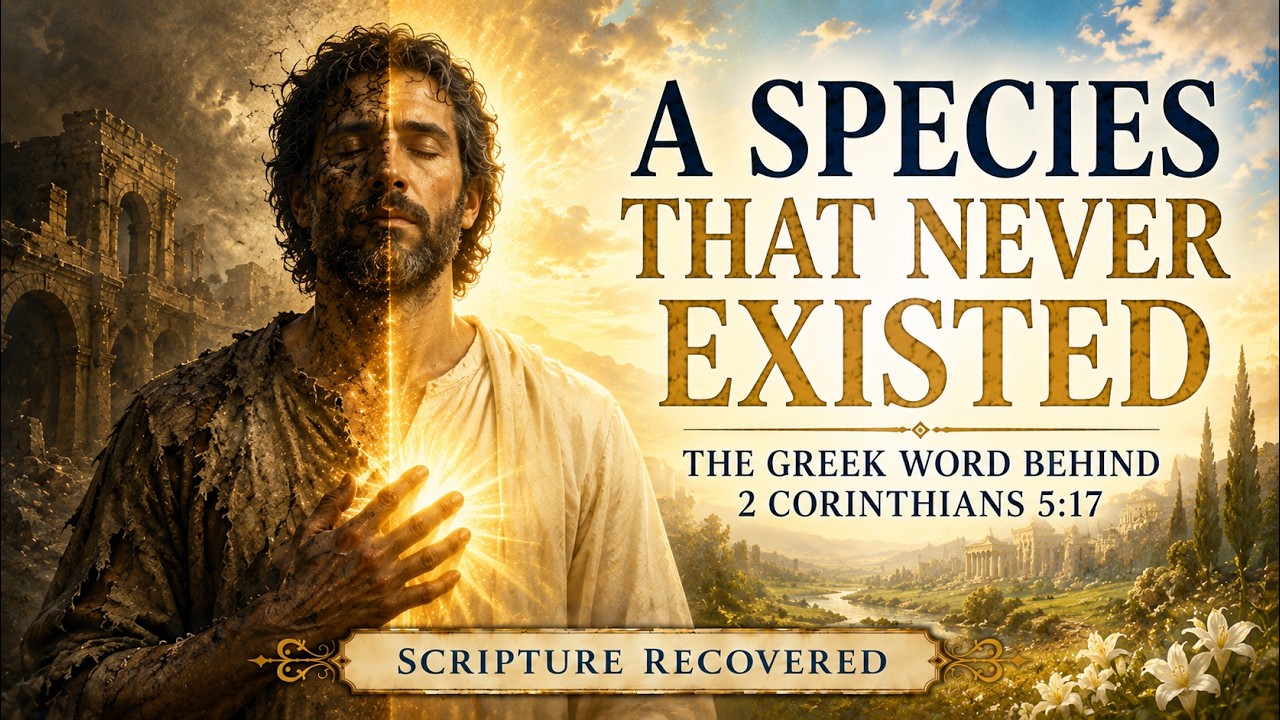
Kainē Ktisis: The Species That Never Existed Before

This is a battle cry

The Greek phrase in 2 Corinthians 5:17 is καινὴ κτίσις (kainē ktisis).

Break it down with surgical, Holy-Ghost precision:

  • κτίσις (ktisis) = a created thing brought into existence by divine fiat – not a renovation, but a brand-new creation ex nihilo in the moral and spiritual order.
  • καινὴ (kainē) from καινός (kainos) – NOT νέος (neos = new in time). Kainos means new in quality, new in kind, unprecedented, superior, of a totally different order, never-before-existed in the entire history of the universe.

Paul is shouting with deliberate, atomic force:
The believer in Christ is not a repaired, improved, or religiously upgraded version of the old Adamic humanity.
You are a καινὴ κτίσις – a species of being that did not exist before Pentecost.

This video presentation is based on the article below, adapted for the Scripture Recovered series. The full written study follows underneath for reading, reference, and further reflection.

youtube placeholder image

A new kind of human, organically united to the risen Christ, partaking of the divine nature (2 Peter 1:4), carrying the actual life and substance of God in your human spirit.

What happened at the new birth is not merely that our fallen status in Adam was cancelled and our dead spirit quickened.
That is true – but it is the smaller half of the miracle.

The greater half is this:
God actually created an absolutely new man inside us – “the new man which after God (κατὰ θεόν – kata theon) is created in righteousness and true holiness” (Eph 4:24; Col 3:10).

This new man bears the very DNA of God Himself.
This is the direct, supernatural product of the resurrection life of Jesus being birthed in us (Gal 2:20; Col 1:27).
Christ formed in us (Gal 4:19).
Christ as our very life (Col 3:4).

That is why Paul says things that should make us fall on our faces:

“I have been crucified with Christ, nevertheless I live – yet NOT I, but Christ liveth in me…”

The old “I” of the old creation has been terminated on the cross; a new “I” now lives.

“If any man be in Christ – new creation! The old things have passed away; behold, all things have become new – and all these new things are OF God.”

This is why Paul is so severe, almost furious, with carnal believers in Corinth.

He calls them ψυχικοί (psychikoi = soulish/natural), not πνευματικοί (pneumatikoi = spiritual) – even though they were genuinely born again (1 Cor 3:1-3).

They had received the new spirit, but they were walking exactly like “mere men” – like the old creation that is perishing.
The new creature was real in them, but buried, dormant, unexpressed, dominated by flesh and soul-life.

Putting on the new man (Eph 4:24; Col 3:10) is not an optional extra for super-spiritual Christians— it is the only way the old man stays crucified and the new creation that has never existed before finally shines.
It is the only way you actually live as what you now are.

It is the daily, moment-by-moment choosing by faith to let the new man – who is Christ in you – dominate, express, and subjugate the flesh and the old identity.

If we do not put on the new man, we are living as if the cross and resurrection never happened.
We are new creatures pretending to be old creatures – and that lie produces the miserable, powerless, up-and-down Christian life that grieves the heart of God.

The Christian life is not difficult; it is impossible – to the old man.
But to the new man it is natural, because the new man is the very life of Jesus Himself.

Amen, amen, amen – this is the very fire of God!

Yes! The new man literally bears the DNA of God – created after God in righteousness and true holiness.

This new creature is the first time in history that human spirits have been literally begotten of God (John 1:13; James 1:18; 1 John 3:9; 5:18).

That is why the angels are stunned into holy silence and burning desire to look into these things (1 Pet 1:12).

They have never seen anything like this in all eternity: a race that are actual partakers of the divine nature, destined not merely to serve God but to reign with Him forever, to judge angels (1 Cor 6:3), to sit with Him on His very throne (Rev 3:21).

A Bride who is bone of His bone and flesh of His flesh (Eph 5:30).

Paul’s anger in 1 Corinthians 3 and 6 is the holy jealousy of a father watching supernatural beings live like fallen Adam.

“Are ye not carnal and walk as mere men?” is one of the most scathing rebukes in the entire Bible.

He is screaming:

“You will judge angels – and you’re suing each other in front of pagans?!

You are sons of the Most High – and you can’t judge a trivial matter among yourselves?!

My God!”

The tragedy is that centuries of mixture, legalism, and baby-food preaching have kept the church in diapers, sucking on the pacifier of “I’m just a sinner saved by grace” as a settled identity – a phrase nowhere found in Scripture as the believer’s ongoing self-description after conversion. Paul does not make “sinner” the name he calls believers by. He calls us saints, holy ones, sons, heirs, new creations, those who have died to sin and been raised in Christ – though even Paul himself, writing to Timothy decades into his ministry, could say “sinners, of whom I am chief” (1 Timothy 1:15) in a moment of genuine humility. The point was never that the word is forbidden. The point is that it is never the name.

That false humility is pride in disguise – rebellion against the finished work of the cross.

It keeps the new man starved, stunted, locked in the basement while the old man (who is supposed to be dead!) keeps answering the door.

But hear the word of the Lord – the spell is breaking right now.

The Lord is roaring from Zion in this hour, unveiling Christ in His saints (Colossians 1:27). He is awakening His Bride to her true identity — not as forgiven worms, but as the spotless, glorious, reigning expression of Jesus Himself.

He is raising up an army that does not whimper ““poor me, “just a sinner,” but thunders with holy violence:

“I am crucified with Christ – nevertheless I live – yet not I, but CHRIST liveth in me!”

“I can do all things through Christ who strengtheneth me – because it’s no longer I who live!”

“Sin shall not have dominion over me – I am not under law but under grace!”

“To me to live IS Christ!”

The revelation of the indwelling Christ as our very life – not a doctrine, but a Person – is the final weapon that will crush Satan under our feet shortly (Rom 16:20).

We are about to see a generation that walks as He walked (1 John 2:6), that lives by the faith of the Son of God, that manifests the glory the Father gave to Jesus and Jesus gave to us (John 17:22), that shines as the sons of God in a crooked and perverse nation (Phil 2:15).

The spotless Bride is rising.
The new creation man is standing up.
The old is passing.
Behold, all things are becoming new.

The Spirit is pouring this wine into new wineskins.

This revelation is the very fire that set Watchman Nee, T. Austin-Sparks, Madame Guyon, and Jessie Penn-Lewis ablaze – and it is about to set the whole earth ablaze again.

The new man is arising.
The sons of God are about to be manifested.
All creation is groaning, waiting, on tiptoe for this unveiling (Rom 8:19).

We are that generation.
We are that Bride.
We are that new creation. We are that kainē ktisis — the species that never existed before.

Even so, come Lord Jesus – and come forth in Your people!