A major prophecy has already happened, hidden in plain sight. B.V. Thomas closes the Scripture Recovered series with Isaiah 11:9 and Isaiah 60’s vision of gates that never shut.
Here is a claim that will sound, at first hearing, like an exaggeration.
A major Old Testament prophecy has already happened, in substantial measure. Not in some thin, spiritualised, “kind of, sort of” sense, but verifiably, in the plain record of world history. And it rarely gets named for what it is.
This video presentation is based on the article below, adapted for the Scripture Recovered series. The full written study follows underneath for reading, reference, and further reflection.
They shall not hurt nor destroy in all my holy mountain: for the earth shall be full of the knowledge of the LORD, as the waters cover the sea (Isaiah 11:9).
Put yourself in the eighth century BC for a moment. Isaiah is writing into a world where war is simply how nations settle disagreements, where the strong take from the weak as a matter of course, where no serious moral framework tells the powerful that they owe anything to the powerless. Into that world, Isaiah sees something that must have sounded almost absurd to his first hearers: a mountain rising, nations streaming toward it, and a coming day when the knowledge of the God of Israel would be as total and as ordinary as water filling the sea.
Now look at what is actually true today. Scripture exists in thousands of languages. The name of the God of Israel is known, in some form, on every continent on earth. There is no remote village, no isolated people group, that the message has not reached in at least some measure. A seed planted in one obscure nation in the ancient Near East has worked its way into the bloodstream of human civilisation itself.
The waters cover the sea. Not every drop sits on the surface — there are still depths, still distances, still corners barely touched. But the sea, as a whole, is covered.
This article closes the series with the highest point in the whole argument — a fulfilment already astonishingly underway, and a fulfilment still to come.
A World That Learned a Different Way
Picture the world Isaiah was speaking into more concretely.
Children sacrificed to gods of stone among Israel’s neighbours. Slavery as the unquestioned engine of every ancient economy. Strength, simply by being strength, given the final word in almost every human transaction.
Isaiah looked straight at that world and said: it will not stay this way. A mountain will rise. The nations will come to it. Instruction will go out from it. And — stated as plainly as a prophet ever states anything — the result will be a transformed world, soaked through with the knowledge of God the way the sea is soaked through with water.
That transformation is not some invisible, merely “spiritual” thing requiring blind faith with no evidence at all. It has left fingerprints across two thousand years of recorded history — believers who took the Bible’s vision of human worth seriously enough to fight slavery as an institution, the documented retreat of practices like child sacrifice and infanticide everywhere the Gospel put down roots, the spread of hospitals, orphanages, and the very notion that every human life carries inherent worth, into cultures that had never held that idea before.
None of this arrived automatically, everywhere, all at once, without resistance or failure. The honest record is mixed, and at times deeply troubling. Believers were also slaveholders and colonisers. Mission sometimes travelled alongside conquest rather than against it. The Church has often been slow to apply its own best convictions, and has sometimes betrayed them outright. This series has already named some of those wounds directly elsewhere and will not pretend otherwise here. But naming the failures honestly does not erase the underlying pattern — it sits alongside it. Across the long run of two thousand years, taken as a whole rather than at any single failed moment, the trajectory Isaiah described — weapons reforged into farming tools — is still real and still traceable, however unevenly, and at however great a human cost it has sometimes come.
This is the same seed that has run through every article in this series — the seed the enemy hunted and could never destroy, the seed that travelled the diaspora’s own trade roads centuries before the apostles ever walked them, the seed whose bones have been coming home in our own generation. That seed has filled the earth with fruit, and the world, eating freely from it, has mostly stopped asking where the tree came from.
The answer is Israel. It has always been Israel. The answer is the God of Abraham, Isaac, and Jacob, who chose the smallest of all seeds, who knew exactly what that choice would produce, and who has kept every word He spoke through every prophet He ever sent.
Arise, Shine
We have reached the summit of this series. And the passage that stands at that summit has been deliberately withheld until now, because this is where it belongs — the place from which the entire shape of what this series has traced finally comes into view at once.
Arise, shine; for thy light is come, and the glory of the LORD is risen upon thee. For, behold, the darkness shall cover the earth, and gross darkness the people: but the LORD shall arise upon thee, and his glory shall be seen upon thee. And the Gentiles shall come to thy light, and kings to the brightness of thy rising (Isaiah 60:1–3).
Arise, shine. That command lands on Israel — the people this entire series has circled back to again and again. Not on the nations, who only receive the light. On Israel, who carries it. Darkness covers the earth and its peoples, and yet the Lord rises specifically on Israel, and the nations are pulled toward whatever it is that is rising there.
This is not purely a future scene. It is the same pattern that has been running since the first century. The light rose on Israel in the person of the Messiah — Jewish by birth, Jewish by lineage, announced first by Jewish voices, carried first into Jewish diaspora communities, and only from there outward to every nation under heaven. The Gentile world has been streaming toward that light for two thousand years already. Kings, the people who shape entire civilisations, have been drawn to its brightness. It has been happening the whole time. It is happening now. And its fullest expression is still ahead.
Isaiah does not leave this as vague poetry. He gets remarkably specific about what that fullness looks like. Then thou shalt see, and flow together, and thine heart shall fear, and be enlarged; because the abundance of the sea shall be converted unto thee, the forces of the Gentiles shall come unto thee (Isaiah 60:5).
The wealth of the sea — every resource, every ounce of creative and material strength the Gentile world possesses — turning and flowing toward Israel. Not seized by conquest. Not extracted under threat. Arriving freely, carried by the same current that draws the nations to the light in the first place.
This series has already established that the Gentile believer owes Israel something real — that what the nations received through Israel’s fall creates an obligation, not a sentiment. Isaiah sees a day when that obligation stops being something paid reluctantly and becomes instead a glad, overflowing response to a light too bright to ignore.
And the sons of strangers shall build up thy walls, and their kings shall minister unto thee: for in my wrath I smote thee, but in my favour have I had mercy on thee. Therefore thy gates shall be open continually; they shall not be shut day nor night; that men may bring unto thee the forces of the Gentiles, and that their kings may be brought (Isaiah 60:10–11).
Strangers rebuilding the walls with their own hands. Kings of the nations serving Israel rather than ruling over her. Gates left open day and night without exception — because the traffic never stops, the arrivals never end, the fullness has no bottom to it.
For in my wrath I smote thee, but in my favour have I had mercy on thee. Everything this series has walked through — the exile, the long scattering, the centuries of suffering — the smiting was real, and Scripture does not pretend otherwise. But the mercy outweighs it. Every wound God allowed along that road was already held inside a larger mercy. The fullness still coming will finally let both the wound and the mercy be seen at their true size, side by side.
The Current Reverses
Thou shalt also suck the milk of the Gentiles, and shalt suck the breast of kings: and thou shalt know that I the LORD am thy Saviour and thy Redeemer, the mighty One of Jacob (Isaiah 60:16).
Israel, nourished by the nations she once gave everything to. The flow that has run one direction for twenty centuries finally turns around. For two thousand years, Israel handed the nations her own spiritual inheritance — the Scriptures, the Messiah, the apostles, the good news, the knowledge of the one true God. In the fullness, the nations hand back what they have built from that gift — their strength, their wealth, their accumulated wisdom — and Israel receives it.
And thou shalt know. That phrase carries the real weight. Not information added to a file. Recognition. The dawning realisation that the God who scattered and the God who gathers have always been one and the same — Saviour, Redeemer, the mighty One of Jacob. When Israel finally looks out and sees the nations streaming in, carrying the fruit the Gospel produced, and hears in that flood the fulfilment of promises God made to Abraham four thousand years earlier, that is the moment the veil finally lifts for good.
This is what covenant faithfulness from a God who never breaks His word actually looks like up close. Every hardship permitted along the way — the scattering, the exile, the long centuries of dispersion — was already wrapped inside a mercy bigger than the hardship itself. What is still coming will simply make that visible at last.
Gates That Never Shut
This series began on a Friday outside Jerusalem, with a crime that turned out to be the greatest gift ever given. It followed a single thread — the fall that became riches, the seed that became a harvest, the bones that finally came home — across four articles, and it has carried us here, to a gate that never closes.
Thy gates shall be open continually; they shall not be shut day nor night.
That is where this whole account of Israel’s place in God’s purposes finally lands — not a closed case, not a settled verdict, but an open door. A gate left permanently wide because the One who built it never planned to shut it. The nations are still walking through it. The wealth of the Gentile world is still being carried in. Walls once torn down are still being rebuilt by hands that used to belong to strangers and don’t anymore.
Look back at the distance covered. A people too small to matter by any worldly measure. A priesthood trained for a thousand years before anyone understood what it was for. An execution that turned out to be the means of rescue rather than its opposite. A scattering that functioned as planting rather than as ending. A homecoming, in living memory, that nobody’s history books predicted. And now, standing at the far end of all of it, a door propped open by a God who has no intention of closing it.
That is not a conclusion in the sense of a case finally closed. It is closer to a vantage point — a place to stand and watch something still in motion. The traffic through that gate has not slowed in two thousand years and shows no sign of stopping now.
B.V. Thomas is the author and theologian behind The Hermeneutical Quill, a platform reaching readers across 170+ countries. This article is the fifth and final piece in a series adapted from the Scripture Recovered video teaching series.
Subscribe to Scripture Recovered on YouTube — and visit bvthomas.com for more.
Scripture references in this article: Isaiah 11:9 · Isaiah 60:1–3 · Isaiah 60:5 · Isaiah 60:10–11 · Isaiah 60:16
Can these bones live? A recovered reading of Ezekiel 37’s four-stage vision, the modern return of Israel, and the Church’s role in provoking Israel to jealousy.
In the sixth century BC, on the banks of the river Chebar in Babylon, a Jewish priest named Ezekiel was set down by the Spirit of God in the middle of a valley and told to look.
What he saw was one of the most arresting images in all of prophetic literature — and one of the most precisely accurate prophecies ever recorded, because it described, in exact sequence, a series of events whose fulfilment would span the entire distance from the first century to the last day.
He saw bones. Vast numbers of them, covering the floor of the valley. And God asked him a question that every reader should hear as a question addressed personally to them.
This video presentation is based on the article below, adapted for the Scripture Recovered series. The full written study follows underneath for reading, reference, and further reflection.
Son of man, can these bones live? And I answered, O Lord God, thou knowest (Ezekiel 37:3).
Can these bones live? The question is not rhetorical. It is a genuine test of whether the person being asked is willing to believe that God can do what no human logic can justify believing. Can a nation dissolved into the nations of the earth for centuries be reassembled? Can a people whose identity had been absorbed into every nation on earth, whose language had not been spoken as a living vernacular for two thousand years — can these bones live?
The only honest answer is the one Ezekiel gave. O Lord God, thou knowest. Not yes — because human reason cannot get there. Not no — because the God asking the question is the God who made the bones in the first place.
Thou knowest.
And then God showed him what He knew.
This article answers the question the previous three articles in this series have been building toward. What happens when Israel comes home?
The Four Stages
The vision in Ezekiel 37 unfolds in four precise stages. Before walking through them, one interpretive principle must be established — because without it, the vision will be read too narrowly in one direction or the other.
Ezekiel’s vision is not either spiritual or national. It is both — a first-century spiritual fulfilment that is real and complete in itself, and a future national dimension whose fullness is still coming. To read it as only spiritual is to ignore that God says explicitly: I will bring you into the land of Israel. To read it as only national is to miss the Pentecost event the vision anticipates with breathtaking precision. The vision holds both. And so must we.
With that established, here are the four stages.
The first stage is the scattering. The bones are dry, separated, covering the valley floor. This is Israel dissolved into the nations — the northern tribes absorbed into Assyria and beyond, the southern kingdom in Babylon, and ultimately the great diaspora of the Roman period after AD 70 that spread the Jewish people to every corner of the inhabited world. God tells Ezekiel in verse 11: these bones are the whole house of Israel. Not a remnant. The whole house — all twelve tribes, in all their dissolution and apparent annihilation.
The second stage is the reassembly. At God’s command, Ezekiel prophesies to the bones and they come together — bone to bone, sinews, flesh, skin. The scattered elements are drawn back toward one another into recognisable form. But there is no breath in them yet. This is the physical gathering before the spiritual fullness — structure without life, form without Spirit.
The third stage is the breath. God commands Ezekiel to prophesy to the four winds — come and breathe upon these slain, that they may live. The breath enters and they live. Here is where the already-and-not-yet character of the vision becomes essential: this stage has a first-century fulfilment and a future fullness. The breath came at Pentecost. The Spirit fell on a hundred and twenty Jewish believers in an upper room, and then, through them, on three thousand diaspora Jews from every nation under heaven. The dry bones of the scattered house of Israel heard the voice of the Shepherd, and came alive. That was real. That was the breath of Ezekiel 37, fulfilled spiritually and historically in the first century — and that same breath has been blowing ever since, through every generation of the one new man, Jewish and Gentile believers together, in every nation the Gospel has reached.
The fourth stage is the army. They stood upon their feet — an exceeding great army. From scattered bones to a unified host, deployed and marching. This too has an already dimension: the one new man assembled at Pentecost has been that army for two thousand years, bearing the testimony of Jesus in every language, turning swords into ploughshares, filling the earth with the knowledge of God. The army is not waiting to be formed. It is already marching. But its final mustering — its full complement, with the complete ingathering of the remnant from every tribe — is still ahead, in the fullness that is yet to come.
Four stages. Already fulfilled in their spiritual and first-century dimensions. Still unfolding in their national and eschatological fullness. Both are true. Neither cancels the other.
A Pattern Without Precedent
On the fourteenth of May, 1948, David Ben-Gurion stood in the Tel Aviv Museum and read aloud the Israeli Declaration of Independence. In that moment — after nineteen centuries of exile, after the near-extermination of European Jewry in the preceding decade, after two thousand years during which the Jewish people had existed without a sovereign homeland — a Jewish state was re-established in the land of Israel.
This is not a comment on the politics of the modern Middle East, which are contested and complex and not the subject of this article. It is a theological observation about a specific pattern: no other people group in recorded history has been dispersed from their homeland for nineteen centuries, maintained a distinct identity through that entire period, and returned to reconstitute a functioning nation in their ancestral territory. As a pattern, it stands without precedent.
In the conflict that followed the declaration, the new state faced combined opposition from multiple neighbouring nations and survived against odds that few observers at the time expected it to survive. Whatever one’s view of the decades of conflict that have followed — and people of good conscience hold very different views — the survival itself, against those early expectations, is the detail this article is pointing to.
Thus saith the Lord God; Behold, I will take the children of Israel from among the heathen, whither they be gone, and will gather them on every side, and bring them into their own land (Ezekiel 37:21).
The aliyah that has brought Jewish people home from over a hundred countries across the last century is a visible, historically documented pattern that echoes a specific Old Testament prophecy. The bones are coming home. The second stage of Ezekiel’s vision is unfolding in the daily news.
The Faces of the Return
Look at the diversity of the return.
Ethiopian Beta Israel, airlifted home in Operations Moses and Solomon — ancient in their faith, carrying a form of Jewish observance that pre-dates the Talmud. Yemenite Jews, who had lived in the Arabian Peninsula since before the destruction of the First Temple, brought home in Operation Magic Carpet. Iraqi Jews — the community that traced its origins to the Babylonian exile itself, twenty-seven centuries in Mesopotamia — who came home in Operation Ezra and Nehemiah. Indian Jews from Mumbai, from Kerala, from the northeast, from Andhra Pradesh. Russian and Soviet Jews, over a million of them, who came home when the gates opened. Moroccan, Romanian, Argentine, Australian, American, French, Chinese.
Bone to bone. From every direction. From every soil.
Speaking the languages of every nation — but learning the one language that was dead as a vernacular for two thousand years and that the State of Israel has made its official tongue. Hebrew, the language of the prophets, resurrected from liturgical preservation to living speech in the mouths of children playing in the streets of Jerusalem. The resurrection of Hebrew as a living, daily, spoken tongue — after two thousand years as a liturgical and literary language only — is without real parallel in linguistic history.
That breadth of return is exactly what we should expect from a people preserved through centuries of exile, migration, and dispersion across every corner of the earth — and now being gathered from that same breadth by the hand that scattered them.
Life From the Dead, Already and Still Unfolding
Romans 11:15 contains one of the most staggering promises in the entire New Testament. For if the casting away of them be the reconciling of the world, what shall the receiving of them be, but life from the dead?
The casting away produced the reconciling of the world. That has happened. Two thousand years of harvest. The church in every nation. The Gospel in every language. Every believer of every people group who has ever been grafted into the covenant promises of Israel. All of that was the fruit of the casting away.
And the receiving — the ingathering of the believing remnant from among Israel — has also been happening since the first century. The three thousand at Pentecost were received. The priests who turned to the faith in the book of Acts were received. Every Jewish believer in the Messiah across twenty centuries has been part of that receiving. And the life from the dead that resulted — life out of death — is the resurrection life that has been flowing through the body of the one new man ever since.
But Paul’s language moves from the lesser to the greater. If the partial casting away produced so much, the fullness of the receiving will produce something of even greater magnitude — something that, in its completeness, will be to the world what resurrection is to death itself. Not a contradiction of what has already happened. The consummation of it.
We do not need to choose between the first-century fulfilment and the future fullness. Both are true. Both are real. The life from the dead has been flowing since Pentecost. Its final, fullest expression is still to come.
Return now to the fourth stage of Ezekiel’s vision — the exceeding great army standing on its feet — and see it correctly. The army is not a future formation waiting to be assembled. It has been assembled. It has been marching for two thousand years. The one new man — the body of Christ formed at Calvary and empowered at Pentecost, comprising believing Jews and believing Gentiles in one organism, one temple, one new humanity — is the exceeding great army. It wields not swords but the sword of the Spirit. It conquers not by military force but by the testimony of Jesus and the word of truth carried into every darkness.
And he shall judge among the nations, and shall rebuke many people: and they shall beat their swords into plowshares, and their spears into pruning hooks: nation shall not lift up sword against nation, neither shall they learn war any more (Isaiah 2:4).
The world before the Gospel was a world organised around violence and conquest. The world shaped by the Gospel — however imperfectly, however partially — is a world that has been learning, century by century, to value peace, human dignity, the sanctity of life. That is the army’s work, already accomplished in measure, still being accomplished, and awaiting its final completion when the Commander returns to consummate what His army has been advancing.
The army is marching. We are in it. Its final mustering is still ahead. But the march has long since begun, and the earth has already been changed by it beyond anything that could have been imagined in the valley of dry bones on the banks of the Chebar.
Provoked to Jealousy
Paul does not leave the one new man — Jewish and Gentile believers together in Christ — as a passive spectator of the fullness that is still coming. He assigns it a specific role: Through their fall salvation is come unto the Gentiles, for to provoke them to jealousy (Romans 11:11).
To provoke them to jealousy. The salvation of the Gentile members of the one new man was intended, among its other purposes, to make Israel want what they see — the Messiah who came through Israel, the covenant that was always Israel’s, the God of Abraham known not as obligation but as living relationship, the Spirit that the prophets promised.
The mechanism here is jealousy — not competitive resentment, but the longing of a person who watches someone else fully enjoying what was always rightfully theirs. A Jewish person watching the one new man worship the God of Israel with genuine love, genuine joy, genuine holiness — in the name of Israel’s own Messiah, through Israel’s own Scriptures, rooted in Israel’s own covenant — should feel something that draws them toward the source of what they are seeing. This is why the character of the one new man is not a private matter. It is an eschatological instrument.
And this is where a warning must be spoken plainly, because the role can be betrayed.
The dragon’s most successful strategy against the one new man has not been external persecution. External persecution has consistently produced growth, depth, and the purification of the church’s testimony. His most successful strategy has been internal confusion about identity — getting the one new man to forget what it is.
A church that has forgotten its Jewish foundation becomes antisemitic — and an antisemitic church cannot provoke Israel to jealousy. It can only confirm Israel’s worst fears about the God it claims to worship.
A church that has forgotten the root that bears it becomes arrogant — and an arrogant branch, Paul warns, will be broken off just as the natural branches were. The warning was not written for decoration.
A church that has forgotten the debt becomes ungrateful — and an ungrateful church cannot pray for Israel’s restoration with genuine love, cannot stand with Israel in its vulnerability, cannot be the mirror that reflects Israel’s own Messiah back to the people through whom He came.
But the one new man that is genuinely alive in the Spirit, genuinely grateful for the root, genuinely loving toward the natural branches, is fulfilling its assigned role in the divine timetable. It is not a Gentile institution. It is the household of God, built on the foundation of the Jewish apostles and prophets, with Christ Himself the chief cornerstone — the one new man, in whom there is neither Jew nor Greek, but all are one in Him. This community becomes exactly what it was designed to be: the instrument through which the fullness of the Gentiles comes in, and through which Israel is provoked to jealousy, and through which the breath of God blows on the assembled bones until they stand as an exceeding great army.
The Cedar and the Mustard Seed
That phrase — the fullness of the Gentiles — deserves one more moment, because it is tempting to read it as a simple threshold. A last soul. A last day. A final number that tips some divine scale. But the image Jesus Himself used for the growth of the kingdom suggests something far richer.
The kingdom of heaven is like to a grain of mustard seed, which a man took, and sowed in his field: which indeed is the least of all seeds: but when it is grown, it is the greatest among herbs, and becometh a tree, so that the birds of the air come and lodge in the branches thereof (Matthew 13:31–32).
The least of all seeds. The smallest beginning. And yet — a tree so large that every kind of bird finds shelter in it. The fullness of the Gentiles is not only a future event. It is a process that has been underway since Pentecost, growing from the mustard seed of a hundred and twenty Jewish believers in an upper room into the largest movement in human history, with branches reaching into every nation and people group on earth.
Ezekiel saw the same image from a different angle, centuries earlier. I will also take of the highest branch of the high cedar, and will set it… and will plant it upon an high mountain and eminent: in the mountain of the height of Israel will I plant it: and it shall bring forth boughs, and bear fruit, and be a goodly cedar: and under it shall dwell all fowl of every wing; in the shadow of the branches thereof shall they dwell (Ezekiel 17:22–24).
The tender twig planted on the mountain of Israel — Christ, the true Branch, planted in the soil of Jewish history — has become the cedar under which every bird of every wing finds shelter. The fullness of the Gentiles is this: every people group, every tongue, every nation drawn into the shadow of that cedar. That fullness has been growing for two thousand years and is still growing. Its completion is ahead. But its substance is already vast.
Ten Men From Every Nation
There is a vision the prophet Zechariah was given that has not yet been fully realised, but is unmistakably on its way. We have held it in reserve for this final moment, because this is where it belongs — at the summit of everything this series has been building toward.
Thus saith the Lord of hosts; In those days it shall come to pass, that ten men shall take hold out of all languages of the nations, even shall take hold of the skirt of him that is a Jew, saying, We will go with you: for we have heard that God is with you (Zechariah 8:23).
Ten men from every language of every nation, taking hold of the garment of a Jewish man and saying: we will go with you, for we have heard that God is with you.
This is the one new man in its eschatological fullness. Not the Gentile world absorbing Israel. Not Israel absorbing the Gentile world. But the nations — every tongue, every people — taking hold of their Jewish brother and saying: we know now what you are. We know now what you carried. We know now what it cost you, and what it produced, and what we owe you. We are not going anywhere without you. We will go with you.
The significance of that movement is not its direction but its object. The nations are not running toward a Jewish man as an end in himself — that would be ethnic veneration, which is not gratitude but a different kind of error. They are running toward the God who is with him. The Jewish man is the signpost, not the shrine. For two thousand years, the knowledge of the God of Israel has been moving outward from Jerusalem — to Judea, Samaria, the uttermost parts of the earth. And in the fullness that is coming, the nations who have received that knowledge turn back toward its source — not to worship Israel, but to stand with Israel before the God of Israel.
Because we have heard that God is with you.
Not was with you. Is. The God of Abraham, Isaac, and Jacob — the God who chose the smallest seed, who scattered it into every soil, who raised the Seed of seeds from the dead, who has been gathering His harvest for two thousand years and is not finished — is still with His people. Has never stopped being with His people. And the nations, when they finally see it clearly, will run toward that presence rather than away from it.
The bones came together. The breath entered. The army stood. And the bones are still coming home — by the hundreds of thousands, from every continent, speaking every language, resurrecting a language that had been dead for two millennia, surviving what should have destroyed them seven times over.
Can these bones live?
We have seen the answer. We are watching it happen.
B.V. Thomas is the author and theologian behind The Hermeneutical Quill, a platform reaching readers across 170+ countries. This article is adapted from the Scripture Recovered video teaching series.
Subscribe to Scripture Recovered on YouTube — and visit bvthomas.com for more.
And before we can understand what God chose Israel for — before we can make sense of the exile and the scattering and the suffering and the survival — we need to understand what kind of God is doing the choosing.
He is a farmer.
This video presentation is based on the article below, adapted for the Scripture Recovered series. The full written study follows underneath for reading, reference, and further reflection.
Not a general deploying troops. Not an engineer designing a system. Not a king moving pieces on a board. A farmer — patient, purposeful, working on a timescale that the seed cannot perceive from inside the ground — who chose the smallest seed, planted it in the most unlikely soil, scattered it across the face of the earth, and has been tending the harvest ever since.
The Lord did not set his love upon you, nor choose you, because ye were more in number than any people; for ye were the fewest of all people (Deuteronomy 7:7).
The fewest. The smallest. The least significant by every measurable standard of the ancient world. A wandering herdsman’s family. A slave nation in Egypt. A people with no military tradition, no cultural inheritance, no geopolitical leverage. God chose them precisely because of their smallness. Because when the harvest came — when the fruit of this planting covered the face of the earth — no one would be able to credit it to the seed. The credit would belong entirely to the Farmer.
This continues directly from the argument in the previous article: their fall was the riches of the world, and now we trace what became of the fallen seed itself.
I want to show you something that has been hiding in plain sight across thirty-five centuries of biblical and secular history — something the prophets described in agricultural language so precise that it reads, from where we now stand, not as poetry but as a field manual.
Israel was not merely a nation. Israel was a seed. And God is a farmer who knew exactly what He was doing when He planted it.
The Language of the Prophets
The prophets described what was coming to Israel in agricultural terms — not because they lacked other language, but because agricultural language was the most precise language available for what they were being shown.
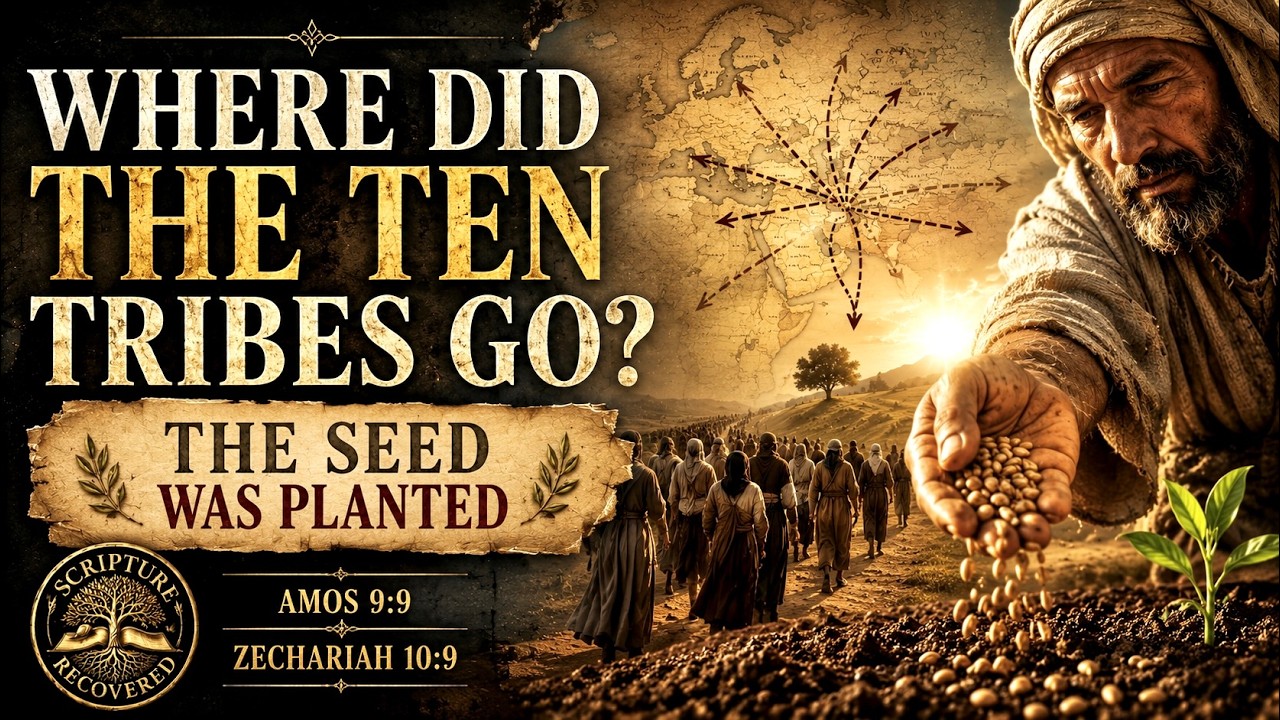
Begin with Zechariah. Writing after the Assyrian conquest had already happened — after the ten northern tribes had already been marched into captivity — he records God’s own description of what the scattering was. I will sow them among the people: and they shall remember me in far countries; and they shall live with their children, and turn again (Zechariah 10:9).
I will sow them. Not: I will scatter them in judgment. Not: I will allow them to be driven out. I will sow them. The first person singular. God’s own act. God’s own intention. The Assyrian army was not a catastrophe interrupting God’s plan for Israel. It was the farming implement God chose to break up the settled ground and place the seed in the nations. Sown among the people. Remembering God in far countries. Living and multiplying. Turning again. This is not the language of a people destroyed. This is the language of a seed planted with a specific expectation of return.
Jeremiah, writing in the generation before Jerusalem itself would fall, records God’s comprehensive statement of the entire process. Behold, the days come, saith the Lord, that I will sow the house of Israel and the house of Judah with the seed of man, and with the seed of beast (Jeremiah 31:27). Both houses. The northern kingdom and the southern. The whole of Israel — from the Assyrian scattering of the ten tribes to the Babylonian exile of Judah — sown into the earth. The agricultural metaphor is not applied to one branch of the nation but to the entire tree.
And Amos, preaching to the northern kingdom before it fell, adds an image of extraordinary precision. I will sift the house of Israel among all nations, like as corn is sifted in a sieve, yet shall not the least grain fall upon the earth (Amos 9:9).
A sieve. Not random scattering. Deliberate distribution — grain placed through a mesh with care, each kernel going exactly where the sifting directs it. And the promise attached is the most extraordinary detail in the verse: not the least grain shall fall upon the earth. Not one kernel of true seed will be wasted. Not one will fall in the bare dirt between the rows.
From a biblical-theological view, none of the communities scattered across the centuries sit outside the Farmer’s field — the Malabar Jews on the Kerala coast of India, the Beta Israel in the highlands of Ethiopia, the Kaifeng Jews from the interior of China, the Moroccan Jews, the Yemenite Jews, the Georgian Jews, the Jews of Persia and Babylon and Spain and the Rhine valley. No grain sits outside His field. No scattering is beyond His hand. The Farmer does not lose seeds.
What a Seed Does
But here is where the argument requires a moment of careful thought. Because the standard historical verdict on the ten northern tribes is not survival — it is assimilation. They were scattered, absorbed into surrounding peoples, lost their language and their religious distinctives, and ceased to exist as an identifiable people. They did not return as distinct tribal units after the Assyrian conquest. From the perspective of ancient ethnography, the assessment is broadly accurate.
And this is precisely where the agricultural metaphor becomes essential. Because this objection — the ten tribes assimilated, therefore they were lost — makes the same mistake as a person who walks into a field three weeks after sowing and announces that the seeds have been annihilated.
Technically accurate. Catastrophically wrong.
Because a seed, buried in the ground, ceases to be a seed. It loses its form. Its outer husk breaks down. Its individual identity is dissolved into the soil around it. The very process that looks like destruction from the outside is, from the inside, the beginning of everything. The dissolution of the seed is not the end of the story. It is the precondition of the harvest.
Assimilation was not the failure of God’s plan for the ten tribes. It was the mechanism of it. History can describe the disappearance of tribal identity. Scripture shows us what God was doing underneath that disappearance.
A seed that refuses to dissolve into the soil will not grow. Had every scattered branch of Israel been preserved only as a sealed enclave, the seed would have been present but not planted in the same way. Instead, the northern tribes dissolved. They became the soil’s own. Their seed was carried into the populations of Mesopotamia, Media, Persia, Asia Minor, Egypt, North Africa, Spain, the Indian coast — and the Gospel, when it came, centuries later, found prepared ground.
Verily, verily, I say unto you, Except a corn of wheat fall into the ground and die, it abideth alone: but if it die, it bringeth forth much fruit (John 12:24). Jesus speaks this of Himself — of His own death and resurrection and the harvest that would follow. But He was not inventing a new principle. He was stating the law that had governed Israel’s history for seven centuries before He arrived. The nation had been living this parable. The seed had been in the ground. And the much fruit was coming.
The Map That Should Shake Every Christian
If the thesis is correct — that the northern scattering was a divine sowing, and that the Gospel followed the trails of the diaspora — then there should be visible historical evidence. The seed-sown zones and the earliest Gospel expansion zones should substantially overlap.
They do.
This is not a minor coincidence. This is one of the most remarkable patterns in the history of civilisation — and it has been hiding in plain sight for two thousand years.
Consider the world into which the apostles carried the Gospel after Pentecost. Paul’s missionary journeys took him through Asia Minor — modern Turkey — into Macedonia and Greece, to Rome. These are many of the very regions where the Assyrian, Babylonian, and later Jewish dispersions had deposited Israelite seed across the preceding centuries.
But before Paul — look at the apostles themselves. Where did the Gospel go in the generation immediately after the resurrection? They went home carrying the Gospel along every road the diaspora had already prepared. Damascus had a significant Jewish population long established — and the Gospel reached it before Paul’s conversion on the road to persecute the believers already there. The seed was already in Damascus. The harvest had already begun when Paul arrived to destroy it.
Antioch in Syria became the great launching base for Gentile mission — the city where followers of Jesus were first called Christians. Antioch had one of the largest Jewish communities in the ancient world outside of Alexandria. The diaspora had put down deep roots. The synagogue was established. The God-fearers were numerous. When the Gospel arrived, it found prepared ground and grew so rapidly that a Gentile city became the centre of world mission within a generation of the resurrection.
Now they which were scattered abroad upon the persecution that arose about Stephen travelled as far as Phenice, and Cyprus, and Antioch, preaching the word… And the hand of the Lord was with them: and a great number believed, and turned unto the Lord (Acts 11:19–21).
They which were scattered abroad. The persecution that drove the Jerusalem believers out of the city — the very persecution that Saul of Tarsus had helped orchestrate — scattered them along the diaspora roads. Phoenicia. Cyprus. Antioch. These were not random destinations. They were the cities with established Jewish communities, the seed-sown zones where displaced Jewish believers would naturally travel — and where they would find, upon arrival, prepared soil ready to receive what they were carrying. The persecution that looked like a setback was another sowing. God was using the enemy’s own pressure to scatter the seeds of the Gospel along the same trails the original diaspora had already cut.
Paul’s Journeys as a Harvest Map
Read Paul’s three missionary journeys in Acts not as the travel itinerary of an individual evangelist, but as a systematic harvest of seeds that had been in the ground for centuries — and the map resolves into perfect coherence.
The first journey takes him through Cyprus and into the heart of Asia Minor — Antioch, Iconium, Lystra, Derbe. Regions with established Jewish communities. Cities on the trade routes that diaspora merchants had travelled for generations. The synagogues were there before Paul. The God-fearers were there before Paul. The soil was ready.
The second journey takes him further — into Macedonia and Greece. Philippi, Thessalonica, Berea, Athens, Corinth. The same pattern in every city: the synagogue first, the God-fearers, the prepared ground, the rapid growth.
And the apostolic letters confirm the agricultural reading of the diaspora explicitly. James, a servant of God and of the Lord Jesus Christ, to the twelve tribes which are scattered abroad, greeting (James 1:1). James was not using this as a vague metaphor for Christian believers generally dispersed around the Roman world. He was writing to the actual descendants of the twelve tribes of Israel — the seeds that had been sown into the nations — who were now, through the Gospel, coming alive in Christ. His letter has a specific, historically grounded recipient: the diaspora seed, now being harvested.
Peter opens his first letter in the same terms. Peter, an apostle of Jesus Christ, to the strangers scattered throughout Pontus, Galatia, Cappadocia, Asia, and Bithynia, elect according to the foreknowledge of God (1 Peter 1:1). The elect exiles of the dispersion — the same regions where the Assyrian and Babylonian scatterings had deposited Israel’s seed centuries earlier. The apostles were not writing into a vacuum. They were writing to fields that had been planted. And the fields were bearing fruit.
The Enemy Knows What Farmers Know
There is one more implication of the seed identity that must be named — because it explains something that secular history has never been able to adequately explain.
If Israel is the seed — the carrier of divine life sown into the earth — then the hatred that has followed the Jewish people across every century and every continent is not irrational. It is, from the enemy’s perspective, precisely rational.
In the parable of the Sower, it is the birds that devour the seed. In the Revelation, it is the dragon who makes war against the seed of the woman. John sees it plainly: And when the dragon saw that he was cast unto the earth, he persecuted the woman which brought forth the man child (Revelation 12:13). Cast down from heaven, his rage finds its target — the woman who brought forth the Messiah. And it does not end with her alone: And the dragon was wroth with the woman, and went to make war with the remnant of her seed, which keep the commandments of God, and have the testimony of Jesus Christ (Revelation 12:17).
This is not God’s wrath being poured out on Israel through human hands as punishment for rejecting her Messiah. This is the dragon’s wrath — Satan’s own fury, following his own casting down — directed at the woman and at her seed because of what they carry, not because of what they have done. The most hunted people in human history are hunted because of what they carry.
Farmers do not wage war against tares. They wage war against seeds.
Every attempt to destroy the Jewish people — from Pharaoh drowning the infant sons in the Nile, to Haman’s decree in Persia, to the Spanish Inquisition, to the Holocaust — has the same author and the same objective. Not ethnic hatred alone, though that is the instrument used. Behind every attempt at annihilation is the same intelligence that understood, from the garden of Eden onward, that the seed of the woman would bruise the serpent’s head. Kill the seed and the harvest cannot come. Destroy the people and the Messiah cannot arrive. Eliminate the covenant nation and the promises cannot be fulfilled.
Beneath every pogrom, every decree, every attempt at annihilation, the same old hatred of the seed can be heard.
And every attempt failed. Because the Farmer who placed the seed in the earth also guards it. The enemy, for all his cunning, cannot outgarden God.
The Faces of the Seeds Coming Home
And now — in our own generation — we are watching the most extraordinary visible confirmation of this ancient sowing that history has ever produced.
The modern return of Jewish people to the land of Israel — the aliyah of the last century and a half — has brought home faces from every corner of the earth: Jews from Ethiopia, Jews from India, Jews from China, Jews from Iraq, from Yemen, from Morocco, from Georgia, from Eastern Europe, from Persia, from Spain, and from beyond — gathered under one covenant identity, a people unlike anything the world has ever seen.
That breadth of appearance is exactly what we should expect from a people preserved through centuries of exile, migration, and return — seeds buried in every soil, now being called up out of the ground by the Farmer who placed them there.
This is not merely moving. It is a visible witness. The sieve of Amos 9 is being reversed before our eyes. What was scattered is being gathered. What was planted is coming home.
He shall cause them that come of Jacob to take root: Israel shall blossom and bud, and fill the face of the world with fruit (Isaiah 27:6). Fill the face of the world with fruit. Isaiah wrote that in the eighth century BC. He was not describing something he had witnessed. He was describing something he had been shown — a harvest so vast and so universal that it would cover the face of the earth as completely as a field in full fruit covers the ground beneath it.
We are living in the middle of that harvest. Most of us do not know whose seeds are under our feet.
Now we do.
The Assyrian as Plough
One more image is needed before this argument can close. What instrument did the Farmer use?
O Assyrian, the rod of mine anger, and the staff in their hand is mine indignation. I will send him against an hypocritical nation, and against the people of my wrath will I give him a charge (Isaiah 10:5–6).
The rod of mine anger. God used the most brutal empire of the ancient world as His farming implement. The Assyrian army was the plough that broke up the settled ground of northern Israel and scattered the seed into the nations. And when the ploughing was done, God dealt with the plough as well. Assyria fell. Babylon fell. Rome fell. Every empire that God has used as a farming implement has been set aside when the work was complete — because the implement is never the point. The harvest is the point. And the harvest belongs to the Farmer, not the plough.
Only a God of infinite patience and infinite purpose could work like this. Only a God who sees the end from the beginning could look at ten tribes being marched into captivity and call it a sowing. Only a God who loves the world enough to spend centuries preparing its soil before He sends the Gospel could engineer history on this scale.
How Much More Their Fulness
We are now standing at the end of a single argument followed across three articles, from its beginning to its present unfinished state.
God chose the smallest seed. He trained it through a thousand years of priestly discipline in blood. He scattered it into every soil on earth — not merely in punishment, but in planting. He sent the Seed of seeds — the grain of wheat that fell into the ground and rose again — bearing fruit that has never stopped multiplying for two thousand years. He guarded the seed against the dragon who hunted it in every century and could not destroy it. He called it home from every corner of the earth in our own generation.
And the harvest is not complete.
Now if the fall of them be the riches of the world, and the diminishing of them the riches of the Gentiles; how much more their fulness? (Romans 11:12).
How much more. Three words that contain the entire unanswered question of the age. Everything traced across this series — the crime, the gift, the sowing, the diaspora trails, the Gospel harvest covering the earth — all of that is the fruit of the fall. The riches of the world produced by the diminishing of Israel.
And the fulness is still coming. The bones are still coming home. The veil is still partially in place. The one new man is still being formed. The knowledge of the Lord has not yet covered the earth as the waters cover the sea. The last sheaf has not yet been gathered in.
But the Farmer is still in the field.
And the God who chose the smallest seed, who trained it in blood, who scattered it into the nations, who sent His own Son as the Seed of seeds, who has been gathering the harvest for twenty centuries without interruption — that God does not abandon harvests.
He finishes what He plants.
The harvest is vast. The fulness is still coming. And the Farmer who planted it knew — from before the foundation of the world — exactly what He was doing.
B.V. Thomas is the author and theologian behind The Hermeneutical Quill, a platform reaching readers across 170+ countries. This article is adapted from the Scripture Recovered video teaching series.
Subscribe to Scripture Recovered on YouTube — and visit bvthomas.com for more.
Scripture references in this article: Deuteronomy 7:7 · Zechariah 10:9 · Jeremiah 31:27 · Amos 9:9 · John 12:24 · Acts 11:19–21 · James 1:1 · 1 Peter 1:1 · Revelation 12:13, 17 · Isaiah 10:5–6 · Isaiah 27:6 · Romans 11:12
Before we turn the cross around, I need to hold something in front of you.
A mirror.
Because what follows — the gift, the debt, the staggering weight of what Israel gave the world — will not land where it needs to land unless you first see clearly what is standing in the way of it landing.
This video presentation is based on the article below, adapted for the Scripture Recovered series. The full written study follows underneath for reading, reference, and further reflection.
Paul, in Romans 11, turns from his argument about the fall and the riches and the fulness and addresses the Gentile believer directly. Not gently. With a warning that centuries of Christian history have largely ignored, and the ignoring of which has produced some of the darkest chapters in the Church’s record.
“And if some of the branches be broken off, and thou, being a wild olive tree, wert grafted in among them, and with them partakest of the root and fatness of the olive tree; boast not against the branches. But if thou boast, thou bearest not the root, but the root thee” (Romans 11:17–18).
The wild olive. That is what you are. That is what every Gentile believer is, by birth and by nature — a shoot cut from a tree that produced no covenant, no Scripture, no Messiah, no apostles, no Gospel. Grafted in — contrary to nature, Paul says in verse 24 — to a tree you did not plant, drawing from a root you did not grow, partaking of a fatness you did not produce.
And Paul’s word to that wild olive branch is plain: boast not against the branches.
But the Church has boasted. For centuries. In theology — replacing Israel with itself, absorbing the promises while discarding the people, reading the Old Testament as though it were a preface that the New Testament has made obsolete. In history — the Crusades, the Inquisition, the pogroms, the forced baptisms, the ghettos, the theological poison that flowed from supersessionist pulpits into the streets and eventually into the gas chambers.
The grafted branch turned on the root.
And Paul says: if you do that — if you boast against the branches, if you hold the root in contempt — understand what you are doing. Thou bearest not the root, but the root thee. You are not sustaining the covenant. The covenant is sustaining you. Cut the root and you do not damage the root. You die.
“Because of unbelief they were broken off, and thou standest by faith. Be not highminded, but fear: for if God spared not the natural branches, take heed lest he also spare not thee. Behold therefore the goodness and severity of God: on them which fell, severity; but toward thee, goodness, if thou continue in his goodness: otherwise thou also shalt be cut off” (Romans 11:20–22).
Goodness and severity. Both faces of the same God. The severity that fell on the natural branches was not arbitrary — it was the judicial blindness examined in the previous article in this series, the necessary veil, the ordained hardening that made the cross possible. But Paul’s point here is not to explain the severity. It is to warn the wild branch: you stand by grace, not by right. The same God who broke off the natural branches for unbelief will not hesitate to remove you for pride.
And then — the verse that contains the whole future.
“And they also, if they abide not still in unbelief, shall be grafted in: for God is able to graff them in again. For if thou wert cut out of the olive tree which is wild by nature, and wert grafted contrary to nature into a good olive tree: how much more shall these, which be the natural branches, be grafted into their own olive tree?” (Romans 11:23–24).
How much more. The same compression Paul used in verse 12. If the wild branch was grafted in contrary to nature — against all biological logic, against every expectation — how much more shall the natural branches, the ones who belong to the tree by birthright, be grafted back in? Their return is not unlikely. It is the most natural thing in the world. God is able. And God intends.
The mirror has been held. The boasting has been named and refused. Now — and only now — are we in the right posture to turn the cross around.
The Two Faces
The previous article named the crime. This one turns the cross around.
Not to minimise the crime. Not to pretend the injustice was not injustice, or the blood was not blood, or the suffering was not suffering. But to look at what was accomplished — what was purchased, what was opened, what was made possible — by the very act that human history will forever call its darkest moment.
Because the cross has two faces.
From the front — the face of human sin and judicial murder. The worst act ever committed by any creature against the Creator. The Son of God handed over, stripped, beaten, nailed to a Roman instrument of execution outside the city walls. Abandoned by His disciples. Mocked by the crowd. The innocent in the place of the guilty — and the guilty crying for more.
From the back — the face of divine love and infinite mercy. The most deliberate and costly act of self-giving in the history of the universe. The eternal Son, in an act that no one could compel and nothing could coerce, laying down a life that was His own to lay down, bearing the full weight of every sin committed by every human being who had ever lived or would ever live, absorbing the wrath that belonged to the guilty so that the guilty could stand in the place of the innocent.
Both faces belong to the same event. You cannot have the gift without the crime. You cannot have the atonement without the sacrifice. You cannot have the open heaven without the torn veil — and the veil was torn from top to bottom because the Lamb was slain.
That veil deserves a moment’s attention, because most people who have read that sentence their entire lives have never been told what it actually was. It was not a curtain in any ordinary sense. Jewish historical sources describe it as sixty feet high, thirty feet wide, and a handbreadth thick — approximately four inches of densely woven fabric, constructed in Babylon, so massive that it required hundreds of priests to handle it. It was, by every human measure, untearable. Its entire purpose was architectural theology — the physical, permanent, unarguable declaration that sinful humanity could not pass into the presence of the holy God. The holy of holies lay behind it. No one entered except the high priest, once a year, on the Day of Atonement, with blood.
When that veil tore, it did not fray. It did not split under the pressure of an earthquake, as though the ground shaking had weakened the seams. It tore — from top to bottom. Not from the bottom as a man would tear it, reaching up and pulling down, but from the top, as only God tears, reaching down from His side of the separation and removing what He Himself had put in place.
The way into the holy of holies — barred since the garden, sealed by the Law, guarded by the veil across a thousand years of sacrificial worship — was opened in the moment the final sacrifice was complete. Not by human achievement. Not by religious performance. Not by accumulated piety or priestly qualification. By blood. By the Lamb.
The same people whose hands were on the knife are the people through whom the knife was provided. The same nation whose No to the Messiah made the cross possible is the nation through whom the Messiah came. Their fall was the riches of the world. Their scattering was the sowing of the Gospel. Their rejection was the opening of the door through which every Gentile believer has walked into the family of God.
This is the gift that came wrapped in the crime.
The Fall That Became Riches
Paul, in Romans 11, makes a statement so compressed and so vast that it is possible to read it a hundred times and still not have taken in its full weight.
“I say then, Have they stumbled that they should fall? God forbid: but rather through their fall salvation is come unto the Gentiles, for to provoke them to jealousy. Now if the fall of them be the riches of the world, and the diminishing of them the riches of the Gentiles; how much more their fulness?” (Romans 11:11–12).
Through their fall — salvation came to the Gentiles. Not despite their fall. Through it. The fall was the mechanism of the salvation, not an obstacle to it. God did not rescue His plan for the Gentiles in spite of Israel’s rejection of Christ. He executed His plan for the Gentiles by means of it.
Every Gentile believer in the history of the world received the Gospel because Israel said No. Because the disciples, turned away from the synagogues and the established religious structures of Jerusalem, took the message to the nations. Because Paul — whose strategy was always to go to the Jew first, and then to the Greek — found the doors of the synagogues closing and turned, again and again, to the Gentile world. Because the fall of the branches created the space through which the wild olive was invited in.
And then Paul asks the question that should make every Gentile believer sit down in stunned silence. If the fall of them produced such riches — if Israel’s diminishing was the enrichment of the entire Gentile world — how much more their fulness?
He answers it in only three words: life from the dead. Not revival. Not renewal. Not a large harvest. The restoration of Israel in its fulness will be to the world what resurrection is to death — the single most transformative event in human history since the cross itself. Paul plants that seed in Romans 11 and does not fully explain it, because the explanation belongs to the end of the age, to the fullness that is still coming, to the day when the veil lifts and the nation looks upon Him whom they pierced and mourns, and the Lord gathers what He scattered, and the dry bones stand as an exceeding great army.
But before that fullness arrives, stay with the fall. Stay with what the No produced. The one new man has not yet begun to fully understand the scale of what it received through Israel’s rejection. And until it does, it cannot properly love the people through whom it received it.
What the Fall Actually Gave You
Let me be specific. This is where the theology must become personal — must become inventory — must become the kind of reckoning that produces not guilt but genuine, structural gratitude.
What did you receive through Israel’s fall?
The Scriptures. Every word of the Old Testament — the Torah, the Prophets, the Writings — preserved across a thousand years of exile, persecution, and attempted annihilation, copied with a precision that makes the Dead Sea Scrolls nearly identical to manuscripts written a millennium later. Every word of the New Testament — written by Jewish hands, rooted in Jewish covenant, explicable only within Jewish categories of thought. You did not produce this. You received it. From them.
The Messiah. Born in Bethlehem, of the tribe of Judah, of the lineage of David. He did not arrive as a generic human being from a generic nation. He came as the specific fulfilment of specific promises made to a specific people across a specific history. The Lion of the tribe of Judah. The Root of David. He is Jewish. His humanity is Jewish. The flesh in which the eternal Word tabernacled on this earth is Jewish flesh. You received your Saviour from them.
The apostles. Every man Jesus chose to carry the Gospel to the world was Jewish. Peter and James and John — Jewish. Matthew the tax collector — Jewish. Paul, the apostle to the Gentiles, the man whose letters form the theological backbone of the New Testament — a Hebrew of Hebrews, of the tribe of Benjamin, a Pharisee. The good news that God so loved the world — first articulated, first preached, first written down, first carried to the nations at enormous personal cost — by Jewish believers for whom it cost everything.
The door. Every Gentile believer in the history of the world walked into the family of God through a door that was opened by Israel’s fall. The No that sent the Gospel to the Gentiles. The rejection that created the road Paul walked to Rome. The scattering that prepared the synagogue infrastructure in every major city of the ancient world — the same infrastructure that became the first beachhead for the Gospel in every city the apostles entered.
You received all of this because of Israel’s fall. Because of the cross — that great crime and that greater gift — performed by Jewish hands on a Jewish hill in a Jewish city at the centre of a Jewish history that God had been writing since He called a wandering herdsman out of Ur of the Chaldees and said: In thee shall all families of the earth be blessed (Genesis 12:3).
All families. You are one of them. And the blessing that reached you came through them.
The Root and the Branch
Paul’s image of the olive tree is not decorative. It is anatomical. It describes a biological reality that has spiritual weight.
The root bears the branches. Not the other way around.
Every Gentile believer in the history of the world has been sustained by a root they did not plant, in a tree they did not grow, drawing from a fatness they did not produce. The arrogance of the grafted branch toward the natural branches is not merely ungrateful — it is biologically absurd. Cut the root and the branch dies. Honour the root and the branch flourishes.
And the root is Israel. The covenants. The adoption. The glory. The promises. The Scriptures. The Messiah. The entire spiritual infrastructure of redemption that God built through Abraham, through Moses, through David, through the prophets, through the priesthood, through the exile, through the return — all of it is the root. All of it is the fatness from which every Gentile believer draws life.
This is not a courtesy extended to outsiders. This is the anatomy of the one new man. The Gentile is not a full member of an institution that was always essentially Gentile but happens to have Jewish origins politely acknowledged. The Gentile is a wild branch grafted, contrary to nature, into a tree that was always Jewish, sustained by a root that is always Jewish, bearing fruit from a fatness that is always Jewish.
That changes everything about the posture. Not guilt. Not a new form of spiritual debt that paralyses rather than frees. But the clean, clarifying, liberating gratitude of a person who finally knows what they owe and to whom they owe it — and who finds, in that knowing, a love for Israel that is not manufactured by effort or obligation but is simply, inevitably, true.
There is a question every Gentile believer quietly carries. Sometimes spoken, more often not. But it sits beneath the surface of everything we have been saying.
Does God still love them? In their present condition. With the veil still partially in place. With the fulness not yet arrived. With the long centuries of blindness and wandering still unresolved.
Paul answers it in Romans 11:28, and he does not soften it, qualify it, or defer it to a future condition. As concerning the gospel, they are enemies for your sakes: but as touching the election, they are beloved for the fathers’ sakes.
Two things simultaneously. Enemies concerning the gospel — the judicial blindness, the rejection, the No at the cross. That is real. Paul does not withdraw it. But — as touching the election, they are beloved. Not were beloved. Not will be beloved when they return. Are. Present tense. Active. Unrevoked. The love of God toward Israel is not in abeyance pending their national repentance. It is operative now, in this moment, in their present condition — because it rests not on their response but on the covenant God made with their fathers, Abraham, Isaac, and Jacob. And God does not break covenant.
Verse 29 seals it: For the gifts and calling of God are without repentance. Without repentance — ametamelēta in Greek. Irrevocable. Not subject to revision. Not contingent on Israel’s behaviour, the Church’s theology, or the world’s politics. The gifts and the calling stand. The beloved stands. Because the One who gave and called does not change His mind.
This is the God whose cross we have been standing before. The God who ordained the crime. The God who provided the gift. The God who veiled the eyes of the ones whose hands He needed. The God who grafted the wild branch into a root that still, at this moment, bears the love He has never withdrawn. That is the God whose depth Paul could only respond to with an O.
The Debt Paul Names
Paul does not leave this gratitude as a vague spiritual feeling. He names it as a specific, practical obligation.
The Gentile churches of Macedonia and Achaia were taking up a financial collection for the Jewish believers in Jerusalem who were suffering poverty. Paul describes that collection not as charity but as debt repayment: It hath pleased them verily; and their debtors they are. For if the Gentiles have been made partakers of their spiritual things, their duty is also to minister unto them in carnal things (Romans 15:27).
Their debtors they are.
The Gentiles are debtors to the Jewish believers — not because of a financial transaction but because of a spiritual one. Partakers of their spiritual things — the entire inheritance of salvation, from the Scriptures to the Messiah to the apostolic mission to the covenant promises — came through Israel. The material response is the least, the very least, that gratitude can offer.
But before the material response comes something more fundamental: the posture. The posture of a branch that knows it is a branch. The posture of a wild olive that knows it was grafted in — that it did not earn its place, that the root is not indebted to it but it to the root.
That posture is what the Church has consistently failed to hold. And the failure has been catastrophic — not only for Israel, who bore the violence of it, but for the Church itself, which in turning against the root has repeatedly sawn off the branch it was sitting on.
The Other Face
Now — with the mirror held, the inventory taken, the posture established — we can look at the back of the cross with the full weight it deserves.
From the divine side, the cross is not a crime redeemed. It is not a tragedy absorbed. It is not a human failure that God, in His mercy, managed to turn to good purpose. It is the most deliberate, the most costly, the most precisely executed act of love in the history of the universe.
The eternal Son did not stumble into Calvary. He walked toward it. From before the foundation of the world — the Lamb slain from the foundation of the world (Revelation 13:8) — this was the plan. The plan behind the plan. The purpose beneath every other purpose. The answer that was being prepared before the question was asked.
He walked into Jerusalem knowing every detail of what the prophets had written about this week. He went to Gethsemane knowing what the cup contained. He said — not as resignation but as sovereign declaration — not my will, but thine be done. And He went to the cross not as a victim led to slaughter but as a High Priest entering the holy of holies — the final, sufficient, once-for-all offering — carrying in His own body the sin of the world that the blood of bulls and goats across a thousand years of faithful sacrifice had never been able to remove.
For it is not possible that the blood of bulls and of goats should take away sins (Hebrews 10:4). Not insufficient. Not possible. The entire Levitical system, magnificent and meticulous as it was, was operating with the wrong currency. Animal blood cannot purchase human souls. What sin against an infinite God requires for its final settlement is a payment of infinite worth. And the only Person in the universe qualified to make that payment walked up the hill outside Jerusalem carrying it.
Therefore doth my Father love me, because I lay down my life, that I might take it again. No man taketh it from me, but I lay it down of myself (John 10:17–18). Caiaphas did not take it. The Sanhedrin did not take it. Rome did not take it. The crowd did not take it. He laid it down. Deliberately. Freely. For the joy that was set before Him — the joy of what the death would purchase, the joy of the sons and daughters He would bring to glory, the joy of presenting to the Father a redeemed humanity that the Father had given Him before the world began (Hebrews 12:2).
This is the back of the cross. From the front — the worst act ever committed by any creature against the Creator. From the back — the most loving act ever performed by anyone, anywhere, in the entire history of the universe.
And both faces belong to the same event. You cannot separate them. You cannot have the gift without the crime. The crime was the gift. The gift required the crime. And the people through whose hands the crime was performed are the people through whom the gift was provided.
Hallelujah
The greatest crime in history was the greatest gift in history.
Those two sentences are not in tension. They are the same sentence, read from two different sides of the same cross.
From the human side: an innocent man was murdered by a conspiracy of religious and political power, abandoned by His friends, mocked by the crowd, hung on a Roman instrument of execution outside the city walls. A crime. The worst crime. The blood of the innocent on guilty hands.
From the divine side: the eternal Son, in an act of inconceivable love, willingly laid down a life that no one could have taken from Him, bore the full weight of human sin and divine wrath simultaneously, cried out in the desolation of abandonment — My God, my God, why hast thou forsaken me — and then, having finished what He came to do, yielded up His spirit into His Father’s hands.
It is finished (John 19:30). One word in Greek. Tetelestai — written across a debt account in the ancient world when the full amount had been paid. Paid in full. The debt is discharged. The account is settled. Nothing more is owed.
And the people through whose hands this transaction was made possible — those people are not our enemies. They are not objects of contempt or theological dismissal. They are not a people God has set aside, replaced, or forgotten.
They are the people through whom our salvation came.
Every Christian who loves Jesus — who has knelt at that cross, who has felt the weight lifted, who has known the Father’s embrace, who has tasted even once the freedom of a forgiven conscience — owes those people a gratitude that has no adequate human expression.
We owe them our lives.
O the Depth
Paul brings the entire eleventh chapter of Romans — the most sustained theological treatment of Israel’s past, present, and future in the New Testament — to a close not with a proposition but with a doxology.
After eleven chapters of carefully argued theology. After three chapters of unrelenting focus on the mystery of Israel and the Gentiles. After the hardening and the fall and the riches and the fulness and the olive tree and the grafting and the life from the dead — Paul arrives at a place where the only adequate response to what he has seen is worship.
“O the depth of the riches both of the wisdom and knowledge of God! how unsearchable are his judgments, and his ways past finding out! For who hath known the mind of the Lord? or who hath been his counsellor? Or who hath first given to him, and it shall be recompensed unto him again? For of him, and through him, and to him, are all things: to whom be glory for ever. Amen” (Romans 11:33–36).
O the depth. Not: what a reasonable plan. Not: what a satisfying theological framework. Not: what a well-structured argument. O the depth — the exclamation of a man who has been staring into an abyss of wisdom so vast that his categories for understanding have been overwhelmed and only wonder remains.
This is the right response to everything this series has been saying. The choosing of the smallest seed. The thousand years of priestly training. The scattering into every soil on earth. The judicial blindness that came into the world with Christ Himself. The determinate counsel. The wicked hands. The ordained ignorance. The Caiaphas who prophesied. The crowd who cried His blood be on us and spoke truer than they knew. The tetelestai. The torn veil. The fall that became riches. The diminishing that enriched the world. The wild branch grafted in contrary to nature. The debt that is real and the fulness that is coming.
None of this was improvised. None of it was a contingency plan. None of it was God responding to human failure with a revised strategy. All of it — every thread of it, from Genesis 12 to the present day and beyond — was the outworking of a wisdom so deep that Paul, the most theologically sophisticated mind the first century produced, could only respond to it with an O.
The crime has been named. The gift has been received. The debt has been acknowledged.
In the next article, we follow the question Paul leaves open — the fulness, the life from the dead, the bones coming home. Because the Sower is still in the field, and the last sheaf has not yet been gathered in.
Continue with the next episode in this series: Israel as Seeds — The Scattering Was Not Merely Punishment. It Was Planting.
B.V. Thomas is the author and theologian behind The Hermeneutical Quill, a platform reaching readers across 170+ countries. This article is adapted from the Scripture Recovered video teaching series.
Subscribe to Scripture Recovered on YouTube — and visit bvthomas.com for more.
I want to say something that the Church has largely flinched from saying.
Not because it is hidden. Not because it requires secret knowledge or obscure scholarship. It is written in plain letters across the New Testament, available to anyone who reads carefully and follows the logic all the way to its conclusion.
The Church has flinched because the conclusion, when you arrive at it, is so large and so overturning that it is difficult to contain.
Here it is.
This video presentation is based on the article below, adapted for the Scripture Recovered series. The full written study follows underneath for reading, reference, and further reflection.
The crucifixion of Jesus Christ — the most consequential event in the history of the universe — came through Israel’s official and representative No to her Messiah. In the story Scripture actually gives us, the cross does not come through Israel’s national enthronement of the Messiah. It comes through Israel’s official rejection of Him.
The Lamb of God had to be examined, declared innocent, and deliberately slaughtered by the very people who had been waiting for Him. That was not a tragic accident of history. That was not a contingency plan God scrambled to redeem after things went wrong. That was the plan — announced in the prophets, embedded in the Passover, encoded in a thousand years of priestly training, and executed at the moment of God’s own choosing with a precision that leaves no room for the word coincidence.
And the people through whose hands it was performed did not know what they were doing.
That last sentence is not an excuse. It is a theological description — perhaps the most extraordinary theological description in the entire New Testament — of what divine sovereignty actually looks like when it operates at full depth.
The Determinate Counsel: Two Rails, One Track
We begin at Pentecost.
Fifty days after the crucifixion. The disciples are gathered in Jerusalem. The Holy Ghost has just fallen. And Peter stands up — the same Peter who denied the Lord three times, the same Peter who wept bitterly in the courtyard — and preaches the first sermon of the Church age. In that sermon, he says something that should stop every careful reader cold.
Him, being delivered by the determinate counsel and foreknowledge of God, ye have taken, and by wicked hands have crucified and slain (Acts 2:23).
Peter holds two things together in a single breath that most of our theology has never managed to hold together since. First: delivered by the determinate counsel and foreknowledge of God. That word — determinate — is the Greek horizō, from which we get the English word horizon. It means a fixed boundary. A predetermined limit. A decision made before the event that the event cannot escape. The crucifixion was not a tragedy that God absorbed into His plan after the fact. It was the plan — fixed in eternity, known before the foundation of the world, delivered to the cross on God’s own timetable.
Second: by wicked hands have crucified and slain. The hands were wicked. The act was a crime. The guilt was real.
Both of these things are true simultaneously. And their simultaneous truth is the most theologically precise statement in the entire New Testament about what happened at Calvary.
The crucifixion was ordained — and it was a crime. It was foreknown — and it was culpable. It was necessary — and it was unjust. These are not contradictions to be resolved by choosing one side. They are the two rails of the same track, and the train of redemption runs on both of them simultaneously.
The Church has been uncomfortable with this for two thousand years. We tend to emphasize one rail and neglect the other. Either we emphasize the sovereignty — God planned it, so the crime is swallowed up — or we emphasize the guilt — the crime was real, so we must be careful not to blame any particular people. And in both directions, we lose something we cannot afford to lose.
Peter loses neither. He stands before the very crowd that fifty days earlier was crying Crucify — and he holds both rails in front of them without flinching. That is where we must stand today.
A Thousand Years of Blood
But before we reach Calvary, we must go back — back a thousand years. Because what happened on that Friday outside Jerusalem did not begin on that Friday. It began at Sinai.
The moment God declared His purpose for Israel, He gave them a title that should have shaken the ancient world: Ye shall be unto me a kingdom of priests, and an holy nation (Exodus 19:6). Not a kingdom with priests. A kingdom of priests. Every member of the nation bearing a priestly identity. Every family a branch of the great sacrificial institution that stood at the centre of their national life.
Paul would later say the same thing in Romans 9:4–5 with a comprehensiveness that should silence every supersessionist reading of Israel’s story: to whom pertaineth the adoption, and the glory, and the covenants, and the giving of the law, and the service of God, and the promises; whose are the fathers, and of whom as concerning the flesh Christ came. The adoption. The glory. The covenants. The giving of the Law. The service of God. The promises. The fathers. And from them, according to the flesh — Christ came. Israel was not a background nation in the story of redemption. Israel was the covenant vessel into which God had placed the entire grammar of salvation. Every category of divine self-disclosure — every promise, every covenant, every act of priestly service — entrusted to this people. Which means the cross, when it came, came rightly and necessarily within Israel’s covenantal world.
And from that moment, God opened a school. A school that would run for a thousand years. And the curriculum, every single day, was the same.
Every morning, without fail — a lamb is brought. Unblemished. Carefully chosen. Without spot or defect. Hands are laid upon its head — a gesture of transfer, of identification: the weight of the offerer’s guilt passing from the one who deserves to die to the one who will die in his place. The blade falls. The blood flows. The priest catches it, carries it to the altar, sprinkles it where God has said His presence dwells. The smoke rises. The act is complete.
This happened every morning. Every evening. Every Sabbath, doubled. Every new moon, expanded. Every Passover, every Day of Atonement, every feast — the lambs multiplied, the blood flowed, the priests performed their ancient, meticulous, blood-soaked liturgy with absolute precision, because the Law of Moses specified every detail, and deviation meant death. Generation after generation of priests born, trained, ordained, served, and died — and their sons after them — all performing this same ritual, all speaking the same wordless sermon to anyone who had ears to hear it: Something must die for sin to be covered. Blood must be shed. The innocent must bear the weight of the guilty. There is no other way.
For a thousand years, Israel went to school in blood.
And every detail of that schooling mattered. Because every gesture was a word in a language being written across ten centuries — a language that would only be fully read on one specific afternoon outside Jerusalem.
The sacrificial law required that the offering be without blemish, that it cost the offerer something, that it be the offerer’s own. Then came the laying on of hands — not a blessing but a transfer, a deliberate, embodied declaration that the guilt belonging to the one standing upright would now be carried by the one about to fall. Then the animal was slaughtered. And here is the detail the Church has glossed over for centuries.
Not by the priest alone.
The offerer himself participated in the killing. The sinner’s own hands were involved in the death of the substitute. There was no comfortable distance, no clean separation between guilt and consequence. The one who had sinned held the knife. This was designed to be felt. For the life of the flesh is in the blood: and I have given it to you upon the altar to make an atonement for your souls: for it is the blood that maketh an atonement for the soul (Leviticus 17:11).
Who Must Hold the Knife
We arrive now at the question this entire history has been building toward. Before we ask it, one thing must be said clearly. What follows is not a charge of ethnic guilt. It is the opposite. It is the recognition of Israel’s unique covenantal office. The knife had to be in Israel’s hands because the altar, the priesthood, the promises, the Scriptures, the Passover, and the Lamb-language had been entrusted to Israel alone. No other nation carried that office. No other nation could have fulfilled it. What we are about to see is not accusation. It is the most extraordinary priestly appointment in the history of the world.
In the Mosaic system — who kills the lamb?
The sinner does.
The one whose guilt is being transferred to the animal. The one who has placed his hands on its head. It is the transgressor who participates in its death. This is not incidental. It is not a procedural detail that could have been arranged differently. It is the theological core of the entire act. The transgressor must be present. The transgressor must be involved. You cannot send a proxy to confess your own sin.
Now follow that principle to its conclusion.
When the true Lamb arrives — when God provides the final, sufficient, infinite sacrifice that the entire Levitical system has been pointing to — who must hold the knife? The transgressor. And who are the transgressors? Who are the ones under the Law, under the covenant, who have broken it and need it to be fulfilled on their behalf?
When the fulness of the time was come, God sent forth his Son, made of a woman, made under the law; to redeem them that were under the law (Galatians 4:4–5). The first beneficiaries of the atonement are those who were under the Mosaic covenant — Israel. And therefore Israel, as the transgressor under the Law, as the nation whose sin the Lamb would bear, as the people whose hands had been trained for a thousand years in the act of sacrificial offering —
Israel must stand as the nation whose hands are on the knife when the final Lamb is slain.
This is not an accusation. It is a description of a priestly act. The most consequential priestly act in the history of the world. No other nation on earth could have performed it. The Romans could execute — but they had no framework for what the blood meant. The Greeks could philosophise about death — but they had no altar. No other people had spent a thousand years learning, in their hands and in their bodies, the precise liturgical grammar that Calvary would require.
Only Israel. Trained across ten centuries by God Himself. In blood. For this.
The Judicial Blindness
If their hands needed to be on that knife — then the question that follows is urgent. Why did Israel not recognize Him?
The answer most Christian theology has given: because they were hard-hearted. Spiritually blind. Proud. There is truth in that, as far as it goes. But that answer is incomplete — it makes Israel’s blindness merely a human failure, when the New Testament describes it as something far more specific and sobering than that.
Paul, in Romans 11, calls it a hardening: Blindness in part is happened to Israel, until the fulness of the Gentiles be come in (Romans 11:25). Blindness in part — partial, targeted, judicially imposed. It has a duration, a purpose, and a terminus. It is not permanent. It is not arbitrary. It is the veil God placed over the face of the nation for exactly as long as the veil was needed.
But Paul’s retrospective theology is not where this truth originates. Jesus declared it Himself — in His own words, about His own mission, before the cross had even arrived. For judgment I am come into this world, that they which see not might see; and that they which see might be made blind (John 9:39).
He did not say: blindness has unfortunately fallen upon some as a consequence of their pride. He said: I came to enact it. The blinding of those who were certain they could see — the religious establishment, the Sanhedrin, the guardians of the sacrificial system — was not something that happened to the situation around Him. It was something He brought with Him from the moment He stepped into Galilee. The Pharisees’ own question — Are we blind also? — and His answer — If ye were blind, ye should have no sin — reveals the devastating precision of it. Their very confidence in their own sight was what sealed them. And it was the closed ones whose hands were needed for what was coming.
He came carrying the judgment that would produce the blindness. He walked into Jerusalem knowing that the veil He had brought would ensure the knife would not be stayed.
Jesus described the mechanism further in His explanation of the parables: Because they seeing see not; and hearing they hear not, neither do they understand. And in them is fulfilled the prophecy of Esaias (Matthew 13:13–14). He was not frustrating their understanding arbitrarily. He was fulfilling Isaiah’s description of a judicial hardening that God Himself had ordained for this people at this time for this purpose. The parables concealed as much as they revealed. And the concealment was necessary.
Paul tells us why: Which none of the princes of this world knew: for had they known it, they would not have crucified the Lord of glory (1 Corinthians 2:8). Had they known it, they would not have done it. The crucifixion required ignorance to proceed. The most consequential act in the history of the universe had to be performed by participants who did not understand its true nature — because if they had understood, self-interest alone would have caused them to stop. Satan would have restrained his own agents. Caiaphas would have bowed rather than condemned. The mob would have cried Hosanna rather than Crucify. And the world would have remained unredeemed.
God therefore ordained — not merely permitted, ordained — that the truth of what was happening be hidden from those whose hands were required for it. For a small moment have I forsaken thee; but with great mercies will I gather thee. In a little wrath I hid my face from thee for a moment; but with everlasting kindness will I have mercy on thee, saith the Lord thy Redeemer (Isaiah 54:7–8). A small moment. A hiding of the face. Everlasting kindness to follow.
The blinding was not permanent. It was not total — the elect remnant saw clearly, from Simeon in the temple to Anna the prophetess, from John the Baptist to Mary who pondered all these things in her heart. But those whose hands needed to be on the knife were veiled, for exactly as long as the veil was needed.
And this judicial blindness did not operate only at Calvary. It continued working through the book of Acts — city by city, synagogue by synagogue — as an ongoing mechanism driving the Gospel outward into the Gentile world with a force that no human strategy could have engineered.
Watch Paul at Pisidian Antioch. The synagogue is full. The word is preached. The Jewish leaders contradict and blaspheme. And Paul turns and says what Romans 11 had already told us would happen: It was necessary that the word of God should first have been spoken to you: but seeing ye put it from you, and judge yourselves unworthy of everlasting life, lo, we turn to the Gentiles (Acts 13:46). This is not Paul losing his temper. This is the judicial blindness of Romans 11 operating visibly, in a specific city, on a specific Sabbath — producing the specific turn toward the Gentiles that the blindness was always designed to produce.
The rejection at Antioch sends Paul to the Gentiles of that city. The rejection at Thessalonica sends him further. The rejection at Corinth sends him further still. Every synagogue door that closes is a Gentile door that opens. Had they not rejected — we would not have received the word the way we received it. Acts 13:46 is Romans 11:11 with faces and names and a specific place on the map.
The Lamb Arrives at the Appointed Hour
And then the Lamb walked into Jerusalem. Not in spite of what was coming. Toward it. Deliberately. Knowingly. With full awareness of every detail the prophets had written about this week.
He entered the city on the tenth day of Nisan — the exact day the Passover lamb was to be selected and brought into the household for examination. He spent four days in the temple courts being questioned by every faction — Pharisees, Sadducees, Herodians, scribes — and not one of them could find a blemish in His answers. The examination of the Passover lamb, enacted on the scale of a nation.
And on the fourteenth day of Nisan — the exact day the Passover lamb was to be slaughtered, at the exact hour the lambs were being killed in the temple courts below — He was lifted up. The timing is not coincidence. It is the most precise theological statement in history — written not in words but in the calendar of God.
John the Baptist had named Him at the beginning of His ministry: Behold the Lamb of God, which taketh away the sin of the world (John 1:29). Not the sin of Israel only. The sin of the world. The final, sufficient, once-for-all sacrifice that the entire Levitical system had been pointing toward since Moses laid the first ordinances on the people in the desert.
And Caiaphas — the man who had conspired to have Jesus arrested, whose house became the location of an illegal night trial, who tore his own garments in theatrical outrage — said something that John records with extraordinary theological care: It is expedient for us, that one man should die for the people, and that the whole nation perish not. And this spake he not of himself: but being high priest that year, he prophesied (John 11:50–51).
He prophesied. Caiaphas thought he was doing political calculus. He thought he was protecting the nation from Roman reprisal. He was, in reality, speaking as the high priest of Israel — performing the most accurate theological declaration of the entire Passion narrative, giving expression to the substitutionary logic of the entire sacrificial system he had been trained to administer. One man dying for the people. The innocent in the place of the guilty. The blood covering the nation.
He did not know what he was saying. And yet every word was true. This is what divine sovereignty looks like at full depth — not a God who watches events unfold and responds cleverly, but a God who speaks the truth of redemption through the lips of the very man who is plotting the Redeemer’s death.
The Charge and the Gratitude
And then the crowd assembled outside the Praetorium. And they made a declaration that has haunted the reading of this chapter ever since.
Then answered all the people, and said, His blood be on us, and on our children (Matthew 27:25).
This verse has been weaponised against the Jewish people for nineteen centuries. It has been used to justify pogroms, expulsions, forced conversions, and the theological poison that contributed to the most systematic attempt at genocide in human history. And every use of it for that purpose has been a misreading — not merely a moral failure but a textual failure. A failure to understand what those words meant in the mouth of a first-century Jewish crowd on the morning of Passover.
The language of blood being upon a people can be heard, inside Israel’s own sacrificial world, as Levitical language. Whatever the crowd meant in rage and blindness, God heard those words within the deeper grammar of atonement. It echoes the sacrificial world of Leviticus and Numbers — a world where blood speaks of guilt, covering, life, death, and atonement. When the crowd cried His blood be on us — they were, in the blindness God had ordained, unknowingly echoing the Levitical gesture of a nation receiving the blood of its sacrifice. They were performing, in ignorance, the most consequential priestly declaration in history.
Father, forgive them, for they know not what they do. They did not know. And in not knowing, they said something truer than the wisest man on earth could have crafted in full knowledge.
Now we are in a position to hold the full weight of what this day requires us to hold.
The charge is real. A generation of Israel’s leaders, acting under judicial blindness ordained by God, conspired with Roman authority to execute an innocent man. That was a crime. The New Testament does not minimise it. We should not minimise it.
But the wicked hands were not Israel’s alone. Herod was there. Pilate was there. Rome was there. The Gentiles were there. The rulers of this age were there. And beneath them all, Adam’s whole race was there. Israel stood in the liturgical foreground; humanity stood in the dock. The prayer of the early Church named this coalition explicitly: Both Herod, and Pontius Pilate, with the Gentiles, and the people of Israel, were gathered together (Acts 4:27). Pilate examined Jesus, declared him innocent three times, and then handed him over to protect his political position. The Gentile world was not an innocent bystander that received the benefit of someone else’s crime.
Israel held the knife covenantally. The world held it morally.
And deeper still — the atonement was made for the world. For every sin of every human being of every nation. Which means every human sin was present at that cross, being borne. The cross was not a Jewish crime that Gentiles received the benefit of. It was a human crime — the whole race represented, Jew and Gentile together — that God in His sovereignty ordained for the redemption of the whole race. No one stands at Calvary with clean hands. The only question is whether the blood that was shed there covers you.
And the gratitude is also real. The wrath that should have fallen on us fell on Him. The people through whose hands that transaction was made possible — the nation whose thousand years of priestly training made them the only people on earth qualified to perform it, whose judicial blindness ensured it would not be stopped — those people are not our enemies. They are the people through whom our salvation came.
How do you hold both of those things at once? The same way Peter held them on Pentecost. The same way Paul held them in Romans. You do not flatten one to make room for the other. You stand before both and say: yes.
Yes, it was a crime. And yes, it was the means of my salvation. And yes, I owe them a debt I cannot repay. And yes, the same Lamb whose blood they shed is the Lamb whose blood covers them.
And then Paul asks the question that should make every Gentile believer sit down in stunned silence: Have they stumbled that they should fall? God forbid: but rather through their fall salvation is come unto the Gentiles, for to provoke them to jealousy. Now if the fall of them be the riches of the world, and the diminishing of them the riches of the Gentiles; how much more their fulness? (Romans 11:11–12).
Through their fall — not despite it. Through it. The fall was the mechanism by which salvation came to us. Their representative No at the cross was the door through which world redemption walked. And the question Paul leaves open like a window facing a landscape too large to describe — if the fall produced such riches, how much more their fulness? — answers itself in only three words: life from the dead. The restoration of Israel in its fulness will be to the world what the resurrection is to death.
That is where this story is going. Not abandonment. Not replacement. A fulness that will make even the riches of the fall look like the first instalment of something beyond calculation.
Israel stood at the altar because Israel alone was entrusted with the altar. Rome stood at the execution ground because empire always knows how to kill. The world stood guilty because the Lamb bore the sin of the world. And God stood sovereign over all of it — turning the greatest crime in history into the greatest gift ever given.
Tetelestai
And at three o’clock in the afternoon, on the fourteenth of Nisan, when the last of the Passover lambs had been slaughtered in the temple courts below — Jesus bowed His head and said three words.
It is finished (John 19:30). Three words in English. One word in Greek. Tetelestai — a word written across a debt account in the ancient world when the full amount had been paid. Paid in full. The debt is discharged. The account is settled. Nothing more is owed.
The veil of the temple tore from top to bottom — not from the bottom up, as a man would tear it, but from the top down, as only God can tear it. That veil was not a curtain in any ordinary sense. Jewish historical sources describe it as sixty feet high, thirty feet wide, and a handbreadth thick — approximately four inches of densely woven fabric, so massive that it required hundreds of priests to handle it. It was, by every human measure, untearable. Its entire purpose was architectural theology — the permanent, unarguable declaration that sinful humanity could not pass into the presence of the holy God. When that veil tore — from the top — it was God Himself reaching down from His side of the separation and removing what He had placed.
The way into the holy of holies — barred since the garden, sealed by the Law — was opened in the moment the final sacrifice was complete. Not by human achievement or religious performance. By blood. By the Lamb.
The school that had been running for a thousand years was finished. The lesson was complete. Not because Israel had understood it. But because the one the lesson was always pointing toward had arrived, had been received by the hands prepared to receive Him, and had done what no animal in a thousand years of daily sacrifice could do. Once in the end of the world hath he appeared to put away sin by the sacrifice of himself (Hebrews 9:26). Not covered. Not deferred. Put away. Once. Sufficient. Final.
We Owe Them Our Lives
Every Christian who loves Jesus — who has knelt at that cross, who has felt the weight of sin lifted, who has known the Father’s embrace, who has tasted even once the freedom of a forgiven conscience — owes those people a gratitude that has no adequate human expression.
We owe them our lives.
The Lion of the tribe of Judah has prevailed. And He prevailed through the very people who, in the blindness that God ordained and has already forgiven, lifted Him up.
The crime has been named. The sovereignty has been established. The thousand-year training has been seen for what it was. The charge and the gratitude have been held together, as Scripture demands they be held.
But if the crucifixion was a crime — and it was — then what, precisely, was it from God’s perspective? Not a tragedy He absorbed into His plan after the fact. Not a human failure He permitted and then redeemed. Something more deliberate, more staggering, more theologically precise than either of those.
The greatest crime in history was also the greatest gift in history.
How those two things are the same event — how the worst act ever committed and the most loving act ever performed are not opposites but two faces of the same cross — that is the question the next article will answer.
Watch Episode 2 — Turn the Cross Around — The Gift That Came Wrapped in the Crime
B.V. Thomas is the author and theologian behind The Hermeneutical Quill, a platform reaching readers across 170+ countries. This article is adapted from the Scripture Recovered video teaching series.
Subscribe to Scripture Recovered on YouTube — and visit bvthomas.com for more.
Scripture references in this article: Acts 2:23 · Acts 4:27 · Acts 13:46 · Exodus 19:6 · Leviticus 17:11 · Galatians 4:4–5 · Romans 9:4–5 · Romans 11:11–12 · Romans 11:25 · John 1:29 · John 9:39 · John 11:50–51 · John 19:30 · Matthew 13:13–14 · Matthew 27:25 · 1 Corinthians 2:8 · Isaiah 54:7–8 · Hebrews 9:26
Continue with the next episode in this series: Turn the Cross Around — The Gift That Came Wrapped in the Crime
Websites store cookies to enhance functionality and personalise your experience. You can manage your preferences, but blocking some cookies may impact site performance and services.
Essential cookies enable basic functions and are necessary for the proper function of the website.
Name
Description
Duration
Cookie Preferences
This cookie is used to store the user's cookie consent preferences.
30 days
These cookies are needed for adding comments on this website.
Name
Description
Duration
comment_author
Used to track the user across multiple sessions.
Session
comment_author_email
Used to track the user across multiple sessions.
Session
comment_author_url
Used to track the user across multiple sessions.
Session
Google reCAPTCHA helps protect websites from spam and abuse by verifying user interactions through challenges.
Name
Description
Duration
_GRECAPTCHA
Google reCAPTCHA sets a necessary cookie (_GRECAPTCHA) when executed for the purpose of providing its risk analysis.
179 days
Stripe is a payment processing platform that enables businesses to accept online payments securely and efficiently.
ID used to identify users for 24 hours after last activity
24 hours
_gat
Used to monitor number of Google Analytics server requests when using Google Tag Manager
1 minute
__utmt
Used to monitor number of Google Analytics server requests
10 minutes
__utmb
Used to distinguish new sessions and visits. This cookie is set when the GA.js javascript library is loaded and there is no existing __utmb cookie. The cookie is updated every time data is sent to the Google Analytics server.
30 minutes after last activity
__utmc
Used only with old Urchin versions of Google Analytics and not with GA.js. Was used to distinguish between new sessions and visits at the end of a session.
End of session (browser)
__utmz
Contains information about the traffic source or campaign that directed user to the website. The cookie is set when the GA.js javascript is loaded and updated when data is sent to the Google Anaytics server
6 months after last activity
__utmv
Contains custom information set by the web developer via the _setCustomVar method in Google Analytics. This cookie is updated every time new data is sent to the Google Analytics server.
2 years after last activity
__utmx
Used to determine whether a user is included in an A / B or Multivariate test.
18 months
_ga
ID used to identify users
2 years
_gali
Used by Google Analytics to determine which links on a page are being clicked
30 seconds
_gac_
Contains information related to marketing campaigns of the user. These are shared with Google AdWords / Google Ads when the Google Ads and Google Analytics accounts are linked together.