
Episode 1
By B.V. Thomas | The Hermeneutical Quill
I want to say something that the Church has largely flinched from saying.
Not because it is hidden. Not because it requires secret knowledge or obscure scholarship. It is written in plain letters across the New Testament, available to anyone who reads carefully and follows the logic all the way to its conclusion.
The Church has flinched because the conclusion, when you arrive at it, is so large and so overturning that it is difficult to contain.
Here it is.
This video presentation is based on the article below, adapted for the Scripture Recovered series. The full written study follows underneath for reading, reference, and further reflection.
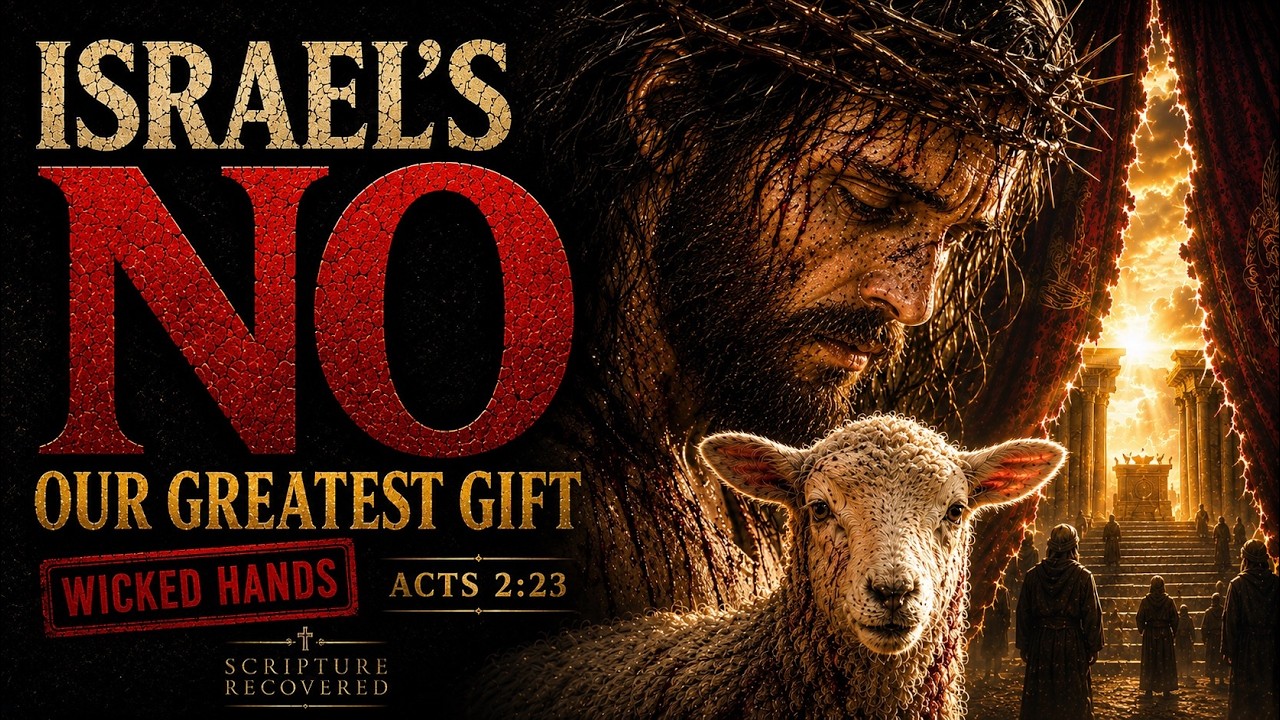
The crucifixion of Jesus Christ — the most consequential event in the history of the universe — came through Israel’s official and representative No to her Messiah. In the story Scripture actually gives us, the cross does not come through Israel’s national enthronement of the Messiah. It comes through Israel’s official rejection of Him.
The Lamb of God had to be examined, declared innocent, and deliberately slaughtered by the very people who had been waiting for Him. That was not a tragic accident of history. That was not a contingency plan God scrambled to redeem after things went wrong. That was the plan — announced in the prophets, embedded in the Passover, encoded in a thousand years of priestly training, and executed at the moment of God’s own choosing with a precision that leaves no room for the word coincidence.
And the people through whose hands it was performed did not know what they were doing.
That last sentence is not an excuse. It is a theological description — perhaps the most extraordinary theological description in the entire New Testament — of what divine sovereignty actually looks like when it operates at full depth.
The Determinate Counsel: Two Rails, One Track
We begin at Pentecost.
Fifty days after the crucifixion. The disciples are gathered in Jerusalem. The Holy Ghost has just fallen. And Peter stands up — the same Peter who denied the Lord three times, the same Peter who wept bitterly in the courtyard — and preaches the first sermon of the Church age. In that sermon, he says something that should stop every careful reader cold.
Him, being delivered by the determinate counsel and foreknowledge of God, ye have taken, and by wicked hands have crucified and slain (Acts 2:23).
Peter holds two things together in a single breath that most of our theology has never managed to hold together since. First: delivered by the determinate counsel and foreknowledge of God. That word — determinate — is the Greek horizō, from which we get the English word horizon. It means a fixed boundary. A predetermined limit. A decision made before the event that the event cannot escape. The crucifixion was not a tragedy that God absorbed into His plan after the fact. It was the plan — fixed in eternity, known before the foundation of the world, delivered to the cross on God’s own timetable.
Second: by wicked hands have crucified and slain. The hands were wicked. The act was a crime. The guilt was real.
Both of these things are true simultaneously. And their simultaneous truth is the most theologically precise statement in the entire New Testament about what happened at Calvary.
The crucifixion was ordained — and it was a crime. It was foreknown — and it was culpable. It was necessary — and it was unjust. These are not contradictions to be resolved by choosing one side. They are the two rails of the same track, and the train of redemption runs on both of them simultaneously.
The Church has been uncomfortable with this for two thousand years. We tend to emphasize one rail and neglect the other. Either we emphasize the sovereignty — God planned it, so the crime is swallowed up — or we emphasize the guilt — the crime was real, so we must be careful not to blame any particular people. And in both directions, we lose something we cannot afford to lose.
Peter loses neither. He stands before the very crowd that fifty days earlier was crying Crucify — and he holds both rails in front of them without flinching. That is where we must stand today.
A Thousand Years of Blood
But before we reach Calvary, we must go back — back a thousand years. Because what happened on that Friday outside Jerusalem did not begin on that Friday. It began at Sinai.
The moment God declared His purpose for Israel, He gave them a title that should have shaken the ancient world: Ye shall be unto me a kingdom of priests, and an holy nation (Exodus 19:6). Not a kingdom with priests. A kingdom of priests. Every member of the nation bearing a priestly identity. Every family a branch of the great sacrificial institution that stood at the centre of their national life.
Paul would later say the same thing in Romans 9:4–5 with a comprehensiveness that should silence every supersessionist reading of Israel’s story: to whom pertaineth the adoption, and the glory, and the covenants, and the giving of the law, and the service of God, and the promises; whose are the fathers, and of whom as concerning the flesh Christ came. The adoption. The glory. The covenants. The giving of the Law. The service of God. The promises. The fathers. And from them, according to the flesh — Christ came. Israel was not a background nation in the story of redemption. Israel was the covenant vessel into which God had placed the entire grammar of salvation. Every category of divine self-disclosure — every promise, every covenant, every act of priestly service — entrusted to this people. Which means the cross, when it came, came rightly and necessarily within Israel’s covenantal world.
And from that moment, God opened a school. A school that would run for a thousand years. And the curriculum, every single day, was the same.
Every morning, without fail — a lamb is brought. Unblemished. Carefully chosen. Without spot or defect. Hands are laid upon its head — a gesture of transfer, of identification: the weight of the offerer’s guilt passing from the one who deserves to die to the one who will die in his place. The blade falls. The blood flows. The priest catches it, carries it to the altar, sprinkles it where God has said His presence dwells. The smoke rises. The act is complete.
This happened every morning. Every evening. Every Sabbath, doubled. Every new moon, expanded. Every Passover, every Day of Atonement, every feast — the lambs multiplied, the blood flowed, the priests performed their ancient, meticulous, blood-soaked liturgy with absolute precision, because the Law of Moses specified every detail, and deviation meant death. Generation after generation of priests born, trained, ordained, served, and died — and their sons after them — all performing this same ritual, all speaking the same wordless sermon to anyone who had ears to hear it: Something must die for sin to be covered. Blood must be shed. The innocent must bear the weight of the guilty. There is no other way.
For a thousand years, Israel went to school in blood.
And every detail of that schooling mattered. Because every gesture was a word in a language being written across ten centuries — a language that would only be fully read on one specific afternoon outside Jerusalem.
The sacrificial law required that the offering be without blemish, that it cost the offerer something, that it be the offerer’s own. Then came the laying on of hands — not a blessing but a transfer, a deliberate, embodied declaration that the guilt belonging to the one standing upright would now be carried by the one about to fall. Then the animal was slaughtered. And here is the detail the Church has glossed over for centuries.
Not by the priest alone.
The offerer himself participated in the killing. The sinner’s own hands were involved in the death of the substitute. There was no comfortable distance, no clean separation between guilt and consequence. The one who had sinned held the knife. This was designed to be felt. For the life of the flesh is in the blood: and I have given it to you upon the altar to make an atonement for your souls: for it is the blood that maketh an atonement for the soul (Leviticus 17:11).
Who Must Hold the Knife
We arrive now at the question this entire history has been building toward. Before we ask it, one thing must be said clearly. What follows is not a charge of ethnic guilt. It is the opposite. It is the recognition of Israel’s unique covenantal office. The knife had to be in Israel’s hands because the altar, the priesthood, the promises, the Scriptures, the Passover, and the Lamb-language had been entrusted to Israel alone. No other nation carried that office. No other nation could have fulfilled it. What we are about to see is not accusation. It is the most extraordinary priestly appointment in the history of the world.
In the Mosaic system — who kills the lamb?
The sinner does.
The one whose guilt is being transferred to the animal. The one who has placed his hands on its head. It is the transgressor who participates in its death. This is not incidental. It is not a procedural detail that could have been arranged differently. It is the theological core of the entire act. The transgressor must be present. The transgressor must be involved. You cannot send a proxy to confess your own sin.
Now follow that principle to its conclusion.
When the true Lamb arrives — when God provides the final, sufficient, infinite sacrifice that the entire Levitical system has been pointing to — who must hold the knife? The transgressor. And who are the transgressors? Who are the ones under the Law, under the covenant, who have broken it and need it to be fulfilled on their behalf?
When the fulness of the time was come, God sent forth his Son, made of a woman, made under the law; to redeem them that were under the law (Galatians 4:4–5). The first beneficiaries of the atonement are those who were under the Mosaic covenant — Israel. And therefore Israel, as the transgressor under the Law, as the nation whose sin the Lamb would bear, as the people whose hands had been trained for a thousand years in the act of sacrificial offering —
Israel must stand as the nation whose hands are on the knife when the final Lamb is slain.
This is not an accusation. It is a description of a priestly act. The most consequential priestly act in the history of the world. No other nation on earth could have performed it. The Romans could execute — but they had no framework for what the blood meant. The Greeks could philosophise about death — but they had no altar. No other people had spent a thousand years learning, in their hands and in their bodies, the precise liturgical grammar that Calvary would require.
Only Israel. Trained across ten centuries by God Himself. In blood. For this.
The Judicial Blindness
If their hands needed to be on that knife — then the question that follows is urgent. Why did Israel not recognize Him?
The answer most Christian theology has given: because they were hard-hearted. Spiritually blind. Proud. There is truth in that, as far as it goes. But that answer is incomplete — it makes Israel’s blindness merely a human failure, when the New Testament describes it as something far more specific and sobering than that.
Paul, in Romans 11, calls it a hardening: Blindness in part is happened to Israel, until the fulness of the Gentiles be come in (Romans 11:25). Blindness in part — partial, targeted, judicially imposed. It has a duration, a purpose, and a terminus. It is not permanent. It is not arbitrary. It is the veil God placed over the face of the nation for exactly as long as the veil was needed.
But Paul’s retrospective theology is not where this truth originates. Jesus declared it Himself — in His own words, about His own mission, before the cross had even arrived. For judgment I am come into this world, that they which see not might see; and that they which see might be made blind (John 9:39).
He did not say: blindness has unfortunately fallen upon some as a consequence of their pride. He said: I came to enact it. The blinding of those who were certain they could see — the religious establishment, the Sanhedrin, the guardians of the sacrificial system — was not something that happened to the situation around Him. It was something He brought with Him from the moment He stepped into Galilee. The Pharisees’ own question — Are we blind also? — and His answer — If ye were blind, ye should have no sin — reveals the devastating precision of it. Their very confidence in their own sight was what sealed them. And it was the closed ones whose hands were needed for what was coming.
He came carrying the judgment that would produce the blindness. He walked into Jerusalem knowing that the veil He had brought would ensure the knife would not be stayed.
Jesus described the mechanism further in His explanation of the parables: Because they seeing see not; and hearing they hear not, neither do they understand. And in them is fulfilled the prophecy of Esaias (Matthew 13:13–14). He was not frustrating their understanding arbitrarily. He was fulfilling Isaiah’s description of a judicial hardening that God Himself had ordained for this people at this time for this purpose. The parables concealed as much as they revealed. And the concealment was necessary.
Paul tells us why: Which none of the princes of this world knew: for had they known it, they would not have crucified the Lord of glory (1 Corinthians 2:8). Had they known it, they would not have done it. The crucifixion required ignorance to proceed. The most consequential act in the history of the universe had to be performed by participants who did not understand its true nature — because if they had understood, self-interest alone would have caused them to stop. Satan would have restrained his own agents. Caiaphas would have bowed rather than condemned. The mob would have cried Hosanna rather than Crucify. And the world would have remained unredeemed.
God therefore ordained — not merely permitted, ordained — that the truth of what was happening be hidden from those whose hands were required for it. For a small moment have I forsaken thee; but with great mercies will I gather thee. In a little wrath I hid my face from thee for a moment; but with everlasting kindness will I have mercy on thee, saith the Lord thy Redeemer (Isaiah 54:7–8). A small moment. A hiding of the face. Everlasting kindness to follow.
The blinding was not permanent. It was not total — the elect remnant saw clearly, from Simeon in the temple to Anna the prophetess, from John the Baptist to Mary who pondered all these things in her heart. But those whose hands needed to be on the knife were veiled, for exactly as long as the veil was needed.
And this judicial blindness did not operate only at Calvary. It continued working through the book of Acts — city by city, synagogue by synagogue — as an ongoing mechanism driving the Gospel outward into the Gentile world with a force that no human strategy could have engineered.
Watch Paul at Pisidian Antioch. The synagogue is full. The word is preached. The Jewish leaders contradict and blaspheme. And Paul turns and says what Romans 11 had already told us would happen: It was necessary that the word of God should first have been spoken to you: but seeing ye put it from you, and judge yourselves unworthy of everlasting life, lo, we turn to the Gentiles (Acts 13:46). This is not Paul losing his temper. This is the judicial blindness of Romans 11 operating visibly, in a specific city, on a specific Sabbath — producing the specific turn toward the Gentiles that the blindness was always designed to produce.
The rejection at Antioch sends Paul to the Gentiles of that city. The rejection at Thessalonica sends him further. The rejection at Corinth sends him further still. Every synagogue door that closes is a Gentile door that opens. Had they not rejected — we would not have received the word the way we received it. Acts 13:46 is Romans 11:11 with faces and names and a specific place on the map.
The Lamb Arrives at the Appointed Hour
And then the Lamb walked into Jerusalem. Not in spite of what was coming. Toward it. Deliberately. Knowingly. With full awareness of every detail the prophets had written about this week.
He entered the city on the tenth day of Nisan — the exact day the Passover lamb was to be selected and brought into the household for examination. He spent four days in the temple courts being questioned by every faction — Pharisees, Sadducees, Herodians, scribes — and not one of them could find a blemish in His answers. The examination of the Passover lamb, enacted on the scale of a nation.
And on the fourteenth day of Nisan — the exact day the Passover lamb was to be slaughtered, at the exact hour the lambs were being killed in the temple courts below — He was lifted up. The timing is not coincidence. It is the most precise theological statement in history — written not in words but in the calendar of God.
John the Baptist had named Him at the beginning of His ministry: Behold the Lamb of God, which taketh away the sin of the world (John 1:29). Not the sin of Israel only. The sin of the world. The final, sufficient, once-for-all sacrifice that the entire Levitical system had been pointing toward since Moses laid the first ordinances on the people in the desert.
And Caiaphas — the man who had conspired to have Jesus arrested, whose house became the location of an illegal night trial, who tore his own garments in theatrical outrage — said something that John records with extraordinary theological care: It is expedient for us, that one man should die for the people, and that the whole nation perish not. And this spake he not of himself: but being high priest that year, he prophesied (John 11:50–51).
He prophesied. Caiaphas thought he was doing political calculus. He thought he was protecting the nation from Roman reprisal. He was, in reality, speaking as the high priest of Israel — performing the most accurate theological declaration of the entire Passion narrative, giving expression to the substitutionary logic of the entire sacrificial system he had been trained to administer. One man dying for the people. The innocent in the place of the guilty. The blood covering the nation.
He did not know what he was saying. And yet every word was true. This is what divine sovereignty looks like at full depth — not a God who watches events unfold and responds cleverly, but a God who speaks the truth of redemption through the lips of the very man who is plotting the Redeemer’s death.
The Charge and the Gratitude
And then the crowd assembled outside the Praetorium. And they made a declaration that has haunted the reading of this chapter ever since.
Then answered all the people, and said, His blood be on us, and on our children (Matthew 27:25).
This verse has been weaponised against the Jewish people for nineteen centuries. It has been used to justify pogroms, expulsions, forced conversions, and the theological poison that contributed to the most systematic attempt at genocide in human history. And every use of it for that purpose has been a misreading — not merely a moral failure but a textual failure. A failure to understand what those words meant in the mouth of a first-century Jewish crowd on the morning of Passover.
The language of blood being upon a people can be heard, inside Israel’s own sacrificial world, as Levitical language. Whatever the crowd meant in rage and blindness, God heard those words within the deeper grammar of atonement. It echoes the sacrificial world of Leviticus and Numbers — a world where blood speaks of guilt, covering, life, death, and atonement. When the crowd cried His blood be on us — they were, in the blindness God had ordained, unknowingly echoing the Levitical gesture of a nation receiving the blood of its sacrifice. They were performing, in ignorance, the most consequential priestly declaration in history.
Father, forgive them, for they know not what they do. They did not know. And in not knowing, they said something truer than the wisest man on earth could have crafted in full knowledge.
Now we are in a position to hold the full weight of what this day requires us to hold.
The charge is real. A generation of Israel’s leaders, acting under judicial blindness ordained by God, conspired with Roman authority to execute an innocent man. That was a crime. The New Testament does not minimise it. We should not minimise it.
But the wicked hands were not Israel’s alone. Herod was there. Pilate was there. Rome was there. The Gentiles were there. The rulers of this age were there. And beneath them all, Adam’s whole race was there. Israel stood in the liturgical foreground; humanity stood in the dock. The prayer of the early Church named this coalition explicitly: Both Herod, and Pontius Pilate, with the Gentiles, and the people of Israel, were gathered together (Acts 4:27). Pilate examined Jesus, declared him innocent three times, and then handed him over to protect his political position. The Gentile world was not an innocent bystander that received the benefit of someone else’s crime.
Israel held the knife covenantally. The world held it morally.
And deeper still — the atonement was made for the world. For every sin of every human being of every nation. Which means every human sin was present at that cross, being borne. The cross was not a Jewish crime that Gentiles received the benefit of. It was a human crime — the whole race represented, Jew and Gentile together — that God in His sovereignty ordained for the redemption of the whole race. No one stands at Calvary with clean hands. The only question is whether the blood that was shed there covers you.
And the gratitude is also real. The wrath that should have fallen on us fell on Him. The people through whose hands that transaction was made possible — the nation whose thousand years of priestly training made them the only people on earth qualified to perform it, whose judicial blindness ensured it would not be stopped — those people are not our enemies. They are the people through whom our salvation came.
How do you hold both of those things at once? The same way Peter held them on Pentecost. The same way Paul held them in Romans. You do not flatten one to make room for the other. You stand before both and say: yes.
Yes, it was a crime. And yes, it was the means of my salvation. And yes, I owe them a debt I cannot repay. And yes, the same Lamb whose blood they shed is the Lamb whose blood covers them.
And then Paul asks the question that should make every Gentile believer sit down in stunned silence: Have they stumbled that they should fall? God forbid: but rather through their fall salvation is come unto the Gentiles, for to provoke them to jealousy. Now if the fall of them be the riches of the world, and the diminishing of them the riches of the Gentiles; how much more their fulness? (Romans 11:11–12).
Through their fall — not despite it. Through it. The fall was the mechanism by which salvation came to us. Their representative No at the cross was the door through which world redemption walked. And the question Paul leaves open like a window facing a landscape too large to describe — if the fall produced such riches, how much more their fulness? — answers itself in only three words: life from the dead. The restoration of Israel in its fulness will be to the world what the resurrection is to death.
That is where this story is going. Not abandonment. Not replacement. A fulness that will make even the riches of the fall look like the first instalment of something beyond calculation.
Israel stood at the altar because Israel alone was entrusted with the altar. Rome stood at the execution ground because empire always knows how to kill. The world stood guilty because the Lamb bore the sin of the world. And God stood sovereign over all of it — turning the greatest crime in history into the greatest gift ever given.
Tetelestai
And at three o’clock in the afternoon, on the fourteenth of Nisan, when the last of the Passover lambs had been slaughtered in the temple courts below — Jesus bowed His head and said three words.
It is finished (John 19:30). Three words in English. One word in Greek. Tetelestai — a word written across a debt account in the ancient world when the full amount had been paid. Paid in full. The debt is discharged. The account is settled. Nothing more is owed.
The veil of the temple tore from top to bottom — not from the bottom up, as a man would tear it, but from the top down, as only God can tear it. That veil was not a curtain in any ordinary sense. Jewish historical sources describe it as sixty feet high, thirty feet wide, and a handbreadth thick — approximately four inches of densely woven fabric, so massive that it required hundreds of priests to handle it. It was, by every human measure, untearable. Its entire purpose was architectural theology — the permanent, unarguable declaration that sinful humanity could not pass into the presence of the holy God. When that veil tore — from the top — it was God Himself reaching down from His side of the separation and removing what He had placed.
The way into the holy of holies — barred since the garden, sealed by the Law — was opened in the moment the final sacrifice was complete. Not by human achievement or religious performance. By blood. By the Lamb.
The school that had been running for a thousand years was finished. The lesson was complete. Not because Israel had understood it. But because the one the lesson was always pointing toward had arrived, had been received by the hands prepared to receive Him, and had done what no animal in a thousand years of daily sacrifice could do. Once in the end of the world hath he appeared to put away sin by the sacrifice of himself (Hebrews 9:26). Not covered. Not deferred. Put away. Once. Sufficient. Final.
We Owe Them Our Lives
Every Christian who loves Jesus — who has knelt at that cross, who has felt the weight of sin lifted, who has known the Father’s embrace, who has tasted even once the freedom of a forgiven conscience — owes those people a gratitude that has no adequate human expression.
We owe them our lives.
The Lion of the tribe of Judah has prevailed. And He prevailed through the very people who, in the blindness that God ordained and has already forgiven, lifted Him up.
The crime has been named. The sovereignty has been established. The thousand-year training has been seen for what it was. The charge and the gratitude have been held together, as Scripture demands they be held.
But if the crucifixion was a crime — and it was — then what, precisely, was it from God’s perspective? Not a tragedy He absorbed into His plan after the fact. Not a human failure He permitted and then redeemed. Something more deliberate, more staggering, more theologically precise than either of those.
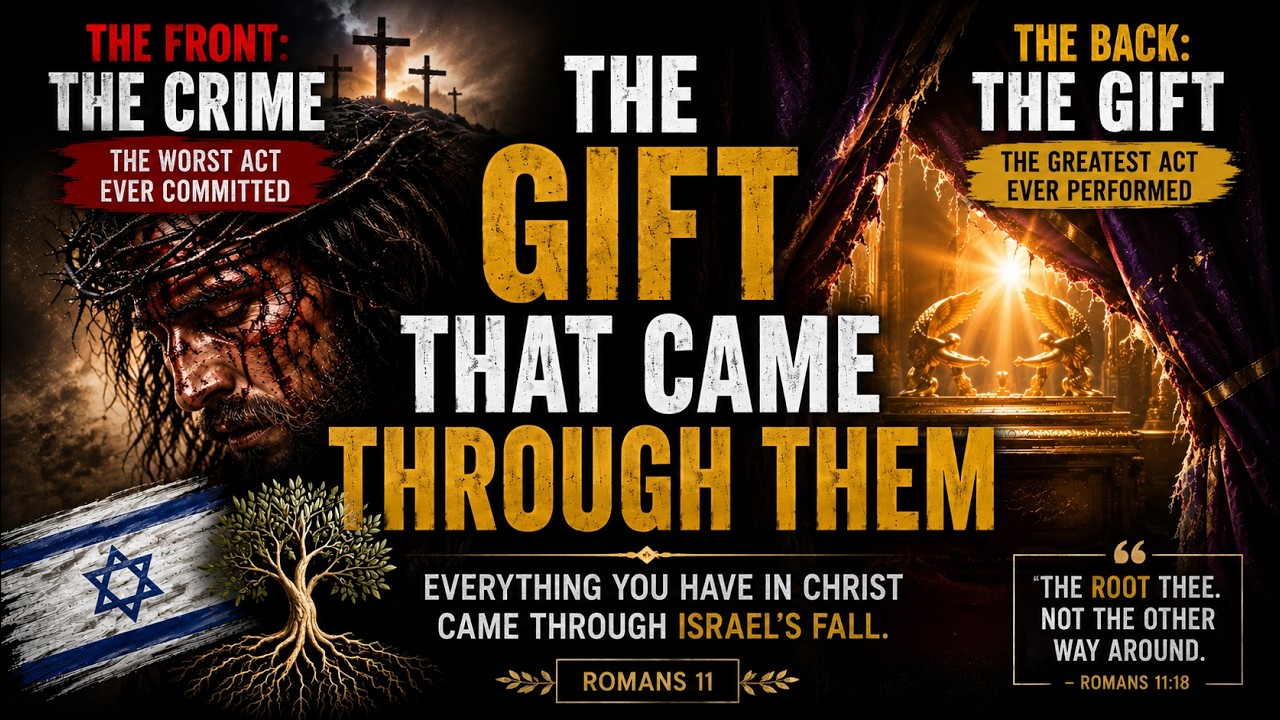
The greatest crime in history was also the greatest gift in history.
How those two things are the same event — how the worst act ever committed and the most loving act ever performed are not opposites but two faces of the same cross — that is the question the next article will answer.
Watch Episode 2 — Turn the Cross Around — The Gift That Came Wrapped in the Crime
B.V. Thomas is the author and theologian behind The Hermeneutical Quill, a platform reaching readers across 170+ countries. This article is adapted from the Scripture Recovered video teaching series.
Subscribe to Scripture Recovered on YouTube — and visit bvthomas.com for more.
Scripture references in this article: Acts 2:23 · Acts 4:27 · Acts 13:46 · Exodus 19:6 · Leviticus 17:11 · Galatians 4:4–5 · Romans 9:4–5 · Romans 11:11–12 · Romans 11:25 · John 1:29 · John 9:39 · John 11:50–51 · John 19:30 · Matthew 13:13–14 · Matthew 27:25 · 1 Corinthians 2:8 · Isaiah 54:7–8 · Hebrews 9:26
Continue with the next episode in this series: Turn the Cross Around — The Gift That Came Wrapped in the Crime
Or read the full article: Turn the Cross Around