
Here is a claim that will sound, at first hearing, like an exaggeration.
A major Old Testament prophecy has already happened, in substantial measure. Not in some thin, spiritualised, “kind of, sort of” sense, but verifiably, in the plain record of world history. And it rarely gets named for what it is.
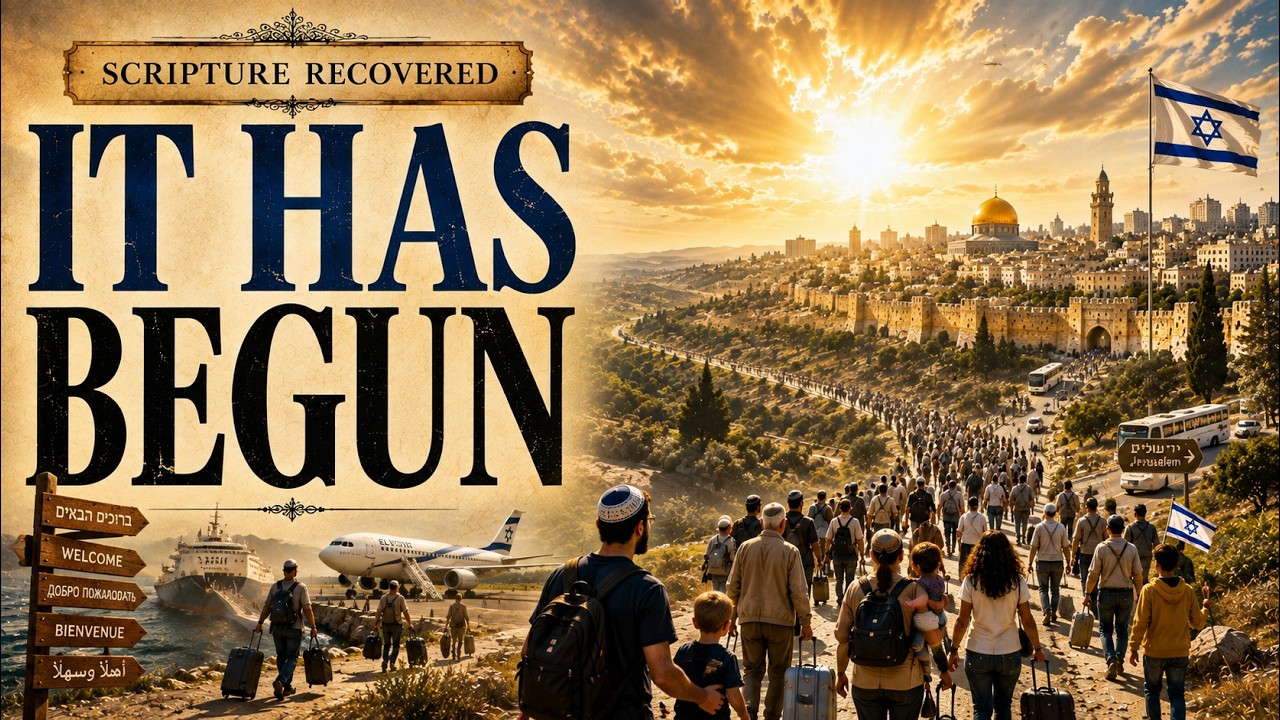
This video presentation is based on the article below, adapted for the Scripture Recovered series. The full written study follows underneath for reading, reference, and further reflection.
They shall not hurt nor destroy in all my holy mountain: for the earth shall be full of the knowledge of the LORD, as the waters cover the sea (Isaiah 11:9).
Put yourself in the eighth century BC for a moment. Isaiah is writing into a world where war is simply how nations settle disagreements, where the strong take from the weak as a matter of course, where no serious moral framework tells the powerful that they owe anything to the powerless. Into that world, Isaiah sees something that must have sounded almost absurd to his first hearers: a mountain rising, nations streaming toward it, and a coming day when the knowledge of the God of Israel would be as total and as ordinary as water filling the sea.
Now look at what is actually true today. Scripture exists in thousands of languages. The name of the God of Israel is known, in some form, on every continent on earth. There is no remote village, no isolated people group, that the message has not reached in at least some measure. A seed planted in one obscure nation in the ancient Near East has worked its way into the bloodstream of human civilisation itself.
The waters cover the sea. Not every drop sits on the surface — there are still depths, still distances, still corners barely touched. But the sea, as a whole, is covered.
This article closes the series with the highest point in the whole argument — a fulfilment already astonishingly underway, and a fulfilment still to come.
A World That Learned a Different Way
Picture the world Isaiah was speaking into more concretely.
Children sacrificed to gods of stone among Israel’s neighbours. Slavery as the unquestioned engine of every ancient economy. Strength, simply by being strength, given the final word in almost every human transaction.
Isaiah looked straight at that world and said: it will not stay this way. A mountain will rise. The nations will come to it. Instruction will go out from it. And — stated as plainly as a prophet ever states anything — the result will be a transformed world, soaked through with the knowledge of God the way the sea is soaked through with water.
That transformation is not some invisible, merely “spiritual” thing requiring blind faith with no evidence at all. It has left fingerprints across two thousand years of recorded history — believers who took the Bible’s vision of human worth seriously enough to fight slavery as an institution, the documented retreat of practices like child sacrifice and infanticide everywhere the Gospel put down roots, the spread of hospitals, orphanages, and the very notion that every human life carries inherent worth, into cultures that had never held that idea before.
None of this arrived automatically, everywhere, all at once, without resistance or failure. The honest record is mixed, and at times deeply troubling. Believers were also slaveholders and colonisers. Mission sometimes travelled alongside conquest rather than against it. The Church has often been slow to apply its own best convictions, and has sometimes betrayed them outright. This series has already named some of those wounds directly elsewhere and will not pretend otherwise here. But naming the failures honestly does not erase the underlying pattern — it sits alongside it. Across the long run of two thousand years, taken as a whole rather than at any single failed moment, the trajectory Isaiah described — weapons reforged into farming tools — is still real and still traceable, however unevenly, and at however great a human cost it has sometimes come.
This is the same seed that has run through every article in this series — the seed the enemy hunted and could never destroy, the seed that travelled the diaspora’s own trade roads centuries before the apostles ever walked them, the seed whose bones have been coming home in our own generation. That seed has filled the earth with fruit, and the world, eating freely from it, has mostly stopped asking where the tree came from.
The answer is Israel. It has always been Israel. The answer is the God of Abraham, Isaac, and Jacob, who chose the smallest of all seeds, who knew exactly what that choice would produce, and who has kept every word He spoke through every prophet He ever sent.
Arise, Shine
We have reached the summit of this series. And the passage that stands at that summit has been deliberately withheld until now, because this is where it belongs — the place from which the entire shape of what this series has traced finally comes into view at once.
Arise, shine; for thy light is come, and the glory of the LORD is risen upon thee. For, behold, the darkness shall cover the earth, and gross darkness the people: but the LORD shall arise upon thee, and his glory shall be seen upon thee. And the Gentiles shall come to thy light, and kings to the brightness of thy rising (Isaiah 60:1–3).
Arise, shine. That command lands on Israel — the people this entire series has circled back to again and again. Not on the nations, who only receive the light. On Israel, who carries it. Darkness covers the earth and its peoples, and yet the Lord rises specifically on Israel, and the nations are pulled toward whatever it is that is rising there.
This is not purely a future scene. It is the same pattern that has been running since the first century. The light rose on Israel in the person of the Messiah — Jewish by birth, Jewish by lineage, announced first by Jewish voices, carried first into Jewish diaspora communities, and only from there outward to every nation under heaven. The Gentile world has been streaming toward that light for two thousand years already. Kings, the people who shape entire civilisations, have been drawn to its brightness. It has been happening the whole time. It is happening now. And its fullest expression is still ahead.
Isaiah does not leave this as vague poetry. He gets remarkably specific about what that fullness looks like. Then thou shalt see, and flow together, and thine heart shall fear, and be enlarged; because the abundance of the sea shall be converted unto thee, the forces of the Gentiles shall come unto thee (Isaiah 60:5).
The wealth of the sea — every resource, every ounce of creative and material strength the Gentile world possesses — turning and flowing toward Israel. Not seized by conquest. Not extracted under threat. Arriving freely, carried by the same current that draws the nations to the light in the first place.
This series has already established that the Gentile believer owes Israel something real — that what the nations received through Israel’s fall creates an obligation, not a sentiment. Isaiah sees a day when that obligation stops being something paid reluctantly and becomes instead a glad, overflowing response to a light too bright to ignore.
And the sons of strangers shall build up thy walls, and their kings shall minister unto thee: for in my wrath I smote thee, but in my favour have I had mercy on thee. Therefore thy gates shall be open continually; they shall not be shut day nor night; that men may bring unto thee the forces of the Gentiles, and that their kings may be brought (Isaiah 60:10–11).
Strangers rebuilding the walls with their own hands. Kings of the nations serving Israel rather than ruling over her. Gates left open day and night without exception — because the traffic never stops, the arrivals never end, the fullness has no bottom to it.
For in my wrath I smote thee, but in my favour have I had mercy on thee. Everything this series has walked through — the exile, the long scattering, the centuries of suffering — the smiting was real, and Scripture does not pretend otherwise. But the mercy outweighs it. Every wound God allowed along that road was already held inside a larger mercy. The fullness still coming will finally let both the wound and the mercy be seen at their true size, side by side.
The Current Reverses
Thou shalt also suck the milk of the Gentiles, and shalt suck the breast of kings: and thou shalt know that I the LORD am thy Saviour and thy Redeemer, the mighty One of Jacob (Isaiah 60:16).
Israel, nourished by the nations she once gave everything to. The flow that has run one direction for twenty centuries finally turns around. For two thousand years, Israel handed the nations her own spiritual inheritance — the Scriptures, the Messiah, the apostles, the good news, the knowledge of the one true God. In the fullness, the nations hand back what they have built from that gift — their strength, their wealth, their accumulated wisdom — and Israel receives it.
And thou shalt know. That phrase carries the real weight. Not information added to a file. Recognition. The dawning realisation that the God who scattered and the God who gathers have always been one and the same — Saviour, Redeemer, the mighty One of Jacob. When Israel finally looks out and sees the nations streaming in, carrying the fruit the Gospel produced, and hears in that flood the fulfilment of promises God made to Abraham four thousand years earlier, that is the moment the veil finally lifts for good.
This is what covenant faithfulness from a God who never breaks His word actually looks like up close. Every hardship permitted along the way — the scattering, the exile, the long centuries of dispersion — was already wrapped inside a mercy bigger than the hardship itself. What is still coming will simply make that visible at last.
Gates That Never Shut
This series began on a Friday outside Jerusalem, with a crime that turned out to be the greatest gift ever given. It followed a single thread — the fall that became riches, the seed that became a harvest, the bones that finally came home — across four articles, and it has carried us here, to a gate that never closes.
Thy gates shall be open continually; they shall not be shut day nor night.
That is where this whole account of Israel’s place in God’s purposes finally lands — not a closed case, not a settled verdict, but an open door. A gate left permanently wide because the One who built it never planned to shut it. The nations are still walking through it. The wealth of the Gentile world is still being carried in. Walls once torn down are still being rebuilt by hands that used to belong to strangers and don’t anymore.
Look back at the distance covered. A people too small to matter by any worldly measure. A priesthood trained for a thousand years before anyone understood what it was for. An execution that turned out to be the means of rescue rather than its opposite. A scattering that functioned as planting rather than as ending. A homecoming, in living memory, that nobody’s history books predicted. And now, standing at the far end of all of it, a door propped open by a God who has no intention of closing it.
That is not a conclusion in the sense of a case finally closed. It is closer to a vantage point — a place to stand and watch something still in motion. The traffic through that gate has not slowed in two thousand years and shows no sign of stopping now.
B.V. Thomas is the author and theologian behind The Hermeneutical Quill, a platform reaching readers across 170+ countries. This article is the fifth and final piece in a series adapted from the Scripture Recovered video teaching series.
Subscribe to Scripture Recovered on YouTube — and visit bvthomas.com for more.
Scripture references in this article: Isaiah 11:9 · Isaiah 60:1–3 · Isaiah 60:5 · Isaiah 60:10–11 · Isaiah 60:16