Faith Working Through Love: The Organic Life of the New Creation

A Biblical Theology of Grace from Reception to Perfection

In the heart of Paul’s letter to the Galatians stands a quiet verse that unlocks the entire mystery of the Christian life: “The only thing that counts is faith working through love” (Galatians 5:6). Not faith “and” love as separate virtues to be balanced on a scale. Not faith “plus” works as a formula to be calculated. But faith “energized” by love—one living reality, like a heart that beats and a body that moves because blood is flowing.

This is no mere doctrinal footnote. It is the engine of the new creation. Faith is the source, love the channel, works the fruit. Reverse the order, and you get legalism or hypocrisy. Remove any part, and life drains away. Yet when grace ignites faith, and faith yields to love, the righteousness once demanded by the law is fulfilled—not by straining effort, but by divine life flowing freely.

The Gift: One Package Delivered by Grace

Everything begins with a single act: believing in the Son of God.

The moment a soul leans its heart toward Christ—trusting not its own goodness, but His finished work—grace delivers a complete package. Eternal life is received immediately (John 5:24). The Holy Spirit is given without delay (Galatians 3:2). Precious faith is imparted as a gift, equal in value to that of the apostles (2 Peter 1:1). The love of God is shed abroad in the heart (Romans 5:5). Union with Christ is established forever (1 Corinthians 1:30).

Nothing essential is missing. No further transaction is required to “complete” salvation. Growth is not about adding what was absent, but unfolding what was already given. As Jesus taught in the Synoptics, the kingdom arrives like a mustard seed—tiny, yet fully alive—or like leaven that quietly transforms the whole (Matthew 13:31–33). The seed is perfect in essence from the beginning; it only awaits manifestation.

This faith is not manufactured by human resolve. Humans already believe—in leaders, systems, ideologies. That capacity is universal. But saving faith is that same capacity redirected by grace toward the true Giver of life. “No one can come to Me unless the Father draws him” (John 6:44). Grace does not create belief from nothing; it awakens and orients the heart toward Christ.

To refuse this offer is to remain condemned—not by arbitrary divine wrath, but by rejecting the only source of life (John 3:18). Yet to receive it is to inherit everything: a spirit of faith (2 Corinthians 4:13), love as the core virtue, and the promise of eternal inheritance.

The Flow: Grace Received, Love Expressed, Fruit Revealed

Scripture never presents faith as sterile doctrine or love as sentimental feeling. Faith works “through” love, and love takes visible form in works.

Paul and James are not opponents but allies. Paul defines the engine: faith energized by divine love. James points to the exhaust: if faith is real, it will appear in deeds. “Show me your faith without works,” James challenges, “and I will show you my faith by my works” (James 2:18). Works do not create or sustain faith; they reveal it. Dead orthodoxy claims belief without transformation. Living faith cannot help but bear fruit.

The order is crucial:

– Grace gives life.

– Faith receives life.

– Love expresses life.

– Works reveal life.

Reverse it—trying to produce works to earn love, or love to secure faith—and you fall into self-righteous effort. But in God’s design, love fulfills the law organically: “The whole law is fulfilled in one word: You shall love your neighbor as yourself” (Galatians 5:14). As Paul declares elsewhere, “The righteousness of the law is fulfilled in us who walk not after the flesh but after the Spirit” (Romans 8:4).

This is why Jesus, in the Synoptic Gospels, frames discipleship as costly yet restful. “If anyone would come after Me, let him deny himself and take up his cross daily” (Luke 9:23). The call is radical—count the cost, sell all, follow without looking back (Luke 14:25–33). Yet the yoke is easy, the burden light (Matthew 11:28–30). Why? Because self-denial is not self-powered grit; it is yielding to the life already given, putting to death the deeds of the body “by the Spirit” (Romans 8:13). Ongoing repentance and mortification are not add-ons to grace but the natural rhythm of abiding in the Vine.

The Cultivation: Abiding, Sowing, Yielding

Jesus distills the entire Christian ethic to one invitation: “Abide in Me” (John 15:4).

A branch does not strain to produce grapes. It simply remains connected to the vine, drawing life without ceasing. Fruit appears inevitably where union persists. “Apart from Me you can do nothing,” Jesus warns—not “not enough,” but “nothing”. Prayer, obedience, service—all flow from dependence, not as proofs of sincerity but as expressions of trust.

Yet abiding is not passivity. Paul urges us to “sow to the Spirit” diligently (Galatians 6:7–8). Prayer, meditation on the Word, acts of love—these are our cooperation, our consent to the Spirit’s movement. The slothful cannot expect harvest, for the Spirit works through yielded hearts, not negligence. Daily repentance, turning from sin, crucifying the flesh—these are the branch’s refusal to disconnect, the heart’s ongoing “yes” to grace.

The Word abides in us not as accumulated information but as living speech carried by the Spirit (John 15:7). It reorients reality, resisting substitutes like law, fear, or self-effort. Fruit—love, joy, peace, patience—emerges quietly, in season (Galatians 5:22–23).

The Refining: Trials and the Perfection of Faith

Faith is a gift, but its full glory shines in the fire.

Trials are not accidents but divine appointments. “The testing of your faith produces patience… that you may be perfect and complete, lacking nothing” (James 1:3–4). Fire exposes hypocrisy, purifies motives, strengthens endurance. Words alone are insufficient; God weighs the heart through testing (1 Peter 1:6–7).

Abraham stands as the archetype. His faith—begun by grace, credited as righteousness (Romans 4)—was perfected when tested to the brink. Offering Isaac, he trusted God’s promise against all evidence, “accounting that God was able to raise him from the dead” (Hebrews 11:17–19). Perfected faith is not sinless flawlessness but mature trust that obeys under fire.

Hebrews sharpens this with solemn warnings: Do not harden your hearts as in the wilderness (Hebrews 3–4). Hold fast the confidence you had at the beginning (Hebrews 10:35–39). Those who shrink back face destruction, but “we are not of those who shrink back… but of those who have faith and preserve their souls” (Hebrews 10:39). Perseverance is not optional; it is the evidence that faith was genuine. Yet even here, grace sustains: we enter God’s rest “through faith”, not effort.

The Warning: Imputation vs. Presumption

Righteousness is imputed only to those who walk in Abraham’s footsteps—not ritual performance, but dependent trust (Romans 4:22–24).

Many practice religion—attend services, observe morals, claim faith—yet lack the living reality. Their works are empty, their profession dead (James 2:14–17). Presumption assumes grace without receiving it through faith. Conceit trusts self-generated righteousness. Both deceive themselves, substituting outward form for inward transformation.

Jesus’ warnings in the Synoptics echo this: “Not everyone who says to Me, ‘Lord, Lord,’ will enter the kingdom… Many will say to Me in that day, ‘Did we not…?’ And I will declare, ‘I never knew you'” (Matthew 7:21–23). Fruit inspectors are needed because trees are known by their fruit (Matthew 7:15–20). Narrow is the gate, and few find it—not because God withholds, but because few enter by faith alone.

The Glory: God Pleased by Trust

Without faith it is impossible to please God (Hebrews 11:6). Not because He demands heroic effort, but because faith is the only way to know Him as He is: Rewarder, not Taskmaster.

Pleasing God is agreement—believing that He exists and rewards those who seek Him. Grace gives. Faith receives. Love reveals. And the Father is glorified not by anxious striving, but by branches heavy with fruit (John 15:8).

This is the astonishing harmony of Scripture: the law commanded what faith now creates, love reveals, and perseverance proves—all by the Spirit, all to the praise of grace.

In the end, the Christian life is not a checklist but a location: abiding in Christ. Remain there, and fruit will argue the rest. The seed planted by grace will grow into the full stature of maturity, bearing much fruit, enduring every trial, and inheriting the promise.

For the only thing that counts is faith—working through love.


The Heartbreak of Heaven: When the Liberated Choose Chains

 “For freedom Christ has set us free; stand firm therefore, and do not submit again to a yoke of slavery.”

— Galatians 5:1 (ESV)

There is a grief in heaven that few dare to name.

It is not the grief over open rebellion or blatant unbelief.

It is deeper, more piercing: the grief over sons and daughters who have been fully redeemed, fully liberated—yet who quietly, often sincerely, walk back into chains.

Paul felt it until it nearly broke him.

Christ feels it still.

This is the unspoken wound at the heart of Galatians.

The Freedom Christ Secured

Paul’s words in Galatians 5:1 are not a gentle suggestion. They are a triumphant declaration forged in the fire of the cross:

Τῇ ἐλευθερίᾳ ἡμᾶς Χριστὸς ἠλευθέρωσεν

“For freedom Christ set us free.”

Notice the emphasis: freedom is both the means and the end. Christ did not merely rescue us from something; He liberated us into a new realm of existence—sonship, Spirit-led life, love that fulfills the law from the inside out.

This freedom is comprehensive:

– From the curse and bondage of the law as a covenant system (Gal 3:13; 4:5)

– From sin’s dominion and the flesh’s mastery (Gal 5:13, 16)

– From condemnation and death

– From the elemental powers of this evil age and Satan’s grip (Gal 1:4; 4:3, 9)

It is exodus language: a mighty redemption already accomplished.

Believers are no longer slaves but heirs—lords of all, even if still maturing (Gal 4:1–7).

In status, the freedom is complete.

A babe in Christ is as free as the most mature saint.

The Tragedy: Liberated Sons Choosing Slavery

Yet Paul writes Galatians in alarm.

These believers had tasted the Spirit by faith (Gal 3:2–5).

Christ had been vividly portrayed as crucified among them (Gal 3:1).

They had run well (Gal 5:7).

And now? They were turning back.

Not to paganism.

Not to gross immorality.

To religion. To circumcision. To law-observance as the path to righteousness.

Paul calls it bewitchment (Gal 3:1).

He fears his labor over them was in vain (Gal 4:11).

He is in the pains of childbirth again until Christ is formed in them (Gal 4:19).

Why is this so grievous?

Because it is not ignorance—it is exchange.

They had known liberty, yet were submitting again to a yoke of slavery (Gal 5:1).

And the slavery is worse than before.

Before Christ, they were enslaved without knowing better.

After Christ—enlightened, indwelt by the Spirit, called sons—they were choosing control over trust, external rules over internal governance, fear over love.

This is the unbearable tragedy: the liberated choosing chains.

The Heartbreak of Heaven

Paul’s anguish is not merely human. It is apostolic participation in Christ’s own sorrow.

See the language:

– “I am afraid I may have labored over you in vain” (Gal 4:11)

– “My little children, for whom I am again in the anguish of childbirth…” (Gal 4:19)

– “O foolish Galatians! Who has bewitched you?” (Gal 3:1)

This is a father watching his children trade inheritance for servitude.

This is the Spirit being grieved when grace is obscured.

And behind Paul stands Christ Himself—the One who gave Himself to rescue us from this present evil age (Gal 1:4).

To see His sacrifice functionally sidelined by religious performance is to watch the cross trampled again, not by enemies, but by the very people He died to free.

It is heartbreaking because it is unnecessary.

It is heartbreaking because it is chosen.

The Severe Mercy of the Warnings

Galatians is Paul’s sharpest letter, and the warnings are severe for a reason:

– “If you accept circumcision, Christ will be of no benefit to you” (Gal 5:2)

– “You are severed from Christ, you who would be justified by the law; you have fallen from grace” (Gal 5:4)

These are not threats of lost salvation.

They are sober declarations of functional reality.

To shift trust from Christ’s finished work to self-effort is to render Christ inoperative in one’s lived spirituality.

It is to fall from the realm of grace—dependence on the Spirit—back into the realm of flesh and law.

Paul does not speak this way because he is angry.

He speaks this way because love refuses to watch freedom die quietly.

He would rather come with a rod than see the gospel distorted (cf. 1 Cor 4:21).

Not to destroy, but to restore.

The Quiet Grief Today

Look around.

Sincere believers—born again, Spirit-indwelt—living in fear, condemnation, and performance.

Crushed by traditions of men that nullify the Word.

Observing days, rules, standards… as if Christ were not enough.

They love Jesus.

They serve faithfully.

Yet they carry burdens He never asked them to bear.

And somewhere, the heart of Christ bleeds again.

Stand Firm

Paul does not end in despair.

He ends with a resolute command:

“Stand firm therefore, and do not submit again to a yoke of slavery.”

Freedom is worth defending.

Not because it is fragile, but because hearts are.

Growth in grace is possible.

Discernment can be trained.

The Spirit is willing to lead sons into the full experience of their inheritance.

But we must refuse the subtle return to Egypt.

We must guard the sufficiency of the cross.

For the glory of Christ.

For the joy of the liberated.

For the healing of heaven’s heartbreak.

As I studied Galatians afresh, this truth pressed on me until it hurt.

If you’ve seen this quiet bondage too — sincere believers carrying chains Christ already broke — know the grief isn’t yours alone.

Christ feels it deeper. May we stand firm together.

—


From Slaves to Sons: The Audacious Glory of New-Covenant Sonship

It began with a single verse—Galatians 4:1—and unfolded into a revelation that shakes the soul: “I mean that the heir, as long as he is a child, is no better than a slave, though he is lord of all the estate.”

On the surface, the words seem paradoxical. An heir who owns everything, yet lives under restraint—like a slave. To the natural mind, this is mind-boggling. To the Spirit-awakened heart, it is the story of every believer in Christ.

What follows is not a mere theological exercise. It is a journey through Scripture, experience, and awe—a living testimony of how the gospel moves us from minority to maturity, from Adamic poverty to audacious heirship, from “poor me” to “Abba, Father.”

1. The Heir in Minority: Israel, Christ, and Us

Paul’s imagery in Galatians 4:1–7 is redemptive-historical gold. Israel, the covenant heir, lived under the Law as a child under guardians and stewards—holy, preparatory, yet temporary. The Law was not false; it was pedagogical, pointing to the fullness of time.

Then Christ entered the story from the inside:

“But when the fullness of time had come, God sent forth His Son, born of a woman, born under the Law, to redeem those who were under the Law, that we might receive adoption as sons.” (Gal 4:4–5)

Jesus did not abolish the Law from afar. He became the true Israel, the true Heir, living its story perfectly to bring it to its telos. And because we are united to Him, His sonship becomes ours—not by imitation, but by participation.

“And because you are sons, God has sent the Spirit of His Son into our hearts, crying, ‘Abba! Father!’ So you are no longer a slave, but a son, and if a son, then an heir through God.” (Gal 4:6–7)

This is not replacement theology. It is inclusion by grace. Israel’s story, fulfilled in Christ, now enfolds Gentiles who believe. We share the same trajectory: from bondage to sonship, from minority to inheritance.

2. Not Lawless, but Under a New Law

We are no longer under the Mosaic Law in its covenantal sense (Rom 6:14). Yet we are not antinomian. Paul is clear: we are “not being without law toward God, but under the law of Christ” (1 Cor 9:21).

The old Law was external—commanding, restraining, condemning. The law of Christ is internal, relational, cross-shaped: “Bear one another’s burdens, and so fulfill the law of Christ” (Gal 6:2). It is empowered by the Spirit of life who sets us free from the law of sin and death (Rom 8:2).

Obedience is no longer compliance out of fear. It is the obedience of faith (Rom 1:5; 16:26)—faith expressing itself in lived allegiance. Desire precedes action. Identity produces fruit. Sons obey because they are sons.

As Augustine captured it: “Love God, and do what you will.” True love fulfills holiness because it flows from transformed affection.

3. Imputation and Impartation: Righteousness Credited, Holiness Worked

Righteousness is never earned or increased by obedience. It is imputed—credited to us through union with Christ (Rom 4:6; 2 Cor 5:21). Justification is a decisive transfer: from death to life, from enmity to peace with God.

Sanctification, however, is the progressive supplanting of the old by the new. The law of sin and death loses dominion because we are under grace (Rom 6:14). The Spirit causes us to walk in God’s statutes (Ezek 36:27). What the Law demanded but could not supply, the Spirit now produces: “that the righteous requirement of the law might be fulfilled in us, who walk not according to the flesh but according to the Spirit” (Rom 8:4).

We partake of the divine nature (2 Pet 1:4)—not becoming God in essence, but sharing His moral life, holiness, and glory by participation. Positionally, we are fully righteous. Conditionally, that righteousness is increasingly embodied as Christ is formed in us (Gal 4:19).

4. Born of God: A New Creation from Above

Here the wonder deepens. Regeneration is not moral improvement or symbolic adoption. It is real begetting.

– “That which is born of the Spirit is spirit” (John 3:6).

 – “His seed remains in him” (1 John 3:9).

 – “Born again… through the incorruptible seed, the word of God that lives and abides forever” (1 Pet 1:23).

The new spirit originates from God Himself—divine in source, heavenly in nature. We are no longer merely Adamic; we are a new creation (2 Cor 5:17), created according to God in righteousness and true holiness (Eph 4:24).

This is not essence-identity. God remains God, the unbegotten source. We are begotten, derived, forever dependent. Yet the life communicated is genuinely His—participatory, transforming, eternal.

We bear the image of the heavenly Man (1 Cor 15:49). “When He appears, we shall be like Him, for we shall see Him as He is” (1 John 3:2). Not in aseity or self-existence, but in immortality, glory, and incorruption.

And when the sons of God are revealed in doxa, creation itself will be liberated from its bondage to corruption (Rom 8:19–21). The meek shall inherit the earth—not by autonomous power, but through the reign of Christ mediated in His glorified body.

5. The Audacity of Identity: From “Poor Me” to Heirship

Yet how many heirs live as slaves?

The Adamic mindset—fear, shame, smallness—dies hard. The enemy’s strategy is simple: keep supreme beings living like mere men, tossed to and fro, dragged by circumstance and lie.

Maturity requires audacity: the bold refusal to be defined by the flesh any longer (2 Cor 5:16). We must put off the old self and put on the new by the renewing of the mind (Rom 12:2; Eph 4:22–24).

One evening, walking the city streets, I felt the weight of present insufficiency pressing in. The ungodly seemed to prosper; believers felt like strangers owning nothing. Then truth rose within: “The earth is the Lord’s, and the fullness thereof. I am His heir.”

Despair turned to joy. Not because circumstances changed, but because perspective did. The world lies in the power of the evil one—for now. But the kingdom is coming, literally. We shall reign with Him. Christ is our wealth, our home, our righteousness, our life.

This is pilgrim realism: “as having nothing, yet possessing everything” (2 Cor 6:10). Outwardly transient, inwardly rich. Like Asaph in Psalm 73 or the heroes of Hebrews 11—strangers on earth, yet confessing a better country.

6. The Awe That Undoes Us

What is man that You are mindful of him?

What kind of love is this—that the Father would beget children from above, make slaves into co-heirs with His eternal Son?

This truth does not inflate. It humbles. The deeper we see our inheritance, the clearer we see God’s grace. We did nothing to deserve household status. We were taken in, sealed, named.

And the proper response is not entitlement, but worship.

Not self-reference, but Abba-cries from the heart.

Not shrinking back, but audacious living as sons.

For though we are heirs—lords of the estate—we once lived as minors. Now the Spirit awakens us. The fullness of time has come. The Son has redeemed us.

And one day, the inheritance will be fully ours.

Until then, we walk with wonder, humility, and hope—refusing to live small, because the God who calls us sons is magnificently, unspeakably great.

“See what kind of love the Father has given to us, that we should be called children of God—and so we are.” (1 John 3:1)


From Custodian to Christ: The Temporary Restraint of the Law and the Eternal Guidance of the Spirit

The apostle Paul, in Galatians 3:23–25, paints a striking picture of the Mosaic Law’s role in redemptive history:

“Now before faith came, we were held captive under the law, imprisoned until the coming faith would be revealed. So then, the law was our GUARDIAN until Christ came, in order that we might be justified by faith. But now that faith has come, we are no longer under a guardian.”

This passage stops many readers in their tracks, and rightly so. Several crucial details demand attention.

First, the “we” here primarily refers to Israel—the people to whom alone the Law was given (Romans 9:4; Deuteronomy 5:1–3). Paul, writing as a Jew, uses “we” for the Jewish experience under the Law, while addressing Gentile believers as “you.” Gentiles were never confined under the Law in this way; they were “without law” and “aliens from the commonwealth of Israel” (Romans 2:14; Ephesians 2:12).

Second, the language is stark: the Law confined (synkleiō—shut up together, imprisoned) and kept under restraint (phroureō—held in custody, under guard). These are unmistakably military and prison images. Why such severe restraint? Precisely to preserve the covenant people from self-destruction. Israel’s repeated iniquity—evident even in the episode of the golden calf (Exodus 32)—threatened to overwhelm them. Without strong boundaries, their unbridled rebellion could have provoked God to cut them off entirely before the promised Seed (Christ) arrived. One can scarcely fathom the gravity of such a moment: if the line of the promised Seed were tampered with or terminated, the redemption of mankind itself would have hung in the balance.

Understanding the Paidagōgos: Historical Context

Paul’s word for “guardian” here is paidagōgos—a term his Greco-Roman readers would recognize instantly. In ancient Greek and Roman culture, the paidagōgos was typically a trusted slave (often stern and authoritative) tasked with escorting a young noble child to school, enforcing discipline (sometimes with a rod), protecting from moral dangers, and keeping the child in line until maturity. He wasn’t primarily a teacher but a guardian with real power to restrain and correct.

Paul’s audience would grasp the imagery immediately: the Law was exactly that—temporary, external, disciplinary, and ending when “maturity” (Christ) arrived. This historical nuance deepens the metaphor, showing the Law not as a permanent master but as a strict overseer for an immature phase.

So the Law acted as a custodian—a strict disciplinarian who protected and preserved the immature child until the time of maturity.

Paul confirms this in Galatians 3:19: the Law was “added because of transgressions, until the offspring should come to whom the promise had been made.” It was not part of the original Abrahamic covenant. Abraham himself was declared righteous by faith alone, centuries before Sinai (Genesis 15:6; Galatians 3:6–9, 17). Justification has always been by faith; the promise to Abraham and his Seed stood on grace, not works. The Law did not annul or improve that promise.

So why was it added? Because of transgression and an unbridled lifestyle that tested the patience of God. Left unchecked, Israel’s sinfulness after the exodus could have led to swift national destruction (Exodus 32:10; Numbers 14:12). The Law served multiple overlapping purposes:

•  It clearly defined and exposed sin (Romans 5:13; 7:7–8).

•  It restrained and curbed rampant wickedness, acting as a hedge against total apostasy.

•  Its curses, sacrifices, priesthood, and ordinances preserved Israel’s distinct identity and covenant relationship through centuries of rebellion.

•  It imprisoned everything under sin (Galatians 3:22) so that the promise would be inherited by faith in Christ.

In short, the Law was not necessary for justification (Abraham proves that), but it became necessary for preservation and pedagogy because of stubborn human sin. It bought time, maintained the line of promise, and pointed forward to Christ.

Even now, in much the same way, some may feel the weight of such an invisible pedagogy in their own lives—a season that feels restrictive, joyless, tightly controlled, even suffocating. Freedom seems absent; life feels fenced in. Yet, know this: if you are a child of God, and the Lord is your Shepherd, such restraint may well be divinely appointed—not to diminish you, but to preserve you. It may be His mercy guarding your life from wandering desires, from a lecherous self left unchecked, and ultimately from self-destruction.

Yet the story does not end with liberation from the old custodian. Believers are no longer minors under the harsh paidagōgos (Galatians 3:25–4:7). We are adult sons, adopted, with the Spirit crying “Abba, Father” within us. Freedom from the Law as covenant guardian does not mean lawlessness. Paul guards against that misunderstanding explicitly in 1 Corinthians 9:21:

“I am not outside the law of God but under the law of Christ.” 1 Corinthians 9:21

The heir, as long as he is a child, differeth nothing from a servant, though he be lord of all; But is under tutors and governors until the time appointed of the father – Galatians 4:1,2.

We are ennomos (ἔννομος) Christō—lawfully subject to Christ, not ἄνομος (ánomos), lawless. The new covenant accomplishes far more than the old: it internalizes and fulfills God’s will through the indwelling Spirit (Jeremiah 31:31–34; Ezekiel 36:26–27).

Romans 8:3–4 declares:

“For God has done what the law, weakened by the flesh, could not do… in order that the righteous requirement of the law might be fulfilled in us, who walk not according to the flesh but according to the Spirit.”

Love is indeed the fulfillment of the law (Romans 13:10), but agapē cannot be perfected outwardly unless the person is first perfected inwardly—numbered among “the spirits of the righteous made perfect” (Hebrews 12:23). Moreover, whoever keeps His word, in him the love of God is truly perfected (1 John 2:5). This demonstrates that obedience flows naturally from inward transformation, not from external compulsion.

The moral essence of the Law is not abolished but upgraded—accomplished in us by the “law of the Spirit of life in Christ Jesus” (Romans 8:2). Thus, love fulfills the Law (Romans 13:8–10; Galatians 5:14), and the Spirit produces fruit against which “there is no law” (Galatians 5:22–23). Unlike the old custodian, the Spirit is the superior guide: internal, gentle yet authoritative, convicting without condemning (John 16:8; Romans 8:1). He leads (Galatians 5:18), disciplines in love as a Father (Hebrews 12:5–11), and progressively conforms us to Christ’s image (2 Corinthians 3:18; Romans 8:29).

Paul defines this dynamic perfectly as “the law of Christ” in Galatians 6:2, demonstrating that the Spirit’s work and love are inseparable from living under Christ’s authority.

“Bear one another’s burdens, and so fulfill the law of Christ.”

It is the royal law of love—Jesus’ new commandment to love one another as He loved us (John 13:34–35). It is the law of liberty (James 1:25; 2:12), written on the heart, empowered by grace.

As long as we remain in this “earthly tent” (2 Corinthians 5:1–4) with indwelling sin (Romans 7:14–25), we need this ongoing ministry of the Spirit. We groan inwardly, awaiting full adoption and the redemption of our bodies (Romans 8:23). Only then will the struggle end—no more sinful nature, only perfect conformity to Christ.

This is the heart of new covenant life: not license, but loving allegiance to our Lord. From the temporary restraint of the old schoolmaster to the eternal guidance of the Spirit under the law of Christ—we have moved from custody to sonship, from external command to internal transformation, from preservation until the Seed to participation in the Seed Himself.

The Hidden Love Story in the New Testament: How Jesus Turned James’ Early Stumble Into an Eternal Legacy

A personal preface from the author

While meditating on Galatians, my spirit suddenly stalled at chapter 2 — at the mention of “certain men from James” whose presence caused even Peter to withdraw. I could not move forward. As I dug deeper, verse by verse, the Holy Spirit began to unveil something I was not looking for: the profound, tender love of Christ for James himself. Tears flowed as I felt the Lord’s own heart for this zealous but still-developing leader. This article was birthed in that anointing — not from mere study, but from an encounter with how patiently Jesus refines those He loves.

Most Christians know James as “the brother of the Lord,” the leader of the Jerusalem church, the author of the epistle that commands us to be doers of the word and not hearers only.

We quote James 1:22, James 2:17, James 3:1 with reverence.

We call him James the Just.

But few notice the quieter, more tender story hiding in plain sight: the story of how Jesus took a zealous, influential, but still-developing James — a man whose early leadership circle carried pressure and leaven — and, over years of patient Spirit-work, transformed him into one of the wisest voices in Scripture.

It is a love story between Christ and one of His giants.

And it is proof that God is never in a hurry with those He loves deeply.

The Zealous Leader (Early 30s – ~50 AD) 

James grew up in the same home as Jesus, yet did not believe until after the resurrection. Once converted, his devotion burned hot. He became the undisputed leader of the mother church in Jerusalem — a community still deeply rooted in Jewish law and tradition.

Paul calls him a “pillar” (Galatians 2:9).

That pillar status carried weight.

So much weight that when “certain men came from James” to Antioch, even the apostle Peter withdrew from eating with Gentiles out of fear (Galatians 2:12).

Those men carried leaven — pressure to maintain Jewish boundary markers.

Peter stumbled.

Even Barnabas was “carried away” (Galatians 2:13).

Many readers instinctively flinch: “How could James, the wise epistle-writer, be connected to this mess?”

But Paul never accuses James of hypocrisy or false teaching.

The Greek phrase is simply ἀπὸ Ἰακώβου — “from James,” meaning associated with his circle, his authority, his sphere.

It was the atmosphere around a zealous Jewish-Christian leader that created fear, not necessarily James’ explicit command.

In other words: James was sincere, devoted, influential — but still learning how grace fully applied to Gentile believers.

He had, as Paul would later describe the Jews, “zeal for God, but not according to knowledge” (Romans 10:2).

Refining Years (~50 – ~60 AD) 

Between the Antioch incident (described in Galatians, written ~50–55 AD) and the writing of his epistle lies a crucial decade of growth.

In that space:

– James presided over the Jerusalem Council (Acts 15), showing Spirit-led wisdom in welcoming Gentiles without the yoke of the law.

– He continued pastoring thousands of zealous Jewish believers (Acts 21:20).

– He undoubtedly wrestled with Paul’s letters, with reports from the mission field, with the Spirit’s ongoing instruction.

God gave him time.

God gave him tension.

God gave him correction without condemnation — the kind of loving discipline that “for the moment… seems painful rather than pleasant, but later it yields the peaceful fruit of righteousness to those who have been trained by it” (Hebrews 12:11).

And James let the Spirit do the deep work.

The Mature Voice (~60–62 AD) 

Near the end of his life, before his martyrdom in 62 AD, James wrote his epistle.

Read it now with the earlier tension in mind, and you will feel the growth:

– He warns against partiality (James 2:1–9) — the very issue that surfaced in Antioch.

– He insists on integrity and warns against double-mindedness (James 1:8; 4:8).

– He invites believers to ask God for the wisdom they lack (James 1:5) — perhaps reflecting lessons learned in his own journey.

– He urges leaders to watch their influence carefully (James 3:1).

– He speaks of faith producing works with a maturity that complements, rather than contradicts, Paul’s grace.

This is not the voice of a man who never stumbled.

This is the voice of a man who “was refined”.

The Heart of Christ Revealed 

James probably never fully grasped, in his earthly life, how greatly he would be honored.

He did not know that millions would read his words two millennia later.

He did not know that his early struggles — the leaven that touched his circle — would become sacred textbook material showing how patiently God forms His servants.

Yet Jesus saw it all.

Jesus loved him through every imperfect stage.

Jesus turned tension into wisdom, pressure into prayer, zeal into enduring fruit.

And today, when a believer digs into Galatians 2 and feels the Spirit stall them there — then floods them with anointing as the portrait comes clear — Jesus is still revealing His heart:

“I never abandon My flawed leaders.

I walk them through the fire.

I turn their sincere but incomplete zeal into treasures that bless My church forever.”

Closing prayer

Holy Spirit, the same Spirit who opened my eyes to see Christ’s tender love for James, open the eyes of every reader now. Let them feel Your heart for the leaders You are refining — including themselves. Reveal Jesus as the patient Refiner who turns zeal into wisdom, tension into triumph, and imperfect journeys into eternal legacies. Yield in us the peaceful fruit of righteousness. In the name of Jesus, amen.

—

Why Paul Calls Christian Death ‘Sleep’: From Thanatos to Koimaō

The New Testament never shies away from the reality of death. It stares it down, names it plainly, and yet—especially in Paul—refuses to let it have the final word. One of the most striking ways Paul does this is through his careful, deliberate choice of words for death. He does not speak uniformly. When describing the death of believers, he almost always reaches for the verb κοιμάω (koimaō, “to fall asleep”) rather than the blunt ἀποθνῄσκω (apothnēskō, “to die”). This is not mere poetic softening. It is theological precision rooted in the resurrection.

In 1 Corinthians 15:6, Paul writes that the risen Christ appeared to more than five hundred brothers and sisters, “of whom the greater part remain until now, but some have fallen asleep (ἐκοιμήθησαν).” Not “some have died.” Fallen asleep. The same language appears in 1 Corinthians 11:30, where Paul warns that many in Corinth are weak, sick, and “a number are asleep (κοιμῶνται)” because of unworthy participation in the Lord’s Supper. Even in the context of divine discipline, Paul frames believers’ deaths as sleep.

Why this consistent choice? Because for Paul, the death of a Christian is not the same event as the death that reigns over Adamic humanity. Death for the unbeliever remains thanatos (θάνατος)—a reigning power, the wages of sin, the last enemy. But for those in Christ, death has been redefined. It is no longer a master but a temporary interval, a sleep from which resurrection awakening is certain.

The Pattern in Paul’s Vocabulary

Paul’s usage is remarkably intentional:

– “ἀποθνῄσκω (apothnēskō)” – the ordinary verb for “to die.”

  Paul uses it freely for:

  – Humanity in Adam (“in Adam all die,” 1 Cor 15:22)

  – Christ’s historical death (“Christ died for our sins,” 1 Cor 15:3)

  – Unbelievers or neutral factual statements

  – Occasionally believers when the focus is on the bare event or union with Christ’s death (e.g., Rom 6: “we died to sin”)

– “κοιμάω (koimaō)” – “to sleep,” used metaphorically for death.

  Reserved almost exclusively for believers:

  – 1 Corinthians 15:6, 18, 20

  – 1 Corinthians 11:30

  – 1 Thessalonians 4:13–15 (“those who have fallen asleep in Jesus”)

The metaphor works because sleep is temporary and implies awakening. Paul is not denying the reality of physical death; he is redefining its meaning in light of resurrection. Believers do not ultimately “die” in the Adamic sense. Their bodies are laid aside for a season, awaiting transformation.

Departure as Transition, Not Annihilation

This mortal body—the earthly tent we inhabit—is dead because of sin (Rom 8:10). At departure, we lay it aside. Paul consistently describes believers’ death as a gentle transition: away from the body and present with the Lord, the folding away of our dwelling, an unmooring rather than extinction (2 Cor 5:1–4; Phil 1:23).

Our old self is crucified with Christ, rendering the body of sin powerless now—and ultimately discarded when this corruptible frame is shed (Rom 6:6). While we remain in it, the Spirit subdues its impulses. At departure, what is sown in corruption rises incorruptible, clothed with the heavenly (1 Cor 15:42–54).

Paul’s “put off” and “put on” language captures this precisely: corruption discarded, incorruption embraced—with embodied continuity preserved. As John assures: “Beloved, now are we the sons of God, and it doth not yet appear what we shall be: but we know that, when he shall appear, we shall be like him” (1 John 3:2).

The Theological Foundation: Already Died and Raised with Christ

This linguistic choice flows from Paul’s core conviction: believers have already participated in Christ’s death and resurrection.

– “We were buried with him by baptism into death… we have been united with him in a death like his… our old self was crucified with him” (Rom 6:3–6; Gal 2:20).

– “You have died, and your life is hidden with Christ in God” (Col 3:3).

– “He who has died is freed from sin” (Rom 6:7).

Because the believer has already died positionally with Christ, physical death is no longer judicial condemnation. Death’s sting—its condemning power—has been drawn (1 Cor 15:55–56). What remains is a temporary separation of body and spirit, rightly called “sleep.” The person continues consciously in the Lord’s presence, awaiting the resurrection body clothed in incorruption.

John’s Gospel echoes this: Jesus tells the disciples about Lazarus, “Our friend Lazarus has fallen asleep (κεκοίμηται), but I go to awaken him” (John 11:11). When they misunderstand, Jesus speaks plainly: “Lazarus has died” (ἀπέθανεν, John 11:14). The plain word is true, but the resurrection-shaped word is truer for those who belong to Christ.

Old Testament Contrast and New Testament Privilege

Before Christ’s resurrection, Lazarus experienced a fuller “sleep” phase—like OT saints who “slept with their fathers.” Their bodies entered dormancy, and their souls awaited in Sheol, not yet in full conscious fellowship with God.

This could only end through Christ’s direct intervention. When He descended and triumphed, He awakened them—foreshadowing the resurrection life He inaugurates for all in Him.

Today, when a believer dies in Christ, the spirit is immediately at home with the Lord. Death remains a temporary body-spirit separation, but—unlike OT saints—the soul enters full, conscious joy, while the body awaits incorruptible raising.

Flesh, Body, and the Intermediate State

Paul’s anthropology deepens the picture. The present body (σῶμα) is intertwined with flesh (σάρξ)—the sin-prone principle inherited from Adam. Nothing good dwells in the flesh (Rom 7:18); the law of sin and death operates in our members (Rom 7:23). Yet the body itself is not morally evil. It is the “body of humiliation” (σῶμα τῆς ταπεινώσεως, Phil 3:21)—mortal, weak, subject to decay because of sin, but redeemable.

The Nakedness of Our Present Tent

This body, in its fallen state, bears the “nakedness” lost through Adam’s transgression—exposed to pain, sorrow, disease, sin’s impulses, and eventual death. Its original covering broken, we experience these effects fully now, groaning as we await full redemption.

Yet even amid this nakedness, grace offers present covering: “Buy of Me gold tried in the fire, that your nakedness be not seen” (Rev 3:18). Through refinement in the Word and God’s testing, believers receive spiritual protection—preparing us until resurrection glory clothes us completely.

“Crucially, “sleep” describes only the body’s state.” Like a bare seed sown in the earth—perishable, in dishonor, in weakness (1 Cor 15:42–44)—the mortal body is laid aside, dormant in the ground, awaiting glorious transformation. In this sowing, the body’s elements return to the soil, disintegration releasing the grip of corruption once and for all.

At resurrection, the heavenly body of glory (doxa) meets and raises the natural one—clothing it upon with incorruption, ensuring no trace of decay remains (1 Cor 15:53–54)—transforming the natural into immortal, that mortality be swallowed up in life. The earthly tent is folded away (2 Cor 5:1–4). To God, the natural holds eternal value—created good, redeemed in Christ, and destined to shine forever as the new creature, when the heavenly glory clothes and transforms it into incorruptible life.

Yet the believer—unlike OT saints—does not sleep or cease: to be “absent from the body” is to be “present with the Lord” (2 Cor 5:6–8)—consciously at home with Christ, beyond death’s reach, while the body rests temporarily.

When Paul says the “body of sin” is destroyed (Rom 6:6), sin’s dominion is broken through union with Christ. The body remains mortal and affected by indwelling sin until death or resurrection, but it is no longer enslaved.

Thus “sleep” perfectly describes the believer’s departure: the body dormant like a seed—its corruption released in the ground—the person awake and at home with the Lord, awaiting the trumpet when the heavenly glory clothes and raises it forever in the “spiritual body” (σῶμα πνευματικόν, 1 Cor 15:44), conformed to Christ’s glorious body (Phil 3:21).

A Pauline Timeline: From Thanatos to Glorified Awakening

| Stage                           | Key Terms                              | Meaning for the Believer |

Humanity in Adam  | ἀποθνῄσκω, θάνατος, νεκρός, σάρξ  | Death reigns; humanity dead in sin, enslaved, destined for judicial death. |

| Union with Christ (Present)  | Crucified old self; body of sin destroyed | Sin’s dominion broken; believer already died and raised with Christ (Rom 6; Col 3). |

| Physical Death    | κοιμάω / “fallen asleep”    | “Body alone” dormant (seed/tent laid aside); believer immediately present with the Lord (2 Cor 5:8). |

| Resurrection    | σῶμα πνευματικόν / δόξης   | Body raised glorious—like seed sprouting in power (1 Cor 15:42–44); full union forever.  |

Pastoral Hope

This is not academic wordplay. It is resurrection realism. When Paul grieves, he does not grieve “as others who have no hope” (1 Thess 4:13). He calls the dead “those who have fallen asleep in Jesus”—their bodies resting as seeds in the earth, their spirits already with Christ in conscious joy. Even disciplinary death (1 Cor 11:30–32) is framed by mercy: “we are disciplined so that we will not be condemned with the world.”

In a world that fears death or denies it, Paul’s vocabulary offers defiant hope. Those in Christ do not ultimately die. We lay aside this humiliated frame, we are immediately at home with the Lord, and one day the seed will burst forth—bodied, glorified, forever with Him.

Jesus said: “I am the resurrection and the life. Whoever believes in me, though he die, yet shall he live, and everyone who lives and believes in me shall never die” (John 11:25–26).

That is the gospel Paul preaches—and the reason he speaks of sleep.

The Prophetic Office vs. the Gift of Prophecy: A Biblical Distinction for the Church Today

The church today is filled with voices claiming prophetic authority—ministers who brand themselves “Prophet,” issue decrees, demand honor, and shield themselves from correction. Yet Scripture draws a sharp, unrepeatable line: there was once a prophetic “office” of covenantal, foundational authority; today there remains a prophetic “gift” for humble edification. Confusing the two diminishes the biblical office, inflates human ministry, and risks leading God’s people astray.

This distinction is not minor. It protects Christ’s sole mediatorial role, preserves the sufficiency of Scripture, and frees the church to experience the Spirit’s gifts without hierarchy or manipulation.

1. The Foundational Prophets of Ephesians 2:20

Paul declares that the church is “built on the foundation of the apostles and prophets, with Christ Jesus himself as the chief cornerstone” (Eph 2:20).

Greek insight:

– θεμέλιος (foundation) denotes something laid once, never relaid (cf. 1 Cor 3:10–11: “no one can lay any foundation other than the one already laid”).

– The genitive “of the apostles and prophets” is possessive—the church rests upon their completed ministry.

– These are first-century New Testament prophets (e.g., Agabus in Acts 11:28; 21:10–11; Silas in Acts 15:32), who, alongside apostles, delivered the revealed mystery of Christ (Eph 3:5).

Their words carried canon-forming authority. Once that revelation was inscripturated, the foundation was complete. The church is not continually adding new layers of prophets; it stands secure on the one already laid.

2. Linguistic Distinction in the Greek

Scripture itself marks the categories:

– ὁ προφήτης (ho prophētēs) — “the prophet”: a person in a recognized role or office (used for OT prophets, Jesus, and foundational NT prophets).

– ἡ προφητεία (hē prophēteia) — “prophecy”: the act, manifestation, or gift (1 Cor 12:10; 14:1, 22).

Same root, different function: office for authority, gift for ministry.

3. Timeline of Prophetic Authority

| Period   | Role of Prophets   | Authority Level  | Key Texts   | Status Today  |

| Old Covenant  | Covenant enforcers, Scripture-giving messengers  | Infallible, canonical  | Deut 18:15–22; Jer 1:9  | Closed (Heb 1:1–2)  |

| Christ & Transitional   | Jesus the ultimate Prophet; early NT prophets         | Apostolic, foundational | Acts 11:28; 21:10; Eph 3:5 | Closed with canon  |

| Apostolic Foundation   | Prophets with apostles lay the church’s foundation  | Revelation that “cannot be broken” (John 10:35) | Eph 2:20; Rev 21:14  | Completed  |

| Post-Apostolic Church  | Gift of prophecy for edification  | Partial, fallible, tested  | 1 Cor 13:9; 14:29; 1 Thess 5:20–21| Ongoing, non-foundational  |

The shift is clear: from covenant mediators to congregational encouragers.

4. Early Church Perspective

The post-apostolic fathers affirmed continuing gifts but rejected ongoing authoritative offices.

– Didache (c. 90–100 AD): Welcomes prophets but tests them rigorously; warns against self-enrichment (Did. 11).

– Justin Martyr (c. 150 AD): Notes prophetic gifts in worship for edification, never equating them with apostolic authority.

– Irenaeus (c. 180 AD): Defends the closed canon against Montanists claiming new revelation.

– Augustine (c. 400 AD): Observes occasional prophecy but declares apostolic-era signs largely ceased.

Consensus: gifts remain for the church’s upbuilding; the foundational office does not.

5. Paul’s Blueprint for Prophetic Gifts in the Church (1 Corinthians 14)

In the fullest New Testament treatment, Paul describes prophecy as a distributed, tested gift—never an office.

– Priority: Love above all, then gifts for edification (14:1–5). Prophecy is “greater” than uninterpreted tongues only because it builds the whole church (strengthening, encouragement, comfort—v.3).

– Clarity and conviction: Corporate prophecy can expose hearts and draw unbelievers to worship (v.24–25)—not through one dominant voice, but many.

– Orderly participation: “When you come together, each of you has…” (v.26). Two or three speak prophecy; others weigh it (v.29). All may prophesy one by one (v.31). Self-control is required (v.32).

– Apostolic safeguard: Even those who think themselves “prophets” must submit to Paul’s instructions (v.37–38).

This is post-foundational church life: participatory, humble, tested, Christ-centered—no titled office, no unchecked authority.

6. The Danger of Confusing the Categories Today

Claiming the prophetic office now creates serious problems:

1. It diminishes the unique, unrepeatable authority of biblical prophets and anointed representatives—those to whom “the word of God came” (John 10:35) and who were called “gods” (elohim) in a delegated, representative sense (Ps 82). Jesus strategically quotes this psalm to affirm that Scripture-given revelation “cannot be broken,” reserving the title for covenant mediators who bore infallible, judicial authority on God’s behalf. This is not a category for every gift-bearer or encourager; it ties directly to those receiving canon-level Word. Modern claims to this status confuse partial, tested impressions with the unbroken revelation reserved for the foundational era.

Lamentations 4:20 further illuminates this unique office, describing the covenant king as “the breath of our nostrils, the LORD’s Anointed” (מְשִׁ֣יחַ יְהוָ֑ה)—a living symbol of God’s protection and a messianic shadow foreshadowing the ultimate Anointed One. Such figures embodied covenantal authority in a way that no believer does today; their anointing signified direct divine representation, and opposing them was opposing God Himself. This category, like the prophetic office, finds its fulfillment in Christ and is not reopened. Claiming it now overlooks the intentional shift to the corporate body, empowered by the Spirit for mutual edification rather than mediated through singular, infallible authorities.

2. It elevates partial, fallible words to infallible status, ignoring commands to test prophecy (1 Cor 14:29; 1 Thess 5:20–21).

3. It fosters hierarchy, financial dependency, and immunity to correction—often misusing “touch not the Lord’s anointed” (originally for OT covenant figures, not modern ministers).

4. It aligns with Jesus’ warning: “Many false prophets will appear and deceive many” (Matt 24:11). True prophets suffered rejection; false ones thrived on popularity (Jer 23; Luke 6:26).

7. A Humble Alternative

Believers with prophetic impressions should offer them as servants: “I sense the Lord saying…,” “This may encourage you…,” always inviting testing and pointing to Christ. The gift is beautiful when it edifies without elevating the vessel.

Conclusion

The church stands on the once-laid foundation of apostles and prophets—Christ the cornerstone, Scripture the completed blueprint. The gift of prophecy remains a precious means of grace, flowing through many for encouragement and conviction, under order and testing.

To claim the closed office today is not merely inaccurate; it risks usurping Christ’s headship and turning ministry into monarchy.

May we eagerly desire the Spirit’s gifts (1 Cor 14:1), walk in love, submit to Scripture, and build one another up—humbly, corporately, and always for His glory.

—


The Unbroken Olive Tree: Why Israel’s Redemption Is Not “Awaiting” a Future Event

 Introduction: A Common Misconception

For many Christians, the redemption of national Israel is seen as a future event—something still pending, held in abeyance until the Second Coming or the end of the age. The assumption is that God has temporarily set aside His covenant people, allowing the church (mostly Gentile) to take center stage until a dramatic, last-minute national repentance of Israel.

But what if this view misses the unbroken continuity of God’s plan? What if the redemption of Israel is not something that “awaits” in the future as if it has not yet begun, but is an ongoing reality rooted in the covenant with Abraham, dramatically advanced in the first century, continuing today, and culminating in the future?

Scripture, history, and the present reality in Israel tell a different story: the good olive tree has never been uprooted. It has been secured from the time of Abraham, the father of us all, and all who are grafted into it—Jew and Gentile alike—share in the same holy root.

1. The Good Olive Tree: Rooted in Abraham, Never Replaced

Paul’s famous metaphor in Romans 11:16–24 is the key:

“If the root is holy, so are the branches… Do not be arrogant toward the branches. But if you are, remember it is not you who support the root, but the root that supports you.”

The root is the covenant promises given to Abraham, Isaac, Jacob, and David—an everlasting covenant (Genesis 17:7–8). The natural branches are the Jewish people. Some were broken off because of unbelief, but the tree itself has never been discarded or replaced. Gentiles are wild olive branches grafted in to share the nourishing sap of the root. The tree remains Israel’s tree.

This means the church does not replace Israel; it is grafted into Israel’s covenant line. The redemption of Israel is not a future restart—it is the ongoing fulfillment of God’s unbreakable word to the patriarchs.

2. Historical Witness: The Early Church Fathers Saw the Church as the Continuation of Israel

The view that the church is grafted into Israel’s olive tree is not a modern invention. It was the dominant understanding in the earliest centuries of Christianity:

• Justin Martyr (c. 150 AD), in his Dialogue with Trypho, describes the church as the “true spiritual Israel,” not as a replacement, but as the fulfillment of the promises to Abraham. He writes: “We, who have been led to God through this crucified Christ, are the true spiritual Israel, and the descendants of Judah, and of Jacob, and of Isaac, and of Abraham” (Dialogue 11). He sees believing Gentiles as fully incorporated into Israel’s covenant line.

• Irenaeus (c. 180 AD), in Against Heresies, affirms that the church inherits the promises made to Abraham: “The promises were made to Abraham and his seed, that is, to those who are joined to Christ by faith” (Against Heresies 4.8.1). He explicitly rejects any notion that God has abandoned Israel; rather, the church participates in Israel’s covenant blessings.

These early voices show that the idea of the church as the continuation of Abraham’s seed was not a later development—it was the apostolic and post-apostolic consensus.

3. The First-Century Fulfillment: A Massive Remnant Believed

The New Testament records that the Messiah’s coming brought an immediate, substantial ingathering of Israel:

• Luke 1:68–69, 76–78: Zechariah prophesies that God has “visited and redeemed His people” (Israel), raising up a horn of salvation in the house of David, to give knowledge of salvation through forgiveness of sins.

• Matthew 2:5–6: The Messiah is born in Bethlehem to “rule my people Israel.”

• Luke 2:14: The angels proclaim peace to those on whom God’s favor rests—beginning with Israel.

• Acts 2:41: 3,000 Jews believe on the day of Pentecost.

• Acts 4:4: The number of believers grows to 5,000.

• Acts 6:7: “A great many of the priests became obedient to the faith.”

• Acts 21:20: James reports “many thousands” (Greek: myriades—tens of thousands) of Jewish believers in Jerusalem, all zealous for the law.

James addresses “the twelve tribes in the Dispersion” (James 1:1), and Paul identifies himself as “an Israelite, a descendant of Abraham, a member of the tribe of Benjamin” (Romans 11:1), part of the “remnant chosen by grace” (Romans 11:5). The early church was overwhelmingly Jewish, and a significant portion of Israel—across tribes, priests, and leaders—recognized Yeshua as their Messiah.

4. The Continuity Today: Messianic Jews in the Land of Israel

The story did not end in the first century. In modern Israel, a vibrant Messianic Jewish movement has emerged:

• Estimates place the number of Messianic believers in Israel at around 30,000 (as of 2025), with 280–300 congregations.

• This represents a roughly sixfold increase since the late 1990s.

• Major ministries include ONE FOR ISRAEL, Caspari Center, King of Kings, Tents of Mercy, and many Hebrew-speaking congregations.

• These believers are often Israeli-born, serve in the IDF, and maintain Jewish identity while confessing Yeshua as Messiah.

This is not a new phenomenon—it is the continuation of the same remnant Paul described in Romans 11:5. The good olive tree is still alive and growing in the land promised to Abraham.

5. The Future Culmination: Preserved Remnant and National Turning

Revelation 7:4–8 describes 12,000 sealed servants from each of the twelve tribes of Israel during the great tribulation. This is not the beginning of Israel’s redemption—it is the preservation of a remnant from every tribe so that the full identity of Israel remains intact through the final judgments.

This aligns with Paul’s promise in Romans 11:25–26:

“A partial hardening has come upon Israel, until the fullness of the Gentiles has come in. And in this way all Israel will be saved.”

The 144,000 are part of the believing remnant, protected by God, and they point to the final national repentance and restoration foretold in Zechariah 12:10–13:1. The piercing of the One they mourn for was fulfilled at the cross (as John 19:37 applies Zechariah 12:10), initiating a spirit of grace and supplication that drew a massive first-century remnant to faith. Yet in the intense pressures of the great tribulation, this small, preserved remnant may “look again” upon Him whom they pierced, with deepened mourning and recognition, amplifying the national turning already underway. But they do not represent a “new start”—they are the continuation of the same olive tree.

This “partial hardening” explains the continued unbelief among many Jews today—it is temporary and purposeful, serving God’s wider plan to bring in the fullness of the Gentiles (Romans 11:25). Yet it has never nullified the root or uprooted the olive tree. The existence of a faithful remnant—first-century, modern Messianic, and future sealed—demonstrates that God’s redeeming work in Israel has continued unbroken, even amid the hardening.

Paul’s statement that “all Israel will be saved” (Romans 11:26) is not a sudden, future-only event that resets history. It is the culmination of the ongoing work God has been doing since Abraham: a final national repentance and ingathering of the remnant (Zechariah 12:10–13:1), in which the believing remnant from every tribe plays a central role.

Rather than seeing Israel’s redemption as a future “Plan B,” Scripture presents it as a continuous, faithful unfolding of God’s covenant promises—culminating when the Deliverer, who has already come from Zion, “fully turns ungodliness away from Jacob” (Romans 11:26–27). This is the same redemptive work that began with the cross, exploded through the massive first-century ingathering of Jewish believers, continues today in the Messianic remnant, and will reach its complete national expression when the partial hardening is fully lifted.

This perspective reshapes how we read the end-times prophecies:

• The 144,000 sealed from every tribe of Israel (Revelation 7:4–8) are not the beginning of Israel’s redemption, as if God were starting over with a new group. They are a protected remnant of the already-believing people of God, preserved through the great tribulation so that the full identity of Israel (every tribe) remains intact—like the final capstone that crowns the structure, ensuring no gap remains in God’s redeemed people.

• Paul’s statement that “all Israel will be saved” (Romans 11:26) is not a sudden, future-only event that resets history—nor does it mean every individual Jew (for “not all who are descended from Israel belong to Israel,” Romans 9:6,8). Rather, “all Israel” refers to the complete tribal nation preserved intact. It is the culmination of the ongoing work God has been doing since Abraham: a final national repentance and ingathering of the remnant (Zechariah 12:10–13:1), in which the believing remnant from every tribe—the 144,000 sealed servants—plays a central role.

6. A Middle Path: Neither Replacement Theology nor Strict Dispensationalism

This biblical picture occupies a balanced middle ground between two common extremes:

• Replacement theology (supersessionism) teaches that the church has permanently replaced Israel, and the promises to Abraham are now fulfilled only in the church. This view struggles with Romans 11’s clear teaching that the natural branches can be grafted back in and that “all Israel will be saved.”

• Strict dispensationalism often views the church as a parenthesis—an interlude in God’s plan—with Israel’s promises and national redemption held in abeyance until a future, separate event. This can unintentionally suggest that God ultimately has two distinct peoples with two separate destinies, rather than one olive tree in which Jew and Gentile share the same holy root.

Yet the New Testament also guards against equating the covenant promises with a merely political or earthly national kingdom. The old covenant administration of the kingdom—centered on temple, priesthood, and theocratic nation—was judged and transformed in Christ (Matthew 21:43; Hebrews 8–10). The earthly shadows have given way to spiritual realities: the true temple built of living stones (1 Peter 2:4–5), the kingdom bearing fruit through all who believe, and the dividing wall of hostility abolished so that Jew and Gentile are now one new man (Ephesians 2:14–15), with no distinction in access to salvation (Romans 10:12).

The view presented here honors both covenants:

• God’s promises to Israel remain intact and are being progressively fulfilled.

• The church (Jew and Gentile) is fully included in those promises by faith, grafted into the same root.

There is one people of God, one olive tree, one flock, one Shepherd.

7. One Flock, One Shepherd

Jesus Himself confirms this unity in John 10:16:

“I have other sheep that are not of this fold. I must bring them also, and they will listen to my voice. So there will be one flock, one shepherd.”

The “other sheep” (Gentiles) are brought into the same fold—not a new one. There is one flock, one Shepherd, and one olive tree. Gentiles are not a parenthesis or a replacement; they are grafted into the covenant people of God, sharing in the promises given to Abraham.

Conclusion: The Redemption of Israel Is Already Underway

The evidence is overwhelming:

• The olive tree is rooted in Abraham and has never been uprooted.

• A massive remnant of Israel believed in the first century.

• That same remnant continues today in the land of Israel.

• God will preserve a final remnant from every tribe through the tribulation.

Israel’s redemption is not something that “awaits” as if God has forgotten His promises. It began with Abraham, exploded in the first century, continues today, and will reach its climax when “all Israel will be saved.” The church is not a replacement or a detour—it is the fulfillment of God’s plan to bless the nations through Abraham’s seed (Genesis 12:3; Galatians 3:8).

The good olive tree stands unbroken. And we—Jew and Gentile—are privileged to be part of it.

—


The Greatest CRIME in History SAVED Your Soul

The Greatest Crime in History Was the Greatest Gift in History  — and We Owe the Jews Our Lives
How Israel’s Rejection Became the Salvation of the World 
and Why Every Christian Must Fall on His Face in Gratitude

This is going to shock the world, but the Bible says it in plain letters:

The crucifixion could only happen because Israel, officially and representatively, said “No” to her Messiah.

If the nation had recognised Him in AD 30 and crowned Him King in Jerusalem, there would have been no cross, no blood on the mercy seat, no atonement, no salvation for Israel, and no salvation for the Gentiles.

The Lamb of God had to be examined, declared innocent, and deliberately slaughtered by the very people who were waiting for Him.

Caiaphas spoke better than he knew: “It is better that one man die for the people so the whole nation not perish,” and John 11:51–52 declares that the high priest prophesied by the Holy Spirit.

That means the greatest crime in history was, in the unfathomable wisdom of God, the greatest act of service in history.

Without that rejection there is no gospel for any of us.

God therefore ordained a temporary, judicial, partial blindness (Romans 11:25) so the Lamb could actually be slain “with wicked hands” yet exactly according to “to the definite plan and foreknowledge of God” (Acts 2:23).

That is why the apostles could call the crucifiers “betrayers and murderers,” “serpents, brood of vipers,” “children of the devil” (Acts 7:52; Matt 23:33; John 8:44), yet in the same breath cry, “Repent — the promise is still to you and to your children!” (Acts 2:38–39).

The fierce words were covenant lawsuit language against one generation, not a racial curse against a people forever.

Because the same Paul who spoke the harshest also wrote:

“To them belong the adoption, the glory, the covenants, the giving of the law, the worship, the promises, the patriarchs, and from their race, according to the flesh, is the Christ who is God over all, blessed forever” (Romans 9:4–5).

Their fall became riches for the world.

Their scattering became the sowing.

God drove the broken loaf of Israel to the four corners of the earth, and wherever those Jewish seeds fell (Spain, Poland, Russia, Yemen, Ethiopia, Cochin in South India), the gospel followed the exact same trails.

The synagogue appeared first; the church sprang up beside it.

That is why a boy in South India whose family still carries the name Thomas can stand today confessing Christ: because the Apostle Thomas followed the ancient Jewish colonies to Kerala in AD 52, preached in their synagogues, was martyred, and left his bones and his name in my soil.

The scattering that looked like the worst curse was the greatest missionary movement in history.

And there is only one place on earth where the Lord has sworn to put His name forever: Jerusalem.

Every empire that has touched that city has rotted into dust.

The final tug-of-war over that land is not about politics; it is about the finished work of redemption that began when His own people lifted Him on a cross so the whole world could be saved.

The Deliverer has already come out of Zion. The moment He cried “It is finished!” on the cross, He banished ungodliness from Jacob once for all (Romans 11:26–27).

The veil was torn, thousands of Jewish priests became obedient to the faith (Acts 6:7), the church was born 100 % Jewish on the day of Pentecost, and the foundation stones of the New Covenant were laid by Jewish apostles and Jewish prophets.

On the day of Pentecost when the Holy Spirit fell, and three thousand Jews — “devout men from every nation under heaven” (Acts 2:5–11): Parthians, Medians, Elamites, Mesopotamians, Cappadocians, Pontians, Asians, Phrygians, Pamphylians, Egyptians, Libyans, Cyrenians, Romans, Cretans, and Arabians — the classic list of the scattered twelve-tribe Diaspora — were added in one day.

These were the very people James addressed only years later as “the twelve tribes in the Dispersion” (James 1:1) and Peter called “the elect exiles of the Dispersion” in the exact same regions (1 Peter 1:1).

The church was born 100 % Jewish, led by twelve Jewish apostles appointed to judge the twelve tribes of Israel (Matthew 19:28). The apostles themselves understood this first-generation ingathering of the remnant from every tribe scattered among the nations as the literal, visible, once-for-all fulfilment of the promise:

“All Israel has been saved.” “‘All Israel’ does not mean every physical Jew who ever lived, but the remnant according to grace from every tribe who say Yes to Israel’s own Messiah —  then and now (Romans 9:6–8; 11:5–7).”

No symbolism.

No future event required.

It happened in Jerusalem, in the generation that saw Him crucified and risen, exactly as the prophets and apostles declared. The first-generation ingathering of the remnant from every tribe fulfilled the promise: “All Israel has been saved.”

Only because ungodliness was removed from Jacob that day could the Gentiles ever be grafted in and receive the inheritance we now enjoy.  Without that Jewish salvation first, there is no world salvation at all.

Ever since Pentecost the remnant according to grace has never stopped growing.

Today Messianic congregations are multiplying again across the land of Israel, and when the last one of the 144,000 from the twelve tribes receives the seal of the living God, the circle will be complete and God’s promise will stand sealed forever.

The prophets also said the word of the Lord would go forth from the mountain top of Jerusalem to all nations (Isaiah 2:3; Micah 4:2).

It did — on the day of Pentecost, from the upper room in Jerusalem, the gospel exploded to the ends of the earth and has never stopped going.

Both promises are fulfilled.

The root has borne its fruit.

Therefore every Christian who loves Jesus must fall on his face and say:

“Lord, I thank You that You used Israel’s ‘No’ to purchase my forgiveness.

I thank You that You turned their scattering into seed so the gospel reached even me.

I thank You that the Root, the Word, and the returning King are forever Jewish.

Therefore I will bless the descendants of Jacob, pray for the peace of Jerusalem, stand with the people through whom You gave me everything, and I will never boast against the natural branches that still bear me.

All glory belongs to You alone, O God of Abraham, Isaac, and Jacob, and deep, trembling gratitude to the tribes You chose to be the channel of my salvation.

Salvation is from the Jews — and the word has already gone out from Jerusalem to the ends of the earth.

Hallelujah.

The Lion of the tribe of Judah has prevailed.

Maranatha — the Lord has come, and He is coming again in glory to be admired in all His saints, Jew and Gentile together, forever.

Amen.


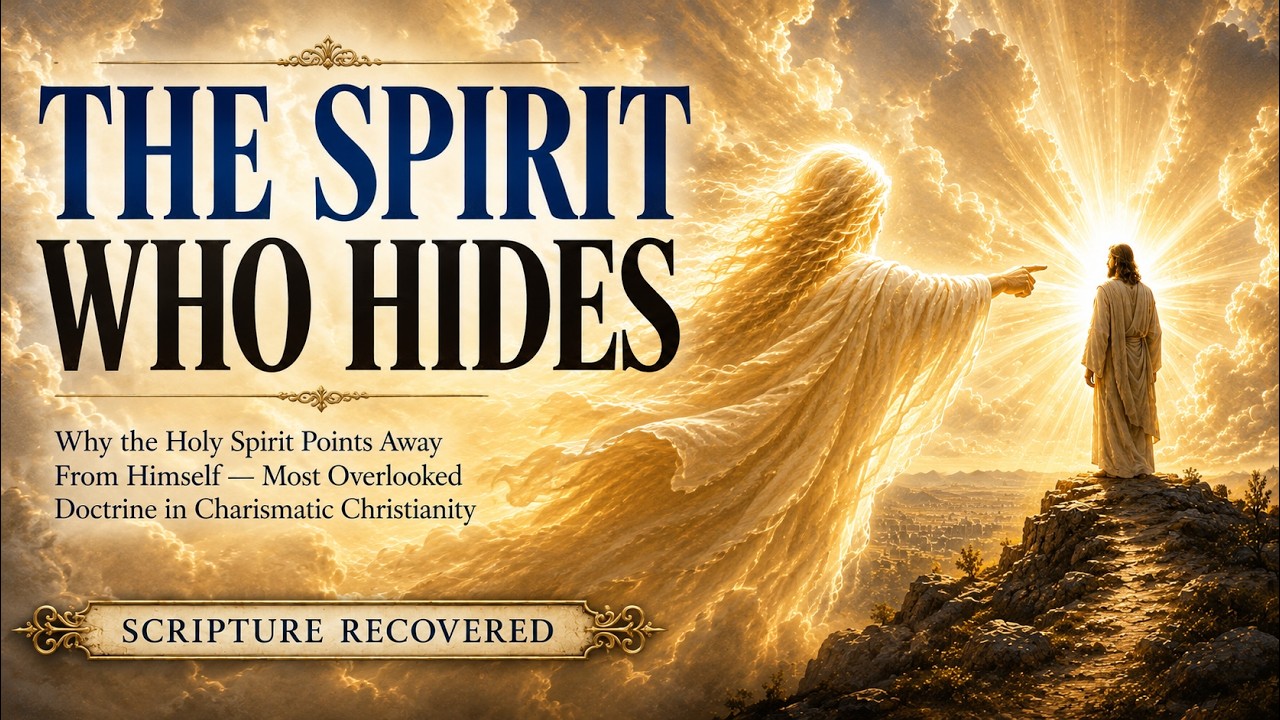
The Spirit’s Veiled Glory: When the Holy Ghost Points Us to the Son

By B.V. Thomas
Scribed in the fire of revelation, November, 2025

There are verses in Scripture that strike like a sudden chord in the hush of eternity—notes that linger, unresolved, until the whole symphony of the Godhead swells in response. I was musing there, in the quiet chamber of 1 Corinthians 8:6, when it pierced me: “yet for us there is one God, the Father, from whom are all things and for whom we exist, and one Lord, Jesus Christ, through whom are all things and through whom we exist.” Paul, that thorn-crowned apostle, distills the cosmos into this divine economy—the Father as the overflowing Source, the Son as the pulsing Channel—binding creation and redemption in a single, breathless stroke. No mention of the Spirit here, not a whisper. And yet, in that very omission, He reveals Himself more starkly than any proclamation could.

This video presentation is based on the article below, adapted for the Scripture Recovered series. The full written study follows underneath for reading, reference, and further reflection.

youtube placeholder image

Turn the page in your spirit to 1 John 1:3: “that which we have seen and heard we proclaim also to you, so that you too may have fellowship with us; and indeed our fellowship is with the Father and with his Son Jesus Christ.” John, the beloved, doesn’t just report a truth; he draws us into its flame, insisting that our communion—yours, mine—is with the Father and His Son. Again, the Spirit is absent from the page. But oh, the chills that race through the soul when you begin to see the pattern. Read that absence beside the words of Jesus in John 16:14, “He will glorify me,” and something extraordinary begins to emerge. It is almost an erasure. Not the erasure of His Person, His deity, or His glory, but the self-effacement of the eternal Breath, delighting to turn the gaze beyond Himself. He who hovered over the waters at creation (Genesis 1:2), who overshadowed Mary in the Incarnation (Luke 1:35), veils His own glory so that ours streams toward the Father and the Son. It is as if the Conductor of the ages steps off the podium, baton lowered, so the melody of Jesus might ring unchained.

This attribute—His hidden nature of joyful erasure—doesn’t shout from the rooftops of theology. No, it whispered into my spirit unbidden, a private tremor from the Dove who rests on the Branch without claiming the nest. And in that revelation, my prayer erupted: Lord, let me know Him too—the Spirit—in His distinctness, as I’ve come to know the Father’s sovereign heart and the Son’s pierced hands. To glimpse the Three not as a flat diagram, but as Persons pulsing with other-centered love. And why does He so consistently direct attention beyond Himself in the apostolic witness, rather than toward His own recognition? Because His delight is in our worship of Them—the Father who begets, the Son who redeems—and in that veiling, He unveils the wild generosity of God.

Layer this mystery upon perichoresis, that ancient word for the divine dance, the eternal circumincessio where Father, Son, and Spirit indwell one another in seamless, swirling unity. It’s no stately procession but a living waltz: the Father eternally begetting the Son in boundless affection, the Son spiraling back in flawless obedience, and the Spirit—the unclaimed bond—circling through Both, His every motion yielding the floor. It is a mutual indwelling where no one leads because all are leading, all following, all embracing. Yet even here, the Spirit’s steps curve humbly, not to spotlight His rhythm but to harmonize the Father’s voice with the Son’s song. Imagine it: the Three who are One, and the Spirit’s self-effacement isn’t diminishment but the very pulse that keeps the circle unbroken. He doesn’t hoard the stage; He ignites it for the Son, turning our gaze from the Wind to the Word made flesh.

But here’s where the conventional Christian air thickens with inversion, where Christian emphasis can become inverted. How often do we hear the Holy Spirit’s name thundered from stages—techniques to summon Him, encounters to chase Him, prophecies to claim Him—while the Name He glorifies echoes faintly, if at all? Modern books and “anointed” voices fixate on the Dove as the destination, dissecting His gifts as if they were treasures to hoard, preaching the Spirit solo as the source of power and presence. Yet Scripture flips the script with surgical precision: His ministry does not terminate in drawing attention to Himself, but in Christ being proclaimed. He is glorified when Jesus is preached, when that Name alone—evoked in faith, lifted in surrender—stirs the heavens to move.

Recall John 16:13-15, where Jesus unmasks the Spirit’s heart: “When the Spirit of truth comes, he will guide you into all the truth… He will glorify me, for he will take what is mine and declare it to you. All that the Father has is mine, and the Spirit will declare it.” See the choreography? The Spirit takes from the Son (and thus the Father) and broadcasts it to us—not a self-portrait, but a living icon of Jesus. And when the Spirit was poured out at Pentecost, what followed was not self-adulation but immediate, Spirit-filled proclamation centering entirely on Jesus: Peter rising to declare, “Let all the house of Israel therefore know for certain that God has made him both Lord and Christ, this Jesus whom you crucified” (Acts 2:36). The Spirit falls, and the apostolic proclamation that immediately emerges from Pentecost centres upon the Son. The Name of Jesus—that’s the spark. Demons scatter at it (Mark 16:17), revival ignites around it (Acts 4:12), and the Spirit’s own filling moves immediately toward exalting that Name unadorned. Chase the Wind, and you’ll grasp smoke; lift the Son, and the Wind will carry you home.

The Spirit does not erase His Person. He erases Himself from the centre of attention so that the Son fills the frame.

This truth didn’t dawn in abstraction for me—it carved itself through the flint of lived fire. I was radically saved, a soul snatched from the jaws of my own rebellion, filled to bursting with the Holy Spirit in those early, electric days. My mouth and heart sang one Name alone: Jesus. Power swelled in me like a river unbound—joy that mocked sorrow, authority that silenced storms, a fellowship so tangible it felt like walking with the Nazarene Himself. His wounds were my wonder; His resurrection, my rhythm. Then came a book that fascinated me with stories of intimate dialogue with the Holy Spirit and a conscious, daily fellowship with Him unlike anything I had deliberately pursued before. I devoured it, hungry for more of the God who had already flooded my life.

But somewhere in what I took from it and began pursuing, a sly theft happened within me. I did not see it at first: the pivot from the Lord who had birthed me in the Spirit to a growing preoccupation with the Spirit Himself, as though He were the prize rather than the One who leads us into the fullness of Christ.

I began shaping my devotional life around that pursuit. Morning greetings, a heightened attention to His personality and presence, and an increasing desire to cultivate experiences of the Spirit gradually occupied more of my spiritual attention. None of those things appeared dangerous to me at the time. But in my own walk, something precious was being displaced.

My first love for Jesus, the Pearl of great price, cooled to embers. Revelation 2:4 convicted me later: “But I have this against you, that you have abandoned the love you had at first.” It was not a full apostasy, but a drift, a fascination that rerouted my river. Power? It ebbed to a trickle. Joy? Swallowed by despondency’s slough.

The fallout was a freight train: powerlessness that mocked my calling, sins that shouldn’t ensnare a saint, a near-shattering of life itself—relationships fractured, purpose frayed, the call on my life dangling by a thread. Years wandered in that wilderness, a prodigal chasing the wrong wind, until grace—the same Spirit I’d misplaced—tugged me back. He taught me, not through thunder but through the quiet ache of return: This isn’t pursuit of Me you crave, child; it’s the Son I introduced you to, the One in whom I rest. By God’s mercy, He mapped me home to that first, fierce love, restoring the song of Jesus as my unceasing pulse.

I want to be careful here, because this testimony is easy to misread in either direction. I am not making a judgment about the motives or spiritual condition of those from whom I encountered these emphases, nor am I saying that every person exposed to them will experience what I experienced, nor am I attempting here to give a comprehensive review of the teaching itself. I can testify only to what happened in my own walk. My problem was never that I learned the Spirit is a Person, or began speaking to Him directly—Scripture itself invites both. What happened was subtler: the means became the destination, and Christ ceased occupying the place He had occupied in my first love.

I’ve told no one this fracture till now, but as we’ve unraveled it thread by thread, it fits like a missing bone: the Spirit never wanted my altars built to Him alone. He yearns for the smoke to rise to the Lamb.

And I cannot believe I am the only one who has been derailed on this track—ensnared by the glamour of Spirit-centric seminars, books that bottle the Dove as a self-help elixir, teaching where the language of presence can become detached from the centrality of the cross. It’s possible to taste sparks but miss the blaze, fragments but not the Fullness. True power, the swelling river of joy? It’s not in dissecting the Breath but abiding in the Branch where He alights (John 15:4-5). The Holy Spirit’s union with the body of Christ is inseparable—we are all baptized by one Spirit into one body (1 Corinthians 12:13), sealed by Him (Ephesians 1:13-14)—yet John describes our fellowship as being with the Father and with His Son (1 John 1:3). He cries “Abba!” within us (Romans 8:15), intercedes wordlessly (Romans 8:26-27), seals every benediction (2 Corinthians 13:14). His distinctive ministry does not terminate upon Himself. This is the erasure I mean: not disappearance, not diminishment, but divine self-effacement. The Spirit makes Himself known by making Christ unavoidable. He brings us into the knowledge, life, and glory of Christ, and through the Son to the Father.

This fights the grain of convention, I know—the tidy formulas that treat Spirit-focus and Christ-focus as interchangeable, the revival circuits that can reduce His presence to something summoned, activated, or pursued as an end in itself. It’s hard to hold such a flame within; it scorches the silence. But now? It’s time to let it flow, all of it, from the verse that started the spark to the scars that sealed the lesson. The Spirit’s veiled glory isn’t a footnote—it’s the gospel’s heartbeat, calling us back to preach one Name, to dance in perichoresis by yielding our steps to the Son. Let pulpits quake, bookshelves bow: the Holy Ghost is most glorified when Jesus is lifted high.

So rise, church—abandon the chase, reclaim the cross. Sing His Name till the winds howl in response. And in that symphony, may we glimpse the Spirit at last: not erased, but exalted in His exquisite surrender. To the Father, the Source; to the Son, the Savior; to the Spirit, the Silent Herald—glory, now and ever. Amen.