Turn the Cross Around — The Gift That Came Wrapped in the Crime

Before we turn the cross around, I need to hold something in front of you.

A mirror.

Because what follows — the gift, the debt, the staggering weight of what Israel gave the world — will not land where it needs to land unless you first see clearly what is standing in the way of it landing.

This video presentation is based on the article below, adapted for the Scripture Recovered series. The full written study follows underneath for reading, reference, and further reflection.

youtube placeholder image

Paul, in Romans 11, turns from his argument about the fall and the riches and the fulness and addresses the Gentile believer directly. Not gently. With a warning that centuries of Christian history have largely ignored, and the ignoring of which has produced some of the darkest chapters in the Church’s record.

“And if some of the branches be broken off, and thou, being a wild olive tree, wert grafted in among them, and with them partakest of the root and fatness of the olive tree; boast not against the branches. But if thou boast, thou bearest not the root, but the root thee” (Romans 11:17–18).

The wild olive. That is what you are. That is what every Gentile believer is, by birth and by nature — a shoot cut from a tree that produced no covenant, no Scripture, no Messiah, no apostles, no Gospel. Grafted in — contrary to nature, Paul says in verse 24 — to a tree you did not plant, drawing from a root you did not grow, partaking of a fatness you did not produce.

And Paul’s word to that wild olive branch is plain: boast not against the branches.

But the Church has boasted. For centuries. In theology — replacing Israel with itself, absorbing the promises while discarding the people, reading the Old Testament as though it were a preface that the New Testament has made obsolete. In history — the Crusades, the Inquisition, the pogroms, the forced baptisms, the ghettos, the theological poison that flowed from supersessionist pulpits into the streets and eventually into the gas chambers.

The grafted branch turned on the root.

And Paul says: if you do that — if you boast against the branches, if you hold the root in contempt — understand what you are doing. Thou bearest not the root, but the root thee. You are not sustaining the covenant. The covenant is sustaining you. Cut the root and you do not damage the root. You die.

“Because of unbelief they were broken off, and thou standest by faith. Be not highminded, but fear: for if God spared not the natural branches, take heed lest he also spare not thee. Behold therefore the goodness and severity of God: on them which fell, severity; but toward thee, goodness, if thou continue in his goodness: otherwise thou also shalt be cut off” (Romans 11:20–22).

Goodness and severity. Both faces of the same God. The severity that fell on the natural branches was not arbitrary — it was the judicial blindness examined in the previous article in this series, the necessary veil, the ordained hardening that made the cross possible. But Paul’s point here is not to explain the severity. It is to warn the wild branch: you stand by grace, not by right. The same God who broke off the natural branches for unbelief will not hesitate to remove you for pride.

And then — the verse that contains the whole future.

“And they also, if they abide not still in unbelief, shall be grafted in: for God is able to graff them in again. For if thou wert cut out of the olive tree which is wild by nature, and wert grafted contrary to nature into a good olive tree: how much more shall these, which be the natural branches, be grafted into their own olive tree?” (Romans 11:23–24).

How much more. The same compression Paul used in verse 12. If the wild branch was grafted in contrary to nature — against all biological logic, against every expectation — how much more shall the natural branches, the ones who belong to the tree by birthright, be grafted back in? Their return is not unlikely. It is the most natural thing in the world. God is able. And God intends.

The mirror has been held. The boasting has been named and refused. Now — and only now — are we in the right posture to turn the cross around.

The Two Faces

The previous article named the crime. This one turns the cross around.

Not to minimise the crime. Not to pretend the injustice was not injustice, or the blood was not blood, or the suffering was not suffering. But to look at what was accomplished — what was purchased, what was opened, what was made possible — by the very act that human history will forever call its darkest moment.

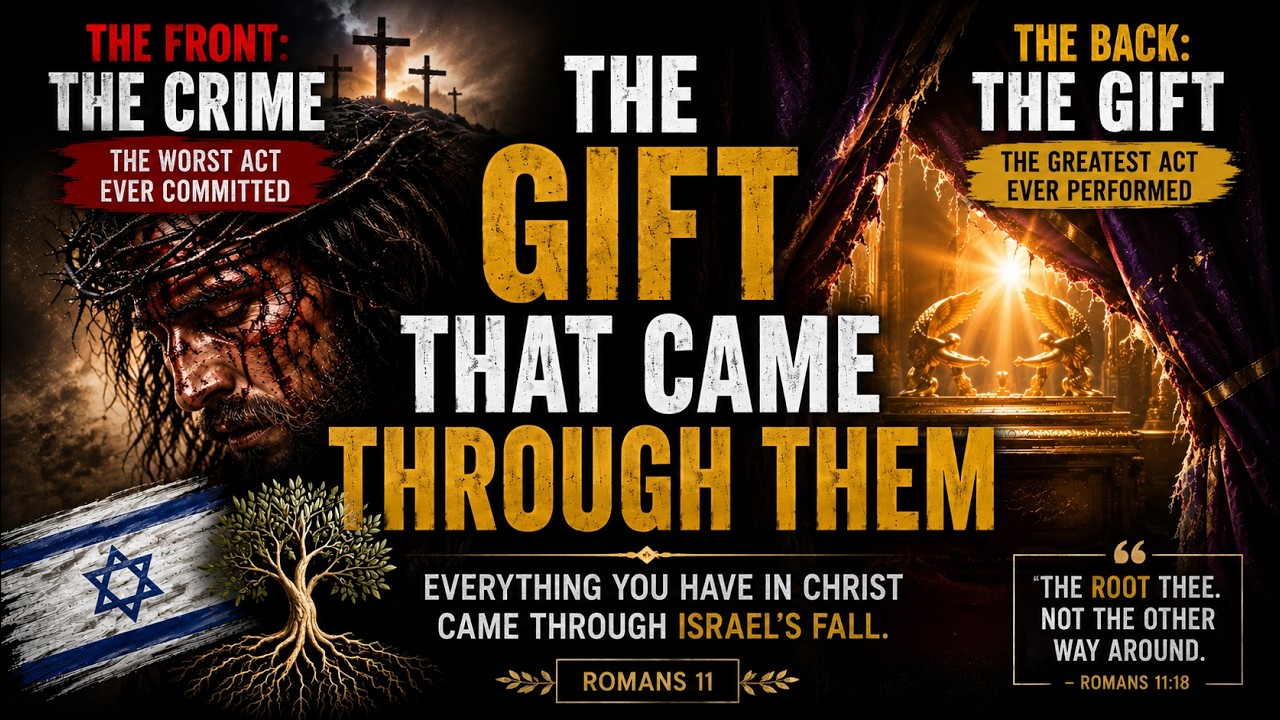
Because the cross has two faces.

From the front — the face of human sin and judicial murder. The worst act ever committed by any creature against the Creator. The Son of God handed over, stripped, beaten, nailed to a Roman instrument of execution outside the city walls. Abandoned by His disciples. Mocked by the crowd. The innocent in the place of the guilty — and the guilty crying for more.

From the back — the face of divine love and infinite mercy. The most deliberate and costly act of self-giving in the history of the universe. The eternal Son, in an act that no one could compel and nothing could coerce, laying down a life that was His own to lay down, bearing the full weight of every sin committed by every human being who had ever lived or would ever live, absorbing the wrath that belonged to the guilty so that the guilty could stand in the place of the innocent.

Both faces belong to the same event. You cannot have the gift without the crime. You cannot have the atonement without the sacrifice. You cannot have the open heaven without the torn veil — and the veil was torn from top to bottom because the Lamb was slain.

That veil deserves a moment’s attention, because most people who have read that sentence their entire lives have never been told what it actually was. It was not a curtain in any ordinary sense. Jewish historical sources describe it as sixty feet high, thirty feet wide, and a handbreadth thick — approximately four inches of densely woven fabric, constructed in Babylon, so massive that it required hundreds of priests to handle it. It was, by every human measure, untearable. Its entire purpose was architectural theology — the physical, permanent, unarguable declaration that sinful humanity could not pass into the presence of the holy God. The holy of holies lay behind it. No one entered except the high priest, once a year, on the Day of Atonement, with blood.

When that veil tore, it did not fray. It did not split under the pressure of an earthquake, as though the ground shaking had weakened the seams. It tore — from top to bottom. Not from the bottom as a man would tear it, reaching up and pulling down, but from the top, as only God tears, reaching down from His side of the separation and removing what He Himself had put in place.

The way into the holy of holies — barred since the garden, sealed by the Law, guarded by the veil across a thousand years of sacrificial worship — was opened in the moment the final sacrifice was complete. Not by human achievement. Not by religious performance. Not by accumulated piety or priestly qualification. By blood. By the Lamb.

The same people whose hands were on the knife are the people through whom the knife was provided. The same nation whose No to the Messiah made the cross possible is the nation through whom the Messiah came. Their fall was the riches of the world. Their scattering was the sowing of the Gospel. Their rejection was the opening of the door through which every Gentile believer has walked into the family of God.

This is the gift that came wrapped in the crime.

The Fall That Became Riches

Paul, in Romans 11, makes a statement so compressed and so vast that it is possible to read it a hundred times and still not have taken in its full weight.

“I say then, Have they stumbled that they should fall? God forbid: but rather through their fall salvation is come unto the Gentiles, for to provoke them to jealousy. Now if the fall of them be the riches of the world, and the diminishing of them the riches of the Gentiles; how much more their fulness?” (Romans 11:11–12).

Through their fall — salvation came to the Gentiles. Not despite their fall. Through it. The fall was the mechanism of the salvation, not an obstacle to it. God did not rescue His plan for the Gentiles in spite of Israel’s rejection of Christ. He executed His plan for the Gentiles by means of it.

Every Gentile believer in the history of the world received the Gospel because Israel said No. Because the disciples, turned away from the synagogues and the established religious structures of Jerusalem, took the message to the nations. Because Paul — whose strategy was always to go to the Jew first, and then to the Greek — found the doors of the synagogues closing and turned, again and again, to the Gentile world. Because the fall of the branches created the space through which the wild olive was invited in.

And then Paul asks the question that should make every Gentile believer sit down in stunned silence. If the fall of them produced such riches — if Israel’s diminishing was the enrichment of the entire Gentile world — how much more their fulness?

He answers it in only three words: life from the dead. Not revival. Not renewal. Not a large harvest. The restoration of Israel in its fulness will be to the world what resurrection is to death — the single most transformative event in human history since the cross itself. Paul plants that seed in Romans 11 and does not fully explain it, because the explanation belongs to the end of the age, to the fullness that is still coming, to the day when the veil lifts and the nation looks upon Him whom they pierced and mourns, and the Lord gathers what He scattered, and the dry bones stand as an exceeding great army.

But before that fullness arrives, stay with the fall. Stay with what the No produced. The one new man has not yet begun to fully understand the scale of what it received through Israel’s rejection. And until it does, it cannot properly love the people through whom it received it.

What the Fall Actually Gave You

Let me be specific. This is where the theology must become personal — must become inventory — must become the kind of reckoning that produces not guilt but genuine, structural gratitude.

What did you receive through Israel’s fall?

The Scriptures. Every word of the Old Testament — the Torah, the Prophets, the Writings — preserved across a thousand years of exile, persecution, and attempted annihilation, copied with a precision that makes the Dead Sea Scrolls nearly identical to manuscripts written a millennium later. Every word of the New Testament — written by Jewish hands, rooted in Jewish covenant, explicable only within Jewish categories of thought. You did not produce this. You received it. From them.

The Messiah. Born in Bethlehem, of the tribe of Judah, of the lineage of David. He did not arrive as a generic human being from a generic nation. He came as the specific fulfilment of specific promises made to a specific people across a specific history. The Lion of the tribe of Judah. The Root of David. He is Jewish. His humanity is Jewish. The flesh in which the eternal Word tabernacled on this earth is Jewish flesh. You received your Saviour from them.

The apostles. Every man Jesus chose to carry the Gospel to the world was Jewish. Peter and James and John — Jewish. Matthew the tax collector — Jewish. Paul, the apostle to the Gentiles, the man whose letters form the theological backbone of the New Testament — a Hebrew of Hebrews, of the tribe of Benjamin, a Pharisee. The good news that God so loved the world — first articulated, first preached, first written down, first carried to the nations at enormous personal cost — by Jewish believers for whom it cost everything.

The door. Every Gentile believer in the history of the world walked into the family of God through a door that was opened by Israel’s fall. The No that sent the Gospel to the Gentiles. The rejection that created the road Paul walked to Rome. The scattering that prepared the synagogue infrastructure in every major city of the ancient world — the same infrastructure that became the first beachhead for the Gospel in every city the apostles entered.

You received all of this because of Israel’s fall. Because of the cross — that great crime and that greater gift — performed by Jewish hands on a Jewish hill in a Jewish city at the centre of a Jewish history that God had been writing since He called a wandering herdsman out of Ur of the Chaldees and said: In thee shall all families of the earth be blessed (Genesis 12:3).

All families. You are one of them. And the blessing that reached you came through them.

The Root and the Branch

Paul’s image of the olive tree is not decorative. It is anatomical. It describes a biological reality that has spiritual weight.

The root bears the branches. Not the other way around.

Every Gentile believer in the history of the world has been sustained by a root they did not plant, in a tree they did not grow, drawing from a fatness they did not produce. The arrogance of the grafted branch toward the natural branches is not merely ungrateful — it is biologically absurd. Cut the root and the branch dies. Honour the root and the branch flourishes.

And the root is Israel. The covenants. The adoption. The glory. The promises. The Scriptures. The Messiah. The entire spiritual infrastructure of redemption that God built through Abraham, through Moses, through David, through the prophets, through the priesthood, through the exile, through the return — all of it is the root. All of it is the fatness from which every Gentile believer draws life.

This is not a courtesy extended to outsiders. This is the anatomy of the one new man. The Gentile is not a full member of an institution that was always essentially Gentile but happens to have Jewish origins politely acknowledged. The Gentile is a wild branch grafted, contrary to nature, into a tree that was always Jewish, sustained by a root that is always Jewish, bearing fruit from a fatness that is always Jewish.

That changes everything about the posture. Not guilt. Not a new form of spiritual debt that paralyses rather than frees. But the clean, clarifying, liberating gratitude of a person who finally knows what they owe and to whom they owe it — and who finds, in that knowing, a love for Israel that is not manufactured by effort or obligation but is simply, inevitably, true.

There is a question every Gentile believer quietly carries. Sometimes spoken, more often not. But it sits beneath the surface of everything we have been saying.

Does God still love them? In their present condition. With the veil still partially in place. With the fulness not yet arrived. With the long centuries of blindness and wandering still unresolved.

Paul answers it in Romans 11:28, and he does not soften it, qualify it, or defer it to a future condition. As concerning the gospel, they are enemies for your sakes: but as touching the election, they are beloved for the fathers’ sakes.

Two things simultaneously. Enemies concerning the gospel — the judicial blindness, the rejection, the No at the cross. That is real. Paul does not withdraw it. But — as touching the election, they are beloved. Not were beloved. Not will be beloved when they return. Are. Present tense. Active. Unrevoked. The love of God toward Israel is not in abeyance pending their national repentance. It is operative now, in this moment, in their present condition — because it rests not on their response but on the covenant God made with their fathers, Abraham, Isaac, and Jacob. And God does not break covenant.

Verse 29 seals it: For the gifts and calling of God are without repentance. Without repentance — ametamelēta in Greek. Irrevocable. Not subject to revision. Not contingent on Israel’s behaviour, the Church’s theology, or the world’s politics. The gifts and the calling stand. The beloved stands. Because the One who gave and called does not change His mind.

This is the God whose cross we have been standing before. The God who ordained the crime. The God who provided the gift. The God who veiled the eyes of the ones whose hands He needed. The God who grafted the wild branch into a root that still, at this moment, bears the love He has never withdrawn. That is the God whose depth Paul could only respond to with an O.

The Debt Paul Names

Paul does not leave this gratitude as a vague spiritual feeling. He names it as a specific, practical obligation.

The Gentile churches of Macedonia and Achaia were taking up a financial collection for the Jewish believers in Jerusalem who were suffering poverty. Paul describes that collection not as charity but as debt repayment: It hath pleased them verily; and their debtors they are. For if the Gentiles have been made partakers of their spiritual things, their duty is also to minister unto them in carnal things (Romans 15:27).

Their debtors they are.

The Gentiles are debtors to the Jewish believers — not because of a financial transaction but because of a spiritual one. Partakers of their spiritual things — the entire inheritance of salvation, from the Scriptures to the Messiah to the apostolic mission to the covenant promises — came through Israel. The material response is the least, the very least, that gratitude can offer.

But before the material response comes something more fundamental: the posture. The posture of a branch that knows it is a branch. The posture of a wild olive that knows it was grafted in — that it did not earn its place, that the root is not indebted to it but it to the root.

That posture is what the Church has consistently failed to hold. And the failure has been catastrophic — not only for Israel, who bore the violence of it, but for the Church itself, which in turning against the root has repeatedly sawn off the branch it was sitting on.

The Other Face

Now — with the mirror held, the inventory taken, the posture established — we can look at the back of the cross with the full weight it deserves.

From the divine side, the cross is not a crime redeemed. It is not a tragedy absorbed. It is not a human failure that God, in His mercy, managed to turn to good purpose. It is the most deliberate, the most costly, the most precisely executed act of love in the history of the universe.

The eternal Son did not stumble into Calvary. He walked toward it. From before the foundation of the world — the Lamb slain from the foundation of the world (Revelation 13:8) — this was the plan. The plan behind the plan. The purpose beneath every other purpose. The answer that was being prepared before the question was asked.

He walked into Jerusalem knowing every detail of what the prophets had written about this week. He went to Gethsemane knowing what the cup contained. He said — not as resignation but as sovereign declaration — not my will, but thine be done. And He went to the cross not as a victim led to slaughter but as a High Priest entering the holy of holies — the final, sufficient, once-for-all offering — carrying in His own body the sin of the world that the blood of bulls and goats across a thousand years of faithful sacrifice had never been able to remove.

For it is not possible that the blood of bulls and of goats should take away sins (Hebrews 10:4). Not insufficient. Not possible. The entire Levitical system, magnificent and meticulous as it was, was operating with the wrong currency. Animal blood cannot purchase human souls. What sin against an infinite God requires for its final settlement is a payment of infinite worth. And the only Person in the universe qualified to make that payment walked up the hill outside Jerusalem carrying it.

Therefore doth my Father love me, because I lay down my life, that I might take it again. No man taketh it from me, but I lay it down of myself (John 10:17–18). Caiaphas did not take it. The Sanhedrin did not take it. Rome did not take it. The crowd did not take it. He laid it down. Deliberately. Freely. For the joy that was set before Him — the joy of what the death would purchase, the joy of the sons and daughters He would bring to glory, the joy of presenting to the Father a redeemed humanity that the Father had given Him before the world began (Hebrews 12:2).

This is the back of the cross. From the front — the worst act ever committed by any creature against the Creator. From the back — the most loving act ever performed by anyone, anywhere, in the entire history of the universe.

And both faces belong to the same event. You cannot separate them. You cannot have the gift without the crime. The crime was the gift. The gift required the crime. And the people through whose hands the crime was performed are the people through whom the gift was provided.

Hallelujah

The greatest crime in history was the greatest gift in history.

Those two sentences are not in tension. They are the same sentence, read from two different sides of the same cross.

From the human side: an innocent man was murdered by a conspiracy of religious and political power, abandoned by His friends, mocked by the crowd, hung on a Roman instrument of execution outside the city walls. A crime. The worst crime. The blood of the innocent on guilty hands.

From the divine side: the eternal Son, in an act of inconceivable love, willingly laid down a life that no one could have taken from Him, bore the full weight of human sin and divine wrath simultaneously, cried out in the desolation of abandonment — My God, my God, why hast thou forsaken me — and then, having finished what He came to do, yielded up His spirit into His Father’s hands.

It is finished (John 19:30). One word in Greek. Tetelestai — written across a debt account in the ancient world when the full amount had been paid. Paid in full. The debt is discharged. The account is settled. Nothing more is owed.

And the people through whose hands this transaction was made possible — those people are not our enemies. They are not objects of contempt or theological dismissal. They are not a people God has set aside, replaced, or forgotten.

They are the people through whom our salvation came.

Every Christian who loves Jesus — who has knelt at that cross, who has felt the weight lifted, who has known the Father’s embrace, who has tasted even once the freedom of a forgiven conscience — owes those people a gratitude that has no adequate human expression.

We owe them our lives.

O the Depth

Paul brings the entire eleventh chapter of Romans — the most sustained theological treatment of Israel’s past, present, and future in the New Testament — to a close not with a proposition but with a doxology.

After eleven chapters of carefully argued theology. After three chapters of unrelenting focus on the mystery of Israel and the Gentiles. After the hardening and the fall and the riches and the fulness and the olive tree and the grafting and the life from the dead — Paul arrives at a place where the only adequate response to what he has seen is worship.

“O the depth of the riches both of the wisdom and knowledge of God! how unsearchable are his judgments, and his ways past finding out! For who hath known the mind of the Lord? or who hath been his counsellor? Or who hath first given to him, and it shall be recompensed unto him again? For of him, and through him, and to him, are all things: to whom be glory for ever. Amen” (Romans 11:33–36).

O the depth. Not: what a reasonable plan. Not: what a satisfying theological framework. Not: what a well-structured argument. O the depth — the exclamation of a man who has been staring into an abyss of wisdom so vast that his categories for understanding have been overwhelmed and only wonder remains.

This is the right response to everything this series has been saying. The choosing of the smallest seed. The thousand years of priestly training. The scattering into every soil on earth. The judicial blindness that came into the world with Christ Himself. The determinate counsel. The wicked hands. The ordained ignorance. The Caiaphas who prophesied. The crowd who cried His blood be on us and spoke truer than they knew. The tetelestai. The torn veil. The fall that became riches. The diminishing that enriched the world. The wild branch grafted in contrary to nature. The debt that is real and the fulness that is coming.

None of this was improvised. None of it was a contingency plan. None of it was God responding to human failure with a revised strategy. All of it — every thread of it, from Genesis 12 to the present day and beyond — was the outworking of a wisdom so deep that Paul, the most theologically sophisticated mind the first century produced, could only respond to it with an O.

The crime has been named. The gift has been received. The debt has been acknowledged.

In the next article, we follow the question Paul leaves open — the fulness, the life from the dead, the bones coming home. Because the Sower is still in the field, and the last sheaf has not yet been gathered in.

Continue with the next episode in this series: Israel as Seeds — The Scattering Was Not Merely Punishment. It Was Planting.

youtube placeholder image

Or read the full article: Israel as Seeds

B.V. Thomas is the author and theologian behind The Hermeneutical Quill, a platform reaching readers across 170+ countries. This article is adapted from the Scripture Recovered video teaching series.

Subscribe to Scripture Recovered on YouTube — and visit bvthomas.com for more.

Scripture references in this article: Romans 11:11–12 · Romans 11:17–18 · Romans 11:20–22 · Romans 11:23–24 · Romans 11:28–29 · Romans 11:33–36 · Romans 15:27 · Genesis 12:3 · Revelation 13:8 · Hebrews 10:4 · Hebrews 12:2 · John 10:17–18 · John 19:30

The Paraklētos and the Celestial Concierge: Recovering the Full Ministry of the Holy Spirit

Before the doctrine can be recovered, the word must be heard again — not as a familiar religious term, but as the weighted, ancient, freighted thing it actually is. The Greek word Paraklētos carries forensic weight, intimate closeness, and a ministry far larger than modernity has allowed it.

The Word Itself

Before the doctrine can be recovered, the word must be heard again — not as a familiar religious term, but as the weighted, ancient, freighted thing it actually is.

This video presentation is based on the article below, adapted for the Scripture Recovered series. The full written study follows underneath for reading, reference, and further reflection.

youtube placeholder image

The Greek word Paraklētos (παράκλητος) comes from two roots: para, meaning “alongside,” and kaleō, meaning “to call.” Taken together, it describes one who is called alongside another. But the moment you ask what kind of calling, and for what purpose, the word opens into a world far removed from the casual associations modernity has imposed on it.

In the ancient Greek-speaking world, a paraklētos was not a domestic assistant. The term carried forensic weight. It described the figure summoned to stand beside the accused in a court of law — one who would speak on behalf of the defendant, argue the case, defend against the charge, and ensure that the one on trial did not stand alone before judgment. To call upon a paraklētos was not a minor convenience. It was a recognition that the situation was serious, that the stakes were high, and that no adequate defence could be mounted without someone of greater authority and competence standing in your corner.

This legal resonance is not incidental. It is embedded in the very word John the Apostle reaches for when recording the words of Jesus Christ in the farewell discourse of the fourth Gospel. When Jesus says, “I will ask the Father, and He will give you another Paraklētos” (John 14:16), he is not promising his disciples a spiritual amenity. He is promising them an advocate — one called alongside them precisely because their situation, spiritually speaking, is one they cannot navigate alone.

The word also carries the warmth of personal presence. It is not only a legal term. A paraklētos was one who came near — who strengthened, who counselled, who interceded, who upheld. The range of its meaning held forensic defence and intimate closeness in the same hand. The one called alongside you was both your advocate before the court and your strengthener in the long night before it.

When the translators of Scripture reach for English equivalents — Comforter, Counselor, Helper, Advocate — each word captures something real. But each word also loses something. Comforter risks sentimentality. Helper risks domestication. Counselor risks reduction to therapeutic function. Advocate captures the legal weight but can miss the intimacy. No single English word holds the full amplitude of what John intends. This is not a translation problem to be solved — it is a signal to be heeded. The word is larger than any one rendering. The ministry it describes refuses to be flattened.

This matters because how a word is heard shapes how a doctrine is lived. When the Paraklētos is received primarily as a Helper in the diminished modern sense — one who assists with the ordinary frictions of daily life, who smooths difficulty, who grants emotional ease — the grandeur of what was given begins to contract. Not through deliberate error, but through habituation to a smaller category than the word itself demands.

The question the rest of this article will press is simply this: What kind of helper is this? Not what we have assumed. Not what our felt needs have projected onto the promise. But what the word actually means, what the texts actually say, and what the ministry of the Holy Spirit actually is — in its full, forensic, transformative, Christocentric scope.

The answer begins, as so many answers in Scripture do, by looking not only at what was given, but at who gave it — and what He Himself still does.

Two Paraklētoi, One Advocacy

There is a detail in the farewell discourse that is easily passed over, yet once seen, it reorders everything.

When Jesus promises the coming of “another Paraklētos” (John 14:16), the word another — allon in Greek, meaning another of the same kind — carries a quiet but staggering implication. If the Spirit is another Paraklētos, then the one speaking is himself a Paraklētos. Jesus does not use the word of himself here. He does not need to. The construction does it for him. He is the first. The Spirit will be the second. And the distinction between them is not one of function but of location and mode of operation.

John the Apostle makes this explicit in his first epistle. Writing not of the Spirit but of the ascended Christ, he states plainly:

“We have a Paraklētos with the Father — Jesus Christ the righteous” (1 John 2:1).

The scene is forensic. A believer has sinned. The accusation stands. And in that moment, there is one who rises to speak — not to minimise the charge, not to deny the wrong, but to present himself as the sufficient answer to it. Christ stands as Paraklētos before the throne of the Father, and his advocacy is grounded entirely in his own propitiatory sacrifice.

He does not plead our innocence. He presents his blood.

Now hold these two texts together — John 14:16 and 1 John 2:1 — and what emerges is not simply a doctrine about the Spirit or a doctrine about Christ, but a single architecture of divine advocacy stretching from the throne of God to the interior of the human soul.

Christ is above, standing before the Father, advocating for the believer on the ground of his finished work. The Spirit is within, standing alongside the believer, applying that finished work, forming Christ inwardly, interceding through the believer’s own weakness with groanings too deep for words (Romans 8:26). The two are not parallel or redundant. They are coordinated. One secures the believer’s standing before God. The other works that standing into the believer’s actual life. One intercedes at the throne. The other intercedes within the soul.

Together, they form a single, unbroken movement of divine grace — descending from God into man, ascending from man back to God.

This architecture has enormous implications for how the ministry of the Spirit is understood. The Spirit is not operating independently of Christ. He is not a second and separate comfort dispensed after Christ’s departure as a kind of consolation for his absence. He is, as Jesus himself said, the one who will take what belongs to Christ and disclose it to the believer (John 16:14-15). His entire ministry is Christocentric. He does not draw attention to himself. He does not point to experiences, gifts, or phenomena as ends in themselves. He points always to Christ — revealing him, forming him, conforming the believer to his image. The Spirit’s goal is not that the believer would feel the Spirit, but that the believer would know Christ.

This is why the farewell discourse in John 14–16 is so carefully structured. Jesus does not simply promise the Spirit as a replacement presence. He describes a ministry of inward instruction (John 14:26), conviction (John 16:8), guidance into truth (John 16:13), and glorification of Christ (John 16:14). Every movement of the Spirit in these chapters is oriented toward one end: that the disciples — and through them, all who believe — would be rooted in Christ, would understand what Christ accomplished, and would be enabled to live in the reality of what Christ secured.

The two Paraklētoi are therefore not two separate ministries loosely associated with each other. They are two movements of a single divine advocacy. To diminish the Spirit’s ministry — to reduce him to an agent of comfort and convenience — is not merely a pneumatological error. It is a Christological one. For the Spirit’s ministry is inseparable from Christ’s. Where the Spirit is misunderstood, Christ is inevitably diminished alongside him.

What, then, does the Spirit actually do in the life of the believer? The New Testament answers this with a specificity and a weight that the following section will trace carefully. But the frame has now been set. The Spirit does not operate as a free agent distributing spiritual amenities. He operates as the inner movement of a coordinated divine advocacy — one whose entire purpose is to bring the soul of the believer into living contact with the Christ who stands, right now, as its advocate before the Father.

He was not sent to make life easier. He was sent to make Christ real.

What the Spirit Actually Does

Doctrine is only as strong as its exegetical roots. The claim that the Holy Spirit’s ministry is primarily inward, transformative, and Christocentric must be demonstrated from the texts that establish it — not asserted over them. The New Testament is not shy on this point. It is, in fact, remarkably specific.

Begin where Jesus himself begins: the farewell discourse of John 14–16, spoken on the eve of the crucifixion, addressed to men who were about to lose everything they thought they understood.

He will teach you all things (John 14:26).

The first function Jesus names is not comfort in the sentimental sense, but instruction. The Spirit comes as a teacher — not of new revelation beyond Christ, but of the meaning and depth of what Christ himself said and did. The disciples had heard the words. They had not yet understood them. The Spirit would be the one who opened the words from within, making them luminous, making them load-bearing, making them liveable. This is not an interior feeling. It is an inward illumination of revealed truth.

He will remind you of everything I have said to you (John 14:26).

Memory here is not passive recall. In the Johannine framework, to be reminded by the Spirit is to have the words of Christ made present and active — brought forward from the past into the living moment, so that they address the believer with immediacy and authority. The Spirit does not generate new content. He makes the content of Christ perpetually available to those who belong to him.

He will convict the world concerning sin, righteousness, and judgment (John 16:8).

This is one of the most misread verses in the pneumatological corpus. The Spirit’s convicting work is often confined in popular imagination to the moment of conversion — a general unease about sin that leads a person to repentance. But the categories here are larger. Conviction concerning sin — because the world did not believe in Christ. Conviction concerning righteousness — because Christ has gone to the Father and his vindication must be proclaimed. Conviction concerning judgment — because the ruler of this world has been condemned. The Spirit does not merely produce vague guilt. He creates a crisis of understanding about who Christ is, what he accomplished, and what his exaltation means for the moral order of the universe.

He will guide you into all truth (John 16:13).

Again, the movement is inward and Christological. The Spirit does not guide the believer primarily through external signs and circumstantial arrangements — he guides into truth, into the deep coherence of what God has revealed in Christ. This is the Spirit’s hermeneutical ministry: opening Scripture, clarifying doctrine, leading the mind and soul into the logic of redemption until the believer sees and knows, not merely believes and hopes.

He will glorify me (John 16:14).

This is the capstone of the farewell discourse’s pneumatology and the sentence that must govern all subsequent reflection on the Spirit’s work. The Spirit’s ultimate aim is not that the believer would have experiences of the Spirit. It is that Christ would be glorified — made visible, central, magnificent — in the life and understanding of the believer. Every other aspect of the Spirit’s ministry in John 14–16 is subordinate to this. He teaches in order to glorify Christ. He reminds in order to glorify Christ. He convicts in order to glorify Christ. He guides in order to glorify Christ. The Spirit is constitutionally self-effacing. His glory is always reflected, never retained.

Now move from John to Paul, and the same pneumatology deepens into a different register.

Romans 8 is the great pneumatological chapter of the Pauline corpus, and it opens with an immediate declaration of emancipation:

“There is therefore now no condemnation for those who are in Christ Jesus” (Romans 8:1).

The Spirit’s ministry in Romans 8 is set from the first verse in a forensic and redemptive frame — which is to say, in direct continuity with the Paraklētos of John. What follows is a sustained account of what the Spirit does within the believer to actualise that freedom.

He liberates from the law of sin and death (Romans 8:2). He enables the righteous requirement of the law to be fulfilled in those who walk according to him (Romans 8:4). He sets the mind — not merely the emotions or the circumstances, but the mind, the deep cognitive and volitional centre of the person — on the things of God (Romans 8:5-6). He gives life to mortal bodies (Romans 8:11). He puts to death the deeds of the body (Romans 8:13) — mortification, the deliberate, Spirit-empowered killing of sin’s activity in the flesh. He bears witness with the believer’s spirit that they are children of God (Romans 8:16). And in what may be the most intimate verse in the entire chapter, he intercedes for the believer with groanings too deep for words (Romans 8:26), taking up the prayer that human weakness cannot form and carrying it before the Father.

This is not the ministry of a celestial assistant managing earthly difficulty. This is the ministry of one who has entered the deepest interior of the human person — the mind, the will, the body, the prayer life — and is working there with the kind of transformative power that belongs to God alone.

Galatians 5 adds the dimension of character. The fruit of the Spirit — love, joy, peace, patience, kindness, goodness, faithfulness, gentleness, self-control (Galatians 5:22-23) — is not a catalogue of pleasant emotional states. It is the character of Christ, reproduced in the believer by the Spirit’s sustained work. Paul’s verb here is instructive: the fruit is not manufactured, not performed, not achieved by moral effort. It grows — organically, from within, as the natural produce of a life surrendered to the Spirit’s cultivation. And the imperative Paul draws from this is equally instructive:

“If we live by the Spirit, let us also keep in step with the Spirit” (Galatians 5:25).

The life is already the Spirit’s gift. The walking — the daily, deliberate alignment with his movement — is the believer’s responsive discipline.

Taken together, the Johannine and Pauline accounts form a unified picture. The Spirit teaches, reminds, convicts, guides, glorifies Christ, liberates, transforms the mind, mortifies sin, bears witness, intercedes, and produces the character of Christ in the believer — not as a series of isolated operations but as a single, sustained, inward movement whose direction is always the same: toward Christ, into Christ, out from Christ into the world.

Yes, and the Ordinary Life Too

A theology that locates the Spirit’s ministry entirely in the interior and invisible risks becoming its own kind of distortion — a hyper-spiritualism that leaves the believer without genuine guidance in the concrete world they actually inhabit. The New Testament does not make this error, and neither should we.

The Spirit of God is not indifferent to the ordinary life of the believer. He is not sealed within the sanctuary of the soul, operating only at the level of conviction and sanctification while remaining uninvolved in the daily, practical, circumstantial texture of Christian living. The evidence against such a truncation is too strong to dismiss, and it is the New Testament itself that supplies it.

The book of Acts is the primary witness. What is striking about Acts is not merely that the Spirit is present and active throughout — that would be expected given the promise of Pentecost — but that his activity extends explicitly into the realm of practical, directional, even geographical decision-making. He sends Philip to a specific road at a specific time to meet a specific Ethiopian official (Acts 8:29). He forbids Paul and his companions from entering Asia (Acts 16:6) and prevents them from going into Bithynia (Acts 16:7), redirecting the entire Macedonian mission through a negative constraint that is itself a sovereign guidance. He tells Peter plainly to go with the men sent by Cornelius without hesitation (Acts 10:19-20), breaking open the Gentile mission through a direct practical instruction. He separates Barnabas and Saul for the work to which he has called them (Acts 13:2), initiating what would become the most consequential missionary endeavour in apostolic history.

These are not interior sanctification events. They are practical, directional movements — the Spirit operating at the level of where to go, whom to meet, what to say, which door to enter and which to leave closed. To acknowledge this is not a concession to a diminished pneumatology. It is fidelity to the text as it actually stands.

The Spirit also distributes gifts for the functioning of the body — gifts that are by nature practical in their expression. Teaching, administration, mercy, helps, giving, leadership, discernment (Romans 12:6-8; 1 Corinthians 12:4-11) — these are not abstract spiritual states. They are concrete capacities exercised in real communities, real situations, real relationships. They involve the mind, the hands, the voice, the material resources of the believer deployed in the service of others. The Spirit who produces inward fruit also equips outward function. He is not only the Spirit of sanctification but the Spirit of service.

And there is the quieter, less dramatic dimension — the one that operates not through visions or prohibitions but through the accumulated wisdom of a life walked with God. Paul speaks of the Spirit helping the believer in weakness (Romans 8:26), a phrase whose scope is wider than intercession alone. The help of the Spirit in weakness encompasses the moment of inadequacy, the situation that exceeds the believer’s resources, the practical dilemma for which no formula is sufficient. In such moments, the Spirit does not leave the believer to manage alone. He is, after all, called alongside — and what is alongside is present in the full range of what that nearness implies.

Yet here is where the crucial distinction must be drawn — not to minimise what has just been affirmed, but to frame it correctly.

Every instance of the Spirit’s practical guidance in Acts is inseparable from a redemptive purpose that transcends the circumstance itself. Philip is sent to the Ethiopian not so that the Ethiopian might have a convenient travelling companion, but so that the Gospel of Isaiah 53 might be opened to him and the kingdom of God might extend to Africa through his conversion. Paul is forbidden from Asia and Bithynia not to spare him inconvenience, but to redirect apostolic energy toward Macedonia — toward Lydia, toward the Philippian jailer, toward the European church. The Spirit’s practical guidance is never arbitrary, never merely circumstantial, never in service of the comfort or preference of the one being guided. It is always in service of something larger: the advancement of the Gospel, the building of the church, the purposes of God moving through history toward the return of Christ.

This is the pattern that governs every instance of the Spirit’s practical involvement in the ordinary life of the believer. He guides not so that the guided might flourish in worldly terms, but so that the mission of God might advance through them. He strengthens not so that the strong might be more effective in their own enterprises, but so that the weak might be vessels through whom divine power is made visible. He grants wisdom not as a cognitive upgrade for earthly success, but as the mind of Christ applied to situations that require discernment in order to honour God and serve others.

The ordinary life is therefore not beneath the Spirit’s attention. But it is never the Spirit’s final concern. He enters the practical, the circumstantial, the geographical, the relational — and he does so with genuine authority and specificity. But he enters it always as one who holds a larger map than the believer can see, who moves through the texture of daily life in service of eternal purposes, who is never interested in earthly ease as an end in itself.

The believer who walks closely with the Spirit will indeed find that their practical life bears the marks of his involvement — unexpected clarity, redirected plans, wisdom that arrived from beyond themselves. This is real. This is not to be denied or spiritualised away. But the believer who mistakes these practical touches for the primary ministry of the Spirit has confused the periphery for the centre.

The Spirit does attend to the ordinary life. He does so, however, not to make it more comfortable, but to make it more Christlike, more useful, more aligned with the redemptive movement of God through this present age.

Which brings us, finally, to the crisis.

The Concierge and the Crisis

There is a form of Christianity that is outwardly pneumatological and inwardly impoverished. It speaks of the Spirit constantly. It invokes his name in every gathering, attributes to him every favourable circumstance, and builds entire worship cultures around the expectation of his felt presence. And yet, beneath the language and the atmosphere, the Spirit it has constructed bears little resemblance to the Paraklētos of the New Testament. He has been quietly, gradually, and often sincerely reshaped into something far more manageable — a divine concierge, perpetually available, whose chief business is the improvement of the believer’s earthly experience.

This is not a fringe error. It is a mainstream one. It lives in the prosperity theology that presents the Spirit as the guarantee of financial blessing and physical health. It lives in the therapeutic spirituality that reduces the Spirit’s ministry to emotional regulation and inner peace. It lives in the devotional culture that evaluates the Spirit’s presence by the intensity of feeling in a worship gathering. It lives, more subtly, in the ordinary piety of believers who have come to regard the Spirit primarily as a problem-solver — one invoked when situations are difficult and credited when they resolve favourably, whose relevance to daily life is measured almost entirely in circumstantial outcomes.

None of these positions is wholly without truth. The Spirit does bless. He does comfort. He is present in worship. He does act in circumstances. But when these peripheral realities are moved to the centre — when the Spirit’s ministry is evaluated primarily by what he does for the believer in worldly terms rather than what he does in the believer for eternal ones — something has been lost that is not easily recovered. The word has been domesticated. The Advocate has been reduced to an attendant. The one who was sent to make Christ real has been reassigned to make life comfortable.

The consequences of this reduction are not trivial. They are visible in the character of much contemporary Christianity.

Suffering becomes a sign of his absence rather than a theatre of his deepest work.

When the Spirit is primarily a comfort-giver, suffering becomes a sign of his absence rather than a theatre of his deepest work. When he is primarily a problem-solver, the believer’s faith becomes functionally transactional — active when needs are pressing, dormant when life is settled. When he is primarily an emotional intensifier, worship becomes an end in itself rather than a means of beholding Christ. When he is primarily a divine assistant, prayer narrows into request and the vast interior work of intercession — the Spirit groaning within the believer with words too deep for human articulation — goes almost entirely unexplored. And when sanctification is no longer understood as the Spirit’s primary work in the believer, holiness becomes optional, moral conformity to Christ becomes aspirational rather than expected, and the church begins to look, in its actual life and character, increasingly like the world it was sent to address.

This is the crisis. Not dramatic. Not sudden. But real, and deepening.

The recovery begins not with a program but with a recovery of the word itself. Paraklētos. Called alongside. Not to make the journey pleasant, but to make it possible. Not to remove the difficulty of the road, but to ensure that the one walking it is not walking alone, is not walking unchanged, is not walking without the resources of heaven being applied to the poverty of earth.

The Spirit was given because the situation of the believer in this age is, spiritually speaking, one that cannot be navigated on human terms. The world, the flesh, and the powers of darkness are not inconveniences. They are formidable. The standard to which the believer is called — conformity to the image of the Son of God — is not a modest aspiration. It is a supernatural one. The prayer life, the mortification of sin, the bearing of fruit, the endurance of suffering, the witness to a hostile world, the maintenance of faith across a lifetime — none of these are achievable by human strength, human wisdom, or human willpower. The Paraklētos was not sent for those who are managing well. He was sent because, without him, the believer cannot manage at all — not in the ways that ultimately matter.

And he is more than equal to what he was sent to do.

The Spirit who hovered over the formless deep and brought forth creation (Genesis 1:2) is the Spirit who hovers over the formless, darkened interior of the human soul and brings forth new creation. The Spirit who raised Jesus Christ from the dead (Romans 8:11) is the Spirit who dwells in mortal bodies and gives them life. The Spirit who descended at Pentecost and turned frightened, hiding men into witnesses who turned the world upside down is the Spirit who indwells every believer who has received him — not as a distant historical memory, but as a present, active, transforming, interceding, Christocentric reality.

This is what was given. Not a spiritual amenity. Not a divine upgrade for earthly living. Not a concierge for the comfortable management of a life still oriented primarily toward this world. What was given was the third person of the Holy Trinity — the Lord and giver of life, as the ancient creed confesses — sent with a specific, weighty, irreducible mission: to make the believer alive unto God, to reveal and form Christ inwardly, to conform the redeemed soul to the image of the Son, and to sustain and empower a life that manifests the nature and will of God in a world that has not yet seen him.

He helps us live in this world. But never merely for this world.

— B.V. Thomas

The Hermeneutical Quill  |  bvthomas.com

The Greatest Crime in History — What the Church Has Flinched From Saying

Episode 1 

By B.V. Thomas | The Hermeneutical Quill

I want to say something that the Church has largely flinched from saying.

Not because it is hidden. Not because it requires secret knowledge or obscure scholarship. It is written in plain letters across the New Testament, available to anyone who reads carefully and follows the logic all the way to its conclusion.

The Church has flinched because the conclusion, when you arrive at it, is so large and so overturning that it is difficult to contain.

Here it is.

This video presentation is based on the article below, adapted for the Scripture Recovered series. The full written study follows underneath for reading, reference, and further reflection.

youtube placeholder image

The crucifixion of Jesus Christ — the most consequential event in the history of the universe — came through Israel’s official and representative No to her Messiah. In the story Scripture actually gives us, the cross does not come through Israel’s national enthronement of the Messiah. It comes through Israel’s official rejection of Him.

The Lamb of God had to be examined, declared innocent, and deliberately slaughtered by the very people who had been waiting for Him. That was not a tragic accident of history. That was not a contingency plan God scrambled to redeem after things went wrong. That was the plan — announced in the prophets, embedded in the Passover, encoded in a thousand years of priestly training, and executed at the moment of God’s own choosing with a precision that leaves no room for the word coincidence.

And the people through whose hands it was performed did not know what they were doing.

That last sentence is not an excuse. It is a theological description — perhaps the most extraordinary theological description in the entire New Testament — of what divine sovereignty actually looks like when it operates at full depth.

The Determinate Counsel: Two Rails, One Track

We begin at Pentecost.

Fifty days after the crucifixion. The disciples are gathered in Jerusalem. The Holy Ghost has just fallen. And Peter stands up — the same Peter who denied the Lord three times, the same Peter who wept bitterly in the courtyard — and preaches the first sermon of the Church age. In that sermon, he says something that should stop every careful reader cold.

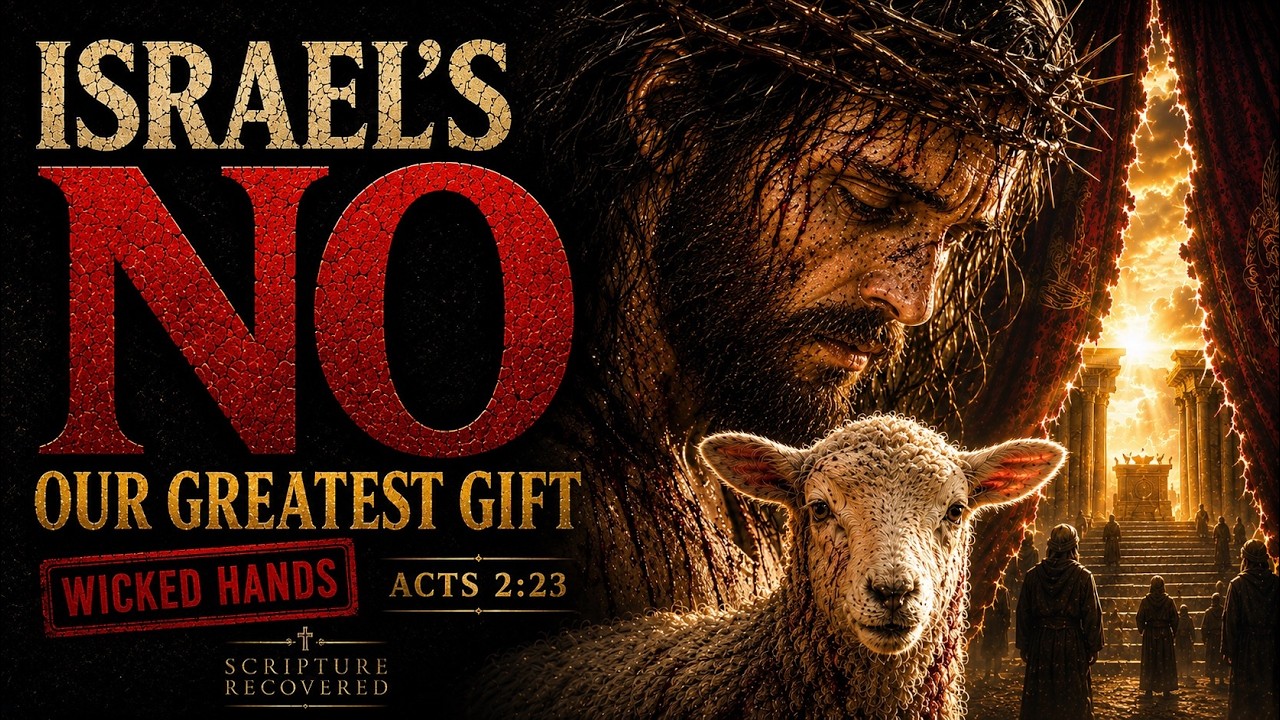
Him, being delivered by the determinate counsel and foreknowledge of God, ye have taken, and by wicked hands have crucified and slain (Acts 2:23).

Peter holds two things together in a single breath that most of our theology has never managed to hold together since. First: delivered by the determinate counsel and foreknowledge of God. That word — determinate — is the Greek horizō, from which we get the English word horizon. It means a fixed boundary. A predetermined limit. A decision made before the event that the event cannot escape. The crucifixion was not a tragedy that God absorbed into His plan after the fact. It was the plan — fixed in eternity, known before the foundation of the world, delivered to the cross on God’s own timetable.

Second: by wicked hands have crucified and slain. The hands were wicked. The act was a crime. The guilt was real.

Both of these things are true simultaneously. And their simultaneous truth is the most theologically precise statement in the entire New Testament about what happened at Calvary.

The crucifixion was ordained — and it was a crime. It was foreknown — and it was culpable. It was necessary — and it was unjust. These are not contradictions to be resolved by choosing one side. They are the two rails of the same track, and the train of redemption runs on both of them simultaneously.

The Church has been uncomfortable with this for two thousand years. We tend to emphasize one rail and neglect the other. Either we emphasize the sovereignty — God planned it, so the crime is swallowed up — or we emphasize the guilt — the crime was real, so we must be careful not to blame any particular people. And in both directions, we lose something we cannot afford to lose.

Peter loses neither. He stands before the very crowd that fifty days earlier was crying Crucify — and he holds both rails in front of them without flinching. That is where we must stand today.

A Thousand Years of Blood

But before we reach Calvary, we must go back — back a thousand years. Because what happened on that Friday outside Jerusalem did not begin on that Friday. It began at Sinai.

The moment God declared His purpose for Israel, He gave them a title that should have shaken the ancient world: Ye shall be unto me a kingdom of priests, and an holy nation (Exodus 19:6). Not a kingdom with priests. A kingdom of priests. Every member of the nation bearing a priestly identity. Every family a branch of the great sacrificial institution that stood at the centre of their national life.

Paul would later say the same thing in Romans 9:4–5 with a comprehensiveness that should silence every supersessionist reading of Israel’s story: to whom pertaineth the adoption, and the glory, and the covenants, and the giving of the law, and the service of God, and the promises; whose are the fathers, and of whom as concerning the flesh Christ came. The adoption. The glory. The covenants. The giving of the Law. The service of God. The promises. The fathers. And from them, according to the flesh — Christ came. Israel was not a background nation in the story of redemption. Israel was the covenant vessel into which God had placed the entire grammar of salvation. Every category of divine self-disclosure — every promise, every covenant, every act of priestly service — entrusted to this people. Which means the cross, when it came, came rightly and necessarily within Israel’s covenantal world.

And from that moment, God opened a school. A school that would run for a thousand years. And the curriculum, every single day, was the same.

Every morning, without fail — a lamb is brought. Unblemished. Carefully chosen. Without spot or defect. Hands are laid upon its head — a gesture of transfer, of identification: the weight of the offerer’s guilt passing from the one who deserves to die to the one who will die in his place. The blade falls. The blood flows. The priest catches it, carries it to the altar, sprinkles it where God has said His presence dwells. The smoke rises. The act is complete.

This happened every morning. Every evening. Every Sabbath, doubled. Every new moon, expanded. Every Passover, every Day of Atonement, every feast — the lambs multiplied, the blood flowed, the priests performed their ancient, meticulous, blood-soaked liturgy with absolute precision, because the Law of Moses specified every detail, and deviation meant death. Generation after generation of priests born, trained, ordained, served, and died — and their sons after them — all performing this same ritual, all speaking the same wordless sermon to anyone who had ears to hear it: Something must die for sin to be covered. Blood must be shed. The innocent must bear the weight of the guilty. There is no other way.

For a thousand years, Israel went to school in blood.

And every detail of that schooling mattered. Because every gesture was a word in a language being written across ten centuries — a language that would only be fully read on one specific afternoon outside Jerusalem.

The sacrificial law required that the offering be without blemish, that it cost the offerer something, that it be the offerer’s own. Then came the laying on of hands — not a blessing but a transfer, a deliberate, embodied declaration that the guilt belonging to the one standing upright would now be carried by the one about to fall. Then the animal was slaughtered. And here is the detail the Church has glossed over for centuries.

Not by the priest alone.

The offerer himself participated in the killing. The sinner’s own hands were involved in the death of the substitute. There was no comfortable distance, no clean separation between guilt and consequence. The one who had sinned held the knife. This was designed to be felt. For the life of the flesh is in the blood: and I have given it to you upon the altar to make an atonement for your souls: for it is the blood that maketh an atonement for the soul (Leviticus 17:11).

Who Must Hold the Knife

We arrive now at the question this entire history has been building toward. Before we ask it, one thing must be said clearly. What follows is not a charge of ethnic guilt. It is the opposite. It is the recognition of Israel’s unique covenantal office. The knife had to be in Israel’s hands because the altar, the priesthood, the promises, the Scriptures, the Passover, and the Lamb-language had been entrusted to Israel alone. No other nation carried that office. No other nation could have fulfilled it. What we are about to see is not accusation. It is the most extraordinary priestly appointment in the history of the world.

In the Mosaic system — who kills the lamb?

The sinner does.

The one whose guilt is being transferred to the animal. The one who has placed his hands on its head. It is the transgressor who participates in its death. This is not incidental. It is not a procedural detail that could have been arranged differently. It is the theological core of the entire act. The transgressor must be present. The transgressor must be involved. You cannot send a proxy to confess your own sin.

Now follow that principle to its conclusion.

When the true Lamb arrives — when God provides the final, sufficient, infinite sacrifice that the entire Levitical system has been pointing to — who must hold the knife? The transgressor. And who are the transgressors? Who are the ones under the Law, under the covenant, who have broken it and need it to be fulfilled on their behalf?

When the fulness of the time was come, God sent forth his Son, made of a woman, made under the law; to redeem them that were under the law (Galatians 4:4–5). The first beneficiaries of the atonement are those who were under the Mosaic covenant — Israel. And therefore Israel, as the transgressor under the Law, as the nation whose sin the Lamb would bear, as the people whose hands had been trained for a thousand years in the act of sacrificial offering —

Israel must stand as the nation whose hands are on the knife when the final Lamb is slain.

This is not an accusation. It is a description of a priestly act. The most consequential priestly act in the history of the world. No other nation on earth could have performed it. The Romans could execute — but they had no framework for what the blood meant. The Greeks could philosophise about death — but they had no altar. No other people had spent a thousand years learning, in their hands and in their bodies, the precise liturgical grammar that Calvary would require.

Only Israel. Trained across ten centuries by God Himself. In blood. For this.

The Judicial Blindness

If their hands needed to be on that knife — then the question that follows is urgent. Why did Israel not recognize Him?

The answer most Christian theology has given: because they were hard-hearted. Spiritually blind. Proud. There is truth in that, as far as it goes. But that answer is incomplete — it makes Israel’s blindness merely a human failure, when the New Testament describes it as something far more specific and sobering than that.

Paul, in Romans 11, calls it a hardening: Blindness in part is happened to Israel, until the fulness of the Gentiles be come in (Romans 11:25). Blindness in part — partial, targeted, judicially imposed. It has a duration, a purpose, and a terminus. It is not permanent. It is not arbitrary. It is the veil God placed over the face of the nation for exactly as long as the veil was needed.

But Paul’s retrospective theology is not where this truth originates. Jesus declared it Himself — in His own words, about His own mission, before the cross had even arrived. For judgment I am come into this world, that they which see not might see; and that they which see might be made blind (John 9:39).

He did not say: blindness has unfortunately fallen upon some as a consequence of their pride. He said: I came to enact it. The blinding of those who were certain they could see — the religious establishment, the Sanhedrin, the guardians of the sacrificial system — was not something that happened to the situation around Him. It was something He brought with Him from the moment He stepped into Galilee. The Pharisees’ own question — Are we blind also? — and His answer — If ye were blind, ye should have no sin — reveals the devastating precision of it. Their very confidence in their own sight was what sealed them. And it was the closed ones whose hands were needed for what was coming.

He came carrying the judgment that would produce the blindness. He walked into Jerusalem knowing that the veil He had brought would ensure the knife would not be stayed.

Jesus described the mechanism further in His explanation of the parables: Because they seeing see not; and hearing they hear not, neither do they understand. And in them is fulfilled the prophecy of Esaias (Matthew 13:13–14). He was not frustrating their understanding arbitrarily. He was fulfilling Isaiah’s description of a judicial hardening that God Himself had ordained for this people at this time for this purpose. The parables concealed as much as they revealed. And the concealment was necessary.

Paul tells us why: Which none of the princes of this world knew: for had they known it, they would not have crucified the Lord of glory (1 Corinthians 2:8). Had they known it, they would not have done it. The crucifixion required ignorance to proceed. The most consequential act in the history of the universe had to be performed by participants who did not understand its true nature — because if they had understood, self-interest alone would have caused them to stop. Satan would have restrained his own agents. Caiaphas would have bowed rather than condemned. The mob would have cried Hosanna rather than Crucify. And the world would have remained unredeemed.

God therefore ordained — not merely permitted, ordained — that the truth of what was happening be hidden from those whose hands were required for it. For a small moment have I forsaken thee; but with great mercies will I gather thee. In a little wrath I hid my face from thee for a moment; but with everlasting kindness will I have mercy on thee, saith the Lord thy Redeemer (Isaiah 54:7–8). A small moment. A hiding of the face. Everlasting kindness to follow.

The blinding was not permanent. It was not total — the elect remnant saw clearly, from Simeon in the temple to Anna the prophetess, from John the Baptist to Mary who pondered all these things in her heart. But those whose hands needed to be on the knife were veiled, for exactly as long as the veil was needed.

And this judicial blindness did not operate only at Calvary. It continued working through the book of Acts — city by city, synagogue by synagogue — as an ongoing mechanism driving the Gospel outward into the Gentile world with a force that no human strategy could have engineered.

Watch Paul at Pisidian Antioch. The synagogue is full. The word is preached. The Jewish leaders contradict and blaspheme. And Paul turns and says what Romans 11 had already told us would happen: It was necessary that the word of God should first have been spoken to you: but seeing ye put it from you, and judge yourselves unworthy of everlasting life, lo, we turn to the Gentiles (Acts 13:46). This is not Paul losing his temper. This is the judicial blindness of Romans 11 operating visibly, in a specific city, on a specific Sabbath — producing the specific turn toward the Gentiles that the blindness was always designed to produce.

The rejection at Antioch sends Paul to the Gentiles of that city. The rejection at Thessalonica sends him further. The rejection at Corinth sends him further still. Every synagogue door that closes is a Gentile door that opens. Had they not rejected — we would not have received the word the way we received it. Acts 13:46 is Romans 11:11 with faces and names and a specific place on the map.

The Lamb Arrives at the Appointed Hour

And then the Lamb walked into Jerusalem. Not in spite of what was coming. Toward it. Deliberately. Knowingly. With full awareness of every detail the prophets had written about this week.

He entered the city on the tenth day of Nisan — the exact day the Passover lamb was to be selected and brought into the household for examination. He spent four days in the temple courts being questioned by every faction — Pharisees, Sadducees, Herodians, scribes — and not one of them could find a blemish in His answers. The examination of the Passover lamb, enacted on the scale of a nation.

And on the fourteenth day of Nisan — the exact day the Passover lamb was to be slaughtered, at the exact hour the lambs were being killed in the temple courts below — He was lifted up. The timing is not coincidence. It is the most precise theological statement in history — written not in words but in the calendar of God.

John the Baptist had named Him at the beginning of His ministry: Behold the Lamb of God, which taketh away the sin of the world (John 1:29). Not the sin of Israel only. The sin of the world. The final, sufficient, once-for-all sacrifice that the entire Levitical system had been pointing toward since Moses laid the first ordinances on the people in the desert.

And Caiaphas — the man who had conspired to have Jesus arrested, whose house became the location of an illegal night trial, who tore his own garments in theatrical outrage — said something that John records with extraordinary theological care: It is expedient for us, that one man should die for the people, and that the whole nation perish not. And this spake he not of himself: but being high priest that year, he prophesied (John 11:50–51).

He prophesied. Caiaphas thought he was doing political calculus. He thought he was protecting the nation from Roman reprisal. He was, in reality, speaking as the high priest of Israel — performing the most accurate theological declaration of the entire Passion narrative, giving expression to the substitutionary logic of the entire sacrificial system he had been trained to administer. One man dying for the people. The innocent in the place of the guilty. The blood covering the nation.

He did not know what he was saying. And yet every word was true. This is what divine sovereignty looks like at full depth — not a God who watches events unfold and responds cleverly, but a God who speaks the truth of redemption through the lips of the very man who is plotting the Redeemer’s death.

The Charge and the Gratitude

And then the crowd assembled outside the Praetorium. And they made a declaration that has haunted the reading of this chapter ever since.

Then answered all the people, and said, His blood be on us, and on our children (Matthew 27:25).

This verse has been weaponised against the Jewish people for nineteen centuries. It has been used to justify pogroms, expulsions, forced conversions, and the theological poison that contributed to the most systematic attempt at genocide in human history. And every use of it for that purpose has been a misreading — not merely a moral failure but a textual failure. A failure to understand what those words meant in the mouth of a first-century Jewish crowd on the morning of Passover.

The language of blood being upon a people can be heard, inside Israel’s own sacrificial world, as Levitical language. Whatever the crowd meant in rage and blindness, God heard those words within the deeper grammar of atonement. It echoes the sacrificial world of Leviticus and Numbers — a world where blood speaks of guilt, covering, life, death, and atonement. When the crowd cried His blood be on us — they were, in the blindness God had ordained, unknowingly echoing the Levitical gesture of a nation receiving the blood of its sacrifice. They were performing, in ignorance, the most consequential priestly declaration in history.

Father, forgive them, for they know not what they do. They did not know. And in not knowing, they said something truer than the wisest man on earth could have crafted in full knowledge.

Now we are in a position to hold the full weight of what this day requires us to hold.

The charge is real. A generation of Israel’s leaders, acting under judicial blindness ordained by God, conspired with Roman authority to execute an innocent man. That was a crime. The New Testament does not minimise it. We should not minimise it.

But the wicked hands were not Israel’s alone. Herod was there. Pilate was there. Rome was there. The Gentiles were there. The rulers of this age were there. And beneath them all, Adam’s whole race was there. Israel stood in the liturgical foreground; humanity stood in the dock. The prayer of the early Church named this coalition explicitly: Both Herod, and Pontius Pilate, with the Gentiles, and the people of Israel, were gathered together (Acts 4:27). Pilate examined Jesus, declared him innocent three times, and then handed him over to protect his political position. The Gentile world was not an innocent bystander that received the benefit of someone else’s crime.

Israel held the knife covenantally. The world held it morally.

And deeper still — the atonement was made for the world. For every sin of every human being of every nation. Which means every human sin was present at that cross, being borne. The cross was not a Jewish crime that Gentiles received the benefit of. It was a human crime — the whole race represented, Jew and Gentile together — that God in His sovereignty ordained for the redemption of the whole race. No one stands at Calvary with clean hands. The only question is whether the blood that was shed there covers you.

And the gratitude is also real. The wrath that should have fallen on us fell on Him. The people through whose hands that transaction was made possible — the nation whose thousand years of priestly training made them the only people on earth qualified to perform it, whose judicial blindness ensured it would not be stopped — those people are not our enemies. They are the people through whom our salvation came.

How do you hold both of those things at once? The same way Peter held them on Pentecost. The same way Paul held them in Romans. You do not flatten one to make room for the other. You stand before both and say: yes.

Yes, it was a crime. And yes, it was the means of my salvation. And yes, I owe them a debt I cannot repay. And yes, the same Lamb whose blood they shed is the Lamb whose blood covers them.

And then Paul asks the question that should make every Gentile believer sit down in stunned silence: Have they stumbled that they should fall? God forbid: but rather through their fall salvation is come unto the Gentiles, for to provoke them to jealousy. Now if the fall of them be the riches of the world, and the diminishing of them the riches of the Gentiles; how much more their fulness? (Romans 11:11–12).

Through their fall — not despite it. Through it. The fall was the mechanism by which salvation came to us. Their representative No at the cross was the door through which world redemption walked. And the question Paul leaves open like a window facing a landscape too large to describe — if the fall produced such riches, how much more their fulness? — answers itself in only three words: life from the dead. The restoration of Israel in its fulness will be to the world what the resurrection is to death.

That is where this story is going. Not abandonment. Not replacement. A fulness that will make even the riches of the fall look like the first instalment of something beyond calculation.

Israel stood at the altar because Israel alone was entrusted with the altar. Rome stood at the execution ground because empire always knows how to kill. The world stood guilty because the Lamb bore the sin of the world. And God stood sovereign over all of it — turning the greatest crime in history into the greatest gift ever given.

Tetelestai

And at three o’clock in the afternoon, on the fourteenth of Nisan, when the last of the Passover lambs had been slaughtered in the temple courts below — Jesus bowed His head and said three words.

It is finished (John 19:30). Three words in English. One word in Greek. Tetelestai — a word written across a debt account in the ancient world when the full amount had been paid. Paid in full. The debt is discharged. The account is settled. Nothing more is owed.

The veil of the temple tore from top to bottom — not from the bottom up, as a man would tear it, but from the top down, as only God can tear it. That veil was not a curtain in any ordinary sense. Jewish historical sources describe it as sixty feet high, thirty feet wide, and a handbreadth thick — approximately four inches of densely woven fabric, so massive that it required hundreds of priests to handle it. It was, by every human measure, untearable. Its entire purpose was architectural theology — the permanent, unarguable declaration that sinful humanity could not pass into the presence of the holy God. When that veil tore — from the top — it was God Himself reaching down from His side of the separation and removing what He had placed.

The way into the holy of holies — barred since the garden, sealed by the Law — was opened in the moment the final sacrifice was complete. Not by human achievement or religious performance. By blood. By the Lamb.

The school that had been running for a thousand years was finished. The lesson was complete. Not because Israel had understood it. But because the one the lesson was always pointing toward had arrived, had been received by the hands prepared to receive Him, and had done what no animal in a thousand years of daily sacrifice could do. Once in the end of the world hath he appeared to put away sin by the sacrifice of himself (Hebrews 9:26). Not covered. Not deferred. Put away. Once. Sufficient. Final.

We Owe Them Our Lives

Every Christian who loves Jesus — who has knelt at that cross, who has felt the weight of sin lifted, who has known the Father’s embrace, who has tasted even once the freedom of a forgiven conscience — owes those people a gratitude that has no adequate human expression.

We owe them our lives.

The Lion of the tribe of Judah has prevailed. And He prevailed through the very people who, in the blindness that God ordained and has already forgiven, lifted Him up.

The crime has been named. The sovereignty has been established. The thousand-year training has been seen for what it was. The charge and the gratitude have been held together, as Scripture demands they be held.

But if the crucifixion was a crime — and it was — then what, precisely, was it from God’s perspective? Not a tragedy He absorbed into His plan after the fact. Not a human failure He permitted and then redeemed. Something more deliberate, more staggering, more theologically precise than either of those.

The greatest crime in history was also the greatest gift in history.

How those two things are the same event — how the worst act ever committed and the most loving act ever performed are not opposites but two faces of the same cross — that is the question the next article will answer.

Watch Episode 2 — Turn the Cross Around — The Gift That Came Wrapped in the Crime

youtube placeholder image

B.V. Thomas is the author and theologian behind The Hermeneutical Quill, a platform reaching readers across 170+ countries. This article is adapted from the Scripture Recovered video teaching series.

Subscribe to Scripture Recovered on YouTube — and visit bvthomas.com for more.

Scripture references in this article: Acts 2:23 · Acts 4:27 · Acts 13:46 · Exodus 19:6 · Leviticus 17:11 · Galatians 4:4–5 · Romans 9:4–5 · Romans 11:11–12 · Romans 11:25 · John 1:29 · John 9:39 · John 11:50–51 · John 19:30 · Matthew 13:13–14 · Matthew 27:25 · 1 Corinthians 2:8 · Isaiah 54:7–8 · Hebrews 9:26


Continue with the next episode in this series: Turn the Cross Around — The Gift That Came Wrapped in the Crime

youtube placeholder image

Or read the full article: Turn the Cross Around

Not to Mock the Branches: Israel, the Gentile Church, and the Mercy of Romans 11

Why Gentile salvation should produce humility, gratitude, and longing — not arrogance toward Israel

There are verses that explain doctrine, and there are verses that shut mouths. Romans 11:11 is one of them.

“Have they stumbled so as to fall beyond recovery? God forbid!” (Romans 11:11).

These words fall like a hammer. The Apostle Paul will not permit the Gentile Church to write Israel out of God’s story. For two thousand years, too many have quietly answered yes to Paul’s question. Romans 11 stands as a permanent rebuke to every form of presumption, replacement theology, and casual contempt.

Their Fall Became Our Door

Paul is ruthlessly honest about reality. Israel stumbled. Many rejected their Messiah. A partial hardening took place. Yet he unveils a mystery of divine mercy: “Through their trespass salvation has come to the Gentiles, so as to make Israel jealous” (Romans 11:11 ESV).

This was never about Gentile superiority. We brought nothing to the table but our need. God sovereignly used Israel’s fall as the doorway through which the riches of Christ would flood the nations. What appeared to be abandonment was in fact a strategic movement of mercy.

Every Gentile believer owes a debt we can never fully repay. Apart from Israel’s long obedience, costly preservation, and faithful remnant, we would still be strangers to the God of Abraham, Isaac, and Jacob. We did not discover this salvation. It was delivered to us through Jewish hands.

We Eat From a Table We Did Not Build

The extent of our indebtedness should humble us to the dust. “To them belong the adoption, the glory, the covenants, the giving of the law, the worship, and the promises. To them belong the patriarchs, and from their race, according to the flesh, is the Christ, who is God over all, blessed forever” (Romans 9:4–5 ESV).

Christianity was never a Gentile invention. It was born in Israel’s womb, nourished by Israel’s Scriptures, shaped by Israel’s prophets, carried by Israel’s apostles, and accomplished by Israel’s Messiah. Every essential category of our faith — covenant, atonement, redemption, kingdom, resurrection, and hope — is saturated with Hebrew soil.

We eat from a table we did not build. We drink from wells we did not dig. Any Christianity that forgets this root becomes shallow, rootless, and dangerously self-confident.

The Broken Branches Are Still Beloved

God has not cast away His people. Even in their current unbelief, His word over them remains unchanged: “As regards the gospel, they are enemies for your sake. But as regards election, they are beloved for the sake of their forefathers. For the gifts and the calling of God are irrevocable” (Romans 11:28–29 ESV).

“Beloved” is not tender emotion. It is covenant steel. God’s love for Israel is anchored not in their present faith but in His unchanging faithfulness to Abraham, Isaac, and Jacob. The promises have not expired. The calling has not been withdrawn. The Gardener still tends the tree.

This does not bypass the necessity of faith in Messiah Jesus. But it does declare with apostolic authority: Israel’s chapter is not closed.

Do Not Boast Against the Branches

Paul now speaks directly to every Gentile believer with sobering intensity. The olive tree stands as both promise and warning:

“If some of the branches were broken off, and you, although a wild olive shoot, were grafted in among the others and now share in the nourishing root of the olive tree, do not be arrogant toward the branches. If you are, remember it is not you who support the root, but the root that supports you” (Romans 11:17–18 ESV).

One tree. One ancient, life-giving root. Natural branches (Israel) broken off through unbelief. Wild branches (Gentiles) grafted in — unnaturally, by sheer grace. We draw sustenance from their root, not our own.

“The Gentile Church was not grafted in to mock the broken branches.” We were not added to the tree to sneer, replace, or boast over the natural ones. Such arrogance is not only unbecoming — it is spiritually lethal. The same God who judged unbelief in the natural branches will judge pride in the wild ones.

“Be not highminded, but fear.”

We exist to bear fruit so rich, so holy, and so beautiful that the broken branches awaken with fresh longing for their own Messiah and their own root.

To Provoke Them to Jealousy

This is the breathtaking purpose of our grafting: to provoke Israel to holy jealousy. Not through superiority or domination, but through the radiant display of what they have always belonged to — the beauty and fullness of their own Messiah.

When the Church lives in genuine holiness, sacrificial love, joyful obedience, and intimate communion with the God of Israel, she becomes a living witness. The Church should make Israel jealous not by claiming her inheritance, but by embodying the surpassing glory of her King.

What Shall Their Receiving Be?

Paul’s vision surges with hope:

“For if their rejection means the reconciliation of the world, what will their acceptance mean but life from the dead?” (Romans 11:15 ESV).

If Israel’s stumble brought salvation to the nations, their future receiving will unleash resurrection power. This is why Paul’s heart burned with unceasing prayer: “My heart’s desire and prayer to God for them is that they may be saved” (Romans 10:1 ESV).

The Gentile Church must share this same burning, hopeful intercession.

Mercy Should Make Us Tremble

After tracing these depths, Paul does not conclude with mastery but with worship:

“Oh, the depth of the riches and wisdom and knowledge of God! How unsearchable are his judgments and how inscrutable his ways!” (Romans 11:33 ESV)

We have not figured God out. We have simply been astonished by His mercy. Gentile inclusion is mercy. Israel’s preservation is faithfulness. Their future restoration will be glory.

Let this mercy make us tremble — with humility instead of arrogance, gratitude instead of presumption, prayer instead of indifference, and worship instead of self-satisfaction.

May the Gentile Church forever renounce every form of boasting against the branches. May we bear such compelling fruit that Israel longs again for her Messiah. And may we live in awe of the God who breaks, grafts, and grafts again — all so that He might have mercy on all.

“To Him be glory forever. Amen.” (Romans 11:36)

HE DWELLS AMONG US

There are moments when fear is no longer theoretical. It becomes a physical weight—pressing on the chest, tightening the throat, clouding the mind until even ordinary responsibilities feel crushing.

I recently found myself in such a moment. Governmental responsibilities demanded my attention, but inside, anxiety was rising. My heart grew heavy. My face showed it. Peace felt distant.

Then something else rose within me—not as an external thought retrieved from memory, but as something living within, surfacing from the inside out: The Lord is my strength and my shield. He is the strength of my heart and my portion forever.

Immediately, the atmosphere inside me shifted. The heaviness did not vanish, but it lost its dominion. Strength rose where fear had ruled. My countenance lifted. Boldness returned.

Nothing in my external circumstances had changed. Yet everything in me had. In that moment, I glimpsed a deeper reality I have been meditating on for some time: many believers, though sincere, are living beneath the astonishing inheritance they already possess in Christ.

The Question Beneath It All

Why do so many of us who confess “God is with me” still pray, worship, and navigate daily life as though we must reach Him, invite Him, or bring Him closer?

There is often a painful gap between our doctrine and our daily experience. Scripture makes staggering declarations about God’s presence with His people. Why then does the lived reality of so many fall short?

The Foundation: God Dwelling Among His People

In 2 Corinthians 6:16–18, the apostle Paul quotes the Old Testament prophets and brings them to their New Covenant fulfillment:

“I will dwell in them and walk among them. I will be their God, and they shall be My people… I will be a Father to you, and you shall be My sons and daughters, says the Lord Almighty.”

This is covenant language at its richest—not occasional visitation, but permanent indwelling. God does not merely visit His people. He dwells in them. He walks among them. He identifies with them as Father.

This promise is breathtaking when we remember its context. It comes as a call to separate from idolatry and uncleanness. The presence of God is not only comfort—it is also consecration.

From Shadow to Substance: The Living Temple

Under the Old Covenant, God’s presence was gloriously manifested in a place—the tabernacle, then the temple. The glory that filled Solomon’s temple was so intense that the priests could not stand to minister.

But in the New Covenant, the dwelling place of God is no longer a building. It is a people. The Church—individually and corporately—is now the temple of the Holy Spirit (1 Corinthians 3:16, 6:19). What was once concentrated in one location has now been multiplied across the earth through every believer.

This is the mystery Paul celebrated:

“Christ in you, the hope of glory” (Colossians 1:27). Not simply God near us, but the Triune God in us—the Father over us, the Son united with us, the Holy Spirit living and active within us. The same Spirit who raised Christ from the dead now dwells in every believer (Romans 8:11).

This is not a lesser glory. It is greater—for Paul himself declared it so: “if what was fading away came with glory, how much greater is the glory of that which lasts” (2 Corinthians 3:11). The glory of the New Covenant does not merely equal the Old—it exceeds it, because it is not written on stone or concentrated in a room, but written on hearts and carried in persons.

The Problem: Functional Forgetfulness

Yet even when this truth is believed, it is often not reckoned as the governing reality of our lives.

In practice, we slip back into an Old Covenant mentality. Prayer becomes an effort to reach a distant God; worship becomes an attempt to bring His presence into the room; and our gatherings sometimes carry the subtle language of invitation, as though the One who promised to dwell in us must first be summoned.

This functional forgetfulness is rarely intentional. It is the result of unrenewed thinking, emotional habits formed in seasons of distance, and church cultures that emphasize striving over resting in what is already true.

What Changes When We Reckon the Truth

When this reality moves from doctrine to living awareness, everything shifts.

Fear loses its authority because a greater Presence is recognized as nearer than the fear itself. Heaviness lifts, not because circumstances change, but because the One who is our Strength rises within. Boldness is restored—not manufactured courage, but the natural outflow of knowing we do not stand alone.

This is what I tasted in my own moment of pressure. The scripture did not bring God closer. It awakened me to the One who was already closer than my own breath.

And with that awakening came something more than relief — it came as a declaration. Not only did I reckon the scripture; my heart attested to it from the inside. For we have not received a spirit of fear — but of power, and of love, and of a sound mind (2 Timothy 1:7). That is not an aspiration. That is the constitution of every believer. And standing on that ground, I said inwardly and without negotiation: I do not care what surrounds me or what it demands of me. The Lord is with me. He is my defence. He is the strength of my countenance. I will not be moved into suppression — not by the intimidating spirit of this age, not by any corrupt human will that seeks to diminish who I am in Christ. I am a son of God. An heir together with Christ. A member of the household of God. This is the moment to put on the new man — which after God is created in righteousness and true holiness (Ephesians 4:24) — and fight the good fight (1 Timothy 6:12). My heart will not be crushed. For the Lord is not a distant resource I appeal to in crisis — He is my ever-present help, already here, already within, already sufficient.

The Climax: Fatherhood

And the promise reaches its highest note: “I will be a Father to you, and you shall be My sons and daughters.”

God’s presence among us is not impersonal power or abstract nearness. It is familial. Intimate. Covenantally committed. The Almighty has bound Himself to us as Father. This redefines identity, security, and belonging at the deepest level.

Living From What Is Already True

The issue has never been the absence of God’s presence. The issue is the dullness of our awareness.

Scripture declares with divine finality: I dwell in them. I walk among them. I am their God. They are My people. I am their Father.

In moments of fear, pressure, or uncertainty, the question is no longer “Is God with me?” According to the New Covenant, that question has been settled forever. The only question that remains is: Will I live from the reality that He is already here?

When we do, fear loses its weight. Strength rises from within. And we begin to walk as those who are not trying to attain the presence of God, but who are learning to abide in the astonishing truth that we have become His dwelling place.

This is the glory of the New Covenant. This is the privilege of every son and daughter.

May we awaken more fully to the One who dwells among us—and within us.

THE CONCENTRIC SPHERES – A Theology of History from the Nucleus to the Gentile World

A Theology of History from the Nucleus to the Gentile World

B.V. Thomas

— — —

I. The Diagram and What It Hides

In recent years voices from within Western political institutions have said openly what previous generations only whispered — that Christianity itself is the problem, and that any alternative, however dark, is preferable to the rule of Christ. Elsewhere the same spirit speaks not in parliamentary chambers but through persecution, imprisonment, vandalizing, and killing — the indirect but unmistakable declaration that Christ and His people are not welcome in the world being built. These are not fringe voices or isolated incidents. They are parliamentarians, policy shapers, cultural architects speaking to journalists and cameras without the procedural restraint of the chamber — and governing regimes across continents that need no cameras at all, because they speak with prison cells and graves. The mask that Western apostasy wore for two centuries — the mask of progress, of tolerance, of enlightened pluralism — has begun slipping. In the nations where the mask was never worn, the hostility was never hidden. Something older and more deliberate is showing its face across the whole earth.

The question worth asking is not whether such men are serious. The question is how a civilization — and a world — arrives at the place where such declarations are possible. Where they are speakable. Where they land without consequence.

That is not a political question. It is a theological one. And it has a theological answer.

What follows is an attempt to map that answer — not through headlines or cultural commentary, but through the whole arc of redemptive history, from the promise made to Abraham in Genesis 22:18 to the advent described in Revelation 19. The map is older than the West’s decline. It was drawn before these men were born. And it accounts for them precisely.

The framework fits inside a diagram. A set of concentric spheres, moving from the nucleus outward to the Gentile world. At first glance it appears to rank — as though proximity to the center measures proximity to God. That reading is wrong. This is not a hierarchy of holiness.

It is a siege map.

The enemy is not at the gates. He has been pressing inward for centuries — through the outermost ring, through the next, and the next — boring toward a kernel he cannot reach and cannot take. What the diagram shows is the state of that siege. What theology shows is why the kernel holds.

That is what this article is about.

Fig. 1 — The Concentric Spheres: A Map of the Spiritual Siege

— — —

II. The Nucleus — Ecclesia as the Inviolable Kernel

At the center of the diagram sits a single word: Ecclesia. Not a building. Not a denomination. Not an institution with a headquarters and a budget. The called-out ones — the Spirit-indwelt Body of Christ, gathered from every tribe and tongue across every generation since Pentecost. This is the nucleus. The kernel. The irreducible center around which everything else in the diagram is arranged.

To understand why it sits at the center, you must begin where the diagram itself begins — not with civilization, not with history, but with a woman, a child, and a dragon.

Revelation 12 is not allegory at a distance. It is the spine of redemptive history compressed into a vision. The woman — Israel, the covenantal people — brings forth the child. The child is caught up to God. And what remains on earth is the Spirit, given precisely because the child has ascended — the Comforter sent, the Body formed, the Ecclesia born into a world that had just tried to devour her at her inception. The dragon failed at the birth. He has been failing ever since.

This is not incidental. It establishes the Ecclesia’s origin as something the enemy could not prevent, cannot occupy, and cannot dissolve. She was formed in the teeth of his opposition. Her existence is already his defeat declared.

The Bridegroom’s Guarantee

The inviolability of the kernel is not a hopeful wish. It is a necessary implication of who Christ is in relation to His Church.

Paul writes in Ephesians 5:25-27 that Christ gave Himself for the Church — that He might present her holy and blameless, without spot or wrinkle. That presentation is not the Church’s achievement. It is the Bridegroom’s work, the Bridegroom’s guarantee, the Bridegroom’s honor at stake. Jesus Himself declares in John 10:28-29 that no one snatches His own from His hand — or from the Father’s. Two hands. One grip. No gap between them.

Consider what the alternative would require. If the kernel could be penetrated — if the enemy could bore through to the Spirit-indwelt Body and occupy it — then the indwelling Spirit was overcome. Which means the Spirit of God is defeatable. Which means the Bride of Christ was violated. Which means the Bridegroom failed to protect what is His. Which means God is not sovereign.

That is not a theological position. It is blasphemy dressed as eschatological concern. The logic collapses under its own weight. The kernel holds not because the Church is strong but because the Keeper of the Church is unassailable.

The Enemy’s Actual Strategy

Knowing this, the enemy does not waste his effort on direct assault against the kernel. That battle is already lost. His strategy is longer, subtler, and in some ways more devastating in its effects on the visible church — though never on the true one.

He cannot conquer the fortress. But he can empty it from within.

The ministers of righteousness Paul describes in 2 Corinthians 11:14-15 are not crude impostors easily spotted. They arrive wearing the vocabulary of the kernel. They occupy pulpits. They hold institutional positions. They publish books and fill conferences. They are, to the undiscerning eye, indistinguishable from the genuine. Their work is not to destroy the Ecclesia — they cannot. Their work is to draw the not-yet-rooted outward from the kernel into the compromised shell of Christendom — close enough to smell like faith, far enough from the Spirit’s indwelling to be unreached.

The boring is real. The outer shells show the damage. But the kernel — the Spirit-indwelt Body, genuinely regenerate, genuinely kept — remains untouched. Not because they defended themselves well. Because the Bridegroom holds them.

— — —

III. The Seed and Its Harvest — From Kernel to Civilization

The kernel was never meant to remain small.

This is the misunderstanding that flattens the diagram into a fortress mentality — as though the Ecclesia exists primarily to survive, huddled at the center, waiting for evacuation. That reading misses the entire middle movement of redemptive history. The kernel was always a seed. And seeds do not huddle. They germinate, push through soil, break surface, and grow until their branches cover the field.

Genesis 22:18 is the first statement of the scope: In your seed all the nations of the earth shall be blessed. Not some nations. Not the nations that welcome the seed. All nations. The promise is not conditional on geopolitical receptivity. It is unconditional in its reach. Abraham’s seed — ultimately Christ, and in Him the Body of Christ — carries a civilizational mandate embedded in the original covenant. The blessing was never only personal and never only Jewish. It was always global in its trajectory.

Psalm 22:27 sees the same horizon from the other side of the cross: all the ends of the world shall remember and turn to the Lord, and all the families of the nations shall worship before Him. The psalmist who opened with My God, my God, why have you forsaken me closes with a vision of universal reach. The suffering and the sovereignty belong to the same psalm. The cross and the harvest are inseparable.

The Mustard Tree

Jesus described the kingdom’s growth in Matthew 13:31-32 with deliberate humility and deliberate extravagance held together. The mustard seed is the smallest of seeds. The mustard tree becomes the greatest of shrubs — large enough that the birds of the air come and nest in its branches. The disproportion is the point. The origin is invisible. The outcome is undeniable.

This is the Ecclesia’s civilizational footprint. What began in an upper room in Jerusalem with a handful of frightened disciples has, over two millennia, permeated every continent, every language family, every people group on earth. There is no race, no tribe, no nation where the seed of the Word has not fallen and cropped up in some form. The harvest is uneven, the growth is contested, the fruit is mixed — but the reach is total. Psalm 22:27 is not a prophecy awaiting fulfillment. It is a prophecy already substantially fulfilled and still fulfilling.

The Civilizational Harvest

What the diagram calls Judeo-Christian civilization and the Western World are not accidental historical formations. They are the downstream harvest of gospel permeation meeting the bulldozing work of Providence — empires paved, missionaries sent, the Word sown across trade routes and conquest paths and quiet village conversations until its ethical and spiritual grammar became the substructure of entire civilizations.

Law rooted in the image of God. Justice grounded in divine accountability. The dignity of the individual derived from the Creator’s valuation. The abolition of slavery driven by men and women who could not reconcile the practice with the gospel they carried. Hospitals, universities, literacy movements, the care of the poor as sacred obligation — these are not coincidences of Western history. They are the fruit of the seed of Abraham working its way through soil across centuries.

Common grace is the theological term — God’s general benevolence extending through the influence of His people to the wider world. Even those who never named Christ benefited from living downstream of a civilization shaped by those who did. The world was blessed through the seed. Genesis 22:18 was not poetry. It was agenda.

The Connection to the Diagram

Fig. 2 — The Concentric Spheres: A Map of the Spiritual Siege

This is why the concentric spheres expand outward from the kernel rather than contracting inward toward it. The movement of redemptive history has always been centrifugal — from Jerusalem, to Judea, to Samaria, to the ends of the earth, as Acts 1:8 mapped it. The Judeo-Christian sphere, the Western World sphere — these are not rival systems competing with the Ecclesia. They are the civilizational echo of what the kernel produced as it grew.

They are the tree. The kernel is the seed that became the tree. And the tree — at its height — gave shelter to the nations. The question the next section must answer is what holds the tree standing. Because the tree is not self-sustaining. It never was.

— — —

IV. The Threefold Restrainer — The Backbone of the Spheres

A tree of that size does not stand by its own strength alone.

This is the assumption the Western world has made about itself for the better part of three centuries — that its order, its stability, its institutions, its capacity to resist the worst expressions of human darkness were products of its own genius. Its constitutions. Its democratic frameworks. Its Enlightenment inheritance. The tree, in this telling, holds itself up.

That assumption is now visibly failing. And its failure is not primarily political or economic. It is theological. The tree was never self-supporting. It was held. And what held it is not a human achievement that can be recovered by the right election or the right policy or the right cultural renewal movement.

What held it was the restrainer.

2 Thessalonians 2:6-7 — The Most Compressed Eschatological Statement in Paul

Paul writes to the Thessalonians with a compressed urgency that has occupied interpreters for two millennia. And you know what is restraining him now so that he may be revealed in his time. For the mystery of lawlessness is already at work. Only he who now restrains it will do so until he is out of the way.

Two things in the Greek demand attention. The first is the shift in grammatical gender. In verse 6 the restrainer is neuter — to katechon, the restraining thing, a force or power. In verse 7 it is masculine — ho katechon, the one who restrains, a person or agent. This is not careless writing. Paul is a precise thinker. The shift is intentional — and it suggests that what restrains is not a single entity but a compound reality: a power expressed through a person, or a force operating through an agent, or — as the framework developed in this article proposes — a threefold cord that is neither reducible to a single person nor to an impersonal force.

The second is the phrase out of the way — ek mesou genetai — literally out of the middle. The restrainer does not fade or weaken into irrelevance. He is removed. This is an act. A sovereign withdrawal. God does not lose His grip on history. He releases it — deliberately, purposefully, at the appointed time.

The Three Cords

The restrainer, properly understood, operates as a threefold cord — and Ecclesiastes 4:12 is not merely decorative here. A threefold cord is not quickly broken.

The first cord is the Holy Spirit Himself. The Spirit of God is the primary restraining agent in history. He convicts the world of sin, righteousness and judgment — John 16:8. His presence among men, through the indwelling of the Body of Christ, is the single most stabilizing force in human civilization. Where the Spirit works, consciences are activated, righteousness is valued, evil is checked not merely by law but by the interior restraint of transformed human hearts. The Spirit does not restrain only within the Church.  The grace that reached every human conscience through this testimony is traced in Two Knockings. Through the Church He permeates the surrounding culture, salting it, lighting it, slowing its decay.

The second cord is the Spirit-indwelt Body of Christ — the Ecclesia itself. Matthew 5:13-14 is not metaphor at a safe distance. Salt retards decay. Light exposes darkness. The presence of genuine disciples in every institution, every community, every nation is the mechanism through which the Spirit’s restraining influence reaches into every sphere of human life. The Ecclesia is not merely a beneficiary of social stability. She is an active agent of it — not by political dominance but by spiritual presence. As the Body goes, so goes the salt. The progressive hollowing of Christendom and the withdrawal of genuine disciples from public life is not merely a cultural loss. It is the removal of a preservative from meat that is already beginning to turn.

The third cord is Archangel Michael. Daniel 10 and 12:1 place Michael in a role that is simultaneously specific and vast. He is Israel’s guardian great prince — standing watch over the covenant people against the hostile princes of the nations. His guardianship is not ceremonial. Daniel 10 describes a cosmic conflict behind the visible political conflicts of nations — the prince of Persia, the prince of Greece, powers operating through human empires against the purposes of God. Michael stands in that conflict as Israel’s designated defender. And by extension — as the defender of the covenantal thread running through history toward its appointed conclusion.

This is why Israel has survived every annihilation attempt. Not because of military superiority alone. Not because of geopolitical alliances alone. Because the third cord of the restrainer has held at the boundary of the nation. Pharaoh, Haman, Antiochus, Hitler — the pattern is not coincidence. It is guardianship.

The Backbone of the Spheres

Look at the diagram again with this in mind. The Ecclesia at the kernel — the Spirit’s dwelling place. The Judeo-Christian and Western World spheres — the civilizational fruit of the Spirit’s permeation through the Body. Israel — held at its boundary by Michael, the third cord. And pressing from the outermost rim — the hold of every foul spirit, the gentile world under the prince of the power of the air, bearing down on every sphere inward.

The restrainer is not one layer of the diagram. He is the structural integrity of the entire diagram. Remove him and the spheres do not merely weaken. They collapse inward — each outer shell losing its backbone, falling to the pressure it could previously resist, until the concentric order itself unravels.

That unraveling is what Paul calls the mystery of lawlessness. It is not a future theoretical concern. Paul says it is already at work. The restrainer holds it in check — not permanently, but until the appointed time of withdrawal. We are watching that check weaken. The mystery is becoming less mysterious by the year.

The Critical Distinction

Before moving forward one distinction must be firmly established — because collapsing it produces a theology that quietly dethrones God’s sovereignty over the sequence.

The restrainer’s progressive withdrawal is God’s sovereign act. It is not God reacting to the West’s apostasy. It is not human failure forcing God’s hand. The Western world’s abandonment of its covenantal moorings — the removal of commandments, the expulsion of prayer, the embrace of what was once called evil and the renaming of what was once called good — these are real and they are catastrophic. But they are the occasion God uses, not the cause He responds to.

He is not reacting. He is conducting.

The Romans 1 giving-over — God’s judicial handing of a society to the unrestrained fruit of its own desires — operates within history as judgment. The 2 Thessalonians 2 withdrawal operates at the close of history as sovereign transition. Both are real. Both are active. But they are not the same mechanism and must never be conflated. One is judgment within the story. The other is the Author closing the chapter.

— — —

V. Two Mechanisms of Decline — Reading the Unraveling Correctly

There is a passage in Romans 1 that the Western world has largely stopped reading. Not because it is obscure or difficult — but because it is too accurate. It describes with surgical precision what a civilization looks like when God steps back and allows it to become what it has chosen to be. And the description is uncomfortably recognizable.

Paul uses one phrase three times in rapid succession. God gave them over. God gave them over. God gave them over.

The repetition is not rhetorical decoration. It is judicial documentation. Three distinct stages of a divine handing-over — to sexual impurity, to degrading passions, to a depraved mind — each one deeper than the last, each one the direct consequence of a prior rejection of God’s self-revelation. The sequence is not random social decay. It is structured judgment. A civilization that suppresses the knowledge of God does not arrive at neutral ground. It arrives at Romans 1:28-32 — and anyone reading that list of outcomes against the backdrop of contemporary Western culture will find the correspondence too precise for comfort.

This is the first mechanism. Call it the Romans 1 descent.

The Judicial Giving Over

The Romans 1 giving-over is God’s active response to human rejection — operating within history, producing consequences within history, intelligible within history. It is not abandonment. It is judgment through consequence. The society that expels God does not get neutrality. It gets the unrestrained fruit of its own desires.

The school shootings. The collapse of family structures. The epidemic of fatherlessness. The lawlessness spreading through institutions once built on the assumption of moral accountability. The normalization of what previous generations across every culture recognized as disordered. These are not random social phenomena without explanation. They are the natural harvest of a field that burned off its topsoil and then expressed surprise at the erosion.

Remove the prayer. Remove the commandments from the courthouse wall. Expel the moral grammar that the Judeo-Christian inheritance gave to Western civilization. And then watch — not immediately, but inevitably — what fills the vacuum. Romans 1 is not a prophecy about pagans in distant lands. It is a diagnostic of any civilization that follows the same sequence of rejection. The West is not an exception to the pattern. It is the most recent and most visible instance of it.

The Second Mechanism — Categorically Different

But the Romans 1 descent, sobering as it is, does not exhaust what is happening. There is a second mechanism operating simultaneously — and it is categorically different in its nature, its agent, and its trajectory.

The 2 Thessalonians 2 withdrawal is not judgment within history. It is a sovereign eschatological act standing outside and above history — God not responding to human choices but moving the whole sequence toward its appointed conclusion. The restrainer does not weaken because the West weakened. The restrainer withdraws because the age of restraint has run its appointed course and the age of unveiling has come.

This distinction matters enormously. If the two mechanisms are collapsed into one — if the restrainer’s removal is read simply as God’s response to Western apostasy — then human rebellion becomes the engine of eschatology. The timetable is set by human failure. God reacts. History moves because man moves first.

But that is not the God of Scripture. The God of Scripture holds history’s timetable in His own hand. He is not caught off guard by Western apostasy. He is not scrambling to respond to what parliamentarians say to journalists. He knew before the foundation of the world what this age would produce — and He appointed its boundaries, its duration, and its conclusion before any of it began.

The West’s apostasy is the occasion He uses. Not the cause He responds to.

What the Two Mechanisms Together Produce

Understanding both mechanisms together produces a reading of the present moment that is neither naive nor despairing.

Naive would be to ignore the Romans 1 descent and pretend the West’s moral unraveling is a temporary political problem fixable by the right election or the right cultural renewal movement. The descent is real, it is judicial, and it follows a logic that does not reverse easily once the sequence has advanced to this stage.

Despairing would be to see only the decay and conclude that darkness is winning. That reading misidentifies the agent. Darkness is not winning. God is conducting. The restrainer’s withdrawal is not defeat — it is transition. The mystery of lawlessness is being permitted its brief season not for darkness’ satisfaction but as the necessary precondition for the final unveiling that resolves everything. For God is sovereign over all.

The Spirit of Antichrist Naming Itself

1 John 4:3 describes the spirit of antichrist as already present in the world, already operative, already working through those who have departed from the confession of Christ. John does not locate this spirit in a distant future or a foreign land. He locates it in his own present — and by extension in every present until the final one.

What is different about the present moment is not the spirit’s existence but its explicitness. The spirit of antichrist has historically operated under cover — dressed as progress, as tolerance, as enlightenment, as the liberation of humanity from superstition. The angel of light strategy of 2 Corinthians 11:14 requires the disguise to hold. Darkness presenting as light is more effective than darkness presenting as darkness.

But something is shifting. The disguise is coming off. When political leaders say publicly that they prefer the devil to Christ — when Christian ethics is named openly as the obstacle to the world they are building — the spirit of antichrist is no longer bothering with the costume. That is not confidence. That is the behavior of a power that believes the restraint is sufficiently weakened that concealment is no longer necessary. It is the boring made visible. The outer shells have been compromised enough that what operated covertly now operates in the open. But it has not reached the kernel. And it will not.

— — —

VI. The Abomination in the Holy Place — Reconsidered

There is a phrase in Matthew 24:15 that has generated more interpretive debate than almost any other in the eschatological passages of the New Testament. Jesus quotes Daniel and then adds four words that function like a warning flare: let the reader understand. The phrase signals that what follows requires more than surface reading. It requires the kind of attention that holds multiple registers of meaning together without collapsing them prematurely into one.

When you see the abomination of desolation spoken of by the prophet Daniel, standing in the holy place.

The debate has almost always centered on what the abomination is and who the man of lawlessness represents. Less attention has been paid to a prior question — one that shapes everything else. What is the holy place?

A Question of Greek

The text does not say the Holy of Holies. The Greek is topon hagion — holy place. The distinction matters. The Holy of Holies — hagia hagion — was the innermost chamber of the temple, entered once a year by the high priest alone. The holy place was the broader sanctuary. More accessible. More extensive in its reference.

But there is a deeper question beneath the architectural one. What constitutes a holy place at all? The criterion has never been the building. It has always been the presence. When the Shekinah filled the tabernacle in Exodus 40, the structure became holy not because of its materials or its craftsmanship but because God took up residence within it. When Ezekiel watched the glory depart from the temple in chapters 10 and 11 — methodically, in stages, as though reluctant to leave — what departed was not a theological abstraction. It was the defining reality that made the temple what it was. The shell remained. The presence was gone.

The second temple Herod rebuilt and beautified was a magnificent architectural achievement. But the Shekinah never returned to fill it. Haggai 2:3 mourned the absence openly. The rabbinical tradition acknowledged that five things present in the first temple were absent from the second. The glory was the first. A building without the presence is not the temple of God. It is a building.

Paul’s Temple

When Paul uses the word naos — the inner sanctuary, the most sacred architectural term available to him — he does not use it for buildings. He uses it consistently and exclusively for people.

Do you not know that you are the temple of God and that the Spirit of God dwells in you? — 1 Corinthians 3:16

You are the temple of the living God. — 2 Corinthians 6:16

A holy temple in the Lord. — Ephesians 2:21

This is not Paul being metaphorical in a loose or decorative sense. This is Paul operating from a precise theological conviction — that with the coming of the Spirit at Pentecost, the locus of God’s dwelling shifted from stone to flesh, from architecture to humanity, from a building in Jerusalem to a Body scattered across the nations. When Paul then writes in 2 Thessalonians 2:4 that the man of lawlessness will seat himself in the temple of God — naon tou theou — the most consistent reading within Paul’s own theological vocabulary is not a future building awaiting construction. It is the community that bears the name of God.

The Holy Place Is Every Consecrated Space

A holy place is any space that has been consecrated to the purposes of God — set apart, designated, bearing His name and His moral grammar. By that criterion the holy places are numerous and varied. The human conscience — stamped with the image of God, designed to register moral reality. The family — the first institution God ordained, the basic unit of covenant community. The legal system — built in the Western tradition on the assumption of divine accountability and the equal dignity of every person bearing the image of God. The educational institution — which in its Western origins existed to form human beings for the glory of their Creator. And the seat of government — which in the Judeo-Christian tradition derives its authority from God and is accountable to Him. The White House, from whose halls presidents once proclaimed national days of prayer and acknowledged the God of Scripture as the foundation of the nation’s authority, has in recent years witnessed the erection of idols and the performance of idol worship within its walls. This is not political commentary. It is the fulfillment of a theological pattern — the holy place systematically vacated of its consecrating presence, and the vacancy filled with what the consecrating presence could never have occupied alongside it.

These are all holy places. And one by one, systematically, they are being desecrated. The commandments removed from the courthouse. Prayer expelled from the school. The family redefined by legislative fiat. The conscience trained to call good evil and evil good. The church hollowed of doctrinal content until it becomes a therapeutic social club that happens to use religious vocabulary. The hollowing does not stop there. When the interior is sufficiently emptied, what fills the vacancy is no longer subtle — drag queens leading worship in churches that still bear the name of Christ are not an aberration. They are the logical destination of a sanctuary from which the fear of the Lord has been systematically removed.

This is the abomination standing in the holy place — not as a single dateable event in a single location, but as a pattern of desecration advancing across every consecrated space in Western civilization simultaneously.

The Abomination Does Not Conquer — It Inherits a Vacancy

Here is the theological key to the entire movement.

The man of lawlessness does not fight his way into the temple. He does not conquer the holy place by superior force. He walks through a door that has already been unlocked from the inside — into a space that has already been spiritually vacated and prepared for him by the long work of apostasy preceding his arrival.

He inherits a vacancy.

He will not look like a conqueror. He will look like a restoration. He will step into the vacancy and the world — having been emptied of the grammar needed to recognize him for what he is — will receive him as the answer to its chaos rather than the culmination of it. This is the angel of light strategy at its most complete expression. Not darkness forcing its way in. Darkness being welcomed into a space that has forgotten what light looked like.

The Kernel Remains

One boundary holds through all of this. The boring advances through the outer shells — through Christendom, through the institutional church, through the cultural assumptions of the West. The ministers of righteousness do their work. The vacancy spreads. But the kernel is untouched.

The Spirit-indwelt Body — the genuinely regenerate, genuinely kept, genuinely held in the Bridegroom’s hand — is not merely a holy place. It is the Holy of Holies. The abomination may stand in every consecrated space from which the presence has been driven out. It cannot stand here — because here the presence has never left. The Spirit does not vacate. The Bridegroom does not release.

The vacancy the man of lawlessness inherits is real — but it is the vacancy of Christendom, not the vacancy of Ecclesia. The holy places can be desecrated. The Holy of Holies cannot be touched.

— — —

VII. The Boring Through — Christendom Compromised, Kernel Intact

There is a difference between a fortress that has been conquered and a fortress that has been hollowed.

Conquest is visible. It has a moment — a wall breached, a gate forced, a flag changed. The inhabitants know when it happens. Hollowing is different. It has no single moment. It has no visible breach. The walls stand. The flag remains. The vocabulary continues — the same words, the same architectural forms, the same institutional names. But the interior has been slowly, methodically emptied of the substance that once filled it. By the time the hollowing is complete, the structure looks from the outside exactly as it always did. Only those who remember what it was like when the substance was present can tell the difference.

This is what has happened to Christendom. Not conquest. Hollowing.

The Strategy From Within

Paul saw it coming with a clarity that should have been impossible given his vantage point. Writing to Timothy from a Roman prison, facing execution, he describes not a church under external assault but a church dissolving from within.

For the time will come when they will not endure sound doctrine, but wanting to have their ears tickled, they will accumulate for themselves teachers in accordance with their own desires, and will turn away their ears from the truth and will turn aside to myths. — 2 Timothy 4:3-4

The turning is not forced. It is chosen. The congregation does not have truth taken from them by hostile external power. They accumulate teachers who will tell them what they want to hear. The agency is theirs. The desire precedes the teacher. The teacher merely services the desire. This is the internal mechanism of the hollowing. The demand creates the supply.

Ministers of Righteousness — The Most Dangerous Infiltration

Paul’s warning in 2 Corinthians 11:14-15 deserves more sustained attention than it typically receives. Satan transforms himself as an angel of light — and therefore it is no great thing, Paul says, if his ministers also transform themselves as ministers of righteousness.

The word transform is metaschematizetai — a deliberate reshaping of outward presentation. Not a superficial disguise that a careful observer could detect. A transformation thorough enough to pass every external test. The vocabulary is right. The institutional credentials are right. The emotional register — compassionate, progressive, concerned for the marginalized — is right. Everything that the undiscerning eye uses to identify a minister of righteousness is present. What is absent is the Spirit’s witness to the Lordship of Christ.

1 Corinthians 12:3 gives the only test that holds when every external marker has been successfully replicated: no one speaking by the Spirit of God says Jesus is accursed, and no one can say Jesus is Lord except by the Holy Spirit. The confession is not the words. Anyone can say the words. The confession is the Spirit-borne acknowledgment of Christ’s actual Lordship over everything — over sexuality, over ambition, over the cultural consensus, over the desire to be approved by the age.

What Compromised Christendom Looks Like

The prosperity gospel that transforms the covenant God into a divine vending machine. The therapeutic Christianity that reduces the gospel to a self-improvement program and the church to a support group for people who prefer religious vocabulary. The progressive theology that begins by softening the edges of biblical ethics and ends by dismantling the atonement, the resurrection, and the exclusive claims of Christ — all in the name of a love that has been carefully emptied of everything the New Testament means by that word.

The endurance of sound doctrine has become legalism. Doctrinal boundaries have become unloving exclusion. The call to repentance has become trauma. The fear of the Lord has become toxic religion. The language of the kernel has been systematically inverted — the same words now pointing in precisely the opposite direction. The dictionary has been changed while no one was watching.

The Boring Is Visible

What makes this moment historically distinctive is that the boring is no longer covert. The ministers of righteousness are no longer working in the shadows. They are occupying the center of institutional Christendom — the denominations, the seminaries, the publishing houses, the conference circuits — with a confidence that comes from having successfully hollowed the shell from within. We can see the boring happening within our very eyes.

The Line the Boring Cannot Cross

And yet. The kernel remains untouched. Not because the true Ecclesia has successfully defended itself — but because it cannot be taken. The Spirit does not vacate on the basis of institutional pressure. The Bridegroom does not release His grip because the denomination voted the wrong way. The genuine, Spirit-indwelt, regenerate Body of Christ is present in every generation — smaller perhaps in visibility, more scattered perhaps in institutional form — but present. Kept. Inviolable.

The most dangerous work of the ministers of righteousness is therefore not the corruption of those already in the kernel — that is impossible. It is the deception of those approaching the kernel — the not-yet-rooted, the seeking, the culturally religious who have not yet crossed the threshold of genuine regeneration — drawing them into the hollowed shell of Christendom and presenting it as the real thing. They receive a vacancy and are told it is a home.

— — —

VIII. The Restrainer’s Removal and What Follows

There is a moment coming that Paul describes with a brevity that belies its magnitude. The restrainer will be taken out of the way. And then — two words in the Greek, kai tote, and then — the lawless one will be revealed.

The sequence is not complicated. It is not ambiguous. The restrainer goes. The lawless one appears. The order is fixed. The causation is direct. What has been holding back is removed and what has been held back is uncovered.

Paul does not say the lawless one breaks free. He says he is revealed — apokaluphthesetai. The same word used for apocalypse. An unveiling. A pulling back of the covering. He was always there. The restrainer was always the only reason he was not visible. When the restrainer goes, the man of lawlessness does not arrive from somewhere else. He is simply no longer hidden.

The Parousia as the Trigger

The Parousia — the appearing of Christ — is not the consequence of the restrainer’s removal. It is the cause of it. The restrainer’s withdrawal is an act of God that God initiates at the appointed time — and the Parousia is the event that simultaneously removes the restrainer, uncovers the man of lawlessness, and triggers what Paul calls the apostasia.

The conventional reading of apostasia — the great falling away of Christians from the faith — misreads both the word and its context. Paul’s entire vocabulary for Christian failure never once employs this term for a believer in decline. Apostasia is defection, revolt, the formal abandonment of a prior allegiance — and Paul reserves it for this single eschatological sentence. What falls away at the Parousia is not the Church departing from Christ. It is the visible shell of Christendom — everything that bore the name of Christ without the Spirit of Christ — finally and visibly collapsing when the kernel that gave it residual coherence is removed. What was always hollow becomes visibly empty. The Parousia does not cause apostasy in the moral sense. It reveals it.

The full exegetical case for this reading belongs to a separate treatment. What matters here is the sequence: the Parousia triggers the rupture, the rupture uncovers the man of lawlessness, and the vacancy that apostasy prepared across the holy places of the West becomes his inheritance.

These are not sequential stages separated by intervals. They are a simultaneous complex — a single divine act with multiple faces. The appearing of Christ is the removing of the restrainer is the uncovering of the lawless one is the great falling away. They belong together as one movement. The sequence is not a timeline. It is a single moment with multiple faces — and every face is God’s.

Western Buffer Collapses — Israel Stands Alone

Ezekiel 38 and 39 describe a coalition descending on Israel — from the north, from multiple directions, a gathering of nations moving against a people dwelling in apparent safety. The passage is studied most often for the identity of the coalition’s members. Less attention is paid to what is absent from the passage — any significant Western military response. The nations that have underwritten Israel’s security for the better part of a century are conspicuously silent. There is no rescue from the West. There is no allied intervention.

Israel stands alone.

Not because the West chose to abandon her in that moment — though the abandonment will have been long in preparation. But because the restrainer whose presence was the backbone of the Western world’s coherence and the spiritual underpinning of its commitment to Israel has been removed. The fortress that could not be conquered from without has been emptied from within.

Zechariah 12:10 — The Wound That Was Always the Doorway

And I will pour out on the house of David and on the inhabitants of Jerusalem the Spirit of grace and of supplication, so that they will look on Me whom they have pierced. — Zechariah 12:10

This is the verse the entire concentric diagram was always moving toward. Not geopolitically. Not militarily. Spiritually.

Israel’s trust in human props — the Western alliance, the military capability, the diplomatic relationships — will be taken away not to destroy her but to bring her to the one place no prop could ever take her. The stripping is the mercy. The exposure is the doorway. The worst hour is the appointed hour.

The nation that carried the covenantal promise across four thousand years of history — that brought forth the child, that survived every Pharaoh and every Haman and every Hitler, that was restored to her land against every geopolitical probability in 1947 — will in her worst hour look upon the one she pierced. Not because she finally figured it out. Because God poured out the Spirit of grace and supplication.

The Darkness Gets Its Hour

Between the restrainer’s removal and the advent of the Bridegroom lies the brief reign of darkness that Scripture describes with consistent and deliberate brevity. A time, times and half a time. Forty-two months. One thousand two hundred and sixty days. The specificity is the point — it is not open-ended. It is not permanent. It is not darkness winning.

It is darkness being permitted its appointed hour for purposes that belong entirely to God. The man of lawlessness will be revealed. He will occupy the vacancy that apostasy prepared for him. And God will let it run. Not because He lost control. But because the hour of darkness — like the hour of the cross — serves purposes that the hour of light could not.

The Restrainer Still Holds

Before the removal comes — and it has not come yet — the restrainer still holds. Despite the boring. Despite the hollowing of Christendom. Despite the parliamentarians and the policy shapers and the cultural architects who have declared their preference openly. Despite the world reeling now like a drunkard under the accumulated weight of its own choices.

The restrainer still holds. Israel still stands. The kernel is still intact. The Spirit still indwells the genuine Ecclesia scattered across every nation. Michael still stands at the boundary. The threefold cord has not yet been fully loosed.

Which means there is still salt in the earth. Still light in the darkness. Still a Body through whom the Spirit permeates and preserves and restrains. The kernel holds. And while the kernel holds — the restrainer holds with it.

— — —

IX. The Advent — Into Israel’s Worst Hour

Every story has a moment when the one who was absent returns. Not to observe. Not to negotiate. Not to offer terms. To finish what was always His to finish.

Revelation 19 is that moment.

It does not arrive as a surprise to those who have been reading the story. Every thread laid down since Genesis 22:18 has been moving toward it. The seed promised to Abraham. The child caught up to God. The Spirit poured out. The Ecclesia formed and grown and kept through every assault. The restrainer holding through every attempt to breach the kernel. The darkness permitted its hour. Israel stripped to her last extremity and looking upon the one she pierced. All of it has been the long preparation for this return.

The Bridegroom Returns for His Bride

Let us rejoice and be glad and give the glory to Him, for the marriage of the Lamb has come and His Bride has made herself ready. — Revelation 19:7

She made herself ready. But she made herself ready because He kept her ready. The preparation and the keeping are both real — and both His work expressed through her. Ephesians 5:27 closes the loop that was opened at the cross. The Bridegroom who never released His grip brings home the Bride who was never taken from Him.

This is the kernel’s ultimate destination. Not survival. Marriage. Not merely impenetrability. Glory.

The Armies of Heaven

And the armies which are in heaven, clothed in fine linen, white and clean, were following Him on white horses. — Revelation 19:14

The fine linen is identified two verses earlier as the righteous acts of the saints. The armies of heaven are the Bride herself, returned with the Bridegroom in the moment of the world’s extremity. The same Body that was the salt and light of the earth. The same Ecclesia whose Spirit-indwelt presence was the backbone of civilizational order. The same kernel that the boring could never reach.

They return not as victims rescued from a siege but as the victorious Bride accompanying the conquering King. The one the world expelled. The one the ministers of righteousness replaced with counterfeits. The one the parliamentarians said they did not want. Returning with the one they preferred the devil to.

Into Israel’s Worst Hour

The timing is precise and it is merciful. Not before Israel’s worst hour — which would spare her the stripping that the Spirit of grace requires as its context. Not after Israel’s worst hour — which would abandon her to destruction. Into it. In the middle of it. At the exact moment when every human prop has failed.

And in that day His feet will stand on the Mount of Olives. — Zechariah 14:4

The geography is not symbolic. The Mount of Olives is where He left. It is where He returns. The angels who stood with the disciples at the ascension said He would return in the same way He departed — Acts 1:11. The same mountain. The same physicality. The same Jesus — not a spiritual principle, not a theological abstraction, but the risen, ascended, returning Son of God whose feet touch the earth at the precise coordinates where they last left it. Into the worst hour of the nation that bore Him. Into the city that crucified Him.

To Avenge and Restore

Revelation 19:11 names Him Faithful and True — and in righteousness He judges and wages war. The restraint of the first advent is finished. The purpose it served is accomplished. What comes now is the righteousness the whole creation has been groaning for since Romans 8:22.

The Lord Jesus will slay with the breath of His mouth and bring to nothing by the appearance of His coming. — 2 Thessalonians 2:8

It is not a battle in any conventional sense. It is a verdict being executed.

Genesis 22:18 to Revelation 19 — One Unbroken Promise

Stand back from the entire arc and see it whole.

God speaks to Abraham on a mountain in Genesis 22. In your seed all the nations of the earth shall be blessed. The promise is unconditional. Its scope is total. Its fulfillment is certain because the one who made it is faithful — not because the human instruments through whom it works are consistent or reliable or adequate.

From that promise — the child born of the woman. From that child — the cross and the resurrection. From the resurrection — the ascension and the Spirit’s coming. From the Spirit’s coming — the Ecclesia formed, the seed sown to all nations, Psalm 22:27 substantially fulfilled across two millennia. From the Ecclesia’s presence — the civilizational permeation that shaped the Western world and preserved Israel through the threefold cord. From the restrainer’s appointed withdrawal — the unveiling, the apostasia, the darkness permitted its hour. From the darkness permitted its hour — Israel stripped and looking on the pierced one. From the looking — the return. From the return — the marriage of the Lamb and the restoration of all things.

One promise. One seed. One arc. No detours. No accidents. No moments where the darkness was actually winning. Every apparent setback a hinge. Every stripping a preparation. Every worst hour a doorway.

— — —

X. Conclusion — Reading the Diagram Rightly

The concentric spheres can now be read for what they are.

Not a ranking of holiness. Not a hierarchy of proximity to God. Not a map of which civilizations are more favored than others. A siege diagram. A theology of history compressed into a visual — showing the state of a battle that began in Genesis, advanced through every century of human civilization, and is now in its final and most visible phase.

The enemy is pressing inward. The outer shells are compromised. The boring is visible to any eye willing to look without flinching. The mystery of lawlessness has been at work in every century — and in this one it has advanced further through the concentric spheres than in any previous generation. The vacancy is spreading. The holy places are being cleared.

All of this is true. All of this is visible. All of this is precisely what the framework predicts. And none of it touches the kernel.

What the Diagram Cannot Tell You

The diagram can map the spheres. Theology can trace the boring. History can document the erosion. Eschatology can plot the trajectory toward the restrainer’s removal, Israel’s worst hour, and the advent of the Bridegroom.

What none of that can answer — for any individual reading this — is the question planted in Section VII and left deliberately unresolved until now.

Which sphere are you actually in?

Not which sphere do you attend. Not which tradition carries your name. Not which vocabulary you use or which institution holds your membership or which theological framework you find most compelling.

The most devastating consequence of the boring through Christendom is the production of a generation of people who believe they are in the kernel because they are inside the shell. Who have received the vocabulary without the Spirit. The religion without the Lordship. The form of godliness without the power — 2 Timothy 3:5. Who were given a vacancy and told it was a home.

The kernel is not entered by comprehension. It is entered by new birth — by the Spirit of God doing in a human soul what the Spirit of God does when God sovereignly and mercifully regenerates a dead heart and brings it to the actual Christ rather than the version the ministers of righteousness have been constructing.

The question is not: do I understand the diagram? The question is: do I know the one at the center of it?

The Salt That Remains

For those who do know Him — who are genuinely in the kernel, genuinely indwelt, genuinely held in the Bridegroom’s hand — the diagram is not a counsel of despair. It is a map of assignment.

The restrainer still holds. Not because the outer shells are intact. Not because Christendom is healthy. Not because the Western world has recovered its covenantal moorings. The restrainer holds because the Spirit still indwells the genuine Ecclesia. Because the kernel is still present in the earth.

The called-out ones are not in the world as spectators waiting for evacuation. They are here as the restraining presence of the Spirit in the last hours of the age — salt in the decay, light in the darkness, the living stones of a temple the abomination cannot enter.

Israel and the Unfinished Covenantal Story

The diagram places Israel beyond the Western World — not as the outer exile but as the covenantal womb from which the entire story emerged and toward which the entire story returns. The woman who brought forth the child. The nation toward whom the Bridegroom returns in the worst hour. The people on whom the Spirit of grace and supplication will be poured out when every human prop has failed.

The restoration of Israel in 1947 is not a footnote to eschatology. It is the non-negotiable calendar marker that distinguishes the present moment from every previous generation’s claim that the end was near. The fig tree has leafed. That is the fixed point the whole framework anchors to — more reliable than any cultural observation, more precise than any geopolitical analysis, more durable than any reading of Western decline.

The Last Word Belongs to the Promise

Genesis 22:18 has not failed. It has not been interrupted. It has not been outmaneuvered by the darkness pressing through the concentric spheres. Every nation, every tribe, every tongue has heard the seed. The harvest is uneven and the field is contested — but the wheat is there. In every nation. In every language. In every generation.

The boring is real. The erosion is real. The vacancy spreading through the holy places is real and its consequences are catastrophic and will become more so as the restrainer’s withdrawal advances toward its completion.

But the kernel is impenetrable. The Bridegroom holds it. The Spirit indwells it. Michael guards the boundary of the covenantal nation toward which the whole arc moves. And at the appointed time — not a moment early, not a moment late, into the worst hour of Israel’s history and the darkest moment of the gentile world’s long rebellion — the one who was caught up to God returns.

With His Bride. With His armies. With the breath of His mouth that ends the reign of the one who inherited the vacancy.

And every concentric sphere — from the outermost rim of the gentile world to the innermost kernel of the Ecclesia — will know that the diagram was never a siege map after all.

It was a wedding invitation.

“And the Spirit and the Bride say, Come.”

— Revelation 22:17


What God DOES With the PLACE You SETTLED For

I did not come to this passage through study. I came to it through a season — one I am still in — where enough had collapsed around me that I found myself doing what you do when the scaffolding is gone: turning directly toward God with nothing polished to offer and no particular confidence that I understood what was happening. I was seeking the Lord for my own situation, and He led me here. To David. To Ziklag. To a story I thought I knew, which turned out to be a mirror.

What follows is not a commentary. It is what I received in that seeking — theological reflection that came alive through personal weight, offered to you because I suspect I am not the only one standing in this kind of fire right now.

—

There is a particular kind of exhaustion that does not come from laziness. It comes from years of faithful obedience inside arrangements that were never quite right — structures you served with everything you had, institutions you believed in longer than the evidence warranted, communities where you performed your calling rather than lived it. You were not rebellious. You were not faithless. You were doing what worked, surviving with dignity, staying close to the promise without quite inhabiting it.

If that description lands somewhere in you, then what follows is for you. David called that place Ziklag, and Scripture has more to say about it than most of us have been given language for.

—

Ziklag was not where David was supposed to be. He was God’s anointed king, chosen, marked, set apart — and he was living among the Philistines, making peace with a geography that was never his inheritance. Not in open rebellion. Not in unbelief. Just in the particular compromise that extended seasons of waiting tend to produce: the slow drift from bold faith into functional survival, from living toward a calling to simply living around it.

Many who will read this know this place by feel if not by name. You know what it is to carry a genuine sense of calling while making entirely practical arrangements with structures that cannot ultimately hold you. You know the subtle deadening that happens when you stop expecting God to move and start managing people’s expectations instead. Ziklag is not dramatic. It rarely announces itself. It is simply the place where the gap between who God made you and what your life actually looks like grows wide enough to live in.

And then one day, it burns.

—

When David returned to Ziklag and found it in ashes — families taken, possessions gone, the city reduced to ruin — his men turned on him. These were not strangers. These were the six hundred who had survived with him, bled with him, trusted him. And they talked about stoning him.

This is the part of the story that gets softened in most tellings. The full weight of it deserves to land: David lost everything at once, including the loyalty of the people closest to him. There was no soft place to fall. No one who would tell him it was going to be alright. No institutional covering, no elder to call, no platform to process grief on.

—

What happened next is the hinge on which the entire narrative turns.

“David strengthened himself in the Lord his God.”

Not his men. Not a worship team. Not a prophetic word from someone else’s mouth. In the wreckage of everything that had supported him externally, David turned directly toward God — not as a last resort, but as the only honest move left. This is what the text calls strengthening yourself in the Lord, and it is one of the most demanding spiritual disciplines in Scripture, because it happens when there is nothing left to make it easier.

This is not inspiration. This is not positive self-talk dressed in theological language. This is a man alone in ashes, doing the one thing no external circumstance could provide for him: choosing direct communion with God when every secondary comfort was gone.

—

There is a reason this story sits where it does in David’s biography. He is weeks, perhaps days, from the throne God promised him decades earlier. And what stands between David and that throne is not political opposition or military strategy. It is this: whether his strength comes from God or from the scaffolding of human support around him.

Ziklag is where God finds out — or rather, where David finds out — what is actually holding him.

This is not a comfortable framework. It resists the prosperity arc that much of Western Christianity prefers. God does not burn Ziklag because David did something wrong. He burns it because David cannot wear a crown that his soul is not ready to carry. The loss is not punishment. It is preparation. But preparation is not the same as gentle. It is simply purposeful.

What attacks you before promotion is often evidence of proximity, not error.

—

There is a figure in this story that deserves more attention than it usually receives: Amalek.

Amalek does not kill the families. Amalek carries them away. This is a specific kind of warfare — not designed to destroy, but to distract, delay, and torment. The enemy of your purpose rarely comes to end you outright. He comes to tie your emotional energy to recovery rather than advance, to keep you in the posture of loss when you are standing at the edge of inheritance.

The Amalekite attack was aimed at what David loved most, not at what David was most — because an attack on calling can be withstood, but an attack on attachment can produce the impulsive, reactive, God-bypassing decisions that disqualify people from what they are about to step into.

David does not pursue without asking. After strengthening himself in God, after the grief and the ashes and the weight of his men’s anger, he stops and asks:

“Shall I pursue?”

He does not assume the answer is yes because the situation demands it. He does not move on momentum or on the logic of the moment. He asks. And this — the discipline of inquiry inside pain — is perhaps the most underestimated mark of spiritual maturity in the whole account. Many people pray before they make decisions when the stakes are low. Fewer pray first when everything is on fire and every instinct is screaming to move.

—

The recovery that follows is complete. Nothing is missing, nothing is lost — and David sends gifts to the elders of Judah, the very people who will soon crown him king. The place of deepest loss becomes the doorway to the throne.

But resist the temptation to make that the point of the story.

The recovery matters. The restoration is real. God does not strip and abandon. But the danger in leading with the ending is that it turns a story about the transformation of a man’s interior life into a story about getting your stuff back. The real movement in this narrative is not from loss to recovery. It is from a man whose strength was distributed across relationships and reputation and survival arrangements to a man whose strength was in God alone.

That transformation does not happen quickly, and it does not feel like breakthrough while it is happening. It feels like ashes.

—

Joseph understood this from a prison cell, where faithfulness had no observable reward and the dreams God gave him seemed to mock his circumstances rather than explain them. Elijah understood it from a cave, burned out and afraid after the greatest prophetic victory of his life, learning that God was not in the fire or the wind or the earthquake — but in the quiet that came after.

Different classrooms. The same curriculum. God isolates before He elevates, not because isolation is good in itself, but because the kind of authority He entrusts to people must be held by those who have learned to stand when there is nothing external to stand on.

God does not promote unprocessed faith.

This is a sentence worth sitting with. Not as condemnation — there is no accusation in it — but as orientation. If you are in a season where the structures have failed you, where the people you served have turned, where the fire has taken things you cannot yet imagine living without, you are not being punished. You are being processed. There is a difference, and learning to feel the difference is part of the education.

—

Ziklag is where calling stops being theoretical and becomes costly. It is where you discover whether your confidence in God is borrowed from an environment that no longer exists or whether it is genuinely, independently yours. It is where the secondary supports fall away not to expose your weakness but to reveal what was always there, waiting to be the only thing you were resting on.

The crown does not change what you are. It only reveals it.

And the question Ziklag asks — the one that echoes in every season of collapse that faithful people walk through — is not “why is this happening to me?” That is a reasonable question, but it is not the productive one. The question Ziklag asks is “where does my strength come from?”

If the honest answer is: from the community, from the role, from being seen and affirmed and trusted by people who now seem to have turned — then the fire is doing its work.

If the answer, even in the ashes, is “the Lord my God” — then you are closer to the throne than it looks.


The APOSTASY That Prepares the HARVEST

When Falling Away Is Not What We Thought

A single verse has shaped generations of end-times teaching:

“Let no one deceive you by any means; for that Day will not come unless the falling away comes first, and the man of sin is revealed, the son of perdition” (2 Thessalonians 2:3, NKJV).

Most readers hear “the great apostasy” and immediately picture Christians drifting away, churches emptying, faith collapsing into lukewarmness or open rebellion. The tone is usually one of warning and loss. But what if that reading is too small — too institutional, too pessimistic — for the word Paul actually chose? What if apostasy isn’t just decay, but a divine realignment preparing the way for Christ’s kingdom? And what if the deeper tragedy isn’t God’s withholding grace, but our hearts’ subtle resistance to it?

The exploration that follows traces an arc from eschatological rupture to the endurance of faith, uncovering why grace shines universally yet penetrates selectively. At its core is a biblical polarity: the heart cannot cling to pride and embrace life simultaneously. Yet hope endures — grace meets groaning, not perfection.

1. Apostasia: Not Drift, But Rupture

The Greek is ἀποστασία (apostasia) — a strong, covenantal term meaning defection, revolt, abandonment of allegiance. It is not casual “backsliding.” In political contexts it meant rebellion against a ruler; in religious contexts, abandonment of a covenant or revealed truth. Paul uses the noun only once in all his letters, and he never applies it casually to believers inside the new covenant. For them he chooses far more relational language: “fallen from grace” (Galatians 5:4), “estranged from Christ,” “shipwrecked faith” (1 Timothy 1:19). So why does he reach for this heavy word when describing the event that must precede the Day of Christ?

Paul is correcting a panic. The Thessalonians feared the Day of the Lord had already arrived. His answer is sequenced and deliberate:

“That Day will not come unless—

  1. the apostasia comes first,
  2. and the man of sin is revealed…”

He does not say “many believers will apostatize” or “the church will fall away from Christ.” He speaks impersonally of the apostasia — a corporate, eschatological event. In the first-century world, embracing Christ often meant apostasy: costly, public, sometimes life-threatening defection from Judaism, from pagan temples, from emperor worship. It was supernatural, Spirit-powered, and kingdom-advancing.

Read positively — and the grammar allows it — Paul may be describing exactly that: a massive, visible, supernatural rupture from inherited religious systems toward Christ. Structures that once concealed truth and falsehood alike are shaken. Coverings are stripped. What was latent becomes exposed. What looks like loss to the old order is harvest to the new.

This is the thief-in-the-night dynamic. The gathering empties certain houses not by stealing the faithful away in secret despair, but by harvesting them into safety while leaving false structures exposed. Religion experiences it as loss. The kingdom experiences it as gain.

Then — and only then — the man of sin is revealed (apokalyphthenāi). Not created. Not empowered from nothing. Uncovered. When the old religious coverings collapse, lawlessness at the core of human systems stands naked. The apostasia does not produce the man of sin; it removes what concealed him.

This reading respects Paul’s apostolic restraint everywhere else. He refuses to cheapen the tragedy of a true believer’s failure by calling it apostasy. For us, the language is relational rupture, not political revolt. The word he saves for the end-times event carries the gravity of covenant abandonment — yet in context, it can be the very abandonment into the new covenant. Apostasy as defection. Lawlessness uncovered. Christ’s parousia as gathering unto Him (v.

1). This is not doom — it is divine choreography.

2. Will He Find Faith on the Earth?

Jesus asks this in Luke 18:8, immediately after promising that God will avenge His elect who cry out day and night — speedily. The context is persistence, not pessimism.

The Greek is piercing: τὴν πίστιν ἐπὶ τῆς γῆς – tēn pistin epi tēs gēs— “the faith on the earth.” Singular. Qualitative. Locative. Not “will anyone still believe?” but “will the God-given, persevering, justice-crying trust still be visibly operative in history when the Son of Man arrives for public vindication?”

The coming here is not the secret gathering of the ecclesia in the air. It is arrival into the human scene — inspection, exposure, rectification. The question assumes faith still exists — but it may be rarer, purer, costlier, hidden in the rubble of shaken systems.

Faith (pistis) isn’t intellectual assent or a headcount — it’s relational trust, a divine gift entering history through Christ (Romans 10:17). Upheaval doesn’t extinguish it; it refines it. As Romans 8:22 declares, creation groans for redemption. Faith endures not despite apostasy, but through it.

The apostasia and the finding of faith belong together. The rupture clears the ground; the exposure reveals both the man of sin and the remnant that still groans for justice. What looks like chaos to the world is the very environment in which true, enduring pistis can be found.

3. Grace Shines on Addressable Souls

How can any of this happen if humanity is “dead in trespasses and sins” (Ephesians 2:1)?

Ephesians 2:8 holds the key:

“For by grace you have been saved through faith — and this is not your own doing; it is the gift of God.”

The demonstrative “this” gathers the whole saving event — grace, faith, salvation — into God’s sovereign initiative. Nothing originates in us.

Yet Ezekiel 37 never calls the dry bones worthless. God asks, “Can these bones live?” Value is assumed; life is the question. Biblical death is bondage, not annihilation. The soul remains — marred, captive, but addressable. The Cross proves worth: God crushes His Son for captives, not debris (Matthew 16:26). This preserves the imago Dei — marred, not erased — allowing groans, lacks, and SOS signals without earning salvation.

Here a vital distinction surfaces between two easily confused concepts:

Term

Meaning

Biblical Source

Role in Salvation

Humbleness

Creaturely openness; a sense of lack; the capacity to groan or cry SOS. Not virtue but ontology — even animals cry when wounded.

Embedded in creation (Micah 6:8; 2 Chr 7:14); wicked humbling (Ahab, Nineveh); conscience in Romans 2.

Pre-regenerate addressability. Creates ‘vacancy’ for grace, but earns nothing. Preserves dignity without denying depravity.

Humility

Participation in Christ’s own mind; joyful dependence; post-illumination relational fidelity.

‘God gives grace to the humble’ (James 4:6); the mind of Christ (Philippians 2:5–8).

Fruit of new birth, not its cause. Grace transforms the ache of humbleness into the joy of humility.

Humbleness is not merit. It is the soil. Grace does not reward it — grace transforms it into humility. But without the soil, grace has no point of contact.

This is why Scripture is saturated with cries — from Hagar, from Israel in Egypt, from Nineveh, from the thief on the cross. God hears because humbleness is still embedded as Creator-mercy. “He knows our frame; He remembers that we are dust” (Psalm 103:14). Dust that remembers its Maker is not nothing. God commands humbling precisely because it’s still possible — otherwise, pleas like “Today, do not harden” (Hebrews 3:7–8) would be incoherent. Even wicked souls can humble themselves (Ahab, Nineveh), proving it is creaturely, not saving. Grace crowns humbleness with humility, turning ache into life.

4. The Sobering Limit: When There Is No Room

The tragedy is not that grace fails to shine. The tragedy is that some hearts leave no room for it.

“In his pride the wicked man does not seek Him; in all his thoughts there is no room for God” (Psalm 10:4).

Pride is not inability; it is fullness. No lack, no groaning, no question mark pointed toward heaven. Jesus said, “Those who are well have no need of a physician” — not because they truly are well, but because they believe they are. Proverbs 16:5 declares pride an abomination; God actively opposes it. When pride concretes, even the embedded capacity for humbleness can be lost. Scripture calls this judicial hardening:

  • “God gave them over” (Romans 1:24, 26, 28) — confirming refusal after patience (Romans 9:22).
  • Esau sought the blessing with tears yet “found no place for repentance” (Hebrews 12:17). Remorse without yielding.
  • Judas was seized with guilt yet never humbled himself before God — suicide over surrender.
  • The Rich Young Ruler (Matthew 19:16–22) stood face to face with Life itself, yet walked away sad, heart settled with the present.

These souls crossed to “the other side.” Not because God arbitrarily withheld grace, but because persistent refusal finally received its confirmation. Grace was never insufficient; resistance became irreversible.

Many souls today are exactly like this. They rub shoulders with grace daily. They sense lostness, feel the ache of loneliness — think of Neil Diamond’s haunting lyric in “I Am… I Said”, a raw confession of isolation and emptiness, the honesty of a soul aware of its own void. They long for something more. Yet their hearts remain moored to what they crave more than life itself. They sense the void but cannot let go of the shadows that fill it.

The universal offer meets binary receptivity: “You cannot serve two masters” (Matthew 6:24). Light shines on all (John 1:9), grace appears to all (Titus 2:11), Christ knocks at every door (Revelation 3:20). But the heart either yields or clings. Groaning welcomes; pride seals. This is the heart’s hidden polarity — and it is real.

Conclusion: Today, If You Hear His Voice

We began with a question about one verse. We discovered a biblical anthropology of grace that honors both divine sovereignty and human dignity. The arc holds:

  • Grace alone saves. No human trigger, no earned openness.
  • Apostasy is not mere decay — it is preparatory harvest, clearing the ground, exposing both the man of sin and the remnant of true faith.
  • Faith endures as God’s implanted gift, refined by upheaval, not extinguished by it.
  • Humbleness invites; pride resists. The difference is not God’s willingness but the heart’s vacancy.

The warnings are therefore urgent, not abstract:

“Today, if you hear His voice, do not harden your hearts” (Hebrews 3:7–8, 15).

The apostasia that prepares the harvest may already be underway. Structures are shaking. Lawlessness is being uncovered. In the midst of it all, the question still hangs over every heart:

When the Son of Man comes — will He find the faith on the earth?

He will find it wherever humbleness has not yet concreted into pride. Wherever a soul still groans, still senses lack, still has room.

Examine your heart: is there vacancy for grace, or settlement in self? The offer stands — unmoor, groan, receive.

Grace remains sovereign and free. The door is still open. Today.


Before The DAY: What the Church Has MISSED About the GREAT APOSTASY — and Why It Changes Everything

There is a word the Apostle Paul uses exactly once to describe a cataclysmic event that must precede the return of Christ. The word is apostasia — and for centuries, the Church has read it the same way: a great falling away of believers, a mass defection from Christianity that signals the end is near. But what if that reading is wrong? What if it misses something that Paul himself, by his own deliberate vocabulary, was trying to show us?

This is not a minor adjustment to end-times theology. If the conventional reading is too small, it affects how we understand the coming of Christ, the nature of grace, the dignity of the human soul, and the tragic reality of lives exposed to life itself yet unable to enter it. The thread, once pulled, unravels a great deal — and then reweaves into something far more coherent, and far more sobering.

I. The Word Paul Refused to Use

To understand 2 Thessalonians 2:3, you first have to notice what Paul does everywhere else. Throughout his letters, when Paul speaks about believers who stumble, drift, or fail, he reaches for relational language: “fallen from grace” (Galatians 5:4), “shipwrecked faith” (1 Timothy 1:19), “turned aside” (2 Timothy 1:15). He writes of weakness of the flesh, struggling with sin, immaturity, and deception. What he never does — not once — is call a believer an apostate.

This matters because apostasia is available to him. He uses it in 2 Thessalonians 2:3. But when he speaks of Christian failure, he refuses it, and the refusal is not accidental. For Paul, a believer is not primarily a member of a religious system who can defect from it. A believer is in Christ — crucified with Him, hidden in Him, sealed by His Spirit. To describe such a person as an apostate would flatten union into ideology, reduce sonship into membership, and turn grace into mere adherence. Paul will not do it.

So when he writes, “That day shall not come unless the apostasia comes first,” he is not reaching for his ordinary language about Christian failure. He is using a word that in Greek carries the weight of rebellion, political defection, and the visible abandonment of a prior allegiance — often at great cost. The question we have rarely thought to ask is: defection from what?

The apostasia Paul describes is not the church losing members. It is something far more dramatic — a supernatural rupture of religious order itself.

Consider the world into which the first-century gospel exploded. To embrace Christ was not a religious upgrade. It was apostasy — from Judaism, from Roman paganism, from emperor worship, from ancestral religion. It was public, costly, and often met with violence. The word apostasia could, in that world, describe exactly this: a mass, visible abandonment of established religious allegiance, not away from God, but toward the kingdom.

Paul’s three-phase sequence in 2 Thessalonians 2 may be describing this very dynamic: a great rupture from old religious orders, followed by the exposure of the man of lawlessness (whose covering the old systems had partially provided), and then the revealing of Christ. What tradition reads as collapse, Paul may be describing as convulsion — the violent realignment of human religion before the Day of the Lord.

II. Humbleness: The Lingering Mercy in Every Soul

This positive reading of apostasia raises an immediate question: what is it that makes some souls capable of such a costly rupture? What allows a person to leave behind everything familiar, to step out of the known into the unknown, to say yes to grace? The answer is not virtue. It is something older and more fragile: humbleness.

Scripture teaches that humanity is truly fallen. We are dead in trespasses and sins (Ephesians 2:1), unable to save ourselves, unable to generate the life we need. This is not a minor theological claim — it is the ground on which grace becomes necessary and glorious. But Scripture also refuses to say that the fall reduced human beings to mere debris. The image of God is marred, not erased. The soul is captive, not annihilated.

The bones in Ezekiel’s valley are very dry. But God addresses them. He does not shout into a void. He calls them, and they hear, and at the word, life enters. That hearing is not power. It is personhood. And personhood — the capacity to be addressed — survives the fall precisely because God did not create disposable things.

The Cross confirms this beyond argument. God does not crush His Son for nothing. He does not spill infinite blood for hollow clay. If the soul had no remaining dignity, no residual worth, no lingering capacity to receive what is offered — redemption would be theater, not rescue.

Even the most wounded soul carries something we might call humbleness: not the virtue of humility, which belongs to the new birth, but a creaturely openness — the honest awareness of lack.

This humbleness is embedded in creation itself. It is lingering mercy, not earned capacity. We see it in the cries Scripture records — not only from the righteous, but from the desperate and the pagan. Hagar in the wilderness. Israel in bondage. Nineveh under threat of judgment. A thief dying beside Christ. None of these are model believers exercising spiritual virtue. They are creatures acknowledging need. And God hears.

This also explains why God can command humility throughout Scripture without it being cruel. He does not demand what has been entirely removed. “Humble yourselves before the Lord” (James 4:10) assumes a capacity still present in fallen humanity — not a saving capacity, not a meritorious one, but a creaturely one. The soul can still bow. The soul can still cry. The soul can still feel its own exile.

This is not humility — the fruit of new birth, the mind of Christ, the joyful dependence of a soul regenerated by the Spirit. That is different, and it is wholly grace. But humbleness — honest poverty of spirit — this is what creation preserved. And it is enough to receive what grace alone provides.

III. Pride: The Door That Seals Itself

“Today, if you hear His voice…”

If humbleness is the creaturely openness through which grace flows, pride is its opposite — and Scripture treats it with a severity that modern Christianity rarely matches. “In his pride the wicked man does not seek Him; in all his thoughts there is no room for God” (Psalm 10:4). Not cannot find room. Does not seek. Leaves no room.

The distinction matters profoundly. The barrier is not metaphysical inability. It is settled fullness. The proud soul is not empty — it is sated. It has no hunger for what it has already replaced with itself. Grace does not fail to reach such a person because grace is weak. Grace is resisted because there is no vacancy.

This is why Jesus consistently encounters tax collectors and sinners — the broken, the hungry, the socially disgraced — and consistently clashes with Pharisees. Not because the

Pharisees were worse sinners, but because they were full. Full of law-keeping, self-assessment, spiritual accomplishment. There was, quite literally, no room. “Those who are well have no need of a physician” — and the tragedy is that they genuinely believe themselves to be well.

Paul describes this trajectory in Romans 1 with harrowing precision. Truth is suppressed. God is exchanged. The heart becomes darkened. And then — three times — “God gave them over.” This is not God creating hardness. It is God confirming a posture that the soul has persistently and deliberately chosen. Hardening is the judicial confirmation of self-chosen closure.

The most dangerous spiritual condition is not brokenness. It is contentment without God — a heart so full of its own world that the knock can no longer be heard.

And this closure can become permanent. Hebrews warns that the heart can harden progressively, that “today” — the window of responsiveness — will not remain open indefinitely. The embedded humbleness, the creaturely openness that creation preserved in us, can be buried under layer after layer of pride until it is no longer exercisable. Not because God withdrew it, but because the soul has spent a lifetime covering it over.

This is not a reason for despair. It is a reason for urgency. “Today, if you hear His voice, do not harden your hearts” (Hebrews 3:7). The warning exists because the condition is reversible — until it is not.

IV. Three Portraits of Sealed Hearts

Scripture does not leave this as abstract theology. It shows us faces.

The Rich Young Man came running. He knelt before the source of life itself, addressed Jesus with reverence, and demonstrated genuine moral seriousness. He was close — closer than most people in the Gospel narratives ever get. Jesus looked at him and loved him. And then the word came: give up the thing your heart is moored to. And he went away sad, because he had great possessions.

He was not stupid. He was not malicious. He longed for life. But his heart had a prior occupant, and he would not evict it. Longing without surrender is insufficient. He went away with his sadness and his possessions, his remorse and his treasure, his sense of something lost and his inability to release what was preventing the gain. What a portrait of the human condition.

Esau is more troubling still. When he desired to inherit the blessing, “he was rejected, for he found no place for repentance, though he sought it carefully with tears” (Hebrews 12:17). The tears are real. The desire is genuine. But the Greek is merciless: he found no topon — no ground, no place, no soil in which repentance could take root. The years of contempt for the birthright, the settled preference for the immediate over the eternal, had so concreted his inner world that even his own sorrow could find nowhere to land. This is the “other side.” Not a dramatic apostasy, but a gradual, ordinary accumulation of choices that closed the door from the inside.

Judas, finally. He felt remorse. He saw the gravity of what he had done with terrifying clarity. He returned the silver. But his cry — “I have sinned by betraying innocent blood” — went to the priests, not to God. There is conscience here, and regret, and even a kind of integrity. What is absent is the one thing needful: the downward turn of the soul toward its Creator, the humbleness that makes room for mercy. Remorse without submission is not repentance. It is tragedy wearing the costume of virtue.

Three men. Three forms of sealed hearts. The rich young man moored to possession. Esau concreted through long contempt for the sacred. Judas collapsed inward rather than upward. All of them close to life. None of them able to enter it.

V. The Phase That Is Coming

Bring these threads together and a coherent picture emerges — not a system, but a witness. The great apostasia is not the Church losing members. It is a supernatural, costly, visible rupture in the religious ordering of human life, the kind that precedes and prepares for the revealing of Christ. The world is moving toward a phase unlike any it has known, and the conventional reading — Christians drifting away from Christianity — is too small and too institutional to account for what Paul was describing.

At the same time, grace has always been real, universal, and sufficient. The light shines in the darkness. Christ stands at the door of every heart and knocks. The Spirit tugs at every conscience. The soul of every person, because it is made in the image of God and because creation preserved in it a humbleness that lingering mercy maintains, is capable of being addressed, summoned, and received.

But grace is not coercive. It does not break down sealed doors. It enters where there is room — where pride has not filled the space, where humbleness still creates the vacancy that grace requires. And that vacancy, Scripture insists, can be gradually, willingly, definitively closed. The lament of Revelation 3 is not that grace ran out. It is that the door was locked from the inside: “I stand at the door and knock.”

The tragedy is not that God is absent. The tragedy is that presence is so near — and the door remains closed.

Luke 18:8 ends with a question that has haunted theology for two thousand years: “When the Son of Man comes, will He find faith on the earth?” It is not a forecast of despair. It is a probing question — qualitative, not quantitative. The faith in view is the God-given, Spirit-sustained, persevering trust that cries out for justice in a world that delays it. That faith will not have disappeared. But it may be rarer, costlier, more refined, more precious. And Christ will search for it.

He will find it in the souls that knew their exile and did not make peace with it. In the ones who felt the knock and opened the door. In the ones who, when the prod of the Spirit reached the humbleness God preserved in them, did not harden — but yielded.

That is the invitation Scripture has always held out. Not to the impressive. Not to the morally accomplished. To the poor in spirit. To the empty. To the ones who, like the prodigal, came to themselves — and went home.

Today, if you hear His voice, do not harden your hearts. — Hebrews 3:7


The Maturing Body of Christ: From Ephesians 4:13 to the Blessed Hope

The church is not a static institution. She is a living, growing organism—the body of Christ—indwelt by the Holy Spirit, equipped with gifts, and moving inexorably toward a corporate maturity that will be fully revealed only when the Lord Himself descends to catch her up.

Paul captures this destiny in Ephesians 4:13:

 “…until we all attain to the unity of the faith and of the knowledge of the Son of God, to a “mature man”, to the measure of the stature of the fullness of Christ.”

The Greek is singular: ἄνδρα τέλειον—a “mature man”, not countless separate perfect individuals. This is the church collectively growing into the fullness of Christ her Head (vv. 15–16). Each part doing its share causes the growth of the body for the building up of itself in love. This maturity is real and progressive now, yet its ultimate consummation—perfect unity, undimmed knowledge, complete conformity to Christ’s stature—remains eschatological.

The Church’s 2,000-Year Growth: Seasons of a Living Tree

From her small beginnings in Jerusalem, the body has grown through seasons—like a living tree.

Springs of vibrant awakening and fruitfulness. Summers of expansion. Harsh winters of dormancy and darkness (the so-called Dark Ages). Fierce storms that shook the branches and threatened to uproot. Fungal diseases and pests that scarred the leaves, blighted the fruit, and tested the very vitality of the trunk. Droughts of spiritual barrenness and floods of persecution.

Yet through every trial, fresh buddings burst forth—the Reformation’s doctrinal renewal, the Renaissance’s rediscovery of truth, the explosive fire of global missions in the 19th and 20th centuries. Today, the church is more globally diverse than ever, with vibrant communities in Africa, Asia, and Latin America carrying the faith forward while parts of the West face secular winters.

The tree continues to grow—taller, wider, deeper-rooted—because the sap of the Holy Spirit has never ceased to flow. All those centuries of pain, pruning, and patience were not wasted. They were the hidden work of the Gardener preparing His tree for greater glory.

The Restrainer and the Impossibility of Light Coexisting with Unrestrained Darkness

The church is the “pillar and buttress of the truth” (1 Tim 3:15), the temple of the living God (Eph 2:21–22), the corporate expression of “the fullness of Him who fills all in all” (Eph 1:23). Where she stands, darkness is restrained.

2 Thessalonians 2:6–8 is clear: something (or someone) actively holds back the full revelation of the man of lawlessness “until he is taken out of the way.” That restrainer is the Holy Spirit working through His temple—the church. The Spirit Himself is omnipresent and will continue convicting the world during the Tribulation, but the unique restraining ministry of this age operates through the body. When the church is removed, the restraint in its present form is lifted, and evil is unleashed for its brief season.

Light and deep darkness cannot permanently share the same canopy (Gen 1:4). Their present overlap is temporary, gracious delay. Once the light is gathered to its Source, the night falls fully—yet only for a moment.

The Pre-Tribulation Hope: Deliverance from the Wrath to Come

Scripture repeatedly promises that the church is “not appointed to wrath” (1 Thess 5:9; 1:10; Rom 5:9). Revelation 3:10 pledges to keep the faithful church “out of” the hour of trial itself. No biblical pattern exists for God pouring out destructive wrath on the righteous together with the wicked:

– Noah lifted above the flood.

– Lot removed before fire fell.

– Israel shielded by the blood while plagues struck Egypt.

The Tribulation is the specific “wrath of the Lamb” (Rev 6:16–17) on a world that rejected the grace offered through the church. To leave the bride in that hour would be unthinkable.

Paul’s words in 1 Corinthians 15:51–52 seal the timing:

“We shall not all sleep, but we shall all be changed—in a moment, in the twinkling of an eye.”

This assumes a significant number of living believers instantly transformed. Yet Jesus warns that the great tribulation will be so severe that, unless shortened, “no flesh would survive” (Matt 24:22). If the rapture were at the end, the “we who are alive and remain” would be a tiny, battered remnant—if any. The pre-tribulation gathering preserves both the plain promise and the sudden, glorious transformation of a thriving church.

Thus the body attains its “mature manhood” at the outset of the rapture—glorified, unified, presented faultless—completing what growth began in this age.

Israel’s Redemption: Decisively Accomplished, Climactically Displayed

Salvation is from the Jews (John 4:22). The Messiah came through Israel. The apostles were Jews. The first myriads of believers were Jews (Acts 2:41; 4:4; 6:7; 21:20—thousands of priests obedient to the faith), including the scattered Jewish believers addressed as “the twelve tribes in the Dispersion” in the Epistle of James (James 1:1). Without their initial reception of the gospel, Gentiles could not have been grafted in.

Romans 11 is unequivocal: God has not cast away His people (v. 1–2). There has always been a remnant according to grace (v. 5), and that remnant has continued unbroken—messianic believers from Pentecost to today. Through their transgression salvation came to the Gentiles (v. 11); how much more will “their full inclusion” bring (v. 12).

The Deliverer came out of Zion at the cross, turning ungodliness away from Jacob through His atoning blood. “And in this way all Israel will be saved” (Rom 11:26)—the corporate reality already decisively accomplished in the pierced Messiah and initiated through the believing Jewish remnant. The 144,000 sealed from every tribe (Rev 7:4–8) symbolize the covenant wholeness of that holy root. The two witnesses and the angelic gospel (Rev 11; 14:6–7) provide the final prophetic testimony, capping the process and displaying God’s irrevocable faithfulness to the patriarchs (Rom 11:28–29) before the kingdom is fully established.

The church returns “with” Him (Col 3:4; Jude 14; Rev 19:14), not as Him. The elect gathered in Matthew 24:31 are the Tribulation saints who endured to the end, not the church already glorified.

Conclusion: Lift Up Your Heads

The body of Christ—Jew and Gentile as one new man—is growing, primed, and restrained by the Spirit until the Head calls her home. Her removal triggers the final events: restraint lifted, wrath poured, the full display of Israel’s accomplished redemption, the kingdom established.

The subtle sign of this transition is in the air already—the post-COVID season feels uniquely Spirit-led: a holy withdrawal, a pruning, a time of self-examination, repentance, and listening prayer. Programs quieted, illusions of institutional strength were exposed, and the church was driven to depend on Christ alone. She is being made leaner, humbler, more desperate for God Himself—preparing for what lies ahead, whether renewed outpouring or sudden translation.

This is the blessed hope (Titus 2:13). This is the comfort Paul commands us to speak (1 Thess 4:18). The night is far spent; the Day is at hand.

Straighten up and lift up your heads—your redemption draws near (Luke 21:28)—decisively purchased at Calvary, experienced by the first-century remnant who looked on the pierced One, and soon consummated for the whole body at His return.

The God who visited and redeemed His people at the first coming (Luke 1:68) will complete what He began in glorious display.

Maranatha. Come, Lord Jesus.